
UGC NET Music Syllabus 2026 is an essential resource for candidates preparing for the UGC NET December 2026 examination. The National Testing Agency (NTA) prescribes the syllabus to evaluate candidates’ understanding of Indian music, including its historical evolution, theoretical concepts, practical applications, musicology, and research methodologies. A thorough understanding of the latest UGC NET Music Syllabus 2026 helps aspirants identify important topics, prioritize high-weightage units, and create an effective preparation strategy. By following the official syllabus and exam pattern, candidates can strengthen their conceptual knowledge and improve their chances of qualifying for Junior Research Fellowship (JRF), Assistant Professor, and PhD Admission.

UGC NET Music Syllabus 2026 Overview
UGC NET Music Syllabus 2026 is prepared by NTA for assessing candidates’ knowledge regarding the cultural background of Indian music, theoretical principles, and practical elements of music. It comprises two papers; Paper 1 includes general teaching and research aptitude, whereas the Paper 2 covers the topic of Music.
| Feature | Details |
| Exam Name | UGC NET December 2026 |
| Conducting Authority | National Testing Agency (NTA) |
| Purpose | Assistant Professor & Junior Research Fellowship (JRF) eligibility determination |
| Exam Frequency | Twice a year |
| Exam Mode | Computer-Based Test (CBT) |
| Medium of Exam | English and Hindi |
| Total Duration | 3 Hours (180 Minutes) |
| Papers | Paper I (General) & Paper II (Subject-specific) |
| Subject Code for Music | 16 |
| Official Website | https://ugcnet.nta.nic.in |
Enroll UGC NET Foundation Course
UGC NET Music Syllabus 2026 PDF (Hindi & English)
UGC NET Music Syllabus 2026 PDF (Hindi/English) has been officially released by NTA for candidates preparing for the exam. The syllabus is provided in both languages to facilitate easy preparation. It provides detailed unit-wise syllabus for Paper 2 related to music theory, history, raga-tala, and other related practicals. Candidates are advised to download the PDF from the link given below and follow it strictly for preparation. Understanding the syllabus would help in concentrating on important topics during the preparation phase.
View UGC NET Exam Pattern 2026
| UGC NET Music Syllabus PDF English | Download PDF |
| UGC NET Music Syllabus PDF Hindi | Download PDF |
UGC NET Syllabus Paper 1 General
The UGC NET Syllabus Paper 1 ensures that basic skills including those related to teaching, research, analysis, and general awareness are tested. This syllabus is supportive of Paper 2 because it enhances the performance of the candidate in the exam.
Enroll UGC NET Foundation Batch Online
| Unit No. | Topic | Key Areas Covered |
| Unit 1 | Teaching Aptitude | Teaching methods, evaluation systems, learner characteristics |
| Unit 2 | Research Aptitude | Research types, methods, thesis writing, research ethics |
| Unit 3 | Comprehension | Reading passages, understanding and interpretation |
| Unit 4 | Communication | Types, barriers, effective communication |
| Unit 5 | Mathematical Reasoning & Aptitude | Number series, percentages, basic calculations |
| Unit 6 | Logical Reasoning | Arguments, syllogism, coding-decoding, analogies |
| Unit 7 | Data Interpretation | Graphs, charts, tables, data analysis |
| Unit 8 | Information & Communication Technology (ICT) | Computer basics, internet, digital tools |
| Unit 9 | People, Development & Environment | Sustainable development, environmental issues |
| Unit 10 | Higher Education System | Governance, policies, structure of education in India |
Join UGC NET Offline Classes in Jaipur
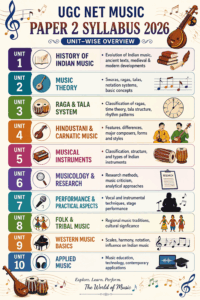
UGC NET Music Paper 2 Syllabus 2026 Unit-Wise
UGC NET Music Paper 2 Syllabus 2026 is a comprehensive syllabus that covers the various facets of Indian music. This syllabus includes different units, all related to classical and applied aspects of music. A clear understanding of each unit helps candidates prepare effectively and score well in the exam.
View UGC NET Paper 1 Important Topics 2026
Check Complete UGC NET Syllabus 2026
| Unit No. | Unit Name | Key Topics Covered |
| Unit 1 | History of Indian Music | Evolution of Indian music, ancient texts, medieval & modern developments |
| Unit 2 | Music Theory | Swaras, ragas, talas, notation systems, basic concepts |
| Unit 3 | Raga & Tala System | Classification of ragas, time theory, tala structure, rhythm patterns |
| Unit 4 | Hindustani & Carnatic Music | Features, differences, major composers, forms and styles |
| Unit 5 | Musical Instruments | Classification, structure, and types of Indian instruments |
| Unit 6 | Musicology & Research | Research methods, music criticism, analytical approaches |
| Unit 7 | Performance & Practical Aspects | Vocal and instrumental techniques, stage performance |
| Unit 8 | Folk & Tribal Music | Regional music traditions, cultural significance |
| Unit 9 | Western Music Basics | Scales, harmony, notation, influence on Indian music |
| Unit 10 | Applied Music | Music education, technology, contemporary applications |
Best UGC NET Coaching in Jaipur
UGC NET Music Exam Pattern 2026
The UGC NET Music examination for 2026 is designed by NTA to test the candidates’ teaching aptitude and their knowledge about the subject. The UGC NET Music examination will be held using the Computer-Based Test mode and will comprise two papers in one sitting. Two marks will be assigned for each question and all questions will be compulsory.
| Paper | Questions | Marks | Duration |
| Paper 1 | 50 | 100 | 1 hour |
| Paper 2 | 100 | 200 | 2 hours |
| Total | 150 | 300 | 3 hours |

UGC NET Music 2026 Preparation Strategy
Preparing for the upcoming UGC NET Music exam in 2026 will be a combination of proper planning, theory, practice, and understanding. Having an effective strategy that conforms to the UGC NET Music syllabus is essential for success in the examination.
Understand Syllabus Completely: Firstly, go through the entire UGC NET Music Syllabus 2026. Select significant sections such as the raga-tala system, music theory, and history for better preparation.
Concentrate on Important Subjects: Pay particular attention to areas with high weightage, including:
- Raga and Tala system
- Indian Music History
- Hindustani and Carnatic Music
- Music instruments and theory
Practice Previous Years’ Question Papers: Solving UGC NET Music previous years’ question papers gives you insight into the exam pattern and questions asked regularly.
Use Quality Study Material: Refer to reliable UGC NET Music notes, standard books, and updated study material. Make short notes for quick revision.
Revise Important Sections Regularly: Revising regularly helps in retaining crucial topics. Revise essential topics of the UGC NET Music Syllabus.
Attempt Mock Tests: Taking up practice tests will help you manage time efficiently during the examination. Also, analyze your performance and work on weak areas.
Maintain a Balance Between Theory and Practical Knowledge: As the subject Music is theoretical as well as practical, you should concentrate on both aspects.
Conclusion
The UGC NET Music Syllabus 2026 for the December Session serves as the official roadmap for candidates aspiring to qualify for Assistant Professor, Junior Research Fellowship (JRF), and PhD Admission. Covering Indian classical music, musicology, performance techniques, research methodology, and applied music, the syllabus provides a balanced mix of theoretical and practical concepts. Candidates who prepare systematically according to the latest syllabus, revise consistently, practice previous year papers, and attempt mock tests will significantly improve their chances of achieving a high score in the UGC NET December 2026 Music Examination.
UGC NET Music Syllabus 2026 FAQs
It includes music theory, history, raga–tala system, instruments, and practical aspects. These cover both classical and applied music.
UGC NET Paper 2 consists of 100 questions. Each question carries 2 marks, making a total of 200 marks.
The syllabus is available in both English and Hindi. Candidates can choose their preferred language.
Key topics include raga-tala system, music theory, and Indian music history. These are frequently asked in exams.
Focus on concepts, revise regularly, and practice previous year questions and mock tests. A structured approach ensures better performance.