

Get in Touch with JRFAdda for All Your Needs!

jrfadda

Table of Contents

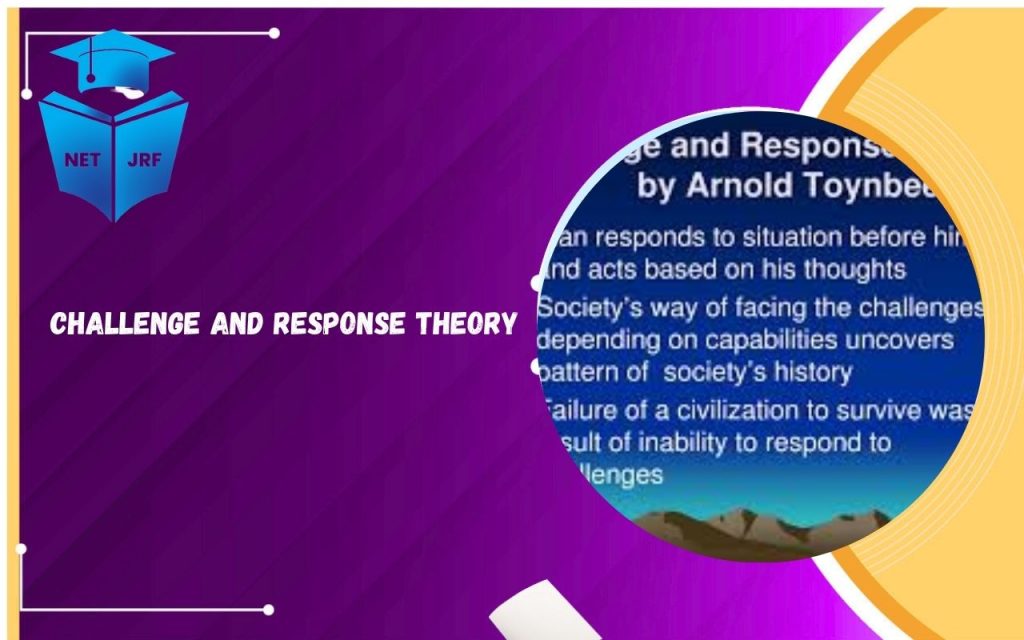
Challenge and Response Theory – Arnold Joseph Toynbee is an important concept in historiography that explains the rise, growth, and decline of civilizations. According to this theory civilizations develop when societies face difficult challenges and respond creatively to those challenges.

Study Planner

The theory was developed by the British historian Arnold J. Toynbee in his famous work A Study of History. Toynbee studied the development of many civilizations and concluded that progress occurs when societies successfully respond to challenges.

Meaning of Challenge and Response Theory Arnold Joseph Toynbee

In historiography Challenge and Response Theory – Arnold Joseph Toynbee explains that civilizations evolve because they face various challenges such as environmental difficulties, social conflicts, political problems, or external threats.

  • A civilization grows when people respond creatively and effectively to these challenges. If society fails to respond properly the civilization declines.
  • Toynbee believed that human creativity and leadership play a key role in shaping historical progress.

Enroll UGC NET Mock Test Series

Historical Background of Theory

During the twentieth century historians began studying civilizations from a global perspective rather than focusing only on national histories.

Arnold J. Toynbee examined the rise and fall of many civilizations including:

  • Egyptian civilization
  • Greek civilization
  • Roman civilization
  • Indian civilization
  • Chinese civilization

Based on his comparative study Toynbee proposed the Challenge and Response Theory – Arnold Joseph Toynbee to explain civilizational growth.

Principles of Challenge and Response Theory

Toynbee proposed several principles that explain how civilizations develop.

  • Existence of Challenges

      • Every civilization faces challenges such as environmental hardships, political instability or external threats.
  • Creative Response

      • Societies that produce creative solutions to challenges experience growth and progress.
  • Role of Leadership

      • Toynbee believed that a small group of creative leaders guides society in responding to challenges.

App JRF Adda

  • Failure of Response Leads to Decline

    • When societies fail to respond effectively civilizations begin to decline.
    • These principles form the foundation of Challenge and Response Theory – Arnold Joseph Toynbee.

Enroll UGC NET Foundation Course

Challenge and Response Theory Significance

The Challenge and Response Theory is an important concept in the study of civilizations proposed by Arnold J. Toynbee. 

  • Toynbee argued that civilizations do not develop automatically or randomly. Instead, they grow and progress when societies successfully respond to various challenges they encounter.
  • According to Toynbee, the rise and fall of civilizations depend on how effectively societies respond to environmental, social, political, and economic challenges. When responses are creative and effective, civilizations grow. When societies fail to respond properly, they decline.

Types of Challenges Faced by Civilizations

Toynbee identified several kinds of challenges that influence the development of civilizations.

1. Environmental Challenges

Natural conditions such as deserts, mountains, rivers, and climate can strongly influence the growth of societies.

For example:

  • Many early civilizations developed near river valleys where water supported agriculture.
  • Difficult environments sometimes forced societies to develop innovative techniques for survival.

Thus environmental challenges often encourage adaptation and technological advancement.

2. Social Challenges

Internal problems within society can also create major challenges. These may include:

  • Social inequality
  • Internal conflicts
  • Cultural tensions
  • Weak social institutions

If societies introduce effective reforms or social adjustments, they may strengthen unity and stability.

Enroll UGC NET Offline Classes in Jaipur

3. Political Challenges

Political factors such as wars, invasions, and political instability often threaten civilizations.

Examples include:

  • Foreign invasions forcing societies to strengthen defenses
  • Political crises leading to institutional reforms

Civilizations that successfully reorganize their political structures and leadership may become stronger.

4. Economic Challenges

Economic difficulties can also threaten social stability. These challenges may include:

  • Resource shortages
  • Trade disruptions
  • Economic crises

When societies develop innovative economic strategies, they may overcome these difficulties and continue to grow.

These various forms of challenges demonstrate the dynamic process described in Toynbee’s Challenge and Response Theory.

Role of Creative Minority

A central concept in Toynbee’s theory is the role of the creative minority. According to Toynbee, a small group of individuals within society plays a crucial role in responding to challenges.

This creative minority includes:

  • visionary leaders
  • intellectual thinkers
  • innovators and reformers

These individuals guide society toward effective solutions and progress.

However, if this leadership group becomes ineffective or self-interested, it loses its ability to inspire society. In such cases, civilization may begin to decline.

Stages of Civilizational Development

Toynbee suggested that civilizations usually pass through several stages during their historical development.

  • Growth Stage

      • Civilizations expand when societies respond successfully to challenges. Effective leadership and innovation encourage development.
  • Time of Troubles

      • Internal conflicts and social tensions begin to appear, weakening unity within the civilization.
  • Breakdown

      • Institutions and political systems begin to fail because society cannot respond effectively to challenges.
  • Disintegration

    • The civilization gradually declines and may eventually disappear or be replaced by another system.
    • These stages illustrate the cyclical pattern of rise and decline described in Toynbee’s theory.

Importance of Toynbee’s Theory in Historiography

Toynbee’s ideas contributed significantly to historical thought in several ways:

  • Encouraged comparative study of different civilizations
  • Emphasized the role of human creativity and leadership in history
  • Promoted a global perspective in historical research
  • Offered a new explanation for the rise and decline of civilizations

These contributions expanded the scope of historical analysis beyond traditional political history.

Join UGC NET Coaching in Jaipur

Criticism of Challenge and Response Theory

Despite its influence, Toynbee’s theory has also faced criticism from historians.

Major Criticisms

  • Civilizational development cannot be explained by a single theory.
  • Economic factors may play a more significant role than Toynbee suggested.
  • Some historians argue that Toynbee generalized historical patterns too broadly.

Because of these limitations, many scholars believe the theory should be used alongside other historical approaches.

Modern Relevance of Toynbee’s Theory

Even today, Toynbee’s ideas remain relevant for understanding social change. Modern scholars often examine how societies respond to contemporary challenges such as:

  • Environmental crises and climate change
  • Technological innovations transforming economies
  • Political reforms responding to social conflicts

These examples show that the relationship between challenge and response continues to shape human societies.

JRF Adda Book

Conclusion

Historical development involves complex interactions between societies and the challenges they face. Challenge and Response Theory – Arnold Joseph Toynbee provides a valuable framework for understanding how civilizations grow and decline over time. By emphasizing creative response leadership and social adaptation the theory highlights the dynamic nature of historical change. Although historians debate its limitations the theory remains important in historiography. 

Read UGC NET Notes
1 Archaeological Sources for UGC NET Epigraphy – Study of Inscriptions Meaning of Historical Sources Archaeological
2 Meaning of Historical Sources Archaeological Sources for UGC NET Literary Sources in History Archaeological
3 Exploration in Archaeology Excavation Techniques in Archaeology Dating of Archaeological Sites Archaeological
4 Excavation Techniques in Archaeology Exploration in Archaeology Dating of Archaeological Sites Archaeological
5 Epigraphy – Study of Inscriptions Inscriptions in Reconstructing History Numismatics in History Archaeological
6 Inscriptions in Reconstructing History Epigraphy – Study of Inscriptions Archaeological Sources for UGC NET Archaeological
7 Numismatics in History Importance of Coins in History Epigraphy – Study of Inscriptions Archaeological
8 Importance of Coins in History Numismatics in History Archaeological Sources for UGC NET Archaeological
9 Dating of Archaeological Sites Excavation Techniques in Archaeology Dating Ancient Literary Sources Archaeological
10 Indigenous Literature Literary Sources in History Secular Literature as Historical Source Literary
11 Dating Ancient Literary Sources Literary Sources in History Dating of Archaeological Sites Literary
12 Literary Sources in History Indigenous Literature Foreign Accounts of India Literary
13 Foreign Accounts of India Greek Accounts on Ancient India Chinese Accounts on India Literary
14 Greek Accounts on Ancient India Foreign Accounts of India Chinese Accounts on India Literary
15 Secular Literature as Historical Source Literary Sources in History Indigenous Literature Literary
16 Role of Myths and Legends in Historical Reconstruction Literary Sources in History Secular Literature as Historical Source Literary
17 Chinese Accounts on India Foreign Accounts of India Greek Accounts on Ancient India Literary
18 Arabic Accounts on India Foreign Accounts of India Chinese Accounts on India Literary
19 Neolithic and Chalcolithic Phases Neolithic Revolution in India Chalcolithic Culture in India Neolithic
20 Hunting, Gathering & Food Production Neolithic Revolution in India Neolithic Settlements in India Neolithic
21 Neolithic Revolution in India Neolithic Settlements in India Tools and Technology in Neolithic Period Neolithic
22 Neolithic Settlements in India Distribution of Neolithic Cultures in India Neolithic Revolution in India Neolithic
23 Distribution of Neolithic Cultures in India Neolithic Settlements in India Tools and Technology in Neolithic Period Neolithic
24 Tools and Technology in Neolithic Period Neolithic Revolution in India Chalcolithic Culture in India Neolithic
25 Chalcolithic Culture in India Settlement Pattern & Economy in Chalcolithic Phase Trade & Exchange Networks in Chalcolithic Societies Neolithic
26 Settlement Pattern & Economy – Chalcolithic Phase Chalcolithic Culture in India Trade & Exchange Networks in Chalcolithic Societies Neolithic
27 Trade & Exchange Networks – Chalcolithic Societies Chalcolithic Culture in India IVC Internal & External Trade Neolithic
28 Indus Valley Civilization – UGC NET Major Sites of Indus Civilization Urban Planning in Harappan Civilization IVC
29 IVC Internal & External Trade Internal Trade – Harappan Civilization Craft Specialization in Harappan Civilization IVC
30 Political Organization – Harappan Civilization Social Structure – Indus Civilization Urban Planning in Harappan Civilization IVC
31 Major Sites of Indus Civilization Indus Valley Civilization – UGC NET Urban Planning in Harappan Civilization IVC
32 Urban Planning & Settlement – Harappan Civilization Architecture & Town Planning – Harappan Cities IVC as First Urbanization in India IVC
33 Architecture & Town Planning – Harappan Cities Urban Planning in Harappan Civilization Major Sites of Indus Civilization IVC
34 Craft Specialization & Industrial Activities – Harappan Agriculture & Food Economy – Harappans IVC Internal & External Trade IVC
35 Agriculture & Food Economy – Harappans Craft Specialization in Harappan Civilization Internal Trade – Harappan Civilization IVC
36 Internal Trade – Harappan Civilization IVC Internal & External Trade Craft Specialization in Harappan Civilization IVC
37 Religion & Beliefs – Indus Civilization Social Structure – Indus Civilization Indus Valley Civilization – UGC NET IVC
38 Social Structure – Indus Civilization Political Organization – Harappan Civilization Religion & Beliefs – Indus Civilization IVC
39 Decline of Indus Civilization Indus Valley Civilization – UGC NET IVC as First Urbanization in India IVC
40 IVC as First Urbanization in India Urban Planning in Harappan Civilization Second Urbanization in India IVC
41 Vedic & Later Vedic Periods – Aryan Varna System Early Vedic Society and Economy Later Vedic Society and Economy Vedic
42 Origin of Vedic Civilization Aryan Debate – Migration, Invasion & Indigenous Theories Early Vedic Society and Economy Vedic
43 Aryan Debate – Migration, Invasion & Indigenous Theories Origin of Vedic Civilization Early Vedic Society and Economy Vedic
44 Early Vedic Society and Economy Political Institutions – Early Vedic Period Social Structure – Early Vedic Period Vedic
45 Political Institutions – Early Vedic Period Early Vedic Society and Economy Monarchical States in Ancient India Vedic
46 Social Structure – Early Vedic Period Emergence of Varnas & Social Stratification Early Vedic Society and Economy Vedic
47 Later Vedic Society and Economy Emergence of Varnas & Social Stratification Impact of Iron Technology in India Vedic
48 Emergence of Varnas & Social Stratification Social Structure – Early Vedic Period Later Vedic Society and Economy Vedic
49 Emergence of Heterodox Sects in India Jainism, Buddhism & Ajivikas – Origins & Teachings Later Vedic Society and Economy Vedic
50 Impact of Iron Technology in India Later Vedic Society and Economy Agricultural Expansion & Economic Changes – Ancient India Vedic
51 Religious & Philosophical Vedic Ideas Emergence of Varnas & Social Stratification Emergence of Heterodox Sects in India Vedic
52 Megalithic Culture of South India Neolithic and Chalcolithic Phases Agricultural Expansion & Economic Changes General
53 State System in Ancient India Rise of Mahajanapadas Transition: Tribal Polities to Territorial States General
54 Transition: Tribal Polities to Territorial States Rise of Mahajanapadas Later Vedic Society and Economy General
55 Rise of Mahajanapadas Monarchical States in Ancient India Republican States (Gana-Sanghas) – Ancient India Magadha
56 Monarchical States in Ancient India Rise of Mahajanapadas Emergence of Magadha Magadha
57 Republican States (Gana-Sanghas) – Ancient India Rise of Mahajanapadas Monarchical States in Ancient India Magadha
58 Agricultural Expansion & Economic Changes – Ancient India Second Urbanization in India Impact of Iron Technology in India General
59 Second Urbanization in India IVC as First Urbanization in India Rise of Mahajanapadas General
60 Jainism, Buddhism & Ajivikas – Origins & Teachings Emergence of Heterodox Sects in India Ashoka’s Policy of Dhamma General
61 Emergence of Magadha Geographical Advantages of Magadha Early Rulers of Magadha Magadha
62 Geographical Advantages of Magadha Natural Resources & Economic Strength of Magadha Reasons for Success of Magadha Magadha
63 Natural Resources & Economic Strength of Magadha Geographical Advantages of Magadha Economic Policies of the Nandas Magadha
64 Early Rulers of Magadha Haryanka Dynasty – Rise of Magadha Emergence of Magadha Magadha
65 Haryanka Dynasty – Rise of Magadha Expansion Policy of Bimbisara Early Rulers of Magadha Magadha
66 Expansion Policy of Bimbisara Ajatashatru – Military Reforms Haryanka Dynasty – Rise of Magadha Magadha
67 Ajatashatru – Military Reforms Wars of Ajatashatru Expansion Policy of Bimbisara Magadha
68 Wars of Ajatashatru Ajatashatru – Military Reforms Udayin & Establishment of Pataliputra Magadha
69 Udayin & Establishment of Pataliputra Wars of Ajatashatru Shishunaga Dynasty Magadha
70 Shishunaga Dynasty Administrative Structure of the Shishunagas Nanda Dynasty Magadha
71 Administrative Structure of the Shishunagas Shishunaga Dynasty Central Administration Under Mauryas Magadha
72 Nanda Dynasty Mahapadma Nanda – Imperial Expansion Shishunaga Dynasty Magadha
73 Mahapadma Nanda – Imperial Expansion Military Strength of the Nandas Nanda Dynasty Magadha
74 Economic Policies of the Nandas Nanda Dynasty Taxation System – Mauryan State Magadha
75 Military Strength of the Nandas Mahapadma Nanda – Imperial Expansion Defeat of Nandas & Rise of Mauryan Empire Magadha
76 Reasons for Success of Magadha Geographical Advantages of Magadha Natural Resources & Economic Strength of Magadha Magadha
77 Mahajanapadas to Empire – Evolution & Rise of Magadha Rise of Mahajanapadas Emergence of Magadha Magadha
78 Mauryan Empire – Expansion Rise of Chandragupta Maurya Expansion of Mauryan Empire Maurya
79 Rise of Chandragupta Maurya Role of Chanakya in Rise of Mauryan Empire Defeat of Nandas & Rise of Mauryan Empire Maurya
80 Role of Chanakya in Rise of Mauryan Empire Rise of Chandragupta Maurya Defeat of Nandas & Rise of Mauryan Empire Maurya
81 Defeat of Nandas & Rise of Mauryan Empire Military Strength of the Nandas Rise of Chandragupta Maurya Maurya
82 Chandragupta Maurya – Seleucus Treaty & Diplomacy Expansion of Mauryan Empire Greek Accounts on Ancient India Maurya
83 Expansion of Mauryan Empire Chandragupta Maurya – Seleucus Treaty & Diplomacy Kalinga War Maurya
84 Administration of Chandragupta Maurya Central Administration Under Mauryas Mauryan Bureaucracy Maurya
85 Sources for Mauryan History Archaeological Sources for UGC NET Greek Accounts on Ancient India Maurya
86 Central Administration Under Mauryas Provincial Administration – Mauryan Empire Mauryan Bureaucracy Maurya
87 Provincial Administration – Mauryan Empire Local Administration – Mauryan Empire Central Administration Under Mauryas Maurya
88 Local Administration – Mauryan Empire Provincial Administration – Mauryan Empire Mauryan Bureaucracy Maurya
89 Mauryan Bureaucracy Central Administration Under Mauryas Espionage System – Mauryan Empire Maurya
90 Espionage System – Mauryan Empire Mauryan Bureaucracy Central Administration Under Mauryas Maurya
91 Ancient India – Trade and Commerce Trade and Commerce Under Mauryas Agrarian Economy – Mauryan Period Maurya
92 Agrarian Economy – Mauryan Period Taxation System – Mauryan State Trade and Commerce Under Mauryas Maurya
93 Trade and Commerce Under Mauryas Ancient India – Trade and Commerce Agrarian Economy – Mauryan Period Maurya
94 Taxation System – Mauryan State Agrarian Economy – Mauryan Period Economic Policies of the Nandas Maurya
95 Kalinga War Ashoka’s Policy of Dhamma Expansion of Mauryan Empire Maurya
96 Ashoka’s Policy of Dhamma Nature & Philosophy of Dhamma Kalinga War Maurya
97 Nature & Philosophy of Dhamma Ashoka’s Policy of Dhamma Jainism, Buddhism & Ajivikas Maurya

Challenge and Response Theory FAQs

Aditi Sharma Ma'am

A Aditi Sharma, founder of JRFAdda, is a Computer Science educator with an MCA degree and JRF qualification (99.91 percentile, Dec 2019). Her experience includes roles as an SBI SO (DBA), work at Cognizant, and over 5 years of teaching online and offline. She has also served as a Government Computer Teacher in Rajasthan.

Get in Touch ​

Let us know how we can assist you


Check Our Recommended Course​