
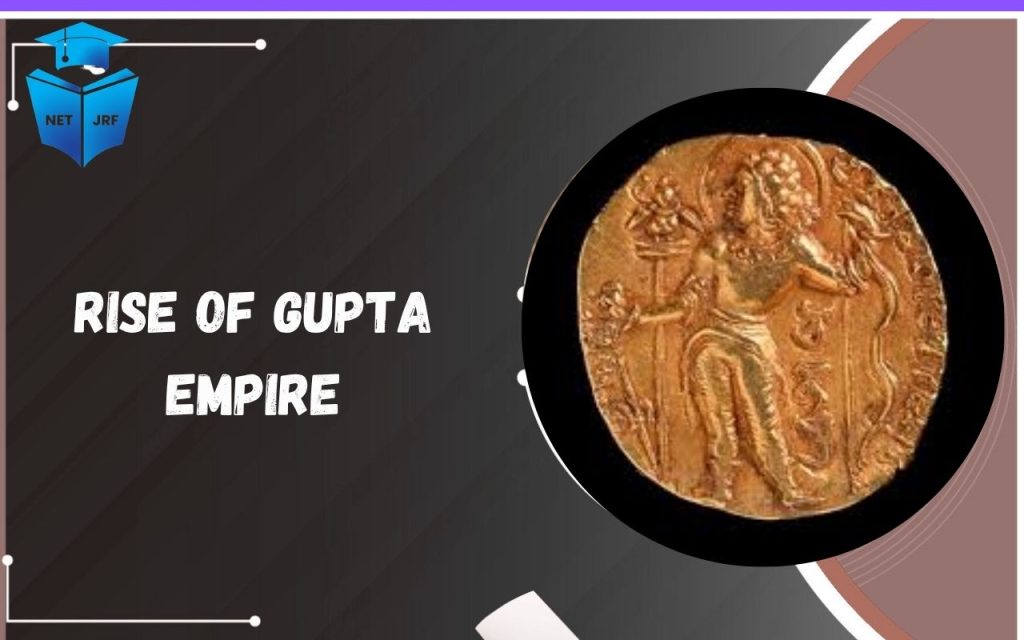

The rise of the Gupta Empire marks a significant phase in ancient Indian history, as it restored political unity after centuries of fragmentation. Beginning with a small ruling family in the eastern Gangetic plains, the Guptas gradually expanded their power to establish one of the most influential and prosperous empires in India, known for its political stability, cultural achievements, and economic growth.

Rise of Gupta empire Background before
Before the Rise of the Gupta empire, India faced political fragmentation. After the decline of the Kushan Empire and Satavahanas, many small kingdoms appeared.
Key conditions
- No strong central power
- Frequent wars among small states
- Decline in trade networks
This situation created an opportunity for a new power to rise.
Enroll UGC NET Mock Test Series
Origins of Gupta Dynasty
The rise of the Gupta Empire began with a modest ruling family in northern India, particularly in the Magadha region.
Early Rulers
- Sri Gupta – Founder of the dynasty, ruled a small territory and laid the initial foundation.
- Ghatotkacha – Successor of Sri Gupta, continued to strengthen the base of the kingdom.
Significance:
These early rulers controlled limited areas, but they established the political and administrative base that later enabled imperial expansion.
Chandragupta I and the Foundation of Empire
The real rise of the Gupta Empire began under Chandragupta I, who transformed a small kingdom into a powerful state.
Key Achievements
- Adopted the Title “Maharajadhiraja”
- Indicated supreme authority and imperial ambitions.
- Territorial Expansion
- Extended control over important regions, especially in Magadha and surrounding areas.
- Strengthening Political Power
- Consolidated rule through alliances (including marriage alliances) and effective governance.
Marriage Alliance with the Lichchhavis
A key factor in the rise of the Gupta Empire was a strategic marriage alliance.
- Chandragupta I married Kumaradevi of the Lichchhavi clan.
- Importance of the Alliance:
- Political Legitimacy: Strengthened Chandragupta’s claim to imperial authority.
- Expansion of Influence: Facilitated Gupta influence in northern India.
- Significance:
This marriage demonstrates the use of diplomatic strategy (marriage diplomacy) for empire-building.
Samudragupta and the Expansion Policy
The rise of the Gupta Empire reached its peak under Samudragupta, who was known as the “Napoleon of India.”
Military Achievements
- Defeated numerous kings across India.
- Expanded the empire both northwards and southwards.
- Consolidated Gupta power and authority over a vast territory.
Allahabad Pillar Inscription
- Provides detailed records of Samudragupta’s conquests, administrative policies, and patronage of arts.
- Essential historical source for understanding the Gupta Empire’s expansion.
Enroll UGC NET Online Test Series
Conquests of Samudragupta
Samudragupta followed a flexible conquest policy that combined direct annexation, tribute, and alliances.
- Northern States:
- Annexed directly and brought under central administration.
- Southern States:
- Defeated in battle but allowed to continue ruling as tributary states.
- Border States:
- Recognized Gupta supremacy and paid tribute without direct annexation.
Significance:
- This policy reduced administrative burden.
- Ensured loyalty without constant warfare.
- Maintained stability and facilitated cultural and economic growth across the empire.

Chandragupta II and Consolidation
The Rise of the Gupta Empire continued under Chandragupta II, also known as Vikramaditya, who strengthened the empire both politically and economically.
Achievements
- Defeated the Shakas, securing western India.
- Expanded territories across central and western India.
- Promoted trade and commerce, linking inland and coastal regions.
- Strengthened imperial authority and governance.
Role of Geography
- Fertile Gangetic plains: Supported agriculture.
- Access to rivers: Facilitated transport and trade.
- Easy communication: Enabled efficient administration and rapid military movement.
- Significance: Geography provided the economic and strategic foundation for Gupta consolidation.
Enroll UGC NET Offline Classes in Jaipur
Economic Factors
- Growth in agriculture ensured food surplus.
- Development of internal and external trade increased wealth.
- Use of gold coins (Dinars) enhanced commerce and financial stability.
- Impact: A strong economy enabled rulers to fund armies, infrastructure, and cultural projects.
Political Strategies
- Marriage alliances strengthened legitimacy and diplomatic ties.
- Diplomacy reduced conflicts with neighboring states.
- Flexible administration allowed local autonomy while maintaining central control.
- These strategies reduced political instability and promoted long-term consolidation.
Role of Religion
- Patronage of Brahmanism strengthened support from influential elites.
- Religious tolerance ensured loyalty from various sects.
- Support for temple construction integrated religion with governance.
- Religion helped unify diverse regions under Gupta rule.
Administrative Efficiency
- Decentralized system with local administration for villages and towns.
- Efficient officers assisted in tax collection, justice, and law enforcement.
- Balance between central and local powers maintained stability.
Military Strength
- Comprised of infantry, cavalry, and war elephants.
- Strong army ensured defense, expansion, and suppression of rebellions.
- Military capability reinforced political authority.
Trade and Commerce
- Expansion of internal trade networks connected villages to cities.
- Growth of urban centers along trade routes.
- Links with foreign regions, including Southeast Asia and West Asia.
- Wealth from trade funded cultural and administrative activities.
Cultural Support
- Patronage of art, architecture, and literature.
- Promotion of Sanskrit as a language of administration and culture.
- Cultural unity reinforced the identity and prestige of the empire.
Key Rulers in the Rise of Gupta Empire
| Ruler | Reign/Period | Key Achievements |
| Sri Gupta | Early 3rd century CE | Founder, small territory control |
| Ghatotkacha | Early-mid 3rd century CE | Consolidated base, laid foundation for expansion |
| Chandragupta I | 320–335 CE | Married Kumaradevi, assumed title Maharajadhiraja, expanded north India |
| Samudragupta | 335–375 CE | Military expansion, defeated northern & southern kings, known as “Napoleon of India” |
| Chandragupta II | 375–415 CE | Defeated Shakas, expanded western India, promoted trade and culture |
The rise of the Gupta Empire marks a significant phase in ancient Indian history, as it restored political unity after centuries of fragmentation. Beginning with a small ruling family in the eastern Gangetic plains, the Guptas gradually expanded their power to establish one of the most influential and prosperous empires in India, known for its political stability, cultural achievements, and economic growth.
Join UGC NET Coaching in Jaipur

The Rise of Gupta empire shows how strong leadership, smart strategies, and economic strength can build a powerful state.