
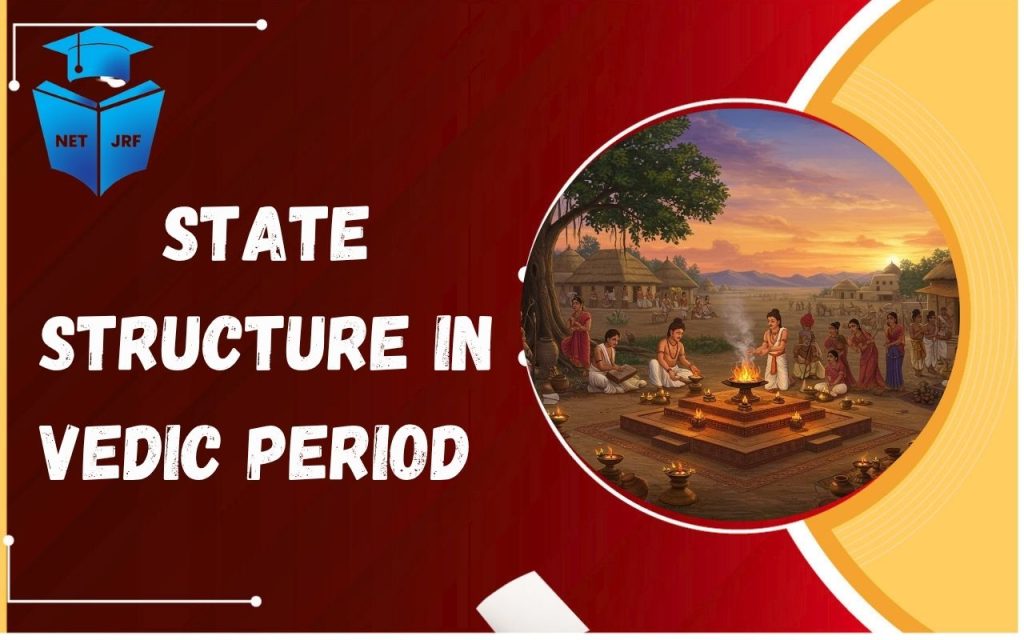

During the Later Vedic period (c. 1000–500 BCE), Indian society began transitioning from tribal communities to larger political units, laying the foundation of early state structures. Unlike the decentralized tribal governance of the Early Vedic period, Later Vedic society witnessed the emergence of monarchical states, with kings (Rajas) exercising greater authority over territories and subjects. These states had organized administrative systems, military forces, and mechanisms for resource collection, such as land revenue.
Vedic Political Organization
The Vedic period began around 1500 BCE when Indo Aryan tribes entered the northwestern part of the Indian subcontinent. These communities organized themselves mainly as tribal groups.
Each tribe functioned independently with its own leader and political institutions.
Important tribal units included:
- Kula meaning family
- Grama meaning village group
- Vish meaning clan
- Jana meaning tribe
These groups created the foundation for the development of State Structure in early Indian civilization.
Enroll UGC NET Coaching in Jaipur
State Structure in Vedic Period
State Structure in the Vedic age evolved from simple tribal leadership to more organized political authority. In the early stage power remained limited because society valued collective decision making.
Kings ruled tribes but assemblies such as sabha and samiti influenced many decisions.
Main Features
- Tribal political organization
- Limited authority of the king
- Importance of popular assemblies
- Military leadership during conflicts
- Collective participation in governance
These features demonstrate that State Structure during the early Vedic age remained simple and decentralized.
Role of the King
The king known as Rajan served as the political leader of the tribe. His authority mainly focused on protecting people, maintaining order and leading the tribe in war.
Functions of the King
- Protection of the tribe from enemies
- Leadership in military campaigns
- Maintenance of law and order
- Supervision of religious ceremonies
- Distribution of wealth after war
Although the king held an important position his power remained limited because community assemblies could influence decisions.
This balance between royal authority and community participation shaped the early State Structure.
Political Assemblies and State Structure in the Vedic Period
During the Later Vedic period, the tribal society of earlier times evolved into more organized political units, giving rise to a state structure where kingship, administration, and assemblies played central roles. Political authority was not absolute but worked alongside councils and officials, reflecting a mix of monarchy and collective participation.
Political Assemblies
Two important institutions, the Sabha and the Samiti, played a significant role in governance:
Sabha
- Functioned as a council of elders or experienced members of the tribe.
- Discussed important social, religious, and political matters.
- Advised the king on key decisions and policy directions.
Samiti
- Represented the general assembly of all tribal members.
- Participated in the selection or approval of the king.
- Ensured that tribal members had a voice in governance.
Importance of Assemblies:
- Assisted in decision-making on political matters.
- Helped resolve disputes within the tribe.
- Advised the king on governance and resource distribution.
- Enabled participation of tribal members in political affairs.
These assemblies show that the state structure of Vedic society was participatory rather than purely autocratic, with collective discussion influencing the king’s actions.
Administrative Officials
Kings did not rule alone; they relied on a network of officials to manage different aspects of governance:
Key Officials:
- Purohita: Religious adviser to the king, responsible for rituals and sacrifices.
- Senani: Military commander in charge of organizing tribal warriors.
- Gramini: Village leader overseeing local administration and resources.
- Spasha: Messenger or spy who carried information and intelligence.
Each official had specific duties, indicating the gradual development of administrative machinery within the state structure. This division of responsibilities helped kings manage tribes efficiently, maintain order, and collect resources.
Enroll UGC NET Offline Coaching in Jaipur
Economic Basis of Political Power
Political authority in Vedic states depended heavily on economic resources. Without wealth, a king could not maintain troops, perform rituals, or command respect:
Sources of Revenue:
- Bali: Voluntary gifts offered by subjects or allies.
- War Booty: Loot obtained from victorious campaigns.
- Tribute: Payments collected from conquered or allied tribes.
While taxation was simple and irregular, these economic resources strengthened the king’s position, supporting both military ventures and religious activities. Control over wealth and land was therefore central to the state structure.
Military Organization
Defense and warfare were essential elements of Vedic political life. The king’s authority was closely tied to his ability to lead and protect his people:
Military Features:
- Tribal warriors formed the core of the army.
- Use of chariots, horses, and weapons enabled more effective combat.
- Wars were mainly fought over cattle, land, or tribal dominance.
- Success in battle increased the king’s prestige and authority.
Military leadership was crucial not only for defense but also for expanding influence and maintaining social order, making it a key pillar of the state structure.
Key Elements of State Structure in Vedic Period
The Vedic period saw the gradual evolution from tribal assemblies to organized states, with key elements such as the king, councils, officials, and territorial divisions forming the backbone of political authority.
| Aspect of State Structure | Description |
| Political leader | Rajan or tribal king |
| Main assemblies | Sabha Samiti |
| Important officials | Purohita Senani Gramini |
| Revenue sources | Gifts tribute war booty |
| Political nature | Tribal leadership system |
Theories of State Formation in the Vedic Period
The emergence of political authority and structured governance during the Vedic period has long fascinated historians. Scholars have proposed several theories to explain how tribes gradually evolved into more organized states. These interpretations shed light on the state structure of early Indian society and its link with economy, religion, and military power.
Enroll UGC NET Online Coaching
Tribal Leadership Theory
- This theory suggests that the state developed naturally from tribal organization.
- As tribes grew in size and complexity, certain leaders gained prominence due to their experience, wisdom, or ability to organize people.
- Over time, these tribal leaders gradually became kings (Rajas), with increasing authority over social, economic, and political matters.
Military Leadership Theory
- Frequent conflicts between tribes required strong leadership for defense and survival.
- Successful warriors who could protect the tribe from rivals earned respect and authority.
- Gradually, these military leaders consolidated power and became hereditary rulers, giving rise to early monarchies.
- This theory emphasizes how warfare and protection influenced the formation of political authority.
Religious Legitimacy Theory
- Priests (Purohitas) played a key role in legitimizing kingship.
- Through rituals, sacrifices, and guidance, priests enhanced the king’s prestige and reinforced his authority.
- Kings who performed religious ceremonies successfully were viewed as divinely sanctioned leaders, strengthening their position within the tribe or emerging state.
Economic Control Theory
- Control over critical resources such as cattle, agricultural land, and tributes from conquered groups increased the power of rulers.
- Economic dominance enabled kings to maintain warriors, fund rituals, and manage administration.
- This theory highlights that wealth and resource management were central to the development of state structures in the Vedic period.
Transition Toward Later Political Systems
During the Later Vedic period, political institutions evolved significantly, marking the shift from tribal leadership to more organized forms of governance. As society became more settled and economically complex, the need for stronger authority and structured administration grew, leading to the development of early kingdoms.
Important Changes in Political Systems
- Increased Royal Authority: Kings (Rajas) gradually acquired more power over their subjects, making decisions on war, justice, and resource distribution.
- Hereditary Monarchy: Leadership began passing from father to son, ensuring continuity and stability within tribes and emerging states.
- Territorial Expansion: Kings extended control over larger areas, sometimes incorporating other tribes through conquest or alliances.
- Administrative Organization: Officials such as the Purohita (priest), Senani (commander), and Gramini (village leader) played greater roles, assisting the king in governance, tax collection, and resource management.
Impact on State Structure
These developments gradually transformed tribal chiefdoms into more structured kingdoms. Political authority became centralized, and administrative, military, and economic systems became more formalized. This evolution laid the foundation for the emergence of Mahajanapadas, the large territorial states that dominated northern India in later centuries.
Transition Toward Later Political Systems
During the later Vedic period political institutions became stronger.
Important Changes
- Kings gained greater authority
- Hereditary monarchy became common
- Expansion of territories occurred
- Administrative organization increased
Important Changes in Political Systems
- Greater Royal Authority: Kings, or Rajas, gradually gained more power over their tribes, controlling resources, leading military campaigns, and making key political decisions.
- Hereditary Monarchy: Leadership became hereditary, usually passing from father to son, which provided stability and continuity in governance.
- Territorial Expansion: Tribes and small kingdoms merged or were conquered, leading to larger territories under a single ruler.
- Enhanced Administration: Officials such as priests (Purohitas), military commanders (Senanis), and village leaders (Graminis) took on greater responsibilities, helping kings manage resources, oversee justice, and organize armies.
Conclusion
The State Structure of the Vedic period developed gradually from simple tribal organization to more complex political authority. Early governance relied on cooperation between the king assemblies and tribal communities.Political institutions such as sabha samiti administrative officials and military leadership shaped the political system of the Vedic age. These institutions laid the foundation for later kingdoms in ancient India.