

The National Testing Agency (NTA) set to conducted the UGC NET June 2026 examination on 30 June 2026 (Shift 1) and Shift 2 in Computer-Based Test (CBT) mode across various examination centres in India. UGC NET Paper 1, which is common to candidates of all subjects, assessed aspirants on Teaching Aptitude, Research Aptitude, Logical Reasoning, Communication, ICT, Data Interpretation, Higher Education System, and People, Development and Environment.
Based on candidates’ feedback and expert reviews, the UGC NET Paper 1 Exam Analysis 2026 for 30 June Shift 1 and 2 provides a detailed overview of the paper’s difficulty level, important topics asked, section-wise weightage, and expected good attempts.
Enroll UGC NET Online Test Series
UGC NET Paper 1 2026 June Session Overview
The UGC NET exam is conducted every year in two sessions, the June and December sessions, by the National Testing Agency (NTA). The exam is conducted in a two-paper pattern:
- Paper 1: General paper, common for all
- Paper 2: Subject-specific (85 Subjects)
Review the Detailed UGC NET Exam Analysis 2026
The UGC NET June 2026 session is scheduled between 22 June and 30 June 2026, and right after the exam completion, a detailed UGC NET Paper 1 Exam Analysis 2026 is being released here for the candidates to evaluate their performance or plan their future attempt. Before that, let’s understand the UGC NET Paper 1 June 2026 Overview:
|
UGC NET Paper 1 June 2026 Overview |
|
| Exam Name | UGC NET June 2026 |
| Conducting Body | National Testing Agency (NTA) |
| Posts | Assistant Professor and Junior Research Fellowship (JRF) |
| UGC NET Exam Date 2026 | 22, 23, 24, 25, 26 June and 30 June 2026 |
| Mode of Exam | Online (CBT-Based) |
| Paper | Paper 1 (General Paper) |
| Total Marks | Paper 1: 100 Marks |
| Total Questions | Paper 1: 50 Questions |
| Negative Marking | No negative marking for incorrect answer |
| Official Website | https://ugcnet.nta.nic.in/ |
Get Your UGC NET Admit Card 2026

UGC NET Paper 1 Exam Analysis 2026 June Session Released
The UGC NET Paper 1 exam analysis 2026 for the June session has been updated here date-wise once the exam for the session starts.
Best UGC NET Foundation Batch Online
UGC NET Paper 1 Exam Analysis 2026 Date-Wise
The UGC NET June 2026 examination is being conducted from 22 June to 30 June 2026 in multiple shifts across the country. As each shift concludes, JRFAdda’s subject matter experts are providing a detailed overall UGC NET Exam Analysis 2026, including the UGC NET Paper 1 Exam Analysis 2026. The analysis has been prepared based on the question pattern, students’ feedback, previous years’ trends, and experts’ observations. Check the detailed date-wise UGC NET Paper 1 Exam Analysis 2026 below.
| Date | Overall Difficulty | Key Highlights / Focus Areas |
| 22 June 2026 | Easy to Moderate | NEP 2020 references, basic ICT tools- Scripting Language (Fortran, COBOL, C++ options), Calculative DI, Types of Communication, Assertion-Reason, Mood & Figure (Fallacies), Square of Opposition, Metacognitive, Cognitive Domains, Learner-centred approach, Domains, Micro Teaching |
| 23 June 2026 | Click Here | Click Here |
| 24 June 2026 | Click Here | Click Here |
| 25 June 2026 | TBA | TBA |
| 29 June 2026 | TBA | TBA |
| 30 June 2026 | Click Here | Click Here |
Check UGC NET Computer Science Exam Analysis 2026
UGC NET Paper 1 Exam Analysis 2026 for 30 June 2026, Shift 1
The National Testing Agency (NTA) will conduct the UGC NET June 2026 Shift 1 examination on 30 June 2026 from 09:00 AM to 12:00 PM. The detailed Paper 1 exam analysis will be updated here immediately after the conclusion of the examination based on candidates’ feedback and expert reviews. Candidates can check the overall difficulty level, important topics asked, good attempts, and section-wise analysis below.
| Section | Questions (Approx) | Difficulty | Key Topics | Good Attempts |
| Data Interpretation | TBA | TBA | TBA | TBA |
| Logical Reasoning | TBA | TBA | TBA | TBA |
| Mathematical Reasoning | TBA | TBA | TBA | TBA |
| ICT | TBA | TBA | TBA | TBA |
| Teaching Aptitude | TBA | TBA | TBA | TBA |
| Research Aptitude | TBA | TBA | TBA | TBA |
| Communication | TBA | TBA | TBA | TBA |
| Reading Comprehension | TBA | TBA | TBA | TBA |
| People & Environment | TBA | TBA | TBA | TBA |
| Higher Education System | TBA | TBA | TBA | TBA |
Review UGC NET Management Exam Analysis 2026 June
UGC NET Paper 1 Exam Analysis 2026 for 30 June 2026, Shift 2
The UGC NET June 2026 Shift 2 examination is scheduled from 03:00 PM to 06:00 PM on 30 June 2026. The complete Paper 1 analysis, including the difficulty level, expected good attempts, and important topics, will be updated after the examination is over.
| Unit | Approx. Questions | Difficulty | Remarks |
| Teaching Aptitude | TBA | TBA | TBA |
| Research Aptitude | TBA | TBA | TBA |
| Reading Comprehension (RC) | TBA | TBA | TBA |
| Communication | TBA | TBA | TBA |
| Logical Reasoning | TBA | TBA | TBA |
| Mathematical Reasoning | TBA | TBA | TBA |
| Data Interpretation (DI) | TBA | TBA | TBA |
| ICT | TBA | TBA | TBA |
| People, Development & Env. | TBA | TBA | TBA |
| Higher Education System (HE) | TBA | TBA | TBA |
Explore UGC NET Home Science Exam Analysis 2026
UGC NET Paper 1 Exam Analysis 2026 for 29 June 2026 Shift 1 Out
The National Testing Agency (NTA) was conduct the UGC NET June 2026 Shift 1 examination on 29 June 2026 from 09:00 AM to 12:00 PM. The detailed Paper 1 exam analysis was updated here immediately after the conclusion of the examination based on candidates’ feedback and expert reviews. Candidates can check the overall difficulty level, important topics asked, good attempts, and section-wise analysis below.
| Unit | Approx. Questions | Difficulty | Good Attempts | Key Topics (Pattern-based) |
| Teaching Aptitude | TBA | TBA | TBA | TBA |
| Research Aptitude | TBA | TBA | TBA | TBA |
| Reading Comprehension | TBA | TBA | TBA | TBA |
| Communication | TBA | TBA | TBA | TBA |
| Logical Reasoning | TBA | TBA | TBA | TBA |
| Mathematical Reasoning | TBA | TBA | TBA | TBA |
| Data Interpretation | TBA | TBA | TBA | TBA |
| ICT | TBA | TBA | TBA | TBA |
| People & Environment | TBA | TBA | TBA | TBA |
| Higher Education | TBA | TBA | TBA | TBA |
View UGC NET Education Exam Analysis 2026 for June Cycle
UGC NET Paper 1 Exam Analysis 2026 for 29 June 2026 Shift 2 Out
The UGC NET June 2026 Shift 2 examination was conducted from 03:00 PM to 06:00 PM on 29 June 2026. The complete Paper 1 analysis, including the difficulty level, expected good attempts, and important topics, will be updated after the examination is over.
| Units | Questions | Difficulty | Key Topics/Observations |
| Teaching Aptitude | TBA | TBA | TBA |
| Research Aptitude | TBA | TBA | TBA |
| Reading Comprehension | TBA | TBA | TBA |
| Communication | TBA | TBA | TBA |
| Logical Reasoning | TBA | TBA | TBA |
| Mathematical Reasoning | TBA | TBA | TBA |
| Data Interpretation | TBA | TBA | TBA |
| ICT | TBA | TBA | TBA |
| People & Environment | TBA | TBA | TBA |
| Higher Education | TBA | TBA | TBA |
Check June UGC NET English Exam Analysis 2026
UGC NET Paper 1 Exam Analysis 2026 for 25 June 2026 Shift 1 Out
The National Testing Agency (NTA) was conduct the UGC NET June 2026 Shift 1 examination on 25 June 2026 from 09:00 AM to 12:00 PM. The detailed Paper 1 exam analysis will be updated here immediately after the conclusion of the examination based on candidates’ feedback and expert reviews. Candidates can check the overall difficulty level, important topics asked, good attempts, and section-wise analysis below.
| Unit | Questions (Approx) | Difficulty | Good Attempts | Key Topics (Based on Shift Patterns) |
| Teaching Aptitude | TBA | TBA | TBA | TBA |
| Research Aptitude | TBA | TBA | TBA | TBA |
| Reading Comprehension | TBA | TBA | TBA | TBA |
| Communication | TBA | TBA | TBA | TBA |
| Logical Reasoning | TBA | TBA | TBA | TBA |
| Mathematical Reasoning | TBA | TBA | TBA | TBA |
| Data Interpretation | TBA | TBA | TBA | TBA |
| ICT | TBA | TBA | TBA | TBA |
| People & Environment | TBA | TBA | TBA | TBA |
| Higher Education | TBA | TBA | TBA | TBA |
Review UGC NET Public Administration Exam Analysis 2026
UGC NET Paper 1 Exam Analysis 2026 for 25 June 2026 Shift 2 Out
The UGC NET June 2026 Shift 2 examination is was from 03:00 PM to 06:00 PM on 25 June 2026. The complete Paper 1 analysis, including the difficulty level, expected good attempts, and important topics, will be updated after the examination is over.
| Unit / Area | Approx. No. of Qs | Difficulty | Key Topics / Question Themes |
| Teaching Aptitude | TBA | TBA | TBA |
| Research Aptitude | TBA | TBA | TBA |
| Reading Comprehension | TBA | TBA | TBA |
| Communication | TBA | TBA | TBA |
| Logical Reasoning | TBA | TBA | TBA |
| Data Interpretation | TBA | TBA | TBA |
| Information & Communication Technology (ICT) | TBA | TBA | TBA |
| People, Development & Environment | TBA | TBA | TBA |
| Higher Education System | TBA | TBA | TBA |
| Quantitative Aptitude | TBA | TBA | TBA |
Explore UGC NET Commerce Exam Analysis 2026
UGC NET Paper 1 Exam Analysis 2026 for 24 June 2026 Shift 1 Out
The National Testing Agency (NTA) was conduct the UGC NET June 2026 Shift 1 examination on 24 June 2026 from 09:00 AM to 12:00 PM. The detailed Paper 1 exam analysis was updated here immediately after the conclusion of the examination based on candidates’ feedback and expert reviews. Candidates can check the overall difficulty level, important topics asked, good attempts, and section-wise analysis below.
24 June Shift 1 UGC NET June Paper 1 2026 Video Analysis 2026 can help the candidates get detailed insights regarding the exam. It includes the exam difficulty level, questions asked, and students’ reactions. Future UGC NET aspirants can plan their preparation accordingly to face the actual UGC NET exam.
| Section | Difficulty | Questions (Approx) | Good Attempts | Key Topics |
| Teaching Aptitude | TBA | TBA | TBA | TBA |
| Research Aptitude | TBA | TBA | TBA | TBA |
| Reading Comprehension | TBA | TBA | TBA | TBA |
| Communication | TBA | TBA | TBA | TBA |
| Reasoning (Logical/Math) | TBA | TBA | TBA | TBA |
| Data Interpretation | TBA | TBA | TBA | TBA |
| ICT | TBA | TBA | TBA | TBA |
| People & Environment | TBA | TBA | TBA | TBA |
| Higher Education | TBA | TBA | TBA | TBA |
Check June UGC NET Law Exam Analysis 2026
UGC NET Paper 1 Exam Analysis 2026 for 24 June 2026 Shift 2 (Available Soon)
The UGC NET June 2026 Shift 2 examination is scheduled from 03:00 PM to 06:00 PM on 24 June 2026. The complete Paper 1 analysis, including the difficulty level, expected good attempts, and important topics, will be updated after the examination is over.
24 June Shift 2 UGC NET June Paper 1 2026 Video Analysis 2026 can help the candidates get detailed insights regarding the exam. It includes the exam difficulty level, questions asked, and students’ reactions. Future UGC NET aspirants can plan their preparation accordingly to face the actual UGC NET exam.
| Section / Unit | Difficulty | Approx. No. of Questions | Key Topics / Observations |
| Teaching Aptitude | TBA | TBA | TBA |
| Research Aptitude | TBA | TBA | TBA |
| Reading Comprehension | TBA | TBA | TBA |
| Communication | TBA | TBA | TBA |
| Logical Reasoning (Indian & Western) | TBA | TBA | TBA |
| Mathematical Reasoning | TBA | TBA | TBA |
| Data Interpretation | TBA | TBA | TBA |
| ICT | TBA | TBA | TBA |
| People, Development & Environment | TBA | TBA | TBA |
| Higher Education System | TBA | TBA | TBA |
Check UGC NET Sociology Exam Analysis 2026
UGC NET Paper 1 Analysis 23 June 2026 Shift 1 Out
The UGC NET Paper 1 Exam Analysis for 23 June 2026 Shift 1 is now available. Based on students’ feedback, the overall difficulty level of the paper was Easy to Moderate, with a strong focus on conceptual understanding and previous year question trends. Most candidates found the paper manageable, while a few numerical and match-the-following questions required careful attention.
The Data Interpretation (DI) section was easy, with percentage-based questions dominating the section. Reading Comprehension passages were short and direct, making them less time-consuming. Match-the-following, sequence arrangement, and multiple-select questions (MSQ) appeared frequently, whereas no assertion-reason questions were reported.
In Teaching Aptitude, questions were asked from John Dewey’s concept, Bloom’s Taxonomy, factors affecting teaching style, and episodic memory. Research Aptitude included questions on sampling techniques, reliability and validity, inductive and deductive research, ethical and non-ethical statements, and research articles. Mathematical Reasoning and Aptitude featured questions on percentage, average, simple and compound interest, successive increase and decrease, remainder theorem, and equation-based problems.
The ICT section contained questions from JPG full form, web generations, number systems, hexadecimal and decimal conversions, open access resources, and OTT platforms. Communication Aptitude included questions from the Shannon-Weaver Model and Schramm Model, while People, Development, and Environment covered topics related to coal, carbon, SO₂, NO₂, volcanoes, disaster management, and renewable resources.
Higher Education questions were asked from RUSA, commissions, the National Education Policy (NEP), Nalanda University, and educational schemes. Candidates also reported questions on Maslow’s Hierarchy of Needs, Kautilya’s book, Aristotle’s syllogism, Vande Mataram lyrics, and topology.
Overall, the UGC NET Paper 1 Shift 1 held on 23 June 2026 was considered scoring for well-prepared candidates. Students who had revised previous year papers and focused on fundamental concepts found the exam straightforward, indicating that the cutoff may remain competitive this year.
The National Testing Agency (NTA) will conduct the UGC NET June 2026 Shift 1 examination on 23 June 2026 from 09:00 AM to 12:00 PM. The detailed Paper 1 exam analysis will be updated here immediately after the conclusion of the examination based on candidates’ feedback and expert reviews. Candidates can check the overall difficulty level, important topics asked, good attempts, and section-wise analysis below.
| Paper 1 Unit | Important Topics Asked | Difficulty Level | Questions asked (approx.) |
| Teaching Aptitude | TBA | TBA | TBA |
| Research Aptitude | TBA | TBA | TBA |
| Reading Comprehension | TBA | TBA | TBA |
| Communication | TBA | TBA | TBA |
| Logical Reasoning | TBA | TBA | TBA |
| Data Interpretation | TBA | TBA | TBA |
| Mathematical Reasoning | TBA | TBA | TBA |
| ICT | TBA | TBA | TBA |
| People & Environment | TBA | TBA | TBA |
| Higher Education System | TBA | TBA | TBA |
| Overall Paper 1 | TBA | TBA | TBA |
Explore UGC NET Philosophy Exam Analysis 2026
UGC NET Paper 1 Exam Analysis 2026 for 23 June 2026 Shift 2
The UGC NET June 2026 Shift 2 examination is scheduled from 03:00 PM to 06:00 PM on 23 June 2026. The complete Paper 1 analysis, including the difficulty level, expected good attempts, and important topics, will be updated after the examination is over.
| Unit | Difficulty | Good Attempts | Key Topics |
| Teaching Aptitude | TBA | TBA | TBA |
| Research Aptitude | TBA | TBA | TBA |
| Reading Comprehension | TBA | TBA | TBA |
| Communication | TBA | TBA | TBA |
| Reasoning (Math/Logical) | TBA | TBA | TBA |
| Logical Reasoning | TBA | TBA | TBA |
| Data Interpretation | TBA | TBA | TBA |
| ICT | TBA | TBA | TBA |
| People & Environment | TBA | TBA | TBA |
| Higher Education System | TBA | TBA | TBA |
View UGC NET History Exam Analysis 2026 for June cycle
UGC NET Paper 1 Exam Analysis 2026 for 22 June 2026, Shift 1 (Unit-Wise)
UGC NET Paper 1 assesses a candidate’s teaching and research aptitude, reasoning ability, communication skills, and general awareness required for eligibility as an Assistant Professor and Junior Research Fellow (JRF). The UGC NET Paper 1 Exam Analysis 2026 for the 22 June 2026 examination is provided here.
The expert faculty at JRFAdda has thoroughly analysed the questions to present a detailed UGC NET Paper 1 Exam Analysis 2026. The analysis covers the overall difficulty level, unit-wise question distribution, topic weightage, and expected good attempts.
- Overall Difficulty: Easy to Moderate (Logical Reasoning and Data Interpretation were comparatively time-consuming, while Mathematical Reasoning was easy to moderate but calculative. Most questions were conceptual and aligned with previous trends.)
- Overall Good Attempts: 38-42 out of 50 – Candidates with strong conceptual clarity, good reasoning skills, and effective time management are expected to have performed well in the examination.
JRFAdda General Paper 1 Online Test Series – Join Now!
| Unit | Major Topics Asked | Difficulty Level | No. of Questions (Approx.) |
| Teaching Aptitude | Teaching methods, learner characteristics, evaluation systems, MOOCs | Easy | 5 |
| Research Aptitude | Types of research, sampling, hypothesis, research ethics | Easy to Moderate | 5 |
| Reading Comprehension | Inference-based passage and vocabulary questions | Easy | 5 |
| Communication | Communication barriers, models, verbal and non-verbal communication | Easy | 5 |
| Mathematical Reasoning & Aptitude | Percentage, ratio, number series, probability, averages | Moderate | 5 |
| Logical Reasoning | Syllogism, statement-conclusion, coding-decoding, Venn diagrams | Moderate to Difficult | 5 |
| Data Interpretation | Table and graph-based calculations, percentage and ratio questions | Moderate | 5 |
| Information & Communication Technology (ICT) | Computer generations, networking, digital initiatives, internet concepts | Easy to Moderate | 5 |
| People, Development & Environment | Sustainable development, environmental issues, international conventions | Moderate | 5 |
| Higher Education System | NEP 2020, educational institutions, regulatory bodies, constitutional provisions | Easy | 5 |
Review UGC NET Expected Cut Off 2026
UGC NET Paper 1 Exam Analysis 2026 for 22 June 2026 (Shift 2)
Based on students’ feedback and the overall easy-to-moderate difficulty level, candidates who attempted around 38-42 questions with good accuracy can be considered to have made a good attempt in Paper 1. Those attempting 42-46 questions accurately may have a strong score, while 32-38 attempts can be considered average. Since the final cutoff depends on Paper 2 performance and overall competition, these figures are only indicative.
Candidates found the paper manageable, although several Match the Column and sequence-based questions made it moderately lengthy. Teaching Aptitude, Research Aptitude, Communication, ICT, and Logical Reasoning contributed significantly to the paper. Aspirants appearing in upcoming shifts should focus on research methodology, communication models, ICT concepts, important chronologies, and logical reasoning topics, as these areas are receiving increased weightage in the current examination pattern.
Here is the UGC NET Paper 1 Exam Analysis 2026 for 22 June 2026, shift 2. Check the unit-wise difficulty, good attempts, and the key topics asked.
The overall difficulty for UGC NET Paper 1 was moderate. Well-prepared candidates found it manageable and scoring, with questions largely syllabus-based and no negative marking.
Good Attempts: A total of 35-40 out of 50 questions qualifies as good attempts, targeting high accuracy in reasoning and quick sections like DI.
| Unit | Major Topics Asked | Difficulty Level | No. of Questions (Approx.) |
| Teaching Aptitude | Characteristics of teaching, learner-centred methods, assessment and evaluation | Easy | 5 |
| Research Aptitude | Research design, types of research, variables, sampling techniques | Easy to Moderate | 5 |
| Reading Comprehension | Comprehension passage with inference and factual questions | Easy | 5 |
| Communication | Models of communication, barriers, classroom communication | Easy | 5 |
| Mathematical Reasoning & Aptitude | Time and work, percentage, ratio, averages, number series | Moderate | 5 |
| Logical Reasoning | Statement and assumption, syllogism, coding-decoding, arguments | Moderate | 5 |
| Data Interpretation | Bar graphs, tables, percentage and ratio-based calculations | Moderate to Difficult | 5 |
| Information & Communication Technology (ICT) | Internet concepts, computer memory, digital initiatives, networking | Easy to Moderate | 5 |
| People, Development & Environment | Climate change, sustainable development, environmental policies | Moderate | 5 |
| Higher Education System | NEP 2020, accreditation bodies, educational commissions and institutions | Easy to Moderate | 5 |


Why is UGC NET Paper 1 Exam Analysis 2026 Important?
The UGC NET Paper 1 Exam Analysis 2026 reveals the overall structure of the exam level. By going through the UGC NET Paper 1 Exam Analysis 2026, the candidates, be it a repeater or a fresher, are able to understand the exam complexity and prepare their preparation according to the requirements. Here are some more benefits of the UGC NET Paper 1 Exam Analysis 2026 listed below:
Top UGC NET Coaching in Jaipur
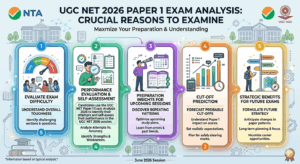
- Performance Evaluation: Candidates can use the UGC NET Paper 1 Exam Analysis 2026 to identify their attempts in the exam and self-assess their performance in the UGC NET 2026 session.
- Preparation Insights: The UGC NET Paper 1 Exam Analysis 2026 helps identify the high-weightage topics, such as logical reasoning and data interpretation.
- Cut-off Prediction: As qualifying Paper 1 is important to qualify for UGC NET, having a UGC NET Paper 1 Exam Analysis 2026 helps provide data for the prediction of UGC NET cut off 2026, safe score, and number of good attempts.
- Strategic Benefits: The UGC NET Paper 1 Exam Analysis 2026 boosts confidence by comparing with peers and experts, emphasizing time management in reasoning-heavy sections. It offers a competitive edge through topic-wise breakdowns, memory-based questions, and shift comparisons.
View UGC NET Paper 1 Download 2026
Conclusion
The UGC NET Paper 1 Exam 2026 was successfully conducted by NTA and was generally rated as Easy to Moderate in difficulty. The paper maintained a balanced distribution across all units and emphasized conceptual understanding rather than rote memorization. Candidates who attempted 40–45 questions accurately are expected to be in a strong position. The detailed analysis helps aspirants understand exam trends, identify high-weightage topics, and prepare strategically for future UGC NET examinations.
UGC NET Paper 1 Exam Analysis 2026 FAQs

What will be included in the UGC NET Paper 1 Exam Analysis 2026?
The UGC NET Exam Analysis for Paper 1 includes a detailed breakdown of the difficulty level unit-wise, as well as a date-wise analysis of Paper 1. It also list the high-weightage topics and the number of questions asked from each unit.
What is the overall difficulty level of UGC NET Paper 1 2026 conducted on 22 June 2026?
The overall difficulty level of UGC NET Paper 1 general paper conducted on 2 Jan 2026, was observed to be Easy to Moderate, with the number of good attempts to be around 40-45/50.
Is there any negative marking in the UGC NET Paper 1 2026?
No, there is no negative marking in UGC NET Paper 1 2026, encouraging candidates to attempt all questions.
How to use this UGC NET Paper 1 Exam Analysis 2026 for repeats?
The UGC NET Paper 1 Exam Analysis 2026 is perfect for repeat students to analyse their weak areas and the units they lacked preparation in, as well as tackle the high-weightage topics. Also, scoring well in Paper 1 increases chances of success.