
UGC NET Paper 1 Unit-Wise Syllabus: UGC NET Paper 1 is a common paper for all candidates appearing for the UGC NET examination, irrespective of their Paper 2 subject. It tests a candidate’s understanding of Teaching Aptitude, Research Aptitude, Comprehension, Communication, Reasoning, Data Interpretation, ICT, Environment and Higher Education. For UGC NET 2026 preparation, candidates should cover all 10 units of Paper 1, along with previous year questions, study notes, mock tests and regular revision.
JRFAdda provides UGC NET Paper 1 study material, handwritten notes, PYQs, quizzes and mock tests to help candidates prepare in a structured way. This article covers the complete UGC NET Paper 1 syllabus, unit-wise topics, study material, notes and preparation strategy.
UGC NET Paper 1 Overview
UGC NET Paper 1 is officially known as the General Paper on Teaching and Research Aptitude. It is common to candidates from all subjects. Candidates should prepare Paper 1 along with their respective Paper 2 subject because Paper 1 contributes to the overall UGC NET score.
| Particulars | Details |
| Paper | Paper 1 |
| Subject | General Paper on Teaching and Research Aptitude |
| Total Questions | 50 |
| Total Marks | 100 |
| Marks for Each Question | 2 |
| Negative Marking | No |
| Total Units | 10 |
| Mode | Computer Based Test (CBT) |
UGC NET Paper 1 Complete Syllabus
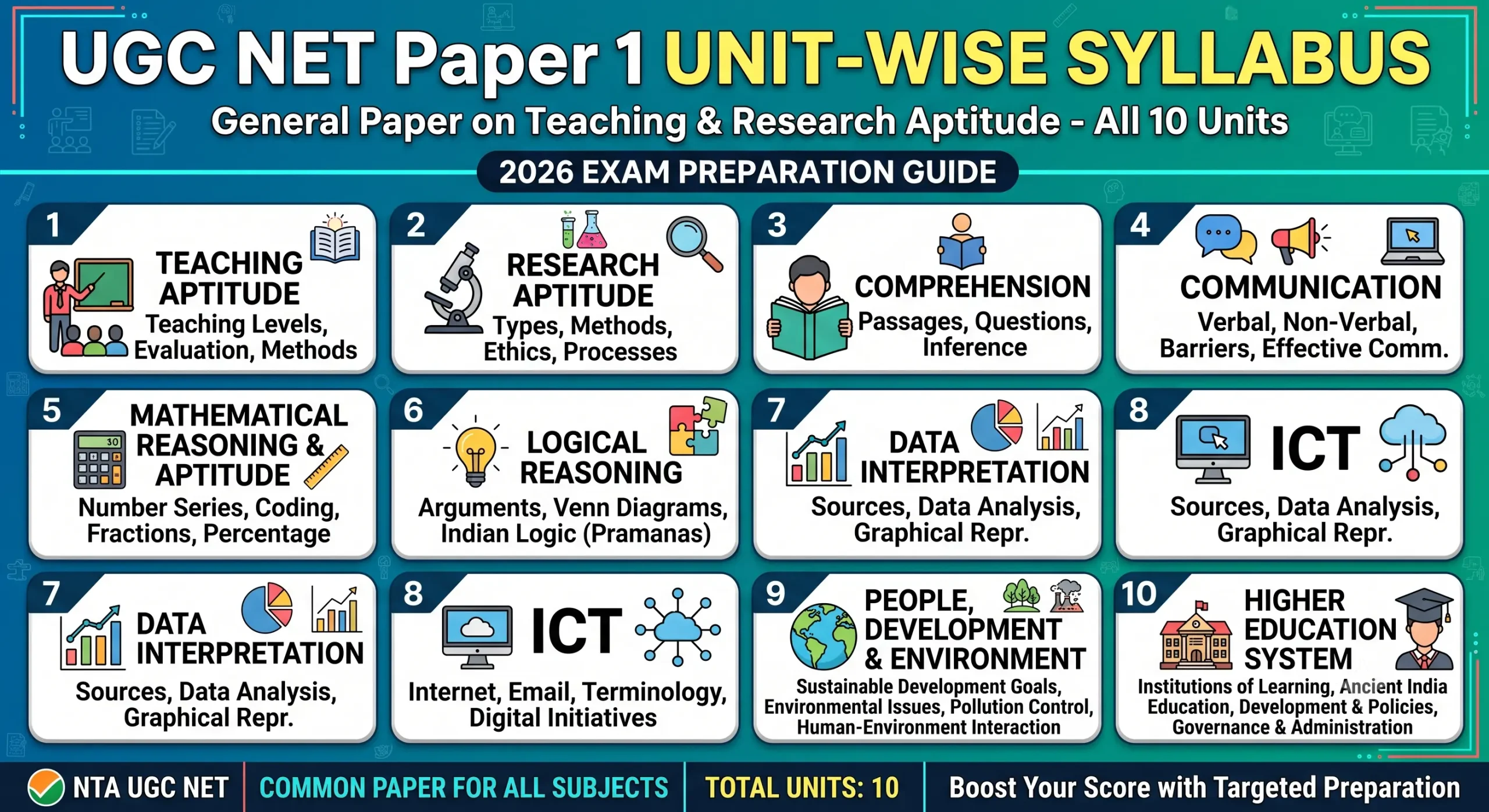
Each unit covers different concepts. Therefore, candidates should avoid preparing only selected topics and try to complete the entire syllabus. The UGC NET Paper 1 syllabus has 10 units:
- Teaching Aptitude
- Research Aptitude
- Comprehension
- Communication
- Mathematical Reasoning and Aptitude
- Logical Reasoning
- Data Interpretation
- Information and Communication Technology (ICT)
- People, Development and Environment
- Higher Education System
Check Complete UGC NET Syllabus 2026
Unit 1: Teaching Aptitude
Teaching Aptitude is the first unit of UGC NET Paper 1. This unit covers the teaching-learning process, features of learners, teaching methods, and evaluation methods.
Important Topics
- Concept of teaching
- Objectives of teaching
- Levels of teaching
- Memory level of teaching
- Understanding level of teaching
- Reflective level of teaching
- Characteristics of effective teaching
- Learner characteristics
- Individual differences
- Factors affecting teaching
- Teacher-centred and learner-centred methods
- Online and offline methods of teaching
- Teaching support systems
- Evaluation systems
- Types of evaluation
- Innovations in evaluation
UGC NET Paper 1 Important Topics 2026
How to Prepare Teaching Aptitude
Prepare short notes on the three levels of teaching, teaching methods, learner characteristics and evaluation systems. After completing the theory, solve previous year questions to understand how these concepts are asked in the examination.
Unit 2: Research Aptitude
Research Aptitude is an important unit because it covers the basic concepts of research, research methods, research process and research ethics.
Important Topics
- Meaning and characteristics of research
- Types of research
- Methods of research
- Experimental research
- Descriptive research
- Historical research
- Qualitative research
- Quantitative research
- Positivism and post-positivism
- Research steps
- Research problem
- Hypothesis
- Sampling
- Data collection
- Thesis writing
- Article writing
- Referencing
- Citation
- Research ethics
- Application of ICT in research
How to Prepare Research Aptitude
Make separate notes for types of research, research methods, research process, sampling, hypothesis and research ethics. Solve PYQs after completing every major topic. This will help you understand the difference between similar research concepts.
Unit 3: Comprehension
Comprehension is a practice-based unit. Candidates are given a passage followed by questions based on the information and ideas presented in that passage.
Important Topics
- Identifying the main idea
- Understanding the passage
- Finding specific information
- Drawing conclusions
- Understanding statements
- Identifying the author’s argument
- Understanding the meaning of words from context
- Analysing the passage
How to Prepare Comprehension
There is no need to memorise large notes for this unit. Regular practice is more important. Solve different comprehension passages and try to improve both speed and accuracy. While solving, answer questions according to the passage rather than using outside information.
Unit 4: Communication
Communication deals with the process of exchanging information, ideas and messages.
Important Topics
- Meaning and characteristics of communication
- Types of communication
- Verbal communication
- Non-verbal communication
- Formal communication
- Informal communication
- Interpersonal communication
- Group communication
- Classroom communication
- Mass communication
- Communication models
- Elements of communication
- Effective communication
- Barriers to communication
How to Prepare Communication
Prepare short notes on communication models, types of communication, elements of communication and barriers to communication. Flowcharts are useful for remembering communication models and processes.
Unit 5: Mathematical Reasoning and Aptitude
Mathematical Reasoning and Aptitude tests basic numerical and mathematical skills.
Important Topics
- Number series
- Letter series
- Coding-decoding
- Mathematical reasoning
- Basic mathematical concepts
- Fractions
- Ratio and proportion
- Percentage
- Profit and loss
- Average
- Interest
- Time and distance
- Relationships and numerical reasoning
How to Prepare Mathematical Reasoning
This unit requires regular question practice. Prepare a formula sheet and solve questions every day. Focus on learning shortcuts only after understanding the basic method.
Unit 6: Logical Reasoning
Logical Reasoning tests the ability to understand arguments, identify logical relationships and analyse statements.
Important Topics
- Structure of arguments
- Deductive reasoning
- Inductive reasoning
- Analogies
- Venn diagrams
- Categorical propositions
- Formal and informal fallacies
- Indian Logic
- Pramanas
- Pratyaksha
- Anumana
- Upamana
- Shabda
- Arthapatti
- Anupalabdhi
- Vyapti
- Hetvabhasas
How to Prepare Logical Reasoning
Indian Logic can initially appear difficult, so prepare it through definitions, examples and comparison-based notes. Regular PYQ practice is especially useful for this unit. Create separate revision notes for:
- Pramanas
- Anumana
- Vyapti
- Hetvabhasa
- Deductive reasoning
- Inductive reasoning
- Venn diagrams
- Fallacies
Unit 7: Data Interpretation
Data Interpretation or DI tests the ability to understand and analyse numerical information.
Important Topics
- Sources of data
- Acquisition of data
- Classification of data
- Quantitative and qualitative data
- Tables
- Bar graphs
- Histograms
- Pie charts
- Line graphs
- Data interpretation
- Data mapping
- Data and governance
How to Prepare Data Interpretation
First revise basic mathematical concepts such as:
- Percentage
- Ratio
- Average
- Difference
- Increase and decrease
- Comparison
Then practise questions based on tables, graphs and charts. The key to scoring well in DI is speed with accuracy.
Unit 8: Information and Communication Technology (ICT)
ICT is an important factual and conceptual unit of Paper 1. It covers computer and internet-related concepts along with digital initiatives.
Important Topics
- ICT terminology
- ICT abbreviations
- Computer basics
- Internet
- Intranet
- Audio conferencing
- Video conferencing
- Digital initiatives in higher education
- ICT and governance
How to Prepare ICT
Prepare a separate list of important abbreviations and terms. Because ICT contains many factual concepts, regular revision is important. Also revise:
- Internet-related terms
- Computer terminology
- Digital education initiatives
- ICT applications
- E-governance
Unit 9: People, Development and Environment
This unit covers the relationship between people, development and the environment. It includes pollution, natural resources, climate change, sustainable development and environmental agreements.
Important Topics
- Development and environment
- Human-environment interaction
- Sustainable development
- Millennium Development Goals
- Sustainable Development Goals
- Anthropogenic activities
- Air pollution
- Water pollution
- Soil pollution
- Noise pollution
- Solid waste
- Liquid waste
- Biomedical waste
- Hazardous waste
- E-waste
- Climate change
- Impact of pollutants on human health
- Natural resources
- Energy resources
- Renewable energy
- Solar energy
- Wind energy
- Hydro energy
- Geothermal energy
- Biomass
- Nuclear energy
- Forest resources
- Natural hazards
- Disaster management
- Environmental Protection Act
- National Action Plan on Climate Change
- Montreal Protocol
- Rio Summit
- Convention on Biological Diversity
- Kyoto Protocol
- Paris Agreement
- International Solar Alliance
How to Prepare People, Development and Environment
This unit contains many factual topics, so repeated revision is useful. Make short revision notes for:
- SDGs
- Types of pollution
- Renewable energy
- Natural resources
- Environmental laws
- Climate change
- International environmental agreements
- Disaster management

Unit 10: Higher Education System
Higher Education System is the tenth and final unit of UGC NET Paper 1. It focuses on the development, structure, policies and administration of higher education.
Important Topics
- Institutions of higher learning in ancient India
- Ancient Indian education
- Development of higher education after Independence
- Evolution of higher learning and research
- Oriental learning programmes
- Conventional learning programmes
- Non-conventional learning programmes
- Professional education
- Technical education
- Skill-based education
- Value education
- Environmental education
- Policies in higher education
- Governance
- Administration
How to Prepare Higher Education System
Prepare notes on the development of higher education, important institutions, education policies, governance and administration. Focus on facts that can be revised quickly before the examination.
UGC NET Paper 1 Study Material
Choosing the right study material is important because Paper 1 has 10 different units. JRFAdda provides Paper 1 resources including notes, PYQs, mock tests, quizzes and other preparation material.
JRFAdda UGC NET Study Material
For Paper 1 preparation, candidates should use the following resources:
1. UGC NET Paper 1 Notes
Use unit-wise notes to understand the concepts and make short revision points.
2. Handwritten Notes
Handwritten notes can be useful for quick revision, especially for factual topics such as ICT, Environment and Higher Education.
JRFAdda UGC NET Paper 1 Handwritten Notes
3. Previous Year Questions
PYQs should be solved after completing each unit. They help candidates understand the question pattern and identify important concepts.
UGC NET Previous Year Question Papers
4. Mock Tests
JRFAdda’s Paper 1 course includes full-length and sectional practice along with PYQs and quizzes. Mock tests help improve:
- Speed
- Accuracy
- Time management
- Question selection
- Exam confidence
JRFAdda UGC NET Paper 1 Course
UGC NET Paper 1 Notes: How to Make Effective Notes
Candidates do not need to prepare extremely long notes for Paper 1. Follow a three-step notes strategy.
| Step | What to Do | What to Include |
| Step 1: Detailed Notes | Understand the topic properly and prepare detailed notes. | Concepts, explanations and important examples |
| Step 2: Short Notes | Convert detailed notes into quick revision material. | Short points, tables, flowcharts and diagrams |
| Step 3: Revision Notes | Before the exam, revise only the most important information. | Definitions, formulas, models, theories, concepts, abbreviations, Acts, environmental agreements, important facts and PYQ-based concepts |
UGC NET Paper 1 Preparation Strategy
A simple preparation strategy can be divided into four stages.
Stage 1: Understand the Complete Syllabus
Start by going through all 10 units. Mark the topics that you already know and the topics that require more preparation. Do not start preparation without understanding the syllabus.
UGC NET Paper 1 Preparation Tips 2026 – December Exam 2026
Stage 2: Complete Concept-Based Study
Study one unit at a time. For conceptual units such as Teaching Aptitude, Research Aptitude and Communication, focus on understanding concepts. For Mathematical Reasoning and DI, focus more on question practice. For ICT, Environment and Higher Education, focus on factual revision.
Stage 3: Solve PYQs
After completing every unit, solve its previous year questions. While checking answers, note down:
- Questions answered incorrectly
- Concepts that were confusing
- Repeated topics
- Questions that took too much time
Stage 4: Mock Tests and Revision
Once the syllabus is completed, start full-length Paper 1 mock tests. After every test:
- Check your score.
- Identify wrong answers.
- Find the reason for each mistake.
- Revise the related concept.
- Attempt similar questions again.
UGC NET Paper 1 Preparation Plan
Candidates can follow a simple weekly cycle. This cycle can be repeated until the complete syllabus is covered.
Monday to Friday: New concepts + practice questions
Saturday: Revision of the week’s topics
Sunday: Mock test/PYQ practice + error analysis
UGC NET Paper 1: Unit-Wise Preparation Approach
For effective UGC NET Paper 1 preparation, focus on the key areas of each unit and combine concept learning with regular practice and revision.
| Paper 1 Unit | Key Preparation Focus |
| Teaching Aptitude | Concepts, teaching levels, methods and evaluation |
| Research Aptitude | Research types, methods, steps, sampling and ethics |
| Comprehension | Regular passage practice and reading skills |
| Communication | Models, types, elements and barriers |
| Mathematical Reasoning | Formulas and regular numerical practice |
| Logical Reasoning | Reasoning concepts, Indian Logic, arguments and Venn diagrams |
| Data Interpretation | Charts, tables, percentages, ratios and calculations |
| ICT | Terminology, abbreviations and digital initiatives |
| People, Development and Environment | Environment, pollution, SDGs, resources and international agreements |
| Higher Education System | Institutions, policies, governance and development of higher education |
UGC NET Paper 1 Important Study Resources by JRFAdda
Candidates preparing for UGC NET Paper 1 can use JRFAdda’s resources for different stages of preparation.
| Resource | Purpose | JRFAdda Link |
| UGC NET Paper 1 Online Course | Structured preparation with classes, study material, practice and tests | JRFAdda Paper 1 Course |
| UGC NET Paper 1 Handwritten Notes | Quick revision and unit-wise preparation | JRFAdda Handwritten Notes |
| UGC NET Study Material | Paper 1 & Paper 2 notes, quizzes, mock tests and PYQs | JRFAdda Study Material |
| UGC NET Notes 2026 | Notes and revision resources | JRFAdda UGC NET Notes |
| UGC NET Books 2026 | Paper 1 and subject-wise preparation books | JRFAdda UGC NET Books |
UGC NET Paper 1 Revision Strategy
The process of revising must begin even before the syllabus gets completed. While revising the complete content, concentrate on short notes, previous year questions, formulas, significant information, and mistakes in the practice test. Follow this cycle:
| Revision Stage | When to Revise |
| First Revision | Within a week of completing the topic |
| Second Revision | After completing the unit |
| Third Revision | During full-syllabus revision |
| Final Revision | Before the examination |

UGC NET Paper 1: What to Study in the Last Few Days?
During the final days before the examination, focus on high-value revision rather than starting large new resources. Do not keep changing your study material at the last moment. Revise:
- Teaching Aptitude concepts
- Levels of teaching
- Teaching methods
- Evaluation
- Research methods
- Research ethics
- Communication models
- Mathematical formulas
- Logical Reasoning concepts
- Indian Logic
- Data Interpretation
- ICT abbreviations
- Environment and SDGs
- Environmental agreements
- Higher Education facts
- Previous year questions
- Mock-test mistakes

Conclusion
UGC NET Paper 1 covers 10 units, and effective preparation requires complete syllabus coverage, notes, PYQs, mock tests and regular revision. JRFAdda provides online classes, handwritten notes, study material and practice tests to support preparation. Candidates should focus on reliable resources, practise regularly and revise weak areas to improve their performance.