

UGC NET Tribal and Regional Language / Literature Syllabus 2026 is intended to test candidates’ knowledge of the country’s varied linguistic heritage, tribal society, and regional literature. This paper is held by the National Testing Agency in collaboration with the University Grants Commission to help aspiring candidates prepare for Assistant Professor and Junior Research Fellowship (JRF).
The UGC NET Tribal and Regional Language / Literature Syllabus consists of a broad spectrum of areas such as ethnology, linguistics, folklore, tribal society, arts, and literary criticism, among others.
UGC NET Tribal and Regional Language/Literature Syllabus Overview
UGC NET Tribal & Regional Language / Literature (Code 70) examination is held by the National Testing Agency under the auspices of the University Grants Commission. It aims to evaluate candidates’ knowledge regarding tribal language, literature, culture, and linguistics.
Enroll UGC NET Mock Test Series
This examination comprises two papers, which are held in one sitting lasting for 3 hours. Although Paper I evaluates candidates’ ability in teaching and research aptitude, Paper II evaluates candidates’ subject-related knowledge through 100 objective type questions, each having 2 marks, thereby amounting to a total score of 200 marks. One significant advantage of this examination is that there is no negative marking system.

| Feature | Details |
| Exam Name | UGC NET Tribal and Regional Language/Literature (Code 70) |
| Conducting Body | National Testing Agency (NTA) |
| Exam Mode | Computer-Based Test (CBT) |
| Papers | Paper 1 (General) + Paper 2 (Gujarati) |
| Total Questions | 150 |
| Total Marks | 300 |
| Duration | 3 Hours |
| Negative Marking | No |
| Official Website | ugcnet.nta.nic.in |
UGC NET Tribal and Regional Language/Literature Syllabus PDF Hindi & English
Aspirants appearing for the UGC NET Tribal and Regional Language Literature examination may download the syllabus PDFs available in Hindi as well as English from the official site in order to get more clarity. These syllabi have been issued by the National Testing Agency on behalf of the University Grants Commission. It is advisable to only consult the official syllabus PDF during preparation.
| UGC NET Tribal and Regional Language/Literature PDF English | Click Here |
| UGC NET Tribal and Regional Language/Literature PDF Hindi | Click Here |
UGC NET Tribal and Regional Language/Literature Syllabus Unit-wise
UGC NET Tribal & Regional Language/Literature (Code 70) syllabus aims to impart an overall knowledge about tribal society in relation to its language, literature, culture, and heritage. The syllabus consists of 10 units that include theoretical as well as practical subjects like folklore, linguistics, art, and literature.
Check UGC NET Syllabus Paper PDF Here
In this subject, there is a special focus on indigenous languages, folklore, regional literature, role of tribal leadership, and evolution of culture. It is imperative for candidates to have a good command over all these units to excel in Paper-II of the UGC NET exam.
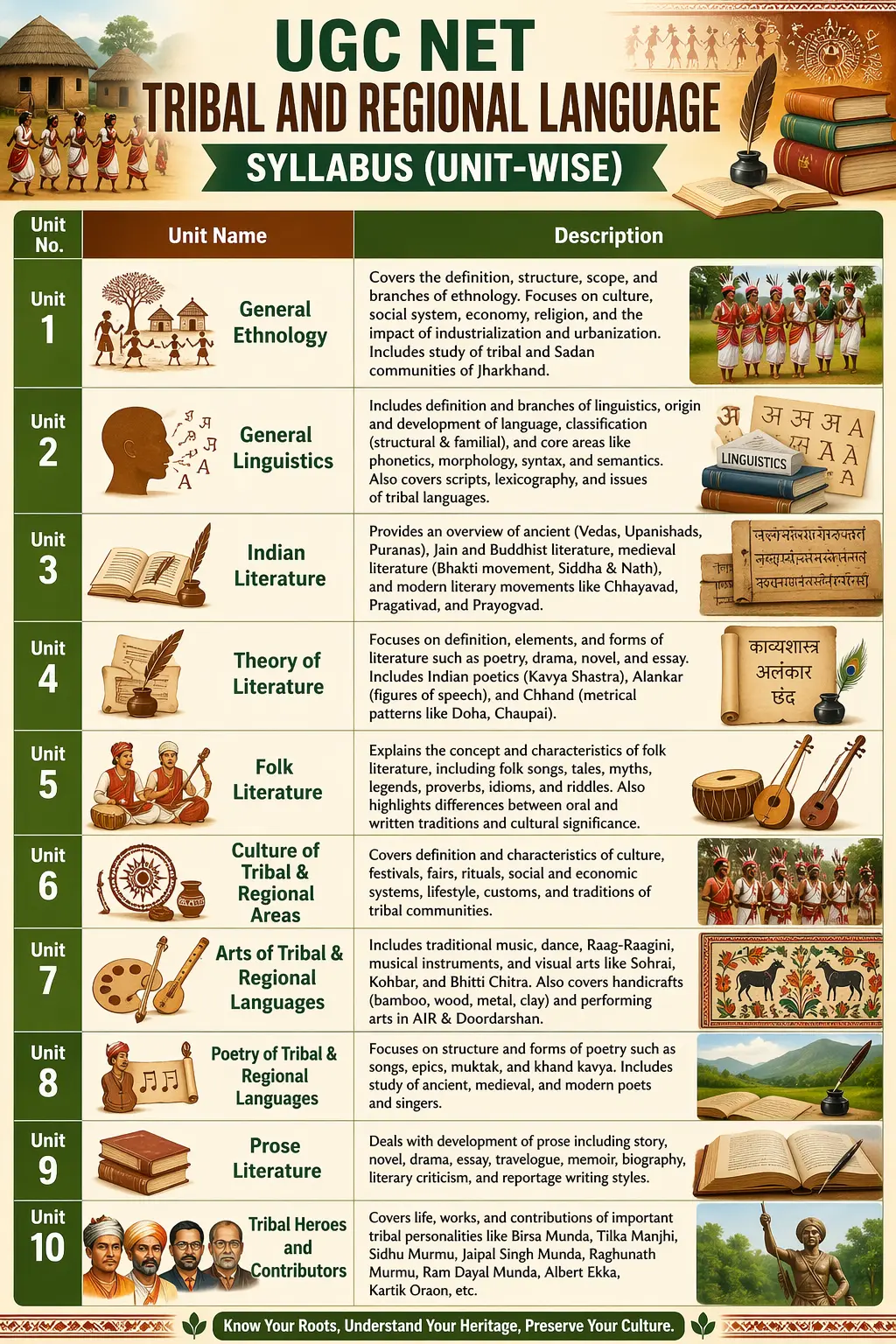
| Unit No. | Unit Name | Description |
| Unit 1 | General Ethnology | Includes the definition, scope, branches, and aspects of ethnology. It deals with culture, social system, economy, religion, and the effects of industrialization and urbanization. Study of tribals and Sadan communities of Jharkhand is included in it. |
| Unit 2 | General Linguistics | Definition and branches of linguistics, evolution of language, classification of language (structural and familial), and the main areas of linguistics such as phonetics, morphology, syntax, and semantics have been discussed. |
| Unit 3 | Indian Literature | Introduction to the ancient literature (Vedas, Upanishads, Puranas), literature of Jainism and Buddhism, medieval literature (the Bhakti Movement, Siddhas and Naths), and contemporary literary movements (Chhayavad, Pragativad, and Prayogvad) has been covered. |
| Unit 4 | Theory of Literature | Focuses on definition, elements, and forms of literature such as poetry, drama, novel, and essay. Includes Indian poetics (Kavya Shastra), Alankar (figures of speech), and Chhand (metrical patterns like Doha, Chaupai). |
| Unit 5 | Folk Literature | Explains the concept and characteristics of folk literature, including folk songs, tales, myths, legends, proverbs, idioms, and riddles. Also highlights differences between oral and written traditions and cultural significance. |
| Unit 6 | Culture of Tribal & Regional Areas | Covers definition and characteristics of culture, festivals, fairs, rituals, social and economic systems, lifestyle, customs, and traditions of tribal communities. |
| Unit 7 | Arts of Tribal & Regional Languages | Includes traditional music, dance, Raag-Raagini, musical instruments, and visual arts like Sohrai, Kohbar, and Bhitti Chitra. Also covers handicrafts (bamboo, wood, metal, clay) and performing arts in AIR & Doordarshan. |
| Unit 8 | Poetry of Tribal & Regional Languages | Focuses on structure and forms of poetry such as songs, epics, muktak, and khand kavya. Includes study of ancient, medieval, and modern poets and singers. |
| Unit 9 | Prose Literature | Deals with development of prose including story, novel, drama, essay, travelogue, memoir, biography, literary criticism, and reportage writing styles. |
| Unit 10 | Tribal Heroes and Contributors | Covers life, works, and contributions of important tribal personalities like Birsa Munda, Tilka Manjhi, Sidhu Murmu, Jaipal Singh Munda, Raghunath Murmu, Ram Dayal Munda, Albert Ekka, Kartik Oraon, etc. |
UGC NET Tribal and Regional Language/Literature Exam Pattern 2026
UGC NET Tribal and Regional Language/Literature Exam Pattern 2026 is designed to test the candidates on their overall teaching ability and subject-related knowledge. The exam is being carried out by National Testing Agency under the University Grants Commission for Computer Based Test (CBT).
Check UGC NET Exam Pattern 2026 Here
There are two papers (Paper I & Paper II) in one sitting without any interval between them. Both the papers contain objective type questions (Multiple Choice Questions).
| Paper | Subject | Questions | Marks |
| Paper 1 | (General Aptitude) | 50 | 100 |
| Paper 2 | (Subject – Tribal & Regional Language) | 100 | 200 |
| Total | 150 | 300 |
Top UGC NET Offline Coaching in Jaipur
Conclusion
UGC NET Tribal and Regional Language / Literature syllabus 2026 (Code 70) has been carefully curated to ensure that the rich cultural, linguistic, and literary heritage of tribal and regional traditions in India is covered in detail through a well-balanced syllabus spread over 10 units.
In order to secure good marks in the exam, candidates need to go beyond mere rote learning and develop a thorough conceptual understanding of each unit. Continuous revision and solving questions from previous years’ papers will help improve scores in high-weightage topics such as linguistics, folklore, and tribal culture.
UGC NET Tribal and Regional Language / Literature syllabus 2026 FAQs
Is there negative marking in the UGC NET Tribal and Regional Language/Literature exam?
No, there is no negative marking in the UGC NET exam, which allows candidates to attempt all questions confidently.
Where can I download the UGC NET Tribal and Regional Language/Literature Syllabus PDF?
You can download the official UGC NET Tribal and Regional Language/Literature Syllabus PDF (Hindi & English) from the websites of National Testing Agency and University Grants Commission.
What is the difficulty level of the UGC NET Tribal and Regional Language/Literature exam?
The exam is generally moderate to difficult, especially Paper 2, which focuses on conceptual understanding, tribal studies, and linguistic analysis.
Is the UGC NET Tribal and Regional Language/Literature Syllabus important for JRF?
Yes, clearing the UGC NET Tribal and Regional Language/Literature exam with good marks in Paper 2 is essential to qualify for the Junior Research Fellowship (JRF).