

UGC NET Electronic Science Syllabus 2026 is important for candidates who want to achieve the Assistant Professor or Junior Research Fellowship (JRF) eligibility in the field of Electronic Science. Thoroughly reviewing the latest UGC NET Electronic Science Syllabus 2026 helps candidates plan their preparation from the beginning in a structured and effective way.
Explore the complete details on the UGC NET Electronic Science Syllabus 2026, exam pattern and also assess the direct links to the UGC NET Electronic Science syllabus download 2026 PDF.
Best UGC NET Online Test Series
UGC NET Electronic Science Syllabus 2026 Overview
The UGC NET exam is a national-level examination that is conducted by the National Testing Agency (NTA) in two cycles (June & December cycles) on behalf of the University Grants Commission (UGC). It determines the candidate’s eligibility for Assistant Professor and Junior Research Fellowship (JRF) positions. Before starting your preparation, understand the UGC NET Electronic Science Syllabus 2026 overview:
| Feature | Details |
| Exam Name | UGC NET 2026 |
| Conducting Authority | National Testing Agency (NTA) |
| Purpose | Assistant Professor & Junior Research Fellowship (JRF) eligibility |
| Exam Frequency | Twice a year (June & December) |
| Exam Mode | Computer-Based Test (CBT) |
| Medium of Exam | English and Hindi |
| Exam Date | 22 June to 30 June 2026 |
| Total Duration | 3 Hours (180 Minutes) |
| Papers | Paper I (General) & Paper II (Electronic Science) |
| Subject Code for Electronic Science | 88 |
| Total Marks | 300 (Paper I: 100, Paper II: 200) |
| Negative Marking | No negative marking |
| Official Website | ugcnet.nta.nic.in |

Download UGC NET Paper 1 Syllabus 2026 PDF
The UGC NET Paper 1 2026 is common for all the candidates, irrespective of their chosen subject. To pass the UGC NET Electronic Science 2026 exam, qualifying Paper 1 is just as important as Paper 2. The main purpose of Paper 1 is to test a candidate’s teaching and research aptitude. The aspirants can download the UGC NET Paper 1 Syllabus 2026 PDF from the link below:
Download UGC NET Electronic Science Syllabus PDF 2026
The UGC NET Paper 2 is subject-specific and evaluates core knowledge of Electronic Science. The UGC NET Electronic Science Syllabus 2026 includes topics like electronic devices, circuits, communication systems, and microprocessors. The aspirants can download the UGC NET Electronic Science Syllabus PDF 2026 from the link provided below:
UGC NET Electronic Science Syllabus 2026 Breakdown
The UGC NET Electronic Science Syllabus 2026 mainly includes the syllabus for two papers:
- Paper 1: General aptitude (common for all) follows the same syllabus for all subjects.
- Paper 2: Electronic Science (subject-based); the syllabus varies on the basis of the subject chosen by the candidates.
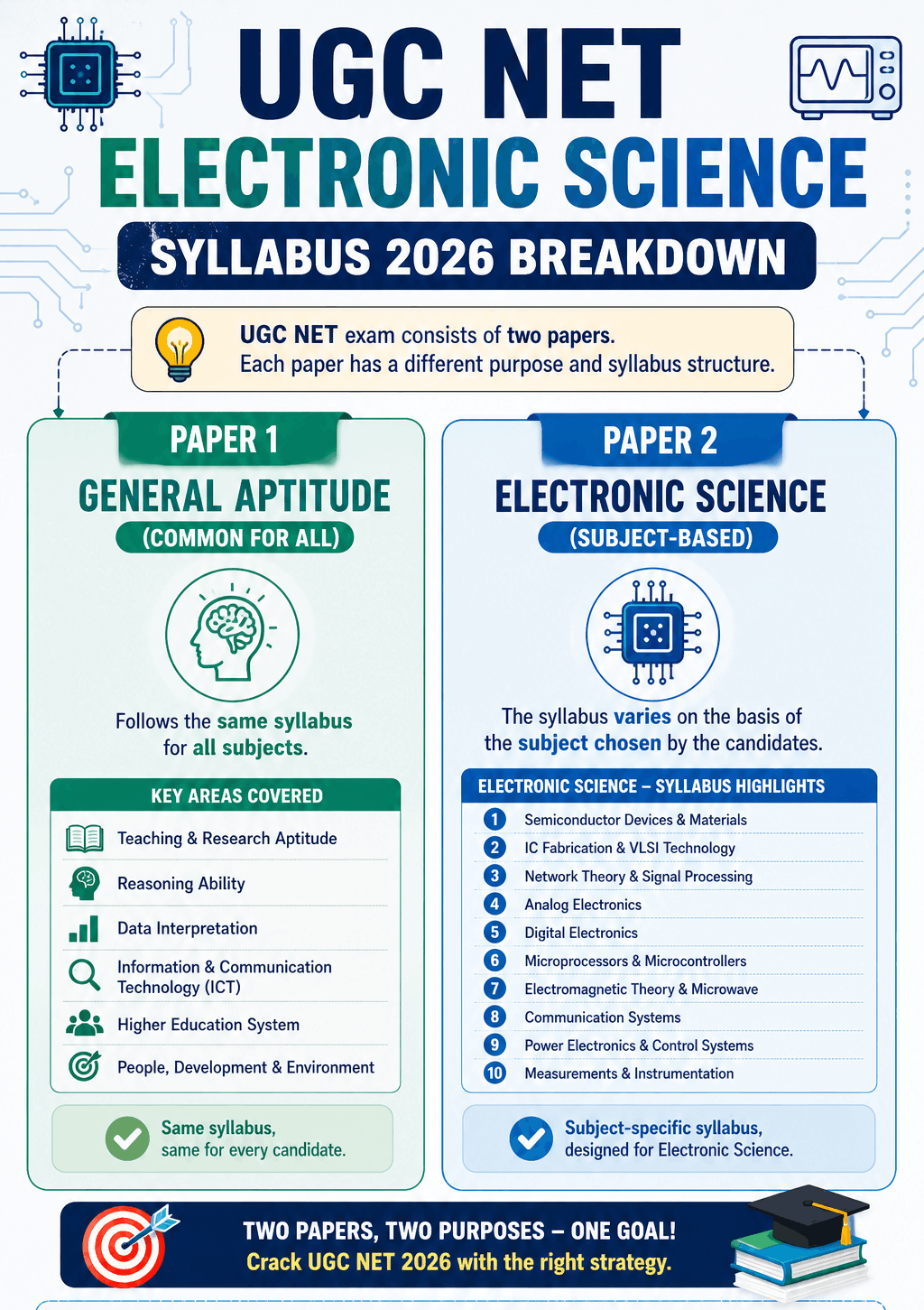
To become eligible for the posts of Assistant Professor or Junior Research Fellowship (JRF), the candidates must prepare both Paper 1 and Paper 2 effectively. Understand the UGC NET Electronic Science Syllabus 2026 and increase your chances of success in the UGC NET June 2026 exam.
UGC NET Paper 1 Syllabus 2026 (Common for All)
The UGC NET Paper 1 syllabus 2026 is the same for all candidates regardless of their postgraduation subject choice. The UGC NET Paper 1 Syllabus 2026 mainly includes the 10 key units, including teaching & research aptitude, comprehension, reasoning, ITC, etc. View the UGC NET Paper 1 syllabus 2026 in the table ahead:
| S.No. | Units | Key Areas Covered |
| 1 | Teaching Aptitude | Nature, objectives, methods of teaching, teaching aids, learner characteristics, evaluation systems |
| 2 | Research Aptitude | Types of research, methods of research, steps, ethics, thesis/dissertation, ICT in research |
| 3 | Comprehension | Reading comprehension passages and answering questions |
| 4 | Communication | Types of communication, effective communication, barriers, classroom communication |
| 5 | Mathematical Reasoning and Aptitude | Number series, codes, Venn diagrams, percentages, profit & loss, time & work |
| 6 | Logical Reasoning | Arguments, analogies, syllogisms, Indian & Western logic |
| 7 | Data Interpretation | Data sources, analysis using data tables, graphs, pie charts, diagrams, classification of data, graphical representation |
| 8 | Information and Communication Technology (ICT) | Fundamentals of ICT, Basics of computers, internet, e-mail, digital learning platforms, cybersecurity |
| 9 | People, Development and Environment | Environment issues, climate change, sustainable development, SDGs, natural hazards |
| 10 | Higher Education System: Governance & Polity | Indian higher education system, value & inclusive education, education policies and governance |
Top UGC NET Coaching in Jaipur

UGC NET Electronic Science Paper 2 Syllabus 2026 (Subject Code: 88)
The UGC NET Electronic Science Paper 2 Syllabus 2026 mainly focuses on the fundamental and advanced topics in electronics and communication. It also includes the 10 major units that make up the entire UGC NET Electronic Science Syllabus 2026. Once the aspirants have accessed the UGC NET Electronic Science Syllabus download 2026 PDF, they can review the units listed below in detail.
| S.No. | Units | Key Topics Covered |
| 1 | Semiconductor Devices & Materials | Semiconductor basics, energy bands, PN junction, diodes (Zener, tunnel), JFET, MOSFET, quantum devices, HEMT, solar cells, LED/LCD, graphene, CNT, ZnO, SiC |
| 2 | IC Fabrication & VLSI Technology | Crystal growth, epitaxy, lithography, doping, etching, MOS technology, CMOS/NMOS, VLSI design, CCD, layout rules, thin film techniques |
| 3 | Network Theory & Signal Processing | Network theorems, nodal/mesh analysis, Laplace/Fourier/Z-transform, filters, Bode plots, DSP basics (DFT, FFT, FIR, IIR), signal representation |
| 4 | Analog Electronics | Rectifiers, amplifiers, feedback, oscillators (Hartley, Colpitts), OP-AMP applications, PLL, active filters, multivibrators |
| 5 | Digital Electronics | Logic gates, Boolean algebra, combinational & sequential circuits, flip-flops, counters, FPGA, PLD, HDL |
| 6 | Microprocessors & Microcontrollers | 8086 architecture, instruction set, 8051 microcontroller, programming, interfacing, interrupts, serial communication |
| 7 | Electromagnetic Theory & Microwave | Maxwell equations, wave propagation, transmission lines, antennas, microwave devices (klystron, magnetron), radar |
| 8 | Communication Systems | Analog & digital modulation (AM, FM, PCM, PSK, QAM), multiplexing, optical communication, satellite/mobile communication, IoT basics |
| 9 | Power Electronics & Control Systems | SCR, DIAC, TRIAC, SMPS, UPS, motor control, control systems, transfer function, stability analysis, PID controllers |
| 10 | Measurements & Instrumentation | Transducers, measurement systems, CRO, DSO, spectrum analyzer, biomedical instruments (ECG, EEG), MEMS, IoT sensors |
Understand the Complete UGC NET Syllabus 2026 Here
Is There Any Changes in UGC NET Electronic Science Syllabus 2026?
As per the latest updates, there are no major changes in the UGC NET Electronic Science Syllabus 2026. The UGC NET Electronic Science Syllabus 2026 continues to follow the same 10-unit structure prescribed by the University Grants Commission for Paper 2.
However, a few minor trends and observations are worth noting:
- There is a growing emphasis on modern topics like IoT, MEMS, and advanced communication systems.
- Questions are increasingly concept-based and analytical, rather than purely theoretical.
There is no significant change in the UGC NET Electronic Science Syllabus 2026, but candidates should focus on conceptual clarity and updated applications of topics to perform well in the UGC NET 2026 exam.
Enroll UGC NET Offline Classes in Jaipur
UGC NET Electronic Science Exam Pattern 2026
Understanding the exam pattern is just as important as the UGC NET Electronic Science Syllabus 2026 when starting the preparation process. The UGC NET exam 2026 is conducted online in a Computer-Based Testing (CBT) mode. The exam has two papers, including Paper 1 (General Paper) and Paper 2 (Subject-Based). Check the UGC NET Electronic Science Exam Pattern 2026 from the table below:
| Paper | Subject | Marks | Questions | Duration |
| Paper 1 | General Aptitude | 100 | 50 | 3 Hours (Combined) |
| Paper 2 | Electronic Science | 200 | 100 |

Important points of the UGC NET Electronic Science Exam Pattern 2026 are as follows:
- Both Paper 1 and Paper 2 are conducted in a single session of 3 Hours without a break.
- All questions are objective-type questions (MCQs)
- There is no negative marking for any incorrect answer.
- +2 marks are awarded for each correct answer
Check the UGC NET Exam Pattern 2026
Conclusion
The UGC NET Electronic Science Syllabus 2026 is designed to assess an aspirant’s basic and advanced concepts of electronics. Candidates should download the UGC NET Electronic Science Paper 2 Syllabus 2026 PDF and go through each unit systematically.
With proper planning, consistent practice, and conceptual clarity, candidates can successfully clear the exam and achieve their academic or teaching goals.
UGC NET Electronic Science Syllabus 2026 FAQs

Is the UGC NET Electronic Science syllabus the same every year?
The UGC NET Electronic Science syllabus generally remains mostly the same, but minor updates or changes may be introduced. Candidates should always check the latest official notification.
What are the important topics from the UGC NET Electronic Science Syllabus 2026?
Important topics include semiconductors, network theory, analog electronics, digital circuits, communication systems, and control systems.
Where can I download the UGC NET Electronic Science Syllabus PDF 2026?
You can download the UGC NET Electronic Science Syllabus 2026 PDF from the official NTA website or from the links provided in the article.
Is programming included in UGC NET Electronic Science syllabus?
Yes, the UGC NET Electronic Science Syllabus 2026 includes programming under microprocessors and microcontrollers (8086 and 8051).