

RSSB Senior & Basic Computer Instructor Syllabus 2026 is now available for candidates who are preparing for the Computer Teacher recruitment test conducted by Rajasthan Staff Selection Board. The Computer Teacher recruitment process includes two positions of Senior Computer Instructor and Basic Computer Instructor. The candidates should know about the complete details like syllabus, pattern, marking scheme, and key topics.
The computer teacher recruitment test will be divided into two parts, and the total marks assigned are 200. Part I is common for both the posts, while part II will vary as per the applied post.
RSSB Senior & Basic Computer Instructor Syllabus 2026 Overview
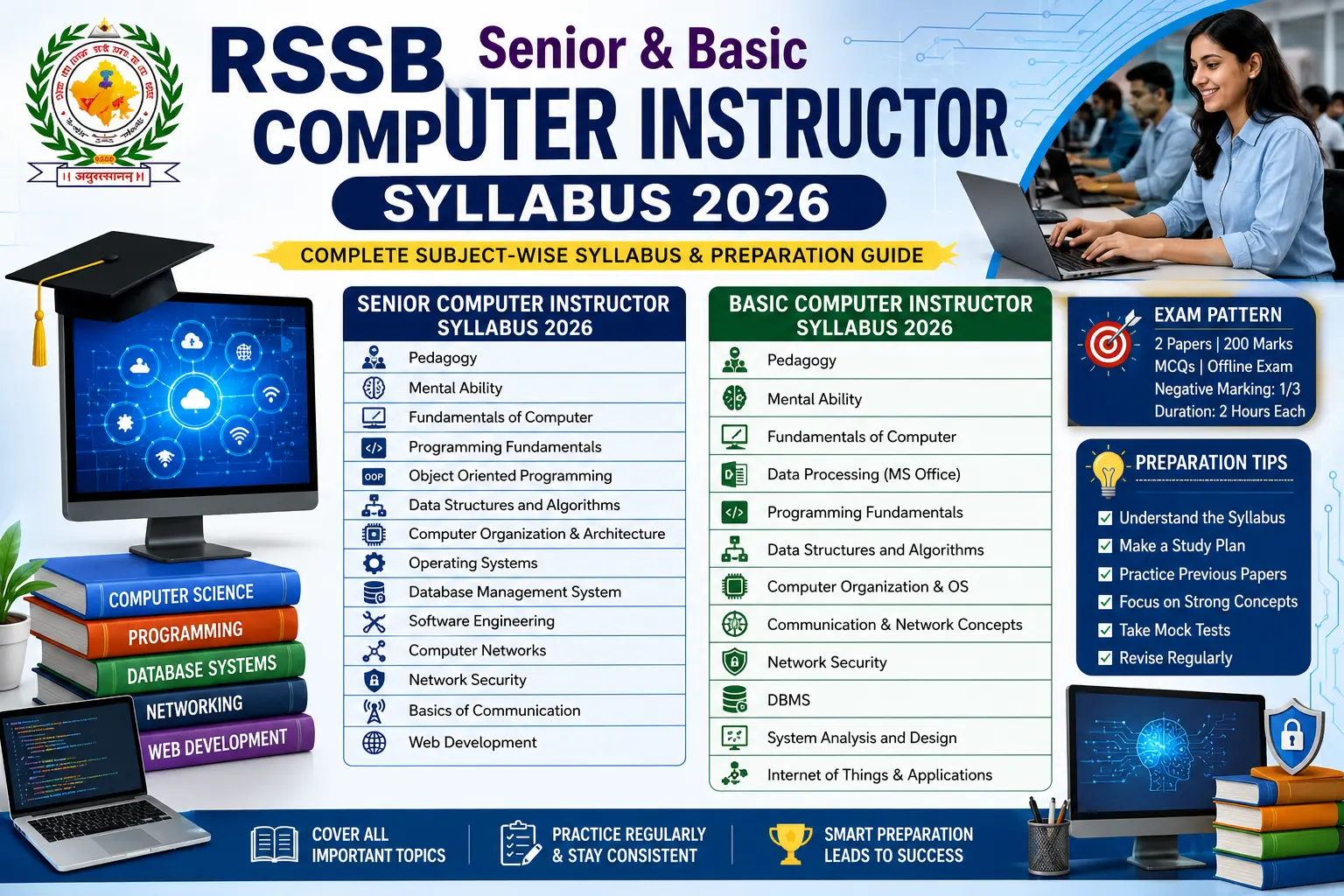
RSSB Senior & Basic Computer Instructor Syllabus 2026 has been set up by Rajasthan State Staff Selection Board for the post of Senior Computer Instructor & Basic Computer Instructor. Exam will be organized in offline mode and has a total of two papers having the combined total of 200 marks. In both exams, there will be MCQ-based questions. Duration allotted for each exam is 2 hours. Negative marking of one-third marks will be applied for every wrong answer.
RSSB Computer Anudeshak Course & Batch 2026
| Particulars | Details |
| Exam Conducting Authority | Rajasthan Staff Selection Board |
| Exam Name | RSSB Computer Instructor Recruitment 2026 |
| Posts | Senior Computer Instructor & Basic Computer Instructor |
| Total Marks | 200 Marks |
| Number of Papers | Paper I & Paper II |
| Exam Mode | Offline |
| Question Type | Multiple Choice Questions (MCQs) |
| Total Questions | 200 Questions |
| Duration | 2 Hours for Each Paper |
| Negative Marking | 1/3 Mark Deduction |
| Minimum Qualifying Marks | 40% |

RSSB Senior Computer Instructor Syllabus 2026
RSSB Senior Computer Instructor Syllabus 2026 has been created to assess candidates on their understanding of various advanced topics like computing science theory, programming languages, networks, operating systems, DBMS, and web technologies. The syllabus consists of all major subjects both theoretical and practical needed for a Computer Instructor role in Rajasthan.
Check RSSB Senior Computer Instructor Notification 2026 PDF Here
| Subjects | Important Topics |
| Pedagogy | Teaching methods, Teaching-learning process, Classroom management, Educational psychology, Learning theories, Student evaluation methods, Communication skills, Educational technology, Motivation and learning techniques |
| Mental Ability | Logical reasoning, Analytical ability, Decision making, Problem solving, Data interpretation, Data sufficiency, Coding-decoding, Series and patterns, Blood relations, Directions, Major developments in Information Technology |
| Fundamentals of Computer | Number system, Binary, Decimal and Hexadecimal conversions, Arithmetic operations, Computer generations, Types of computers, Categories of programming languages, Input and output devices, Memory devices, Storage units, Computer hardware and software concepts |
| Programming Fundamentals | Basics of programming, Algorithms and flowcharts, C Programming, C++, Java, DotNet, Python, Artificial Intelligence, Machine Learning, Blockchain Technology, Data types, Variables and constants, Scope of variables, Operators and precedence, Conditional statements, Loops, Arrays, Pointers, Structures, Unions, Enumerated data types, Functions, Recursion, File handling, Command line arguments |
| Object Oriented Programming | Classes and objects, Constructors and destructors, Encapsulation, Inheritance, Polymorphism, Function overloading, Operator overloading, Abstraction, Exception handling, Event handling, Files and streams, Packages and interfaces in Java |
| Data Structures and Algorithms | Abstract data types, Arrays, Linked lists, Stack operations, Queue operations, Circular queue, Trees, Binary trees, Binary search trees, Graph representations, Searching techniques, Sorting algorithms, Symbol tables, Hashing, Recursion, Dynamic memory allocation Tree traversal algorithms, Greedy methods, Branch and bound techniques, Divide and conquer method, Complexity analysis of algorithms, Time complexity, Space complexity, Big O notation |
| Digital Logic Systems | Boolean algebra, Logic gates, Boolean expressions, K-Maps, Simplification techniques, TTL and CMOS logic families, Half adders, Full adders, Subtractors, Multiplexers, Flip-flops, Sequential circuits, Synchronous sequential system design |
| Computer Organization and Architecture | Von Neumann architecture, Registers and micro operations, Instruction cycle, Processor organization, Bus organization, Addressing modes, Control logic, DMA, Processor input-output, Memory hierarchy, Cache memory, Main memory organization |
| Operating Systems | Operating system concepts, CPU scheduling algorithms, Deadlocks, Process synchronization, Threads and processes, Memory management, Virtual memory, File systems, Disk scheduling algorithms, Distributed systems, Client-server architecture, RPC, Real-Time Operating Systems, Clock synchronization, Task scheduling, Linux operating system, Booting process, User account handling, Backup and restore, Bourne shell programming |
| Database Management System | Database concepts, E-R models, Relational model, Relational algebra, Database calculus, Integrity constraints, Normalization, Indexing, Triggers, Transactions, Concurrency control, Recovery systems, SQL queries, Relational Database Management Systems (RDBMS) |
| Software Engineering | Software Development Life Cycle (SDLC), Requirement analysis, System modeling, Data Flow Diagrams (DFDs), Software requirement specifications, Software design, Testing techniques, Debugging, Software maintenance, Software project management |
| Computer Networks | Evolution of networking, Data communication concepts, Transmission media, Network devices, TCP/IP model, OSI/ISO model, Functions of layers, Physical media characteristics, Multiplexing, LAN technologies (802.3, 802.4, 802.5, 802.11), IP addressing, Routing, Congestion control, TCP and UDP protocols, DNS concepts |
| Network Security | Cryptography basics, Groups, Rings and Fields, Euler and Fermat theorem, Primality testing, Security services, Symmetric and asymmetric encryption, DES, AES, IDEA, RSA algorithms, Key management, Hashing techniques, Message authentication, Email security, Viruses and malware, Trusted systems, Ethical hacking, LAN and WAN security |
| Basics of Communication | Communication systems, Channel capacity, Attenuation, Communication impairments, Electromagnetic wave propagation, PCM, Delta modulation, WDM, GSM communication systems, CDMA communication systems |
| Web Development | HTML and DHTML, Web page designing, Document Object Model (DOM), Dynamic HTML documents, Cascading Style Sheets (CSS), XML, PHP basics, JavaScript basics, Client-side scripting, Website creation and maintenance, Interactive web pages |
RSSB Basic Computer Instructor Syllabus 2026
RSSB Basic Computer Instructor Syllabus 2026 concentrates on basic computer concepts, MS office applications, programming languages, networking, databases, and internet technology. The syllabus is meant to measure the candidate’s knowledge about computer functionality, software application, data processing, and programming required for teaching computer science at the basic level.
Online Course for RSSB Computer Instructor Course 2026
The candidate must prepare for computer basics, MS Office, programming languages, networking concepts, database, and internet technology to pass the RSSB Basic Computer Instructor Exam 2026. Here follows the detailed subject wise RSSB Basic Computer Instructor Syllabus 2026.
| Subjects | Detailed Topics |
| Pedagogy | Teaching techniques, Teaching-learning methods, Student assessment methods, Classroom management, Learning strategies, Educational communication, Motivation and evaluation techniques |
| Mental Ability | Decision making, Problem solving, Data sufficiency, Logical reasoning, Analytical skills, Data interpretation, Coding-decoding, Number series, Verbal and non-verbal reasoning, Major developments in Information Technology |
| Fundamentals of Computer | Overview of computer systems, Input-output devices, Scanner and pointing devices, Digital and analog data representation, Binary, Decimal and Hexadecimal number systems, Data processing concepts, Types of files, Storage devices, Computer hardware and software basics |
| Data Processing | Word Processing using MS Word, Spreadsheet applications using MS Excel, Presentation software using MS PowerPoint, Database management using MS Access, Formatting, Charts, Tables, Formulas, Data analysis tools |
| Programming Fundamentals | Introduction to C and C++, Java, DotNet, Python, Artificial Intelligence basics, Machine Learning basics, Blockchain basics, Principles of programming techniques, Variables and data types, Operators, Control statements, Functions, Object Oriented Programming (OOP) concepts, Integrated Development Environment (IDE) and its advantages |
| Data Structures and Algorithms | Problem-solving techniques, Algorithms, Abstract data types, Arrays, Linked Lists, Stack operations, Queues, Binary Trees, Binary Search Trees, Graphs and their representations, Searching techniques, Sorting algorithms, Symbol tables, Data structures using C and C++ |
| Computer Organization and Operating System | Basic structure of computers, CPU and instruction cycle, Arithmetic operations, Memory organization, Input-output organization, Operating system concepts, Process management, File management, Finding and processing files |
| Communication and Network Concepts | Introduction to computer networks, Networking models and layers, Network devices, LAN, MAN and WAN concepts, Fundamentals of mobile communication, Data communication basics, Transmission media |
| Network Security | Protection against viruses and malicious attacks, Firewalls and their utility, Backup and restore techniques, Networking security concepts, LAN and WAN security, Ethical hacking basics, Cyber security fundamentals |
| Database Management System (DBMS) | Introduction to DBMS, Architecture of database systems, Relational Database Management System (RDBMS), Database design concepts, Data manipulation, SQL basics, NoSQL database technologies, Selecting appropriate databases |
| System Analysis and Design | Introduction to system analysis, Requirement gathering, Feasibility analysis, Structured analysis and design, Object-oriented modeling using UML, Software testing, System implementation, Maintenance, Software development approaches |
| Internet of Things and Applications | Internet technologies and protocols, LAN, MAN and WAN, Search engines and search services, Online and offline messaging, Web browsers, Web publishing, HTML and XML basics, Scripts and website creation, Multimedia and graphics, Voice mail, Video conferencing, Introduction to e-Commerce |
Rajashthan Computer Anudeshk Course Online 2026
RSSB Senior & Basic Computer Instructor Syllabus 2026 Preparation Tips
Candidates who are going to appear in the RSSB Computer Instructor 2026 exam must start their preparation by having knowledge of the updated syllabus and paper pattern of the same. As the exam comprises two papers, candidates have to prepare both Paper-I and Paper-II separately. Paper-I mainly concentrates on General Knowledge of Rajasthan, Reasoning, and General Ability, whereas Paper-II is based on Technical Computer Subjects as per Post Level.
Online Course for RSSB Computer Instructor Course 2026
- Understand the complete syllabus carefully.
- Divide Paper I and Paper II preparation separately.
- Practice previous year papers regularly.
- Focus on Rajasthan GK for Paper I.
- Strengthen programming and networking concepts.
- Attempt mock tests for time management.
- Revise formulas, protocols, and programming syntax daily.
Conclusion
RSSB Senior & Basic Computer Instructor Syllabus 2026 is detailed and consists of general awareness along with computer knowledge. The Paper I syllabus is similar for all aspirants, but the Paper II syllabus is dependent on the post level of aspirants. Aspirants who are preparing for the RSSB Computer Instructor Exam need to prepare an effective study plan regarding programming, networking, operating systems, DBMS, and Rajasthan GK. Regular practice and revision will help aspirants achieve high scores in the exam.
RSSB Senior & Basic Computer Instructor Syllabus 2026 FAQs
What is the exam pattern for RSSB Senior & Basic Computer Instructor Exam 2026?
The RSSB Senior & Basic Computer Instructor Exam 2026 consists of two papers with objective-type MCQs. Each paper carries 100 marks and includes negative marking of 1/3 mark for wrong answers.
What are the important topics in RSSB Senior Computer Instructor Syllabus 2026?
Important topics in the RSSB Senior Computer Instructor Syllabus 2026 include Programming Fundamentals, Data Structures, Operating Systems, DBMS, Computer Networks, Network Security, Software Engineering, and Web Development.
What subjects are covered under RSSB Basic Computer Instructor Syllabus 2026?
The RSSB Basic Computer Instructor Syllabus 2026 covers Computer Fundamentals, MS Office, Networking Basics, Programming Fundamentals, DBMS, Internet Technologies, Data Structures, and Cyber Security basics.
How should candidates prepare for the RSSB Senior & Basic Computer Instructor Syllabus 2026?
Candidates should understand the complete RSSB Senior & Basic Computer Instructor Syllabus 2026, practice previous year papers, revise programming concepts regularly, attempt mock tests, and focus on Rajasthan GK along with technical subjects.