
The National Testing Agency (NTA) successfully conducted the UGC NET Konkani 2026 Examination on 25 June 2026 (Shift I) from 09:00 AM to 12:00 PM in Computer-Based Test (CBT) mode across various examination centres in India. The examination was conducted for candidates aspiring to qualify for the post of Assistant Professor, Junior Research Fellowship (JRF), and PhD Admission in the subject of Konkani.
The UGC NET Konkani 2026 paper assessed candidates’ knowledge of Konkani language, literature, linguistics, grammar, cultural studies, translation studies, and research methodology. Based on initial student feedback and expert analysis, the overall difficulty level of the examination was Moderate, with a balanced mix of factual, conceptual, and analytical questions.
UGC NET Konkani 2026 Exam Analysis
The UGC NET Konkani 2026 examination was conducted in accordance with the latest NTA syllabus and assessed candidates’ understanding of Konkani language, literature, linguistics, cultural studies, translation studies, and research methodology. Based on feedback from candidates and subject experts, the overall difficulty level of the examination was Moderate. Paper I was comparatively easier and focused on teaching and research aptitude, while Paper II required a deeper understanding of Konkani literary traditions, grammar, language history, and critical concepts.
Check UGC NET Exam Analysis 2026 Exam Analysis Here
Paper I featured straightforward and concept-based questions from Teaching Aptitude, Research Aptitude, Communication, ICT, Logical Reasoning, Data Interpretation, Environment, and Higher Education System. Most candidates found this section manageable, with an estimated 42–46 good attempts.
Paper II covered a wide range of topics from the Konkani syllabus, including classical and modern literature, grammar and linguistics, translation studies, folk traditions, cultural studies, literary criticism, and research methodology. Literary Criticism and some analytical questions from Modern Literature were considered relatively challenging, while Classical Literature and Folk Literature offered good scoring opportunities.
| Paper | Difficulty Level |
| Paper I | Easy to Moderate |
| Paper II (English) | Moderate |
| Overall | Moderate |
UGC NET Konkani 2026 Question Paper PDF
The UGC NET Konkani Question Paper 2026 will help candidates analyse the exam pattern, understand topic-wise weightage, and prepare effectively for future examinations.
| Exam | Question Paper PDF |
| UGC NET Konkani 2026 | Available Soon |
UGC NET Konkani 2026 Answer Key
The UGC NET Konkani Answer Key 2026 will be released by the National Testing Agency (NTA) after the completion of all examination shifts.
Check UGC NET Final Answer Key 2026 Here
| Event | Expected Date |
| Provisional Answer Key | July 2026 |
| Challenge Window | July 2026 |
| Final Answer Key | August 2026 |
| Result Declaration | August 2026 |
What is UGC NET Konkani?
UGC NET Konkani is one of the subject-specific exams under the UGC NET framework. It is structured to test a candidate’s understanding of the Konkani language, literature, grammar, and cultural context. The exam gauges the academic and research competencies required for teaching and scholarly work in Konkani.
Successfully clearing this exam allows candidates to:
- Apply for Junior Research Fellowship (JRF) positions in reputed research organizations.
- Become eligible for Assistant Professor roles in Konkani departments of Indian academic institutions.
This certification is highly respected and recognised as a benchmark of academic excellence in Konkani studies.

UGC NET Konkani 2026 Key Highlights
The table below outlines the key features of the UGC NET Konkani 2026 exam:
| Component | Details |
| Exam Name | UGC NET Konkani 2026 |
| Conducting Body | National Testing Agency (NTA) |
| Mode of Exam | Computer-Based Test (CBT) |
| Frequency | Biannual (June & December) |
| Papers | Paper I – General
Paper II – Konkani |
| Total Questions | 150 |
| Total Marks | 300 |
| Exam Duration | 3 Hours |
| Marking Scheme | +2 per correct answer
No negative marking |
| Official Website | ugcnet.nta.nic.in |
UGC NET Konkani 2026 Eligibility Criteria
To appear for the UGC NET Konkani exam, candidates must fulfil the following eligibility conditions:
| Criteria | Details |
| Education | Master’s in Konkani or a related field (e.g., Linguistics, Indian Literature, etc.) from a UGC-recognised university. |
| Marks Required | General/OBC-NCL/EWS: 55%
SC/ST/PwD: 50% Final-year postgraduates may apply provisionally. |
| Age Limit (JRF) | General: ≤ 30 years
OBC-NCL: 3-year relaxation SC/ST/PwD/Women: 5-year relaxation |
| Age Limit (Asst. Professor) | No upper age limit |
Check UGC NET Eligibility 2026 Here
UGC NET Konkani Exam Pattern 2026
The exam consists of two papers held in a single sitting. Here’s a clear breakdown:
| Paper | Subject | No. of Questions | Total Marks | Duration | Type |
| I | Teaching & Research Aptitude | 50 | 100 | 3 hours | Multiple Choice Questions |
| II | Konkani (Core Subject) | 100 | 200 | 3 hours | Multiple Choice Questions |
Note: No negative marking is applicable.
Check UGC NET Exam Pattern 2026 Here
UGC NET Konkani Marking Scheme
Here’s how the marks are distributed:
| Paper | Questions | Marks | Marks/Question | Negative Marking |
| I | 50 | 100 | 2 | No |
| II | 100 | 200 | 2 | No |
| Total | 150 | 300 | – | No |
UGC NET Konkani Minimum Qualifying Marks
To qualify for JRF or Assistant Professor positions, candidates must meet the following cut-offs:
| Category | Paper I | Paper II |
| General / Unreserved | 40% | 40% |
| OBC-NCL / SC / ST / PwD | 35% | 35% |
UGC NET Konkani Syllabus 2026
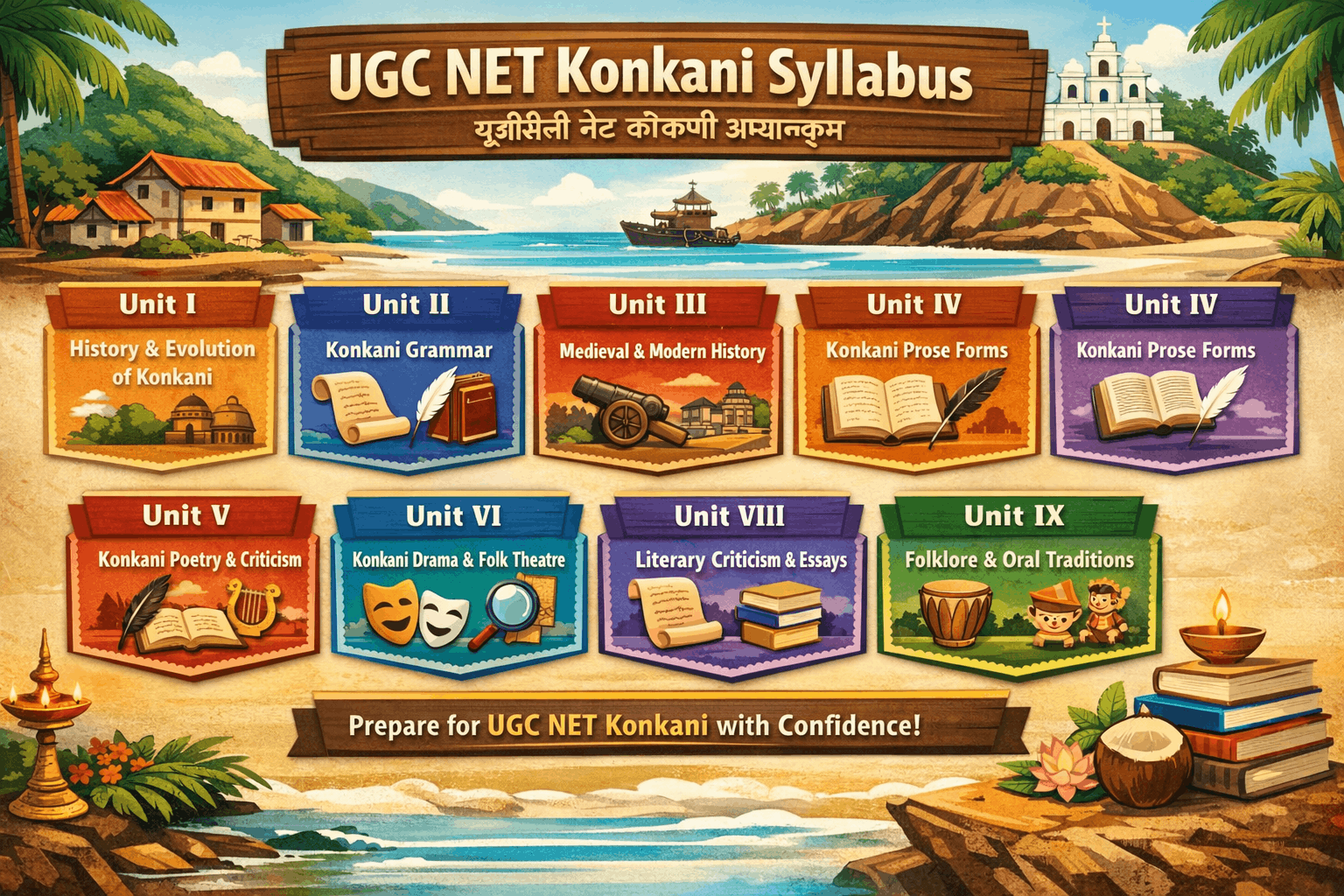
The UGC NET Konkani syllabus covers linguistic, literary, historical, and philosophical components. It is divided into two parts: General Aptitude (Paper I) and Konkani Subject-Specific (Paper II).
Paper I – General Aptitude
Assesses teaching, reasoning, comprehension, and research skills.
- Teaching Aptitude
- Research Aptitude
- Reading Comprehension
- Communication
- Mathematical Reasoning
- Logical Reasoning
- Data Interpretation
- Information & Communication Technology (ICT)
- People and Environment
- Higher Education System
Paper II – Konkani (Subject-Specific)
The Konkani syllabus for Paper II includes classical and modern literature, grammar, linguistic history, and cultural context. It may also cover translation theory, folk traditions, and Konkani’s sociolinguistic aspects.
UGC NET Konkani Syllabus PDF Download Here
UGC NET Konkani Previous Year Question Papers
Practicing previous year papers is crucial for understanding question patterns and exam trends.
| Year | Download Link |
| 2026 | Available Soon |
| 2025 (December) | Download PDF |
| 2025 | Download PDF |
| 2024 | Download PDF |
| 2023 | Download PDF |
| 2022 | Download PDF |
| 2021 | Download PDF |
| 2020 | Download PDF |
| 2019 | Download PDF |
These help in time management and identifying frequently covered topics.
Check UGC NET Previous Year Question Papers
UGC NET Konkani 2026 Career Opportunities
Clearing the UGC NET Konkani exam opens a variety of career avenues:
Academic Roles
- Assistant Professor in colleges/universities
- Junior and Senior Research Fellowships (JRF/SRF)
- Doctoral (Ph.D.) admissions in Konkani and allied subjects
Government & Cultural Organizations
- Research roles in state and central cultural ministries
- Positions in Sahitya Akademi, State Language Boards, and archives
- Work in museums, archaeological surveys, and educational councils
Private & International Roles
- Translation and content creation (literary and academic)
- Work with international linguistic and cultural research bodies
- Roles in publishing, documentation, and digital heritage projects
UGC NET Konkani 2026 Preparation Tips
The following are the UGC NET Konkani 2026 preparation tips for the upcoming UGC NET June 2026 session:
- Understand the Syllabus Thoroughly: Divide topics unit-wise and focus on both traditional and modern aspects of Konkani.
- Refer to Standard Texts: Use Konkani grammar books, anthologies, and works of eminent Konkani authors.
- Regular Practice: Solve MCQs, attempt mock tests, and revise previous year questions.
- Use Digital Resources: Join online discussion groups, follow Konkani study YouTube channels, and attend webinars.
- Revise Systematically: Create flashcards and summaries for key themes, authors, and language rules.
Conclusion
The UGC NET Konkani 2026 examination offers aspirants a pathway to academic excellence and professional engagement with the Konkani language and its cultural heritage. With structured preparation and focused study, candidates can contribute meaningfully to both academia and the broader preservation of Konkani literature and identity.