

The Transition from Tribal Polities to Territorial States occurred during the Later Vedic period when kin-based tribal units evolved into hereditary monarchies. This transformation reshaped political authority, territorial administration, and the economic foundation of emerging states in northern India.
Early Tribal Polities
Early tribal polities represent the initial forms of political organization based on kinship, clan ties, and collective decision-making, providing insights into the transition from simple tribal societies to more complex state systems.
- Political units were kin-based tribes (janas) like the Bharatas and Purus.
- Governance involved assemblies: sabha (advisory council) and samiti (general assembly).
- Leadership was elective, chosen from prominent warriors or elders.
- Decisions were collective, emphasizing community participation.
Comparison Tribal Polities vs Territorial States
This comparison helps us understand how early societies in India evolved from simple tribal systems to more organized and complex states.
Leadership
Tribal Polities:
- Leadership was usually elective
- The chief (rajan) was chosen based on ability, strength, or consensus
- Power was not absolute and depended on the support of the tribe
Territorial States:
- Leadership became hereditary
- Kingship passed from father to son
- The king held strong and centralized authority
This shows a shift from collective leadership to monarchy.
Best UGC NET Offline Coaching in Jaipur
Territory
Tribal Polities:
- People were often nomadic or semi-settled
- No fixed boundaries
- Movement depended on pasture and resources
Territorial States:
- Clear defined boundaries and regions
- Permanent settlements and cities developed
- Control over land became important
This marks the transition to settled life and political control over land.
Governance
Tribal Polities:
- Decisions taken through assemblies like sabha and samiti
- People had a role in decision-making
- Governance was more collective and participatory
Best UGC NET Offline Classes in Jaipur
Territorial States:
- Power concentrated in the hands of the king
- Administration became centralized and structured
- Officials were appointed for governance
This reflects a move from democratic elements to centralized rule.
Military
Tribal Polities:
- Military consisted of tribal warriors
- No permanent army
- Warriors fought when needed
Territorial States:
- Development of standing armies
- Soldiers were trained and maintained regularly
- Strong military used for expansion and defense
This shows increasing military organization and power.
Economy
Tribal Polities:
- Based on pastoralism and small-scale agriculture
- Limited production
- Economy mainly for subsistence
Territorial States:
- Based on surplus agriculture
- Collection of taxes and revenue
- Growth of trade and economic specialization
This indicates the rise of a more complex and organized economy.
Factors Leading to Territorial States
The emergence of territorial states was driven by factors such as agricultural expansion, population growth, surplus production, development of trade networks, and the need for organized administration and control over defined geographical regions.
Agricultural Surplus
- Iron tools enabled forest clearing and cultivation of fertile Ganga plains.
- Surplus supported population growth and urban settlements.
Social Stratification
- Emergence of varna system legitimised kshatriya supremacy.
- Brahmans reinforced kingship through religious sanction.
Economic Power
- Kings collected taxes (bali) and managed resources efficiently.
- Wealth enabled maintenance of armies for defence and expansion.
Military and External Threats
- Frequent tribal conflicts required centralised military leadership.
- Standing armies replaced temporary war parties.
Royal Rituals
- Ceremonies like rajasuya and ashvamedha reinforced kingly authority.
- Kings claimed divine sanction, diminishing assembly influence.
From Jana to Janapada
The transition from jana (tribal groups) to janapada (territorial states) marks one of the most important changes in early Indian history. It reflects how small, mobile communities gradually settled down and built organized political systems.
Transformation from Tribal Settlements to Territorial States
In the early Vedic period, society was organized into janas, which were basically tribal groups bound by kinship and common ancestry.
- These groups were often semi-nomadic, moving from place to place in search of pasture and resources.
- Over time, with the discovery of fertile lands especially along river valleys these tribes began to settle permanently.
- Agriculture became more stable, food production increased, and populations grew.
As a result, these settled communities developed into janapadas, which literally means “the land where a jana sets its foot.” These were fixed territories with defined boundaries, marking the beginning of organized political geography in India.
Growth of Janapadas in Fertile Regions
The rise of janapadas was closely linked to geographical advantages, particularly fertile plains and river systems.
- Rivers like the Ganga and Yamuna provided water for irrigation, transportation, and trade.
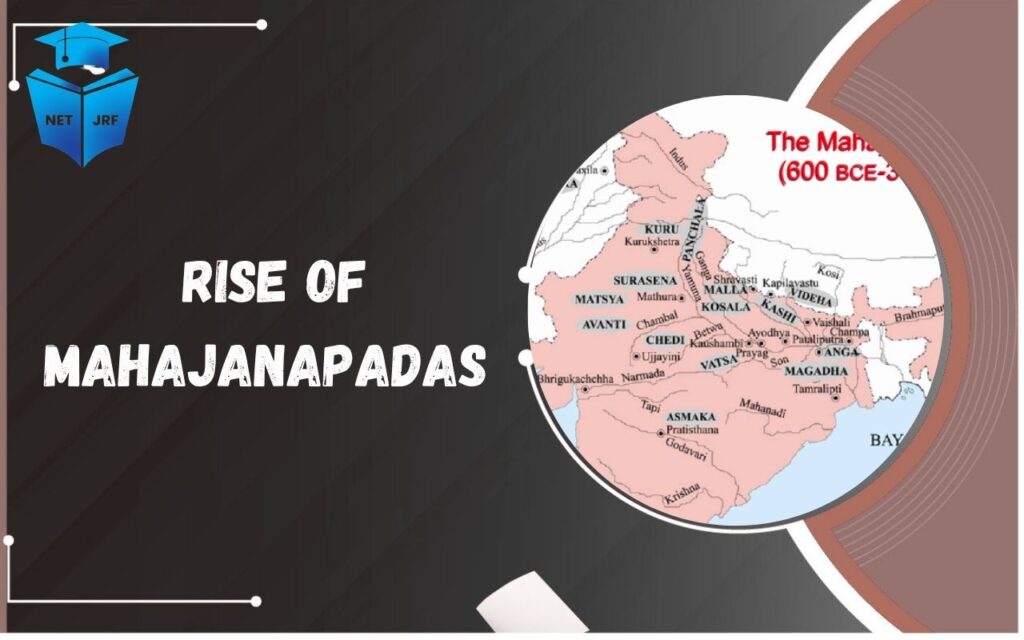
- Regions such as those ruled by the Kuru, Panchala, and Kosala became powerful janapadas.
- These areas saw the development of agriculture-based economies, permanent villages, and early urban centers.
- This shift also encouraged trade, craft production, and social differentiation, making these states more complex than earlier tribal societies.
Shift from Elective Leadership to Dynastic Rule
In the earlier tribal system, leadership was often elective or based on merit, and chiefs ruled with the support of assemblies like sabha and samiti. However, as societies became more settled and complex, this system started changing.
In janapadas, leadership gradually became hereditary, meaning power passed from father to son.
- Kings began to claim authority based on lineage and divine legitimacy, rather than just ability or consensus.
- This led to the rise of dynastic rule, where ruling families maintained power over generations.
- The king’s authority also became stronger and more centralized, reducing the role of popular assemblies.
Governance in Early Territorial States
In the early territorial states, governance became much more organized and structured compared to earlier tribal systems.
- The king emerged as the central figure, exercising control over important functions like taxation, maintaining law and order, and organizing the military.
- Unlike earlier times when decisions were taken collectively in assemblies, now authority was concentrated in the hands of the ruler. However, the king could not manage everything alone. To run the state efficiently, he appointed local officials who looked after villages, towns, and growing urban centres.
- These officials ensured that taxes were collected properly, disputes were resolved, and royal orders were followed. Alongside this administrative system, Brahmans played a key role in strengthening the king’s authority.
- Through rituals and religious practices, they projected the king as divinely supported, which made people more willing to accept his rule. In this way, governance was not just political but also deeply connected with religious belief.
Cultural and Religious Impacts
The rise of territorial states also brought significant cultural and religious changes. As agriculture improved and surplus production increased, cities began to grow, leading to urbanisation. With more resources available, people could focus on activities beyond survival, such as art, literature, and learning.
- This period saw the growth of cultural traditions and intellectual life. At the same time, religion became closely linked with political power. Kings provided patronage to priests and religious institutions by giving them land, wealth, and protection.
- In return, priests performed rituals and supported the king’s authority by presenting him as a sacred figure. Texts like the Shatapatha Brahmana even described the king as a representative of divine power on earth.
- This idea made the ruler’s position stronger and more stable, as opposing the king could also be seen as going against divine will.
Legacy and Significance
The developments in early territorial states had a lasting impact on Indian history. These states laid the foundation for larger and more powerful political units like the Mahajanapadas.
- One of the biggest changes was the shift from kinship-based decision-making to centralized authority, where power rested mainly with the king rather than the community.
- Systems of administration, taxation, and military organization that developed during this time became models for future states and empires. Society also became more structured and hierarchical, with clear divisions and roles, often supported by religious ideas.
- This combination of political authority, economic strength, and religious legitimacy helped rulers maintain control over large territories. Overall, these early states played a crucial role in shaping the political and social framework of ancient India.
Join UGC NET Online Test Series
Transition from Tribal Polities to Territorial States FAQs

What were tribal assemblies?
Tribal councils like sabha and samiti participated in decision-making during the early Vedic period.
How did agriculture influence political change?
Surplus farming supported urban settlements and allowed kings to maintain armies and resources.
What role did the varna system play?
It legitimised kshatriya kingship and reinforced social hierarchy supporting centralised rule.
Who were some early kings?
Parikshit of Kuru is an example, legitimising hereditary monarchy in later Vedic texts.
How did military needs affect governance?
Frequent conflicts required standing armies and centralised authority replacing elective leadership.
What were rajasuya and ashvamedha rituals?
Royal ceremonies asserting supremacy, claiming divine sanction for kings.
What is the significance of the Janapada system?
It marked the formation of territorial units with defined boundaries replacing mobile tribal groups.
How did Brahmans support kings?
Priests received patronage and legitimised political power through rituals and texts.
What was the outcome of this transition?
It laid the foundation for Mahajanapadas, centralised states, and structured governance in ancient India.