



Dating ancient literary sources is a crucial part of historical research because historians depend on written texts to understand how people lived in the past. Works like religious scriptures, epics, chronicles, poems, and biographies offer rich insights into political events, social structures, cultural practices, and philosophical ideas. However, figuring out exactly when these texts were written is not always easy. Many ancient works were passed down orally for generations before being written down. Over time, manuscripts were copied again and again, and these copies sometimes introduced changes, whether intentional or accidental. This makes it challenging for historians to determine the original form and precise date of these sources.
Literary Sources in History
Literary sources refer to written works that describe events, traditions, beliefs, or knowledge of a particular time period. These texts may include religious writings, historical narratives, philosophical works, poetry, biographies.
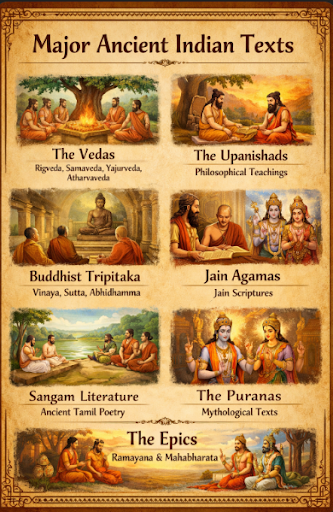
Examples include:
- Vedas
- Upanishads
- Buddhist Tripitaka
- Jain Agamas
- Puranas
- Sangam literature
- epics like Ramayana and Mahabharata
Enroll UGC NET Online Coaching
- Such works help historians understand society, religion, politics, economy of ancient civilizations.
- However historians must carefully analyze these texts before using them as historical evidence.
Dating Ancient Literary Sources in Historical Research
Dating Ancient Literary Sources means determining the approximate period when a particular text was composed, compiled, or written down.
- Historians use several clues to estimate dates such as language style, historical references, mention of rulers, and cultural practices described in the text.
- However this process is complex because many literary works evolved over long periods through additions or modifications.
Techniques for Dating Ancient Literary Texts
Dating ancient literary sources through historical clues involves analyzing internal references such as events, rulers, social practices, language, and material culture within texts to establish their approximate time period and historical context.
| Dating Ancient Literary Sources | Method Used | Example |
| Linguistic analysis | Study of language style | Sanskrit evolution in Vedic texts |
| Historical references | Mention of kings or events | Puranic genealogies |
| Archaeological correlation | Comparison with excavated evidence | Buddhist texts with Mauryan period |
| Manuscript tradition | Study of copies preserved | Medieval manuscript collections |
| Cultural description | Social practices mentioned | Sangam literature describing Tamil society |
Check Out UGC NET Online Course
Dating Ancient Literary Sources Major Problems
The Dating Ancient Literary Sources presents several difficulties for historians. These problems arise due to the nature of ancient texts and transmission methods.
-
Oral Tradition
-
-
- Many ancient texts existed in oral form for a long time before being written.
- For example Vedic literature was transmitted orally by priests for generations. Because of this historians cannot easily determine the exact date of composition.
-
-
Multiple Authors
-
-
- Some texts were created by many authors over a long period.
- For example epics like Mahabharata were expanded gradually through additions.
- This makes dating difficult because different parts belong to different periods.
-
-
Later Interpolations
-
-
- Many manuscripts contain interpolations which means later additions inserted into original text.
- These additions change content and make the original date uncertain.
- Historians must identify which parts belong to early composition.
-
-
Lack of Original Manuscripts
-
- Most ancient literary works survive only in later copies.
- Original manuscripts rarely survive due to decay of materials such as palm leaves or birch bark.
- Therefore historians study later versions which may contain modifications.
Enroll UGC NET Coaching in Jaipur
Linguistic Challenges in Dating Texts
Language evolves over time. Studying language style helps historians estimate the approximate date of a text.
However Dating Ancient Literary Sources using linguistic evidence also creates challenges.
-
Language Evolution
-
-
- Languages change gradually. Words, grammar, pronunciation evolve over centuries.
- Historians analyze linguistic features to determine the period.
-
-
Regional Variations
-
-
- Different regions may use different dialects or writing styles.
- This variation complicates linguistic dating.
-
-
Literary Style
-
- Authors sometimes intentionally use older style language for religious or classical works.
- This practice may mislead historians about the actual date.
Enroll UGC NET Coaching in Jaipur
Historical References in Literary Texts
Historians often rely on references within texts to determine their age.
These references include:
- names of kings
- wars or political events
- cities or regions
- religious movements
However this method also faces difficulties.
-
Mythological Elements
-
-
- Many texts mix historical facts with mythology.
- For example Puranas include stories about gods alongside genealogies of kings.
-
-
Exaggeration
-
-
- Authors sometimes exaggerate the achievements of rulers.
- This may distort historical accuracy.
-
-
Lack of Clear Dates
-
- Ancient authors rarely mentioned exact calendar dates.
- Therefore historians must estimate chronology indirectly.
- These issues highlight difficulties in Dating Ancient Literary Sources through internal evidence.
Archaeological Evidence and Literary Dating
Archaeological discoveries sometimes help historians estimate the age of literary texts.
- For example if a text describes a particular city, artifact, or cultural practice discovered in excavation, historians compare evidence.
- However correlation between archaeology and literature is not always straightforward.
- Archaeological findings may confirm the existence of certain places or objects mentioned in texts.
- But they cannot always determine the exact date of composition.
- Thus archaeological evidence supports but cannot completely solve Dating Ancient Literary Sources problems.
Enroll UGC NET Offline Coaching in Jaipur
Role of Manuscript Tradition
Ancient texts survived through manuscript copying. Scribes copied manuscripts repeatedly over centuries.
Each copying process could introduce:
- spelling changes
- omissions
- additions
- interpretation by scribes
Historians examine manuscript traditions carefully to identify the earliest possible version. Comparing multiple manuscripts helps scholars reconstruct original text.However manuscript variation remains a major difficulty in literary dating.
Comparative Method in Historical Research
Historians use comparative analysis to estimate the age of texts.
They compare literary works with:
- inscriptions
- archaeological discoveries
- foreign travel accounts
- other contemporary texts
This method helps identify an approximate time period.For example Buddhist texts mentioning Mauryan rulers help historians place them within historical context. Through such comparison scholars improve accuracy of Dating Ancient Literary Sources.
Importance Dating Literary Sources
Dating of texts and sources is a core method in historical research. It helps historians not just know what happened, but also when and why it happened. Below is a deep explanation of each point
Understanding Historical Context
Dating helps historians place a text in its correct time and environment.
- Every text is influenced by the political, social, and economic conditions of its time
- Without proper dating, a text may be misinterpreted or wrongly linked to a different period
- It helps identify:
- The ruling powers
- Social structure
Contemporary events
For example, the Rigveda reflects an early Vedic society, while later texts show more complex social systems.
Thus, dating ensures that historians interpret texts in their true historical setting, not in isolation.
Studying Cultural Development
Chronology of texts helps track the evolution of ideas and traditions over time.
- Shows how philosophical thinking developed gradually
- Helps trace the growth of:
- Religion
- Literature
- Social values
For example:
- The Upanishads show deeper philosophical ideas compared to the ritual-focused Vedas
- Epics like the Mahabharata reflect more complex social and ethical debates
This allows historians to understand continuity and change in culture.
Verifying Historical Evidence
Dating plays a key role in cross-checking different sources of history.
- Helps compare literary texts with archaeological findings
- Confirms whether descriptions in texts are historically accurate
- Reduces chances of myths being mistaken as facts
For example:
- If a text describes a city or trade system, archaeologists can verify it through excavations
- Matching timelines increases the credibility of evidence
Thus, dating strengthens the scientific reliability of history.
Enroll UGC NET Offline Coaching in Jaipur
Supporting Academic Research
Dating is a fundamental part of modern historical methodology
Forms the basis of research, thesis writing, and analysis
- Helps scholars:
- Organize historical data
- Build logical arguments
- Compare different time periods
Without dating, research would become confused and unstructured.
It ensures that history is studied in a systematic and scientific manner.
Understanding Interpretation of Literary Evidence
Historians do not just read texts they interpret them carefully, and dating is essential in this process.
- Helps distinguish between:
- Original content and later additions
- Fact and symbolic or mythological elements
- Identifies the author’s perspective and purpose
For example:
- Epics like the Ramayana may contain layers added over time
- Dating helps separate historical core from later modifications
This leads to a more critical and analytical understanding of literature.
Methods Used to Estimate Dates of Literary Works
Historians apply several analytical methods to estimate the age of literary sources.
Linguistic Analysis
Scholars study grammar, vocabulary, language structure.
Changes in language provide clues about time periods.
Historical Cross Reference
References to rulers, political events help determine approximate chronology.
Archaeological Comparison
Material culture described in texts compared with excavated artifacts.
Manuscript Study
Examining earliest surviving manuscripts helps estimate minimum age.
These methods together support Dating Ancient Literary Sources within academic research.
Historical research depends on careful analysis of literary evidence. Dating Ancient Literary Sources remains a complex task because ancient texts evolved through oral tradition, multiple authors, manuscript copying, later additions. Historians therefore combine linguistic analysis, historical references, archaeological comparison, manuscript study to estimate chronology.
Dating Ancient Literary Sources FAQs

Why is dating literary sources difficult?
Dating becomes difficult because many texts existed in oral form, were modified by later writers, or survive only in later manuscripts.
How do historians estimate the age of literary texts?
Historians analyze language style, historical references, archaeological evidence, manuscript tradition.
What is interpolation in literary sources?
Interpolation means later addition inserted into original text by scribes or editors.
Why are manuscripts important in literary history?
Manuscripts preserve ancient texts. Comparing different copies helps scholars reconstruct original content.
What role does language play in literary dating?
Language changes over time. Studying vocabulary, grammar helps estimate period of composition.
What is Dating Ancient Literary Sources?
Dating Ancient Literary Sources refers to the process of determining approximate time when ancient texts were composed or written.
Why is literary dating important for historians?
Literary dating helps historians place texts in correct historical context and understand cultural development.