

Qualifying UGC NET is a significant achievement. But moving from NET to JRF after multiple close attempts requires something more—consistency, self-reflection, disciplined preparation, and the willingness to keep going when the result does not go your way.
Megha Gupta experienced that journey firsthand.
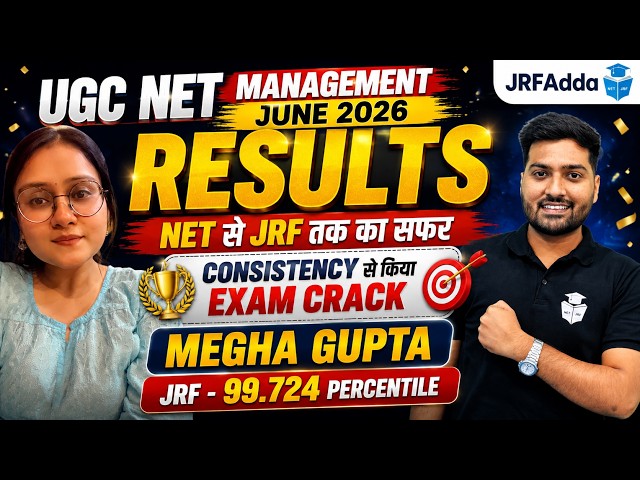
In the UGC NET June 2026 Result, Megha qualified for JRF in Management (Code 17) with an impressive 99.724 percentile. Her achievement came after multiple attempts where she had repeatedly come close to the JRF cutoff but missed it by just a few questions.
JRF Adda UGC NET Topper List 2026
Her story is not simply about qualifying JRF. It is about what happens when a candidate refuses to give up, identifies the gaps in preparation, and continues working on them.
In her conversation with JRF Adda, Megha shared her honest experience—from repeatedly qualifying NET but missing JRF, to managing preparation alongside work and family responsibilities, and finally achieving her JRF goal.
From NET to JRF: Megha’s Journey of Multiple Close Attempts
Megha had been connected with JRF Adda for a long time. While NET qualification was happening, JRF remained just out of reach.
JRF Adda June Result 2026 Topper Aditi Sharma Computer Science AIR 1 Testimonial
She recalls that in some attempts, she missed JRF by only a few questions.
“Bar-bar main usi loop mein phans rahi thi. Bas ek baar mera teen question se reh jaata tha, kai baar ek question se reh jaata tha.”
The repeated near-misses were frustrating. Even after putting in serious effort, the final JRF qualification was not happening.
For the June 2026 attempt, however, things changed.
This time, Megha not only qualified JRF but also achieved a 99.724 percentile, with a significant improvement in Paper 1.

Her Biggest Lesson: Consistency Is the Main Factor
When asked what helped her finally move from NET to JRF, Megha’s answer was direct:
“Consistency is the main factor.”
For Megha, consistency became even more important because she had very limited time.
She was working as an Assistant Professor, handling responsibilities related to her father’s business, and managing other personal responsibilities as well.
Because of this, she could not afford to waste the limited preparation time available to her.
“Mere paas to time bhi bahut limited tha, to time waste karne ka option hi nahi tha.”
Her preparation was therefore not about studying whenever she felt motivated. It was about making the most of the time she actually had.
Most Successful UGC NET June Result 2026 of JRF Adda
Avoiding Distractions During Preparation
Megha also spoke honestly about distractions.
Whether it was spending time in the canteen, getting involved in gossip, using social media, or watching web series, she believed that aspirants need to consciously distance themselves from entertainment during their preparation zone.
“Un saari cheezon se apne aap ko thoda sa bachakar rakhein. Thoda sa door rakhein.”
Her reasoning was simple: once you enter an entertainment mindset, it can become difficult to return to the same repetitive study routine.
Competitive-exam preparation can already create mental fatigue. Adding unnecessary distractions can make consistency even harder.
For Megha, controlling distractions was therefore a crucial part of staying consistent.

Paper 1 Became the Game Changer
One of the biggest changes in Megha’s preparation was her approach to Paper 1.
In her previous attempts, Paper 1 had been one of the areas where her score was holding her back.
She explains:
“Har baar mera Paper 1 mein hi score thoda sa atak raha tha.”
In June 2026, she improved her Paper 1 score to 72 marks, which significantly increased her margin over the JRF cutoff.
“Is baar mera Paper 1 mein 72 marks aa gaya. To haan, uski wajah se wo mera poora JRF ka jo margin tha cut-off se wo bhi kaafi badh gaya.”
This became one of the most important lessons from her journey:
“Paper 1 ko bilkul bhi ignore nahi karna hai. Paper 1 par sabse zyada focus karna hai.”
For aspirants who focus almost entirely on Paper 2, Megha’s experience shows why Paper 1 can become the difference between NET and JRF.
JRF Adda Most Successful Batch in UGC NET June Result 2026
Learning From Her June 2025 Attempt
Megha’s June 2025 attempt was particularly difficult for her.
She had worked extremely hard and focused heavily on Paper 2. Her Paper 2 performance was strong, but Paper 1 did not contribute enough to push her into JRF.
She missed JRF by just three questions.
“Usmein mera bahut achha score gaya tha. But Paper 1 ka kahin na kahin wo score kam reh gaya, jiski wajah se teen questions se mera JRF reh gaya tha.”
The disappointment was significant because she felt that she had worked harder for that attempt than before.
But the experience also showed her exactly where she needed to improve.

December 2025: JRF Missed by Just One Question
Her December 2025 attempt brought her even closer.
This time, she missed JRF by just one question.
“December wale attempt mein… ek marks se mera JRF, ek question se mera JRF reh gaya.”
She was at college when she saw the result. Because she had a lecture shortly afterwards, she did not initially have time to process the disappointment.
Later, when she had time to think about it, the reality hit her.
The result was deeply demotivating. Her research proposal had even been selected at FMS, but she did not attend the interview because she was so disappointed at that point.
Yet she eventually realized something important: giving up would not solve the problem.
The Turning Point: Self-Reflection Instead of Giving Up
Even after multiple close attempts, Megha noticed that her performance in the actual questions was consistently strong when she attempted them again later.
She realized that her preparation was not fundamentally weak. Something in the way she was approaching the examination was preventing her from converting that preparation into a JRF result.
That realization led her to attempt the examination again.
This time, she decided to improve both papers rather than over-prioritizing Paper 2.
Her DI Strategy: Stop Chasing Easy Questions
One of Megha’s strongest pieces of advice is about Data Interpretation (DI).
She explained that many students solve one easy DI set and feel satisfied that they have completed their practice for the day.
She calls this:
“Fake satisfaction.”
Instead, she recommends solving different types of DI sets, including difficult ones.
“Aasan DI ki taraf mat bhaagiye. Jitni mushkil DI ho sake, utni mushkil DI kariye.”
She also recommends solving multiple DI sets rather than stopping after one.
“Paanch-chhah DI lagaiye. Ek baar mein baithkar aaram se, tasalli se jo bhi galat gaya hai usko seekhiye.”
The objective is not simply to tick off a practice session. It is to identify mistakes and actually learn from them.

Don’t Leave Mistakes for Later
This became one of the strongest lessons from Megha’s preparation.
In previous attempts, if she made several mistakes in a particular type of DI, she would sometimes postpone working on them.
“Main usko skip kar deti thi aur kehti thi isko main baad mein kar loongi.”
But, as she realized, the problem with “later” is that it often never comes.
“Wo kabhi ho nahi paata tha.”
Her advice is to address the mistake immediately.
“Aapka jo question jis waqt galat gaya hai, usko wahin baithkar bilkul proper aap seekhiye aur wahin ke wahin khatam kar dijiye.”
For a large syllabus, postponing one weakness can eventually create a much bigger backlog.
JRF Adda’s Role in Megha’s Success
JRF Adda had been part of Megha’s preparation journey for a considerable period, and she specifically highlighted the quality of its content and mock tests.
According to Megha, the JRF Adda Management mock tests were particularly useful.
“Management ke mock test best mock tests hain.”
She appreciated the difficulty level of the questions because they did not create a false sense of confidence.
“Questions ka jo level hai wo bilkul examination ke level se bhi ek level upar hai.”
For her, this had an important benefit: the mocks showed her the reality of her preparation.
“Aap kisi fake delusion mein na rahein ki hamari preparation bahut achhi ja rahi hai.”
The mock tests therefore became a tool for self-assessment and improvement, rather than simply a way of measuring marks.
JRF Adda’s Paper 1 Content Helped Her
Megha also highlighted JRF Adda’s Paper 1 resources.
She specifically mentioned the content taught by Aditi Ma’am, along with Logical Reasoning and Mathematics classes.
“Paper 1 ka jo content hai, wo bhi Aditi Ma’am ho ya aap jo Logical Reasoning padha rahe hain ya phir Mathematics padha rahe hain, to usse kaafi help hui hai.”
This was particularly relevant because Paper 1 had been one of the factors holding her JRF score back in previous attempts.
The improvement in Paper 1 ultimately became an important part of her June 2026 success.
JRF Adda Was Part of Her NET Journey From the Beginning
Megha’s connection with JRF Adda goes back to her early preparation.
She explained that when she prepared for her first NET attempt as a beginner, she took JRF Adda’s Paper 1 paid batch.
“Maine jab apna pehla attempt nikala tha NET ka, bilkul as a beginner, to maine JRF Adda ka hi Paper 1 ka paid batch liya tha.”
She also said that her Paper 1 score in that attempt was higher than Paper 2 and that she qualified NET in her first serious preparation.
“Maine poori ki poori apni preparation jo hai wo JRF Adda se hi kari thi Paper 1 ki.”
This makes JRF Adda a recurring part of her preparation journey—from her initial NET qualification to her eventual JRF success.
JRF Adda’s Content Helped Her Stay Close to Exam-Level Preparation
For Megha, one of the differentiating factors was the level of practice.
The mocks were designed to challenge students rather than simply make them feel comfortable.
This helped her identify the areas where her preparation still needed work.
The role of JRF Adda in her journey can therefore be understood through three key areas:
Exam-level practice:
Management mock tests helped her experience questions that were at, and sometimes above, the examination level.
Paper 1 support:
Classes covering areas such as Logical Reasoning and Mathematics helped her strengthen a paper that had previously limited her JRF score.
Self-assessment:
Mock performance helped her identify gaps instead of assuming that preparation was already sufficient.
Managing Preparation Alongside Work and Responsibilities
Megha’s schedule was demanding.
She would leave home around 7 AM for college, with a commute of approximately one to one-and-a-half hours.
She tried studying during the bus journey, but admitted that she would often fall asleep instead.
“Jaise hi main bus mein baithti thi main so jaati thi.”
Instead, she used the available gaps at college.
If she had one, two, or even three hours free between responsibilities, she tried to use that time productively instead of getting distracted.
“Us poore time ko maine proper utilize kara.”
On returning home around 6:30 PM, she would try to sit at her study table by 6:30 and continue preparation until around 1 or 1:30 AM.
This routine continued throughout her preparation.
Her Most Important Advice: Never Stop Consistency
For Megha, consistency was not limited to weekdays.
She believes that preparation needs to continue every day.
“Ek bhi din ka gap nahi hona chahiye.”
Even weekends were treated as preparation days.
Instead of thinking of Sunday as a break, she used it to complete mocks and other preparation tasks.
This daily consistency became especially important because she was balancing preparation with professional and personal responsibilities.
Plan Your Week Before It Begins
Megha also recommends planning preparation in advance.
She suggests maintaining a separate diary and writing down daily and weekly goals.
“Apni proper diary bana lijiye. Ek aur usmein day-wise se aapke goals likhiye aur unko achieve kariye.”
Her approach was to plan the entire week and clearly define what needed to be completed.
She also emphasizes giving equal importance to Paper 1 and Paper 2.
“Paper 1 and Paper 2 dono ko barabar samay dijiye. Dono equally important hain.”
Track Your Mock Test Performance
Another practical strategy Megha followed was maintaining a separate diary for mock tests.
She recorded her marks and tracked how many questions she got right in Paper 1 and Paper 2.
This allowed her to see whether she was actually improving over time.
“Mere paas meri poori mock test ki ek detail hoti thi ki mera kitna improvement ho raha hai.”
Instead of looking at one mock score in isolation, she looked at the trend.
Her message is encouraging:
“Yakeen maaniye aapke marks zaroor badhenge, agar theek tareeke se aap preparation karoge.”
Don’t Switch Sources Too Quickly
Megha also addressed a common problem among aspirants: changing teachers or study sources after an unsuccessful attempt.
Her advice is to first evaluate your own preparation.
“Agar aapka ek foundation ban gaya hai kisi particular source ke saath ya kisi particular teacher ke saath, to mere khayal se theek nahi hota hai isko switch karna.”
According to her, students today already have access to an abundance of videos, PDFs, and resources.
The real challenge is using them systematically.
“Sources hamare paas hain, sab hamare paas abundance mein sources hain… but aap unko kitna padh pa rahe ho, kitna systematically aap saari cheezon ko arrange kar pa rahe ho, ultimately karte aap hi ho.”
Her message is clear: before blaming a teacher or switching resources, look honestly at your own preparation.
Self-Reflection Is More Important Than Blame
One of the most powerful themes in Megha’s testimonial is self-reflection.
When an attempt does not go as planned, it can be tempting to blame the examination, the teacher, the paper, or the difficulty level.
Megha believes students should instead ask:
Where did I make a mistake?
“Humein zyada self-reflection karna chahiye rather than ki hum kisi par blame daalein.”
This mindset helped her convert repeated disappointment into actionable improvements.
Instead of simply trying harder, she identified specific weaknesses—especially Paper 1, DI practice, revision, and exam strategy—and worked on them.
Preparation Does More Than Prepare You for an Exam
Megha also shared a deeper reflection about what competitive-exam preparation does to a person.
According to her, preparation makes students humble because they repeatedly confront their own mistakes.
“Jitni bhi preparations ki journey hoti hai, ye aapko bahut humble bana deti hai.”
Every mock test can expose weaknesses. Every wrong answer can challenge confidence.
But that process can also develop character.
“Exam ki jo preparation hai wo aapke character ko to develop karti hi karti hai, but aapko bahut zyada humble bana deti hai.”
For Megha, the journey was therefore not just about obtaining the JRF title. It was also about learning discipline, accepting mistakes, and improving continuously.
Megha’s Final Message to JRF Aspirants
Megha’s final advice to aspirants who did not qualify is simple but powerful.
“Consistency, hard work ka koi substitute nahi hai.”
She also emphasizes that JRF is not an easy examination.
“Ye exam easy nahi hai. JRF bilkul bhi easy nahi hai.”
If one attempt does not work, she encourages aspirants to try again.
“Agar kisi wajah se aapka attempt reh raha hai to aap agli baar zaroor koshish kariye.”
And she summarizes her approach through four essential factors:
Hard Work + Consistency + Revision + Practice
From NET Loop to JRF Success
Megha Gupta’s journey from repeatedly qualifying NET but missing JRF by a few questions to achieving JRF with a 99.724 percentile in the UGC NET June 2026 Result is a powerful example of persistence.
Her breakthrough did not come from simply studying more hours.
It came from understanding her mistakes.
She strengthened Paper 1, increased her DI practice, worked on difficult questions instead of chasing easy ones, tracked mock performance, planned her days, minimized distractions, and continued despite repeated disappointments.
JRF Adda played an important supporting role through its Paper 1 classes, Management mock tests, exam-level practice, Logical Reasoning and Mathematics content, while Megha’s own consistency and self-reflection drove her preparation forward.
Her story leaves aspirants with one clear message:
“Revision and practice.”
And perhaps the most important one of all:
“Mera ho gaya hai to sabka bhi ho sakta hai.”

JRF Adda Topper Megha Gupta JRF 99.724 Percentile in June Result 2026 FAQs
Megha Gupta is a UGC NET Management aspirant who qualified for JRF in the June 2026 Result with a 99.724 percentile after multiple close NET-to-JRF attempts.
Megha considers consistency the most important factor. She also focused on revision, PYQs, mock tests, Paper 1, DI practice, and learning from her mistakes.
JRF Adda supported Megha through Paper 1 classes, Management mock tests, Logical Reasoning and Mathematics content, and exam-level practice. She particularly praised the Management mock tests for being challenging and helping her identify gaps in her preparation.
Paper 1 had been one of the areas where Megha's score previously held her back from JRF. In June 2026, she scored 72 marks in Paper 1, which helped increase her margin over the JRF cutoff.
Megha advises aspirants to stay consistent, work hard, revise regularly, practice extensively, accept their mistakes, and focus on self-reflection rather than blaming others. She also recommends giving equal importance to Paper 1 and Paper 2.