

UGC NET Archaeology 2026 examination is a significant national-level eligibility test conducted by the National Testing Agency (NTA) for candidates aspiring to secure Assistant Professor and Junior Research Fellowship (JRF) positions in the field of Archaeology. The UGC NET Archaeology June 2026 examination was successfully conducted on 30 June 2026 (Shift 2) across various examination centres in the country.
Following the conclusion of the exam, candidates can now review the detailed UGC NET Archaeology Exam Analysis 2026 to assess the difficulty level, important topics, and overall performance trends.
Enroll UGC NET Foundation Batch Online
UGC NET Archaeology 2026 Key Highlights
The UGC NET Archaeology 2026 outline for the coming June cycle is mentioned in the table below:
| Feature | Details |
| Exam Name | UGC NET Archaeology 2026 |
| Conducting Body | National Testing Agency (NTA) |
| Mode of Exam | Computer-Based Test (CBT) |
| Exam Date | 30 June 2026 in shift 2 (3:00 PM to 6:00 PM) |
| Duration | 3 hours |
| Papers | Paper I (General) and Paper II (Archaeology) |
| Total Questions | 150 (50 in Paper I, 100 in Paper II) |
| Total Marks | 300 |
| Medium of Exam | English and Hindi |
| Negative Marking | No |
| Official Website | ugcnet.nta.nic.in |
Get Your UGC NET Result 2026 Here
What is UGC NET Archaeology 2026?
UGC NET Archaeology is a subject-specific examination under the UGC NET framework, evaluating candidates on their knowledge of ancient Indian history, archaeological methods, excavation practices, cultural heritage, and scientific techniques used in archaeological research. It tests both theoretical understanding and applied methodologies critical to the field.

This examination opens doors for candidates to work in academic, research, museum, conservation, and heritage sectors in India and abroad.
Understand All About UGC NET Exam 2026
UGC NET Archaeology Exam Analysis 2026 (30 June, Shift 2)
JRFAdda’s expert mentors have prepared the detailed UGC NET Archaeology Exam Analysis 2026 after the conclusion of the examination held on 30 June 2026 (Shift 2). Candidates can now check the overall difficulty level of the paper along with the unit-wise question distribution and important topics covered in the UGC NET Archaeology June 2026 session. The analysis will help aspirants evaluate their performance, estimate their qualifying chances, and understand the latest examination trends for future preparation.
View UGC NET Paper 1 Exam Analysis 2026 for June
- Most Weightage: Questions were predominantly asked from Prehistoric Archaeology, Protohistoric Cultures, Ancient Indian History and Culture, Archaeological Theory and Methods, and Heritage Management, which carried the highest weightage in the paper.
- Conceptual Questions: Greater emphasis was placed on archaeological concepts, excavation methods, dating techniques, cultural sequences, heritage conservation, and application-based questions related to archaeological discoveries and sites.
- Repeated Themes: Questions on the Indus Valley Civilization, Chalcolithic cultures, megalithic traditions, archaeological dating methods, important excavations, ancient inscriptions, conservation practices, and UNESCO World Heritage Sites were frequently asked.
- Difficulty Level: The overall paper was Moderate, with questions from Archaeological Theory and Methods and Prehistoric Archaeology being relatively more challenging.
- Paper 2 Good Attempts: 68-74 questions.
- Overall Good Attempts (Paper 1 + Paper 2): 108-114 questions out of 150.
Get Complete Details on UGC Exam Analysis 2026 Here
UGC NET Archaeology Question Paper 2026
The official UGC NET Archaeology Question Paper 2026 is expected to be released by the National Testing Agency (NTA) after the completion of the examination process. Once available, the question paper will help candidates analyse the latest exam trends, understand unit-wise weightage, and improve their preparation strategy for future attempts.
| Particulars | Status |
| Memory-Based Questions | Available Soon |
| Archaeology Question Paper PDF | To Be Released |
| Candidate Response Sheet | To Be Released |
All India Free UGC NET Live Test – Click Here
UGC NET Archaeology 2026 Answer Key
Following the completion of the examination, NTA is expected to publish the UGC NET Archaeology 2026 Answer Key on its official portal. The provisional answer key will enable candidates to cross-check their responses, calculate their tentative scores, and submit objections, if any. After reviewing all challenges, NTA will release the final answer key, which will form the basis for the declaration of results.
Get UGC NET Archaeology Final Answer Key 2026 PDF Here
| Event | Expected Date |
| Provisional Answer Key | July 2026 |
| Objection Window | July 2026 |
| Final Answer Key | August 2026 |
| Result Declaration | August 2026 |
UGC NET Archaeology Eligibility Criteria 2026
The UGC NET Archaeology Eligibility Criteria 2026 for the examination include the following:
UGC NET Educational Qualification
Candidates must hold a Master’s degree in Archaeology, Ancient Indian History, History, Culture, or a related discipline from a recognized university or institution. Final-year postgraduate students are eligible to apply provisionally.
UGC NET Minimum Marks Required
- General / EWS / OBC-NCL / Third Gender: 55%
- SC / ST / PwD: 50%
UGC NET Age Limit
- Junior Research Fellowship (JRF): Maximum 30 years (with age relaxations: OBC – 3 years; SC/ST/PwD/Women – 5 years)
- Assistant Professor: No upper age limit
Know Your UGC NET Eligibility 2026
UGC NET Archaeology 2026 Exam Pattern
| Paper | Subject | No. of Questions | Total Marks | Duration |
| Paper I | General Paper on Teaching & Research Aptitude | 50 | 100 | 3 hours combined |
| Paper II | Archaeology (Subject-Specific) | 100 | 200 |
Marking Scheme: Each correct answer carries +2 marks. There is no negative marking.
Understand Complete UGC NET Exam Pattern 2026

UGC NET Archaeology Syllabus 2026
Paper I (General Paper)
This paper is designed to assess teaching and research aptitude, comprehension, logical reasoning, communication, ICT, and higher education awareness.
Know About UGC NET Paper 1 in Detail
Paper II (Subject: Archaeology)
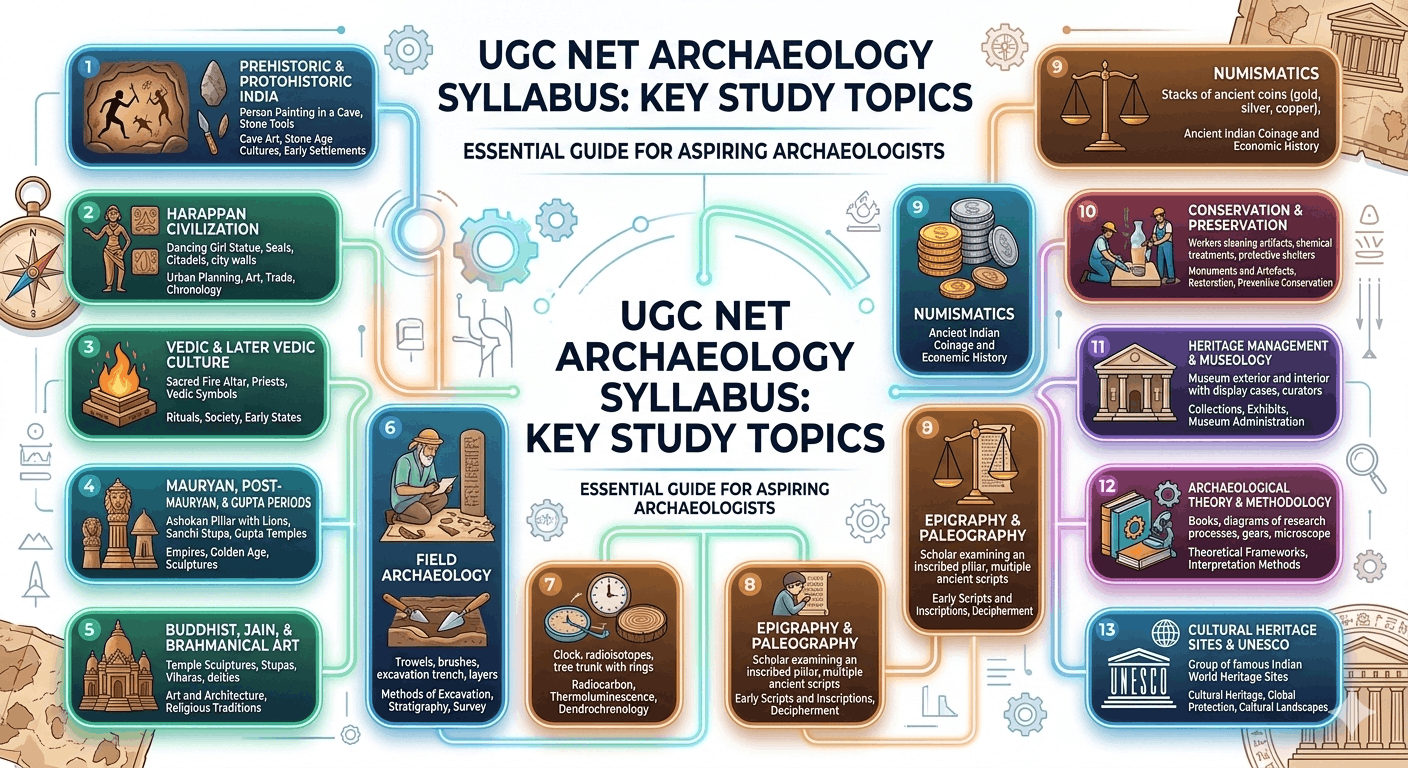
Topics include:
- Prehistoric and Protohistoric Cultures of India
- Harappan Civilization: Urban planning, Art, Trade, and Chronology
- Vedic and Later Vedic Culture
- Mauryan, Post-Mauryan, and Gupta Periods
- Buddhist, Jain, and Brahmanical Art and Architecture
- Field Archaeology: Methods of Excavation, Stratigraphy, Survey
- Scientific Dating Techniques: Radiocarbon, Thermoluminescence, Dendrochronology
- Epigraphy and Paleography: Early Scripts and Inscriptions
- Numismatics: Ancient Indian Coinage and Economic History
- Conservation and Preservation of Monuments and Artefacts
- Heritage Management and Museology
- Archaeological Theory and Methodology
- Cultural Heritage Sites and UNESCO World Heritage Sites
UGC NET Archaeology Syllabus PDF Download
The detailed Archaeology UGC NET syllabus has been released officially and can be downloaded in both Hindi and English below. Below we have provided the UGC NET Archaeology Syllabus PDF download links for both English and Hindi:
|
UGC NET Archaeology Syllabus 2026 PDF |
|
| UGC NET Archaeology Syllabus 2026 PDF in English | Download PDF |
| UGC NET Archaeology Syllabus 2026 PDF in Hindi | Download PDF |
Best UGC NET Offline Classes in Jaipur
UGC NET Archaeology Previous Year Question Papers (2019–2026)
Practicing previous year question papers helps candidates understand the exam pattern and frequently asked topics and improve time management.
| Year | Download Link |
| UGC NET Archaeology 2026 (June session) | Available Soon |
| UGC NET Archaeology 2025 (December session) | Download PDF |
| UGC NET Archaeology 2025 (June session) | Download PDF |
| UGC NET Archaeology 2024 | Download PDF |
| UGC NET Archaeology 2023 | Download PDF |
| UGC NET Archaeology 2022 | Download PDF |
| UGC NET Archaeology 2021 | Download PDF |
| UGC NET Archaeology 2020 | Download PDF |
| UGC NET Archaeology 2019 | Download PDF |
Download PDFs of UGC NET Previous Year Question Papers for Paper 1 & 2
Career Scope After UGC NET Archaeology 2026
After qualifying the UGC NET examination in Archaeology, the following are the career prospects:
Enroll UGC NET Offline Coaching in Jaipur
Academic Roles
- Assistant Professor at colleges and universities
- Eligibility for PhD admission with JRF funding
- Supervisors or mentors in academic institutions
Research and Field Roles
- Research Fellow or Assistant in excavation projects
- Documentation expert in historical archives or archaeological sites
- Archaeological analyst in heritage and research institutes
Government Sector
- Officer roles in the Archaeological Survey of India (ASI)
- Cultural or Heritage Officer in state archaeological departments
- Translator or Epigraphist for government documentation projects
Museums and Cultural Institutions
- Museum Curator, Archivist, and Conservator roles
- Specialists in Museology and Conservation Science
- Positions in INTACH, ICCROM, ICHR, UNESCO projects
Find Out Job Opportunities After Qualifying UGC NET

Preparation Tips for UGC NET Archaeology 2026
Here are some of the key preparation tips for the UGC NET Archaeology 2026 in the coming sessions:
- Understand the syllabus thoroughly and categorize topics by weightage.
- Read standard textbooks by authors like D.K. Chakrabarti, Allchin & Allchin, and Romila Thapar.
- Practice regularly using previous year papers and online mock tests.
- Use visual materials such as excavation videos, site maps, and artifact images.
- Stay updated on recent archaeological discoveries and conservation news.
- Join discussion groups or online forums to exchange study resources.
View UGC NET Paper 1 Preparation Tips 2026
Conclusion
The UGC NET Archaeology 2026 exam provides an excellent opportunity for candidates aspiring to build careers in academics, research, museums, and heritage management. By qualifying for Assistant Professor and JRF positions, candidates can contribute to archaeological research and the preservation of cultural heritage. Success in the examination requires a strong understanding of the syllabus, strategic preparation, and regular practice with previous-year papers.