



UGC NET Geography Important Topic 2026 refers to those high-weightage and repeated topics from which a considerable number of questions appear every year in the UGC NET Geography Paper 2 examination. UGC NET June 2026 session, the candidates need the geography NET must-read topics so that focus can be made to smartly prepare to score the most.
Also Read: UGC NET December 2025
JRFAdda Geography (Paper 2) Test Series for Dec 2025- Enroll Today!
UGC NET Geography 2026 Overview
The UGC NET Geography 2026 Exam is an eligibility test that is conducted by the National Testing Agency on behalf of the University Grants Commission. The outcome of the UGC NET Exam will reveal the eligibility of the candidate for the role of an Assistant Professor as well as the award of Junior Research Fellowship in Geography in the Indian universities.

The UGC NET Geography is thought to be a very conceptual as well as analytical subject, which is extensively dealing with the concept of Physical Geography, Human Geography, Regional Geography, as well as this also demands Previous Year Questions practice on a regular basis.
| Feature | Details |
| Exam Name | UGC NET Geography 2026 June |
| Conducting Authority | National Testing Agency (NTA) |
| Exam Level | National |
| Subject | Geography |
| Subject Code | 80 |
| Exam Mode | Computer-Based Test (CBT) |
| Medium of Exam | English & Hindi |
| Total Papers | Paper 1 & Paper 2 |
| Total Questions | 150 |
| Total Marks | 300 |
| Negative Marking | No |
| Eligibility | Assistant Professor & JRF |
| Official Website | https://ugcnet.nta.nic.in |
Also Read: UGC NET Geography 2025
UGC NET Geography Important Topic 2026 Unit Wise
A clear understanding of unit-wise important topics plays a significant role in scoring well in UGC NET Geography 2026 (Paper 2). Analysis shows that on the basis of previous year questions, 2019–2025, some units consistently provide a higher number of conceptual, diagram-based, and model-oriented questions. Focusing on these high-scoring topics in geography allows candidates to cover nearly 70–75% of the paper with targeted preparation.
| Unit | Unit Name | Key Focus Areas | Why Important | Expected Questions |
| 1 | Geomorphology | Plate tectonics, continental drift; Geomorphic cycles (Davis, Penck, King); Weathering & mass wasting; Fluvial, glacial, aeolian & coastal landforms | Most dominant unit; Diagram-based & conceptual questions; Assertion–reason MCQs frequent | 12–15 |
| 2 | Climatology | Insolation & heat budget; Atmospheric circulation & pressure belts; Air masses & fronts; Köppen & Thornthwaite classifications; Climate change | Core physical geography unit; Factual + analytical MCQs; Repeats every cycle | 10–14 |
| 3 | Oceanography | Ocean floor relief; Temperature & salinity distribution; Ocean currents (El Niño, La Niña); Coral reefs | Static + current affairs integration; Conceptual questions | 6–9 |
| 4 | Biogeography | Ecosystem & biodiversity; World biomes; Ecological succession; Conservation strategies & hotspots | Environment-linked unit; Conceptual & applied MCQs | 6–8 |
| 5 | Population Geography | Population theories (Malthus, DTM); Migration types; Growth & distribution; Population policies | One of the most frequently asked units; Concepts repeat every year | 8–12 |
| 6 | Economic Geography | Von Thünen agricultural model; Weber’s industrial location theory; Resources & sustainable development; World trade | Theory-based and scoring; Direct MCQs from models | 7–10 |
| 7 | Settlement Geography | Rural settlement types; Urban models (Burgess, Hoyt, Harris & Ullman); Urbanization | MCQ-friendly; Match-the-following questions common | 5–8 |
| 8 | Regional Planning & Development | Growth pole theory; Regional disparities; Planning regions | Conceptual but predictable; Statement-based MCQs | 4–6 |
| 9 | Geography of India | Physiographic divisions; Indian climate & monsoon; Agriculture, minerals & industries; Transport & population | Very high-yield unit; Key topics for Paper 2 Geography | 10–14 |
| 10 | Cartography, Remote Sensing & GIS | Map projections; Scale & errors; RS platforms & sensors; GIS applications; GPS & GNSS | Rapidly rising trend; Major high scoring geography topics | 8–12 |
Also Read: UGC NET Geography Syllabus 2025

UGC NET Geography Important Topics 2025 Based on Weightage
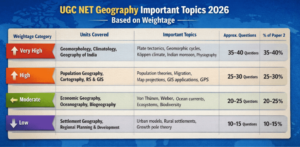
Understanding the UGC NET Geography Important Topics 2026 on the basis of weightage would allow the candidates to prepare for the examination by focusing attention only to those units from which maximum questions have been noticed in Paper 2. Analysis of previous year question papers (2019–2025) reveals that certain units exercise maximum weightage on the examination, while others provide moderate to low but predictable coverage.
| Weightage Category | Units Covered | Important Topics | Approx. Questions | % of Paper 2 |
| Very High | Geomorphology, Climatology, Geography of India | Plate tectonics, geomorphic cycles, Köppen climate, Indian monsoon, physiography | 35–40 | 35–40% |
| High | Population Geography, Cartography, RS & GIS | Population theories, migration, map projections, GIS applications, GPS | 25–30 | 25–30% |
| Moderate | Economic Geography, Oceanography, Biogeography | Von Thünen, Weber, ocean currents, ecosystems, biodiversity | 20–25 | 20–25% |
| Low | Settlement Geography, Regional Planning & Development | Urban models, rural settlements, growth pole theory | 10–15 | 10–15% |
Also Read: UGC NET Exam Centre 2025
UGC NET Geography Frequently Asked Topics 2026
The UGC NET Geography Frequently Asked Topics 2026 would be the concepts, models, and theories that keep repeated every year in direct or an indirectly related manner in the Geography Paper 2. The observation of previous year questions from 2019 to 2025 show that close to 60 to 65% questions are designed around a set group of Frequently Asked Topics, thereby making the preparation based on PYQ highly result-oriented.
| Topic | Unit | Expected Questions | Question Type | PYQ Trend |
| Plate Tectonics | Geomorphology | 3–5 | Conceptual, Assertion–Reason | Asked every cycle |
| Geomorphic Cycles | Geomorphology | 2–4 | Theory-based | Very frequent |
| Köppen Climate Classification | Climatology | 3–5 | Match / Statement | High repetition |
| Atmospheric Circulation | Climatology | 2–4 | Conceptual | Regular |
| El Niño & La Niña | Oceanography | 2–3 | Current-linked | Rising trend |
| Ecosystem & Biodiversity | Biogeography | 2–3 | Conceptual | Frequent |
| Demographic Transition Model | Population Geography | 2–4 | Theory-based | Every cycle |
| Migration Theories | Population Geography | 2–3 | Conceptual | High |
| Von Thünen Model | Economic Geography | 2–3 | Diagram-based | Repeated |
| Weber’s Industrial Theory | Economic Geography | 2–3 | Conceptual | Repeated |
| Urban Models (Burgess, Hoyt) | Settlement Geography | 2–3 | Match-the-following | Very frequent |
| Indian Monsoon | Geography of India | 3–5 | Conceptual + factual | Every cycle |
| Physiographic Divisions of India | Geography of India | 2–4 | Map-based | Very high |
| Map Projections | Cartography | 2–3 | Numerical / Conceptual | Rising |
| GIS Applications | GIS & RS | 2–4 | Application-based | Rapidly increasing |
JRFAdda Premium Dec 2025 Geography Batch Paper 2 – Enroll Today!
Also Read: UGC NET Geography Previous Year Question Papers

Conclusion
The UGC NET Geography Important Topic 2026 forms the foundation of a smart, result-oriented preparation strategy for Paper 2. The topics that feature prominently in exams like Geomorphology, Climatology, Geography of India, Population Geography, and GIS & Remote Sensing occupy close to 70-75% weightage in the entire test paper.
By focusing on high-scoring geography topics, understanding topics with weightage in geography exams, and PYQs for frequent geography topics can help qualify for the exam to a great extent. The most correct and efficient strategy to qualify for UGC NET Geography 2026 for the posts of Assistant Professors and Junior Research Fellow would be a focused approach towards must-read geography topics for NET combined with conceptual clarity, diagrams, and models.
UGC NET Geography Important Topic 2026 FAQs

Which units carry the highest weightage in UGC NET Geography 2026?
Geomorphology, Climatology, and Geography of India carry the highest weightage, together contributing around 35–40% of the Paper 2 questions.
How many questions are asked from frequently asked geography topics?
Based on PYQ analysis (2019–2025), nearly 60–65% of questions are framed from a fixed set of frequently asked geography topics.
Is GIS and Remote Sensing important for UGC NET Geography 2026?
Yes, Cartography, Remote Sensing & GIS is a rapidly rising unit, contributing 8–12 questions and offering high scoring opportunities.
How should I prepare for UGC NET Geography important topics 2026 effectively?
Focus on unit-wise high-weightage topics, practice previous year questions, revise models, theories, and diagrams, and follow a PYQ-driven strategy for best results.