
The UGC NET Gujarati Syllabus 2026 is an important resource for aspirants who wish to get selected as Assistant Professors and Junior Research Fellows (JRF) in Gujarati subject. The examination is organized by the National Testing Agency under the guidance of University Grants Commission, which assesses the teaching ability and subject knowledge of aspirants.
An insight into the syllabus, pattern of examination, and important topics is very much necessary for making a solid plan for preparation. You will get all the information here including PDF download, syllabus of units, books, and other preparatory tips.
UGC NET Gujarati Syllabus 2026 Overview
UGC NET Gujarati 2026 is administered by the National Testing Agency using a Computer Based Test mode for those who wish to become an Assistant Professor or earn eligibility for JRF. The examination comprises two papers (Paper I & Paper II), which contain a total of 150 questions worth 300 marks that need to be answered in 3 hours. There is no negative marking, making it possible for the test takers to answer all questions with confidence.
| Feature | Details |
| Exam Name | UGC NET Gujarati 2026 |
| Conducting Body | National Testing Agency (NTA) |
| Exam Mode | Computer-Based Test (CBT) |
| Papers | Paper 1 (General) + Paper 2 (Gujarati) |
| Total Questions | 150 |
| Total Marks | 300 |
| Duration | 3 Hours |
| Negative Marking | No |
UGC NET Gujarati Syllabus 2026 PDF Download
For the preparation of the UGC NET Gujarati exam, aspirants should always consider the official syllabus PDF available on the site of the National Testing Agency. This will assist them in knowing about the subjects and exam pattern.
The UGC NET Gujarati syllabus PDF can be downloaded by visiting the official website of ugcnet.nta.ac.in. Under the “Syllabus” tab, one can select the subject of Gujarati. They will then get a full list of units and topics, along with the exam pattern in Paper 2.
| UGC NET Gujarati Syllabus 2026 PDF | Download PDF |
UGC NET Gujarati Exam Pattern 2026
The format of UGC NET Exam Gujarati 2026 organized by the National Testing Agency is uniform in nature. The entire examination lasts for 3 hours during which Paper 1 and Paper 2 take place concurrently with no breaks in between. It is important for candidates to know the exam pattern so as to utilize their time effectively.
Top UGC NET Online Test Series
Paper 1: General Paper (Teaching & Research Aptitude)
Paper I is universal for all students and serves to test the analytical capability, logical reasoning, teaching proficiency, and research knowledge of the candidate, not specific subject expertise. This paper assumes great significance in assessing the overall qualification of the candidate because it evaluates logical thinking and concept application abilities.
Also Read: UGC NET Exam Pattern 2026
| Component | Details |
| Questions | 50 |
| Marks | 100 |
| Nature | General Aptitude |
Paper 2: Gujarati Subject
Paper 2 is a discipline-specific test and measures a candidate’s in-depth understanding of Gujarati language, literature, and literary criticism. It demands a deep conceptual understanding of significant texts and authors.
| Component | Details |
| Questions | 100 |
| Marks | 200 |
| Nature | Subject-Specific |
UGC NET Gujarati Paper 2 Syllabus 2026 (Unit-Wise)
The UGC NET Gujarati Paper 2 Syllabus 2026 consists of 10 detailed units which include various subjects such as history of literature, linguistics, criticism, research methodology, etc. This syllabus has been made to test the depth of knowledge about Gujarati literature and language and also about analytical skills of candidates.
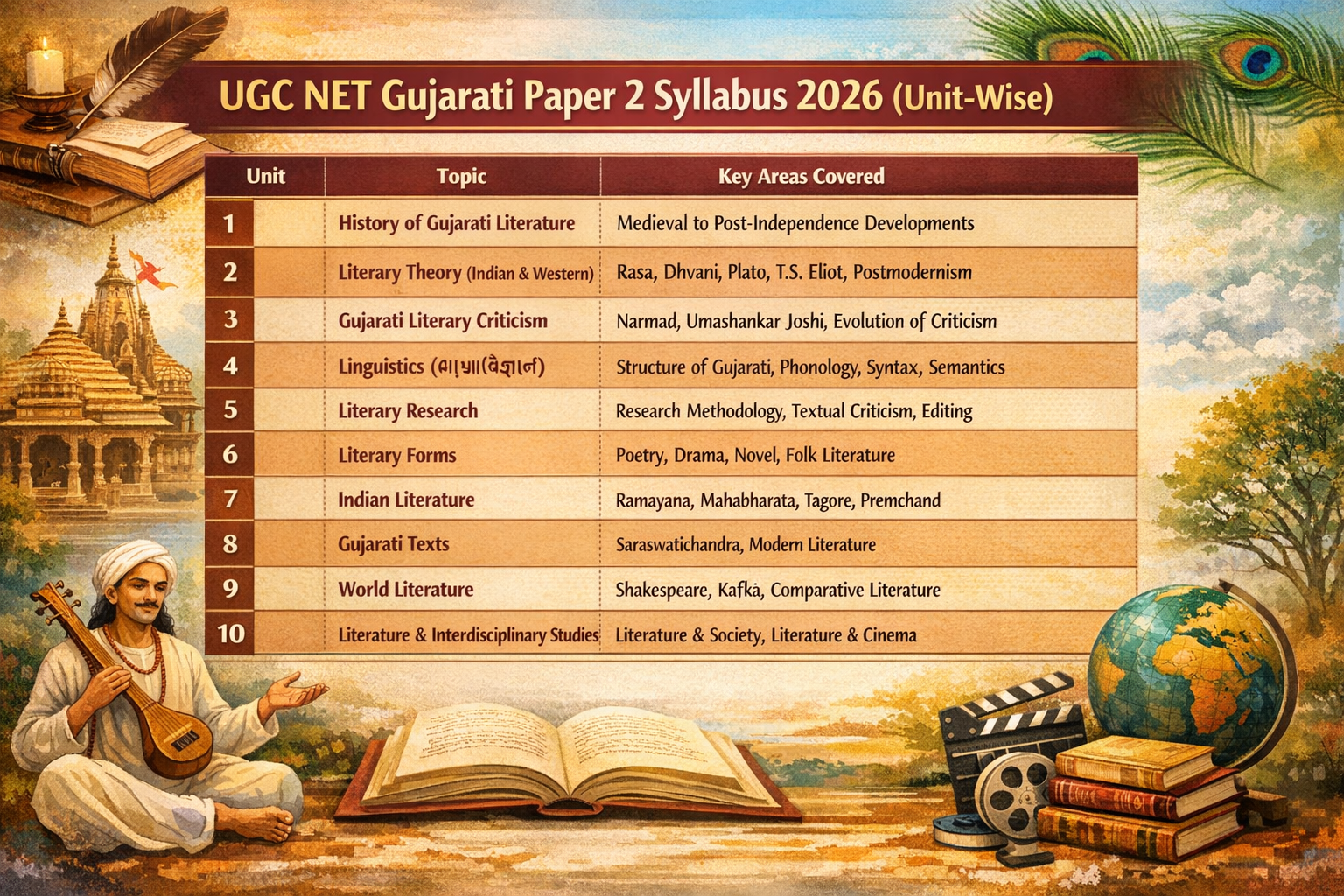
| Unit | Topic | Key Areas Covered |
| Unit 1 | History of Gujarati Literature | Medieval literature, Bhakti movement (e.g., Narsinh Mehta), Modern literature (Dalpatram onwards), Post-independence developments |
| Unit 2 | Literary Theory (Indian & Western) | Rasa, Dhvani, Vakrokti, Plato, Aristotle, T.S. Eliot, Feminism, Structuralism, Postmodernism |
| Unit 3 | Gujarati Literary Criticism | Narmad, Ramanbhai Neelkanth, Umashankar Joshi, Evolution of Gujarati criticism |
| Unit 4 | Linguistics (ભાષાવિજ્ઞાન) | Nature of language, Structure of Gujarati, Phonology, Morphology, Syntax, Semantics |
| Unit 5 | Literary Research | Research methodology, Textual criticism, Editing, Interdisciplinary research |
| Unit 6 | Literary Forms | Folk literature, Poetry, Drama, Novel, Short story, Essays, Autobiography, Biography |
| Unit 7 | Indian Literature | Ramayana, Mahabharata, Classical Sanskrit literature, Works of Tagore and Premchand |
| Unit 8 | Gujarati Texts | Important Gujarati works, Novels like Saraswatichandra, Modern literature |
| Unit 9 | World Literature | Shakespeare, Kafka, T.S. Eliot, Comparative literature, Global literary movements |
| Unit 10 | Literature & Interdisciplinary Studies | Literature & society, Literature & cinema, Cultural and media studies |
UGC NET ગુજરાતી પેપર 2 સિલેબસ 2026
UGC NET Gujarati Paper 2 Syllabus 2026 consists of 10 Units, each focusing on a variety of themes such as literary history, linguistics, literary criticism, methodologies of research, and other interdisciplinary subjects.
Join UGC NET Coaching in Jaipur
| યુનિટ નંબર | યુનિટ નામ | ટૂંકું વર્ણન |
| યુનિટ 1 | ગુજરાતી સાહિત્યનો ઇતિહાસ | મધ્યકાલીનથી આધુનિક સમય સુધીના ગુજરાતી સાહિત્યનો વિકાસ અને મુખ્ય લેખકોનું અભ્યાસ |
| યુનિટ 2 | સાહિત્યસિદ્ધાંત (ભારતીય અને પાશ્ચાત્ય) | ભારતીય અને પશ્ચિમી સાહિત્યના સિદ્ધાંતો અને વિવિધ વિચારોનો અભ્યાસ |
| યુનિટ 3 | ગુજરાતી વિવેચન | ગુજરાતી વિવેચકો અને તેમના સાહિત્યિક યોગદાનનું અધ્યયન |
| યુનિટ 4 | ભાષાવિજ્ઞાન | ભાષાનું સ્વરૂપ, રચના, વિકાસ અને વ્યાકરણના મૂળભૂત તત્વો |
| યુનિટ 5 | સાહિત્યિક સંશોધન | સંશોધન પદ્ધતિઓ, અભ્યાસની રીતો અને સાહિત્યિક વિશ્લેષણ |
| યુનિટ 6 | સાહિત્ય સ્વરૂપો | વિવિધ સાહિત્ય પ્રકારો જેમ કે કાવ્ય, નાટક, નવલકથા વગેરેનું જ્ઞાન |
| યુનિટ 7 | ભારતીય સાહિત્ય | ભારતીય મહાકાવ્યો અને પ્રખ્યાત સાહિત્યકારોનું અભ્યાસ |
| યુનિટ 8 | ગુજરાતી કૃતિઓ | મહત્વપૂર્ણ ગુજરાતી કૃતિઓ અને લેખકોના સાહિત્યનું વિશ્લેષણ |
| યુનિટ 9 | વિશ્વ સાહિત્ય | વિશ્વપ્રસિદ્ધ સાહિત્યકારો અને તેમની કૃતિઓનો પરિચય |
| યુનિટ 10 | સાહિત્ય અને આંતરવિદ્યાઓ | સાહિત્યનો સમાજ, સંસ્કૃતિ અને અન્ય ક્ષેત્રો સાથેનો સંબંધ |
Conclusion
The UGC NET Gujarati Syllabus 2026 has been designed in such a manner that a person’s deep understanding of Gujarati literature, linguistics, and criticism is tested, alongside his teaching and researching capabilities. Not only is an individual’s basic knowledge judged here, but rather his ability to think conceptually and analytically while applying different theories to literary works is equally valued; thus, it becomes important to prepare comprehensively.
In order to excel in such an extremely competitive exam as the one administered by National Testing Agency under the supervision of the University Grants Commission, it is important to have a thorough understanding of all 10 units covered in the syllabus, practice previous year questions, and revise important aspects such as literary criticism, authors, and linguistics.
UGC NET Gujarati Syllabus 2026 FAQs