
UGC NET Hindu Studies Syllabus 2026 has now been made available for those appearing for the University Grants Commission National Eligibility Test (UGC NET). Organized by the National Testing Agency, the test is a means for determining the eligibility of candidates for Assistant Professor and Junior Research Fellowship posts at various universities and colleges in India. Those who have chosen Hindu Studies as their second paper need to acquaint themselves with the new syllabus, exam pattern, and other topics.
Some of the topics covered include Hindu philosophy, Dharma practices, Indian sciences, Ramayana, Mahabharata, Sanskrit grammar, Pramana Siddhanta, and others. Candidates can refer to the PDF file of the syllabus to start their preparation

UGC NET Hindu Studies Syllabus 2026 Overview
UGC NET Hindu Studies Syllabus 2026 is the syllabus for students who are preparing themselves for the University Grants Commission National Eligibility Test which is conducted by the National Testing Agency. This examination takes place at the national level, and this is used for checking whether the candidate has the capability to become an Assistant Professor and Junior Research Fellowship (JRF). The exam is conducted via an online method, and there will be two papers in the exam – Paper I and Paper II.
Join UGC NET Online Test Series
| Particulars | Details |
| Exam Name | UGC NET 2026 |
| Conducting Body | National Testing Agency |
| Exam Level | National Level |
| Exam Mode | Online |
| Paper I | Teaching & Research Aptitude |
| Paper II | Hindu Studies |
| Total Questions | 150 |
| Total Marks | 300 |
| Duration | 3 Hours |
UGC NET Hindu Studies Exam Pattern 2026
UGC NET Hindu Studies Exam 2026 is conducted in a single session consisting of two papers — Paper I and Paper II. Both papers contain objective-type multiple-choice questions (MCQs) and are conducted without any break between them. Paper I is common for all candidates and evaluates teaching aptitude, research aptitude, reasoning ability, comprehension, communication, and general awareness. Paper II is subject-specific and focuses entirely on Hindu Studies topics such as Dharma, Pramana Siddhanta, Ramayana, Mahabharata, Sanskrit, and Indian philosophical traditions.
Check UGC NET Exam Pattern 2026 Here
| Paper | Subject | Questions | Marks |
| Paper 1 | General Aptitude | 50 Questions | 100 Marks |
| Paper 2 | Hindu Studies | 100 Questions | 200 Marks |
UGC NET Hindu Studies Syllabus PDF Download
Candidates who will appear in the upcoming UGC NET Hindu Studies Test Exam 2026 can download the syllabus PDF from the official portal in order to have comprehensive knowledge regarding the entire exam format along with topic-wise division. Candidates can use the syllabus PDF issued by the National Testing Agency for better preparation by covering all topics mentioned in Paper I and Paper II.
| UGC NET Hindu Studies English PDF | Link Here |
| UGC NET Hindu Studies Hindi PDF | Link Here |
UGC NET Hindu Studies Syllabus Unit-Wise Paper II
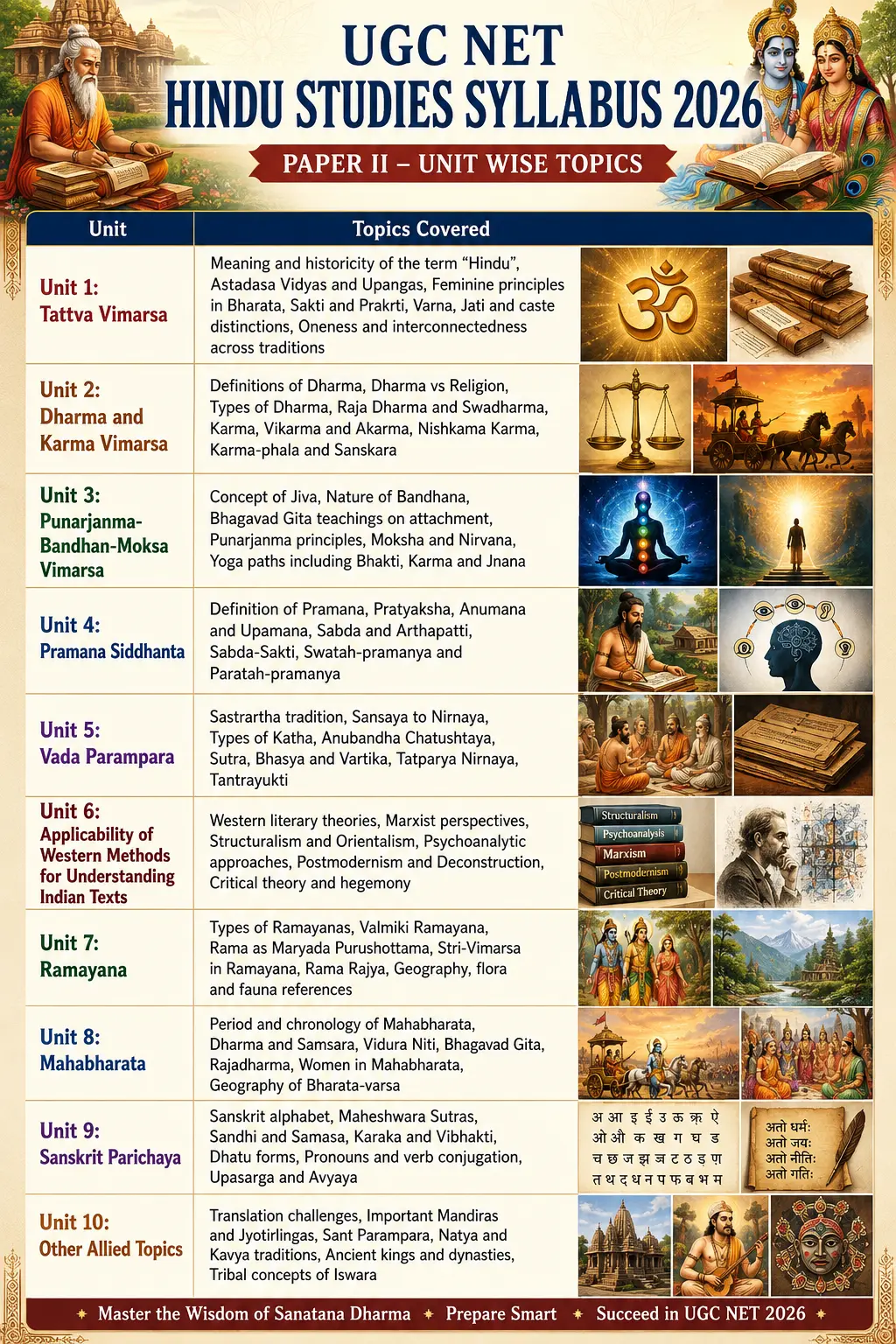
UGC NET Hindu Studies Syllabus Unit Wise Paper II evaluates candidates on their knowledge about philosophical concepts in Hinduism, basics of Sanskrit language, Indian epics, concepts of Dharma, Indian systems of knowledge, and Indian cultural traditions. There are ten units in Paper II in total, which cover theoretical as well as traditional aspects of Hinduism. Those preparing for the examination need to study each unit thoroughly for better results.
Check UGC NET Syllabus Paper PDF Here
| Unit | Topics Covered |
| Unit 1: Tattva Vimarsa | Meaning and historicity of the term “Hindu”, Astadasa Vidyas and Upangas, Feminine principles in Bharata, Sakti and Prakrti, Varna, Jati and caste distinctions, Oneness and interconnectedness across traditions |
| Unit 2: Dharma and Karma Vimarsa | Definitions of Dharma, Dharma vs Religion, Types of Dharma, Raja Dharma and Swadharma, Karma, Vikarma and Akarma, Nishkama Karma, Karma-phala and Sanskara |
| Unit 3: Punarjanma-Bandhan-Moksa Vimarsa | Concept of Jiva, Nature of Bandhana, Bhagavad Gita teachings on attachment, Punarjanma principles, Moksha and Nirvana, Yoga paths including Bhakti, Karma and Jnana |
| Unit 4: Pramana Siddhanta | Definition of Pramana, Pratyaksha, Anumana and Upamana, Sabda and Arthapatti, Sabda-Sakti, Swatah-pramanya and Paratah-pramanya |
| Unit 5: Vada Parampara | Sastrartha tradition, Sansaya to Nirnaya, Types of Katha, Anubandha Chatushtaya, Sutra, Bhasya and Vartika, Tatparya Nirnaya, Tantrayukti |
| Unit 6: Applicability of Western Methods for Understanding Indian Texts | Western literary theories, Marxist perspectives, Structuralism and Orientalism, Psychoanalytic approaches, Postmodernism and Deconstruction, Critical theory and hegemony |
| Unit 7: Ramayana | Types of Ramayanas, Valmiki Ramayana, Rama as Maryada Purushottama, Stri-Vimarsa in Ramayana, Rama Rajya, Geography, flora and fauna references |
| Unit 8: Mahabharata | Period and chronology of Mahabharata, Dharma and Samsara, Vidura Niti, Bhagavad Gita, Rajadharma, Women in Mahabharata, Geography of Bharata-varsa |
| Unit 9: Sanskrit Parichaya | Sanskrit alphabet, Maheshwara Sutras, Sandhi and Samasa, Karaka and Vibhakti, Dhatu forms, Pronouns and verb conjugation, Upasarga and Avyaya |
| Unit 10: Other Allied Topics | Translation challenges, Important Mandiras and Jyotirlingas, Sant Parampara, Natya and Kavya traditions, Ancient kings and dynasties, Tribal concepts of Iswara |
Benefits of Using the UGC NET Hindu Studies Syllabus PDF
UGC NET Syllabus for Hindu Studies PDF is highly important for candidates aspiring to appear in the exam. This syllabus PDF provides complete information regarding the revised syllabus, pattern, and important topics included in the exam. Candidates can get organized with their studies and can easily avoid missing out on important units through the syllabus PDF.
- Helps understand the latest exam pattern
- Covers all important topics systematically
- Assists in creating a structured study plan
- Identifies high-weightage areas
- Saves preparation time
- Provides authentic information from official sources
UGC NET Hindu Studies 2026 Preparation Tips
Preparation for the UGC NET Hindu Studies Exam needs to be done strategically, with concept formation and regular revision. The candidates need to prepare themselves not only theoretically but also practically.
Top UGC NET Offline Classes in Jaipur
- Thoroughly read the complete syllabus before starting preparation.
- Focus on Hindu philosophical concepts and Indian knowledge traditions.
- Prepare Sanskrit grammar regularly.
- Study important sections of the Ramayana and Mahabharata.
- Practice previous year question papers and mock tests.
- Revise Paper I topics daily for aptitude improvement.
- Make short notes for Dharma, Pramana, and Vada concepts.
UGC NET Hindu Studies Syllabus FAQs