
UGC NET Indian Knowledge System syllabus 2026 is one of the most significant sources for all those individuals who are planning to prepare for the exam. By understanding the UGC NET Indian Knowledge System syllabus, candidates can easily prepare a preparation strategy that helps them in preparing for all the crucial sections. If an individual is interested in clearing the UGC NET Indian Knowledge System examination, then the first thing he/she needs to do is understand the UGC NET Indian Knowledge System syllabus.
Join UGC NET Foundation Course

UGC NET Indian Knowledge System Syllabus 2026 Overview
UGC NET Indian Knowledge System Syllabus has been developed by National Testing Agency (NTA), which assesses the knowledge level of Indian traditional knowledge system, philosophy, science, and culture of the candidates. The UGC NET Indian Knowledge System Syllabus has an interdisciplinary approach and emphasizes holistic knowledge. Proper understanding of the UGC NET Indian Knowledge System Syllabus helps the candidates gain theoretical as well as practical knowledge of the subject.
| Aspect | Details |
| Exam Name | UGC NET (University Grants Commission National Eligibility Test) |
| Subject | Indian Knowledge System |
| Conducting Body | National Testing Agency (NTA) |
| Paper | Paper 2 (Subject-specific) |
| Total Units | 10 Units |
| Mode of Exam | Computer-Based Test (CBT) |
| Medium | Hindi & English |
| Total Questions | 100 |
| Total Marks | 200 |
| Duration | 3 Hours (Combined) |
| Subject Code | 103 |
| Type of Questions | Objective (MCQs) |
Join UGC NET Foundation Batch Online
UGC NET Indian Knowledge System Exam Pattern 2026
It is important to understand the UGC NET Indian Knowledge System Syllabus along with the exam pattern. The exam consists of two papers that are taken simultaneously. It is advisable to study the UGC NET Indian Knowledge System Syllabus in conjunction with the exam pattern.
| Paper | Subject | No. of Questions | Marks | Duration |
| Paper 1 | General Paper (Teaching & Research Aptitude) | 50 | 100 |
3 Hours (Combined) |
| Paper 2 | Indian Knowledge System | 100 | 200 |
Check UGC NET Exam Pattern 2026
UGC NET Indian Knowledge System Syllabus 2026 PDF (English & Hindi)
UGC NET Indian Knowledge System Syllabus 2026 PDF is the official document that provides complete information about topics according to units. Going through the UGC NET Indian Knowledge System Syllabus PDF will help candidates remain on track as per the official format. The download of the UGC NET Indian Knowledge System syllabus PDF will make sure that you cover all topics of the NTA UGC NET Indian Knowledge System syllabus. Link is given below:
| UGC NET Indian Knowledge System Syllabus PDF English | Download PDF |
| UGC NET Indian Knowledge System Syllabus PDF Hindi | Download PDF |
Check All Subjects Complete UGC NET Syllabus 2026
UGC NET Indian Knowledge System Syllabus 2026 Paper 2 (Unit-wise)
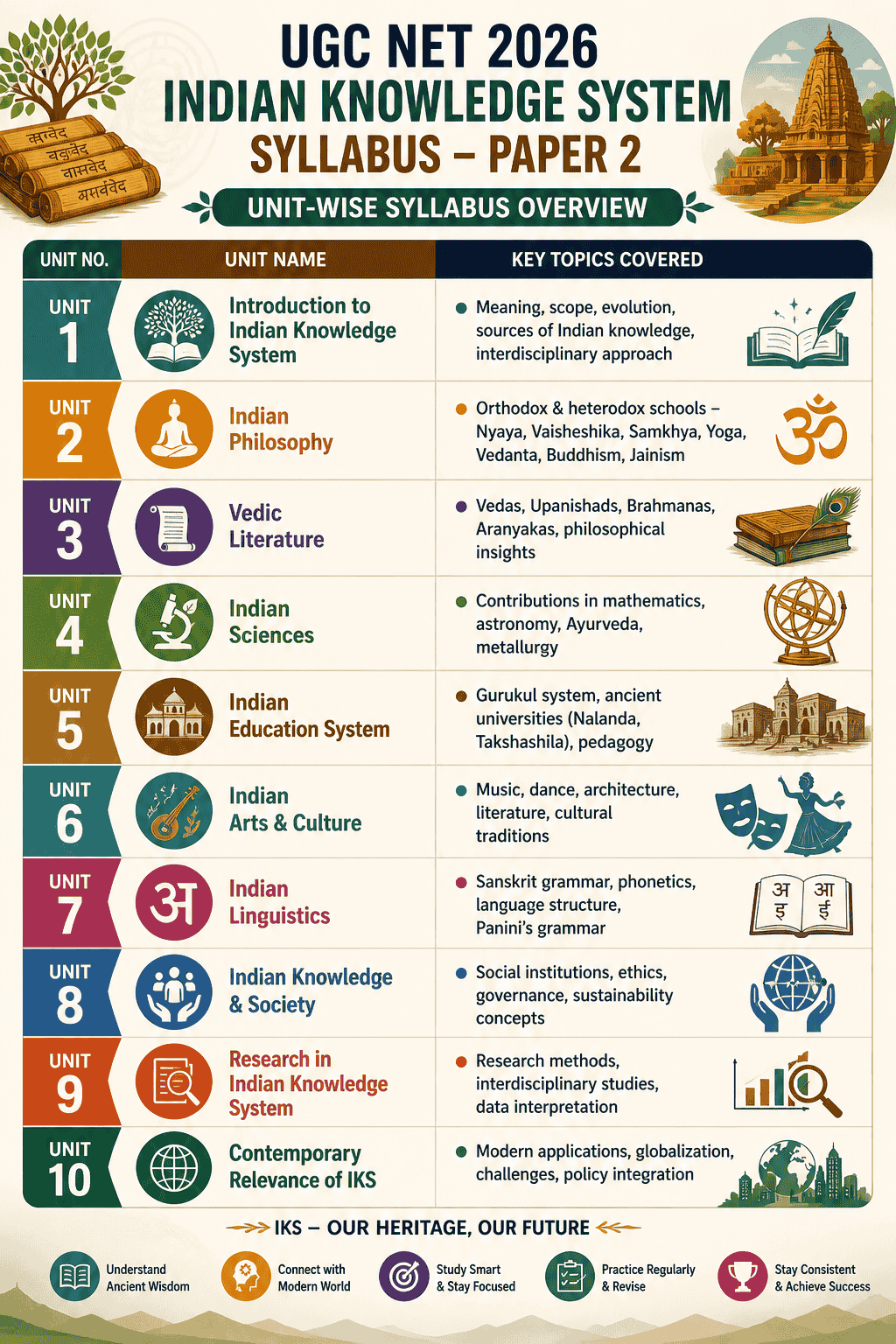
UGC NET Indian Knowledge System Syllabus 2026 Paper 2 consists of an arrangement of topics designed to test candidates on their knowledge about Indian traditional wisdom, philosophy, science, and culture. The syllabus includes 10 units, which include both theoretical and applied knowledge.
| Unit No. | Unit Name | Key Topics Covered |
| Unit 1 | Introduction to Indian Knowledge System | Meaning, scope, evolution, sources of Indian knowledge, interdisciplinary approach |
| Unit 2 | Indian Philosophy | Orthodox & heterodox schools – Nyaya, Vaisheshika, Samkhya, Yoga, Vedanta, Buddhism, Jainism |
| Unit 3 | Vedic Literature | Vedas, Upanishads, Brahmanas, Aranyakas, philosophical insights |
| Unit 4 | Indian Sciences | Contributions in mathematics, astronomy, Ayurveda, metallurgy |
| Unit 5 | Indian Education System | Gurukul system, ancient universities (Nalanda, Takshashila), pedagogy |
| Unit 6 | Indian Arts & Culture | Music, dance, architecture, literature, cultural traditions |
| Unit 7 | Indian Linguistics | Sanskrit grammar, phonetics, language structure, Panini’s grammar |
| Unit 8 | Indian Knowledge & Society | Social institutions, ethics, governance, sustainability concepts |
| Unit 9 | Research in Indian Knowledge System | Research methods, interdisciplinary studies, data interpretation |
| Unit 10 | Contemporary Relevance of IKS | Modern applications, globalization, challenges, policy integration |
Top UGC NET Offline Coaching in Jaipur
UGC NET Indian Knowledge System Important Topics
This will help you increase your marks in the exam. Important topics covered under the syllabus of UGC NET Indian Knowledge System include:
- Literature and Philosophy in Vedas
- Indian Contributions to Science
- Indigenous Educational Systems
- Art and Culture of India
- IKS in Contemporary Times
Top UGC NET Offline Classes in Jaipur
Conclusion
UGC NET Indian Knowledge System Syllabus forms the core of preparation. It is important for candidates to be familiar with the UGC NET Indian Knowledge System Syllabus so that they may prepare well for the examination. Preparation will definitely pay off through consistent practice and revision according to the UGC NET Indian Knowledge System Syllabus.