
UGC NET Museology & Conservation Syllabus 2026 holds importance for candidates appearing in the National Eligibility Test in Museumology and conservation. It is essential for candidates to have complete information regarding the UGC NET Museology & Conservation Syllabus, as it will help them prepare well and cover all important aspects. This article contains all the information about the UGC NET Museology & Conservation Syllabus.
UGC NET Museology & Conservation Syllabus 2026 Overview
The UGC NET Museology and Conservation Syllabus is prepared by the National Testing Agency (NTA). It helps to test the knowledge of candidates in regard to the study of museums, heritage preservation, and conservation methods. The UGC NET Museology and Conservation Syllabus covers the theoretical and practical elements of the topic. It is essential to understand the UGC NET Museology and Conservation Syllabus.
- Conducting Body: NTA
- Paper: Paper 2
- Mode: CBT
- Questions: 100
- Marks: 200
| Feature | Details |
| Exam Name | UGC NET June 2026 |
| Conducting Authority | National Testing Agency (NTA) |
| Purpose | Assistant Professor & Junior Research Fellowship (JRF) eligibility determination |
| Exam Frequency | Twice a year |
| Exam Mode | Computer-Based Test (CBT) |
| Medium of Exam | English and Hindi |
| Total Duration | 3 Hours (180 Minutes) |
| Papers | Paper I (General) & Paper II (Subject-specific) |
| Subject Code for Museology & Conservation | 66 |
| Exam Dates | To Be Updated Soon |
| Official Website | https://ugcnet.nta.nic.in |
Best UGC NET Online Test Series
UGC NET Museology & Conservation Syllabus 2026 PDF (Hindi & English)
The UGC NET Museology & Conservation Syllabus 2026 PDF is a crucial study material for aspirants to ace the upcoming exam. This syllabus has been officially published by NTA and contains all unit-based topics, important concepts, and exam-focused areas.
This syllabus can be downloaded in both Hindi and English versions for easy access for all students. By downloading the official PDF, you will be able to know about the actual exam pattern, concentrate on the important topics, and prepare accordingly. Download the UGC NET Museology & Conservation Syllabus 2026 PDF (Hindi & English) using the link provided below.
| UGC NET Museology & Conservation Syllabus PDF English | Download PDF |
| UGC NET Museology & Conservation Syllabus PDF Hindi | Download PDF |
Check Complete UGC NET Syllabus 2026
UGC NET Paper 1 Syllabus (General Paper)
UGC NET Paper 1 (General Paper on Teaching and Research Aptitude) is a common paper for all students that is meant to test their capabilities related to teaching skills, research aptitude, logical reasoning, comprehension, and general knowledge. Make sure to cover all the topics and solve PYQs on a consistent basis.
| Unit No. | Unit Name | Key Topics Covered |
| Unit 1 | Teaching Aptitude | Teaching concepts, objectives, learner characteristics, methods of teaching, evaluation systems |
| Unit 2 | Research Aptitude | Types of research, methods, steps, thesis writing, research ethics |
| Unit 3 | Comprehension | Reading passages, understanding, interpretation, answering questions |
| Unit 4 | Communication | Types of communication, barriers, effective classroom communication |
| Unit 5 | Mathematical Reasoning & Aptitude | Number series, percentages, profit & loss, basic calculations |
| Unit 6 | Logical Reasoning | Arguments, assumptions, syllogism, coding-decoding |
| Unit 7 | Data Interpretation | Tables, graphs, charts, data analysis |
| Unit 8 | ICT (Information & Communication Technology) | Computer basics, internet, digital tools, e-learning |
| Unit 9 | People, Development & Environment | Sustainable development, environmental issues, policies |
| Unit 10 | Higher Education System | Structure, governance, institutions, policies in India |
Top UGC NET Coaching in Jaipur
UGC NET Museology & Conservation syllabus 2026 Paper 2 Unit-wise
UGC NET Museology & Conservation syllabus 2026 Paper 2 has been prepared to test the candidate’s understanding of museology, conservation, heritage management, and application of theories and practices. The syllabus unit by unit gives you an insight into how to prepare for the exam.
| Unit No. | Unit Name | Unit- Wise |
| Unit 1 | Introduction to Museology | Meaning, scope, types of museums, history and development of museums |
| Unit 2 | Museum Organization & Management | Museum administration, policies, collection management, documentation |
| Unit 3 | Principles of Conservation | Preventive conservation, curative conservation, conservation ethics |
| Unit 4 | Heritage Management | Cultural heritage, preservation techniques, heritage laws and policies |
| Unit 5 | Museum Education & Communication | Interpretation, audience engagement, museum education programs |
| Unit 6 | Exhibition Planning & Design | Exhibition techniques, display methods, lighting, layout and presentation |
| Unit 7 | Conservation Science | Scientific methods, material analysis, conservation technology |
| Unit 8 | Archiving & Documentation | Cataloguing, record keeping, digital archiving and documentation |
| Unit 9 | Legal & Ethical Issues | Museum ethics, intellectual property rights, legal frameworks |
| Unit 10 | Recent Trends in Museology | Digital museums, virtual exhibitions, modern practices |
Top UGC NET Offline Coaching in Jaipur
UGC NET Museology & Conservation Exam Pattern 2026
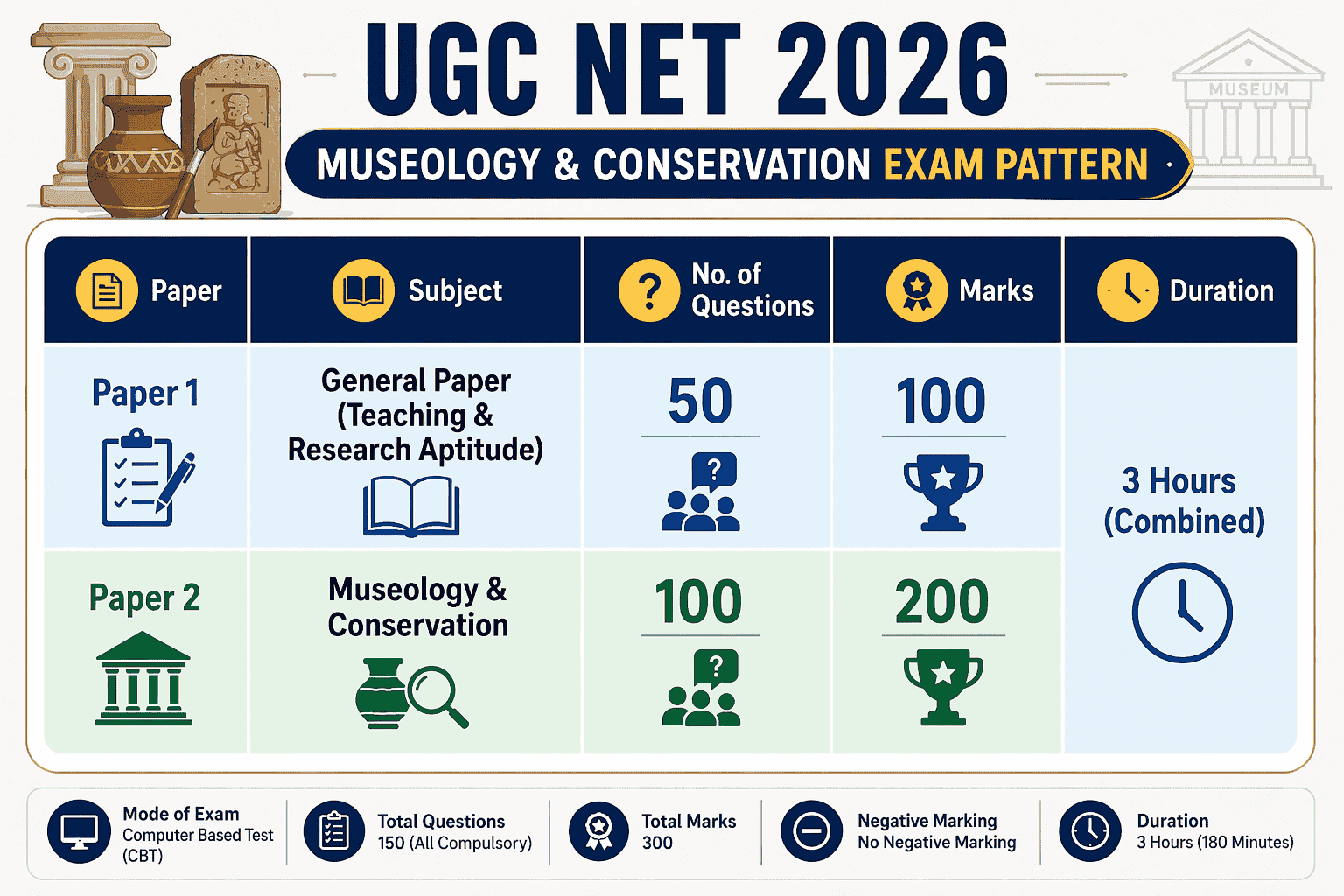
The UGC NET Museology & Conservation Exam Pattern 2026 is determined by NTA and is designed to test the suitability of candidates as teachers based on their aptitude and knowledge about Museology & Conservation. It consists of two papers and is held in one sitting only. Pay attention to both papers equally; however, concentrate more on Paper 2.
| Paper | Subject | No. of Questions | Marks | Duration |
| Paper 1 | General Paper (Teaching & Research Aptitude) | 50 | 100 |
3 Hours (Combined) |
| Paper 2 | Museology & Conservation | 100 | 200 |
Also Read: UGC NET Exam Pattern 2026
UGC NET Museology & Conservation Important Topics 2026
Strategically preparing for the upcoming UGC NET Museology & Conservation Exam 2026 involves concentrating on the subjects that carry more weight and have been asked before. The following are some of the most crucial topics you need to focus on for scoring well.
- Frequently asked definitions & concepts (museology, conservation, heritage)
- Differences: preventive vs curative conservation, museum vs archive
- Case-based questions on heritage preservation and museum practices
- UNESCO conventions & heritage sites (very important)
- Museum documentation process (steps, formats, standards)
- Factors affecting conservation (temperature, humidity, light)
- Types of exhibitions and their real-world application
- Ethical issues & repatriation debates (trending questions)
- Modern tools: digital archiving, virtual museums, ICT use
- Research-based questions from conservation science
Conclusion
The UGC NET Museology & Conservation Syllabus 2026 is a complete guide for those who wish to clear Assistant Professor and JRF. Having a detailed outline with units, important concepts, and the examination format, candidates can prepare accordingly. By concentrating on key concepts such as conservation methods, heritage management, and museums, candidates can boost their chances of succeeding in the exam.