



UGC NET New Rules 2026: In January 2026, the University Grants Commission (UGC) notified a new regulatory framework titled the “Promotion of Equity in Higher Education Institutions Regulations, 2026”. These UGC NET New Rules 2026 replace the earlier 2012 anti-discrimination guidelines and aim to curb caste-based discrimination and enhance equity and inclusion in all universities and colleges across India.
This article discusses the essential aspects, institutional needs, issues, and practical ramifications of the UGC NET New Rules & Equity Regulations 2026.
IGNITION BATCH PYP Last 10 Years PYPs with Detailed Video Solutions Paper 1 – Join Today!

What Are the UGC NET Equity Regulations 2026?
The UGC NET Equity Regulations 2026 are a regulatory instrument issued by the University Grants Commission. They build on the mandate of the UGC Act to ensure equity and eliminate caste-based discrimination in higher education by:
- Formally defining discriminatory conduct
- Mandating institutional architecture for prevention, reporting, and redressal
- Giving UGC the power to enforce compliance
- Introducing clear timelines for action on complaints
These regulations apply to all Higher Education Institutions (HEIs) recognised by UGC in India.
Also Read: UGC NET Vacancy 2026

UGC NET New Rules 2026 at a Glance
The UGC NET examination is conducted by the National Testing Agency (NTA) on behalf of the University Grants Commission (UGC), twice a year, to determine the eligibility for the roles of Assistant Professor or Junior Research Fellowship (JRF).
Check the UGC NET new rules 2026 overview in the table below to understand the complete summary:
| Aspect | Key Point |
| Issued | January 13, 2026 |
| Aim | Prevent caste-based discrimination & promote inclusion |
| Mandatory Structures | Equal Opportunity Centres, Equity Committees |
| Monitoring Roles | Equity Squads, Equity Ambassadors |
| Complaint Channels | Online, written, 24×7 helpline |
| Complaint Resolution | 24 hrs review; 15 working days report; 7-working-day action |
| Covered Groups | SC, ST, OBC |
| Enforcement | UGC can impose penalties for non-compliance |
| Controversy | Concerns over misuse, exclusion of the general category, procedural safeguards |
Also Read: UGC NET Online Coaching 2026
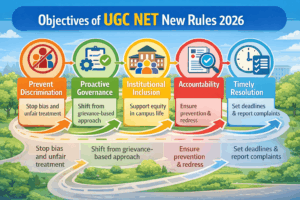
Objectives of UGC NET New Rules 2026
The main objective of the UGC NET New Rules & Equity Regulations 2026 is to create an enforceable framework within the institutions, going beyond the anti-discrimination statements. Some other key objectives of UGC NET New Rules 2026 are listed in the table below:
| Primary Goal | Description |
| Prevent discrimination | Shift from a grievance-based approach to proactive governance |
| Institutional inclusion | Create structures that support equity in everyday campus life |
| Accountability | Hold institutions responsible for prevention and redress |
| Timely resolution | Set deadlines and reporting requirements for complaints |
Also Read: UGC NET Salary 2026
Key Components of the UGC NET New Rules 2026
The UGC NET Equity Regulations 2026 include various components such as:
1. Equal Opportunity Centres (EOC)
Every university and college must establish an Equal Opportunity Centre. The EOC is responsible for:
- Awareness and sensitisation initiatives
- Monitoring campus climate
- Receiving and tracking complaints
- Reporting compliance to UGC
These centres are intended to be the administrative heart of equity implementation on campus.
Also Read: UGC NET Boycott 2026
2. Equity Committees
According to the UGC NET New Rules 2026, each institution must form an Equity Committee, which will include:
- Faculty members
- Administrative staff
- Student representatives from reserved categories
- Women representatives
- Persons with disabilities (where applicable)
These Equity Committees are responsible for reviewing complaints, suggesting corrective action, and ensuring compliance with the regulations.
JRFAdda Gold June 2026 CS Batch (Paper 1 + Paper 2) – Join Today!
3. Equity Squads and Ambassadors
The UGC NET Equity Regulations 2026 also introduce certain teams and individuals called:
- Equity Squads– The teams that monitor vulnerable areas on campus
- Equity Ambassadors– These are the trained individuals who act as points of contact for students and staff
4. Process Timeline
The equity process for discrimination complaints under the UGC NET new rules 2026 focuses on speed and structured action:
| Step | Timeline |
| Complaint receipt by EOC | Continuous (24×7 helpline and digital options) |
| Review by Equity Committee | Within 24 hours |
| Report submission | Within 15 working days |
| Institution head action | Within 7 working days of report |
Also Read: UGC NET Test Series 2026
UGC NET New Rules 2026 Equity Regulations & Discrimination
Based on the UGC NET New Rules 2026 including equity regulations define caste-based discrimination as conduct against:
- Members of Scheduled Castes (SC)
- Scheduled Tribes (ST)
- Other Backward Classes (OBC)
on the basis of caste or tribe alone. This scope is narrower than broader philosophical notions of discrimination but more operationally defined for enforcement.
Also Read: UGC NET Expected Cut Off 2026
UGC NET New Rules 2026 Penalties
While these UGC NET New Rules 2026 measures are designed to compel action, they also increase pressure on institutional administrations. The institutions that do not comply with the UGC NET Equity Regulations 2026 may face the following penalties:
| Possible Penalty | Impact |
| Loss of access to UGC schemes | Financial impact |
| Suspension of degree-granting rights | Academic consequences |
| Removal from UGC recognition list | Institutional status impact |
| Prohibition on offering certain programmes | Operational constraints |
Also Read: UGC NET University Accepting NET Scores
UGC NET New Rules 2026 Criticisms & Concerns
While the UGC NET new rules & equity regulations 2026 are ambitious, they have also sparked significant debate and resistance among the aspirants of previous as well as the upcoming June 2026 session. The following table lists some of the key criticism & concerns against the UGC NET New Rules 2026:
| Aspect | Key Issues Raised |
| Protests and Pushback | • Risk of misuse of regulations
• Vague definition of discrimination • Alleged exclusion of general category students • Fear of surveillance through equity squads • Public Interest Litigations (PILs) filed in the Supreme Court |
| Implementation Challenges | • Limited administrative capacity in colleges
• Increased paperwork without real change • Compliance treated as a formality • Internal committees may face conflicts of interest • Uneven implementation across institutions |
| Concerns Overdue Process | • No strong safeguards against false complaints
• Unclear standards of evidence and proof • Risk of reputational harm from unverified cases • Lack of balanced protection for both complainants and respondents |
JRFAdda Premium June 2026 Education Batch Paper 2- Join Today!
Also Read: UGC NET Selection Procedure 2026
UGC NET New Rules 2026 Response to Criticism
Union Education Minister Dharmendra Pradhan has responded to protests against these UGC NET New Rules 2026. To calm the ongoing unrest, he assures that:
- The regulations will be implemented within constitutional boundaries
- There will be no misuse or injustice against any student or staff member
- The equity framework includes checks and balances
- Decisions will be transparent and fair to all
Also Read: Best App for UGC NET Preparation 2026

Conclusion
UGC NET New Rules 2026 aims to create a transparent and responsible framework to prevent and address any discrimination against caste in higher education. Through defined structures, timelines, and compliance measures, the UGC NET New Rules 2026 seek to overcome the limitations of earlier guideline-based policies.
At the same time, these UGC NET New Rules 2026 have raised several concerns among the students related to the process, institutional autonomy, and fairness to all. The ongoing debates and protests indicate that the success of these UGC NET New Rules 2026 depends mainly on the transparent implementation, inclusive safeguards, and continuous review of these regulations to ensure meaningful and widely accepted outcomes.
UGC NET New Rules 2026 FAQs

Who must comply with these UGC NET New Rules 2026?
All UGC-recognised higher education institutions including colleges & universities all over India must establish these Equal Opportunity Centres and Equity Committees to comply with new rules.
Which groups are explicitly covered in UGC NET New Rules 2026?
The UGC NET New Rules 2026 mainly cover discrimination against Scheduled Caste (SC), Scheduled Tribe (ST), and Other Backward Classes (OBCs) individuals on caste or tribe grounds.
Are there penalties for non-compliant institutions under UGC NET New Rules 2026?
Yes, the penalties against institutions not following these regulations include potential loss of UGC schemes, removal from UGC recognition list, suspension of degree-granting rights or being prohibited from offering certain programs.
What is the timeline of complaints processing under UGC NET New Rules & Equity Regulations 2026?
The equity Committees must review complaints within 24 hours, report within 15 working days, and institutional heads must act within 7 working days.