



UGC NET Normalisation Process 2026 is crucial for the proper evaluation of candidates, which ensures that no candidate is prejudiced due to the conduct of UGC NET exams in multiple shifts. It accounts for differences in the level of difficulty between UGC NET shifts and enables a standard score to reflect the true potential of each candidate.
Also Read: UGC NET Exam 2026
Premium June 2026 Political Science Batch Paper 2- Join Today!
What is Normalisation in Exam?
Normalization process in the exam for UGC NET 2026 is a scientific process that is carried out by the National Testing Agency (NTA) for fairness and equality in scoring in the case of the examination held in multiple shifts. Because each UGC NET shift might have differences in the level of difficulty of the question paper, the UGC NET Normalisation Process 2026 ensures that no candidate is at an advantageous or disadvantageous position because of the particular shift they appeared in.
Also Read: UGC NET Exam Date 2026

UGC NET Normalisation Process 2026 Overview
The UGC NET exam is conducted by the National Testing Agency to allow students to determine eligibility to be recruited as an Assistant Professor in various universities within India or for the posts of Junior Research Fellow (JRF). The UGC NET Exam is generally taken twice a year. In the recent release by NTA, clarity on the UGC NET Normalisation process of UGC NET results has been provided so as to make the assessment procedure more balanced. UGC NET Normalisation process 2026 is an evaluation system UGC NET that ensures that all candidates are assessed in the same scale, regardless of the UGC NET shift in which they appeared for the exam.
How Does UGC NET Normalisation Process 2026 Work?
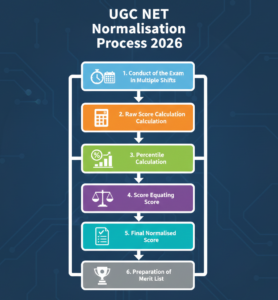
It is essential for a candidate undergoing UGC NET preparation to understand the normalization process in examination. Here are the steps involved in the UGC NET normalisation process 2026:
- Conduct of the Exam in Multiple Shifts: UGC NET exam is conducted in various shifts over multiple days so that a large number of candidates can appear in it. The difficulty level may be different in question papers in each UGC NET shift.
- Raw Score Calculation: The candidates’ raw scores are calculated through their performance. Right answer: +2 marks. Wrong answer: No negative marking
- Percentile Calculation: The performance of candidates can be compared across shifts based on percentile calculation.
- Score Equating: Using the EquiPercentile Method, the scores from all UGC NET shifts are compared and adjusted to bring them to a common scale, in order to ensure parity in assessment.
- Final Normalised Score: The candidates’ normalised scores are applied to make the merit list. So, candidates belonging to different shifts will get fair rankings irrespective of the shift from which they have appeared for the exam.
- Preparation of Merit List: Normalised scores are used to prepare a subject-wise merit list. The merit list decides the eligibility for Junior Research Fellowship (JRF) and Assistant Professorship.
JRFAdda Gold June 2026 Management Batch (Paper1+Paper2)- Enroll Today!
Also Read: UGC NET Admit Card 2026
Significance of the UGC NET Normalisation Process 2026
The UGC NET Normalisation Process 2026 is undertaken to ensure that candidates who are appearing for exams held at different shifts are judged fairly and equally. The main reasons why the UGC NET normalisation process 2026 is crucial are as follows:
- Fair Evaluation: No candidate can benefit or be harmed, as the difficulty level varies across UGC NET shifts of exams.
- Standardised Scoring: Raw scores can be converted to a standard scale for comparison.
- Transparency: It gives an open and scientific evaluation system for UGC NET.
- Equal Opportunity: All aspirants get an equal footing.
- Merit-Based Selection: It ensures fair and correct UGC NET preparation of the merit list.
- Support Multi-Shift Exams: Facilitates smooth holding of exams for large batches of candidates.
Also Read: UGC NET Timing & Schedule 2026

UGC NET Percentile Scores 2026
The UGC NET Percentile Score is the statistical performance of a candidate against a set of people who also appeared in the same shift. It will ensure there is a fair comparison based on multiple shifts, having different marks. Percentile scores indicate the share of candidates scoring equal to or lower than a specified score in the same shift, whereas raw scores describe the total marks obtained.
UGC NET Percentile calculation Formula:
|
Percentile = (Total candidates who appeared in the exam with a raw score ≤your score/Total candidates in the session) ×100 |
Also Read: UGC NET Percentile Calculator 2026
Role of Percentile in UGC NET Results 2026
Percentile scores are integral to the UGC NET normalisation process 2026, wherein they are standardised across shifts to produce a fair and standardised result. These scores are then utilised in preparing the merit list and declaring eligibility for JRF and Assistant Professorship. To sum it up, the percentile score is an important element of the evaluation system UGC NET that ensures equity and uniformity in the multi-shift exam format.
Also Read: UGC NET Result 2026
Factors Affecting UGC NET Normalisation Process 2026
The UGC NET Normalisation Process 2026 is affected by several factors that ensure multi-shift exams are fair and accurate. These factors critically address variations in difficulty among different exam sessions.
- Question Paper Difficulty: The UGC NET shifts may have different levels of difficulty, so that the comparison becomes fair.
- Number of Candidates per Shift: The number of candidates present in each shift affects percentiles and score distribution.
- Score Distribution: The shifts vary in raw score distribution, so the UGC NET normalisation process takes this variation into account.
- Percentile Comparison: Percentiles assist in comparing candidates in relation to one another while also maintaining consistency across all shifts.
JRFAdda Premium June 2026 Law Batch Paper 2 – Enroll Today!
- Statistical Methodology: The EquiPercentile Method allows the scores to be well-distributed across all the shifts fairly.
- Number of Shifts: More shifts need a complex UGC NET normalisation process to ensure equity.
- Exam Pattern and Syllabus: Differences in question types or syllabus coverage may influence the difficulty level of a shift.
- Candidate Performance Trends: Overall trends in each shift’s performance are taken into account in adjusting percentile scores.
Also Read: UGC NET Score Card 2026

Conclusion
The UGC NET Normalisation Process 2026 ensures fairness and transparency in evaluating candidates, especially in exams held across multiple shifts with varying levels of difficulty. By using methods such as percentile calculation, score equating and the EquiPercentile Method, the process ensures that all candidates, irrespective of their UGC NET shift, are evaluated on a level playing field. This would enable the NTA to provide standardised, accurate results that ensure merit-based selection for Junior Research Fellowship and Assistant Professorship.
Eventually, the UGC NET normalization process in the exam maintains the excellence of the UGC NET examination, wherein each of the aspirants gets equal opportunities to prove their potential.
UGC NET Normalisation Process 2026 FAQs

When will the UGC NET results be declared?
The UGC NET result with normalised scores and percentiles is expected to be released around February 2026.
How does percentile affect the UGC NET results?
Percentiles allow for a comparison of performances across shifts and ensure a standardized and fair result.
Is the UGC NET Normalisation Process 2026 applied on both Paper 1 & Paper 2?
Yes, the UGC NET normalisation process is applied to both papers, ensuring a uniform evaluation standard across shifts
Can raw score and normalised score be considered the same?
No, the raw marks in UGC NET are the actual marks obtained, while normalised scores are percentile-based marks adjusted for fairness.