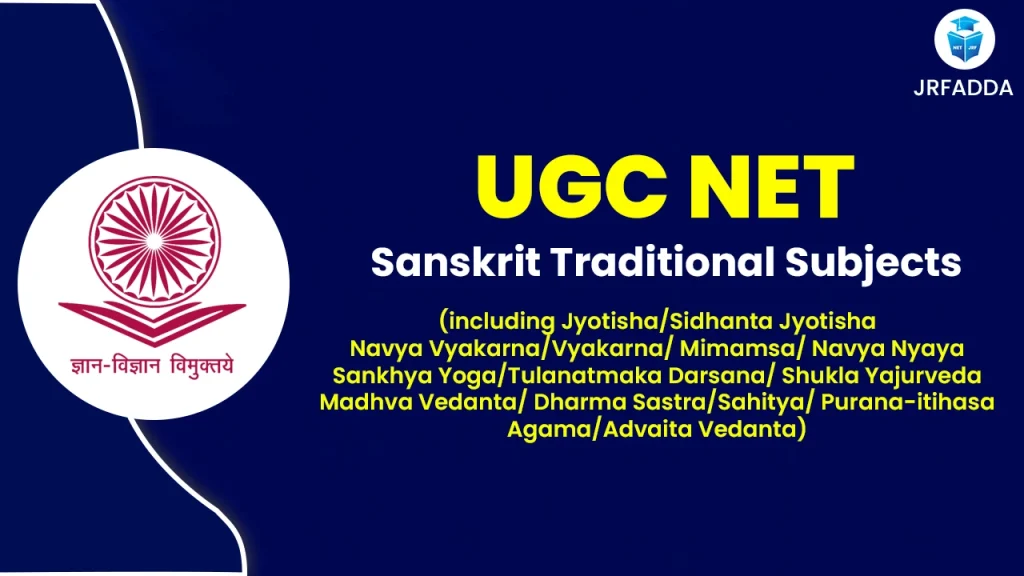

UGC NET Sanskrit Traditional Subjects 2025 exam, conducted by the National Testing Agency (NTA), is a prestigious gateway for aspirants aiming for academic and research careers in India’s classical knowledge traditions. This subject-wise exam covers disciplines like Vyakarana, Mimamsa, Nyaya, Advaita Vedanta, Jyotisha, Sahitya, and Dharma Shastra. The exam was conducted on 5th January 2026 in shift 1.
Rooted in India’s spiritual and intellectual heritage, the exam evaluates both textual knowledge and interpretative, comparative understanding. It consists of two papers – Paper 1 (General Aptitude) and Paper 2 (Sanskrit Traditional Subjects) – testing candidates’ proficiency for Assistant Professor roles and Junior Research Fellowship (JRF) opportunities.
Also Read: UGC NET Selection Procedure 2026
UGC NET Sanskrit Traditional Subjects 2025 Exam Analysis
The UGC NET Sanskrit Traditional Subjects 2025 exam, held on 5 January 2026, Shift 1,
UGC NET Paper 1 for 5 January 2026 Shift 2 was considered as easy to moderate in difficulty, featuring balanced coverage across all 10 units with a focus on conceptual understanding rather than rote memory. Questions showed PYQ-repeated patterns, including assertion-reason, match-the-following, and direct scoring items in Teaching Aptitude, Research Aptitude, Logical Reasoning, and ICT, allowing well-prepared candidates to attempt 42–45 questions confidently. Student feedback highlights manageable Data Interpretation, predictable syllogisms, and no heavy calculations, making the shift student-friendly and aligned with recent exam trends.
Also Read: UGC NET Exam Analysis 2025
Paper 2 (Sanskrit Traditional Subjects) was of moderate difficulty and closely aligned with the syllabus. It covered a broad range of traditional disciplines, including Vedic literature, Darshanas (Nyaya, Mimamsa, Vedanta), Vyakarana (Panini’s Ashtadhyayi), classical Sahitya, Purana-Itihasa, Agamic texts, and comparative philosophy. Questions included conceptual MCQs, assertion-reason types, and sutra-based logical analysis, with a few requiring critical interpretation of classical texts, such as Nyaya pramana theory and Vedantic epistemology. Overall, Paper 2 demanded thorough preparation and a strong grounding in Sanskrit traditional systems.
Also Read: UGC NET Paper 1 Exam Analysis 2025 for December session
What are UGC NET Sanskrit Traditional Subjects ?
Sanskrit Traditional Subjects for UGC NET include a broad spectrum of classical subjects and philosophies rooted heavily in Indian intellectual heritage and cultural traditions. The subjects examine applicants based on their awareness of ancient texts, treatises of grammar, systems of philosophy, and religious teachings. Major subjects are:
- Jyotisha (Astronomy and Astrology)
- Siddhanta Jyotisha (Classical Astronomical Systems)
- Navya Vyakarana (Modern Sanskrit Grammar)
- Vyakarana (Classical Sanskrit Grammar)
- Mimamsa (Exegesis and Ritualistic Philosophy)
- Navya Nyaya (Modern Logic)
- Sankhya Yoga (Philosophical Systems)
- Tulanatmaka Darsana (Comparative Philosophy)
- Shukla Yajurveda (Vedic Texts)
- Madhva Vedanta (Dvaita Philosophy)
- Dharma Sastra (Ancient Law and Ethics)
- Sahitya (Sanskrit Literature)
- Purana-Itihasa (Ancient Histories and Mythologies)
- Agama (Religious Scriptures)
- Advaita Vedanta (Non-Dual Philosophy)
Also Read: UGC NET Result 2025

UGC NET Sanskrit Traditional Subjects Eligibility Criteria 2026
To apply for UGC NET Sanskrit Traditional Subjects 2025, candidates must meet the following eligibility criteria prescribed by the National Testing Agency (NTA):
UGC NET Sanskrit Traditional Subjects Educational Qualification
- Master’s Degree: The candidates must hold a Master’s degree or equivalent in Sanskrit or in any of the recognized traditional Sanskrit subjects like: Jyotisha / Sidhanta Jyotisha, Vyakarana / Navya Vyakarana, Mimamsa, Navya Nyaya, Sankhya Yoga, Tulanatmaka Darsana (Comparative Philosophy), Shukla Yajurveda, Madhva Vedanta, Dharma Shastra, Sahitya, Purana-Itihasa, Agama, Advaita Vedanta
UGC NET Minimum Marks Required
- 55% marks for General/Unreserved category candidates
- 50% marks for OBC (Non-creamy layer)/SC/ST/PwD/Third gender candidates
Final Year Students
- Students appearing in the final year of the qualifying examination or expecting results are also eligible.
- But they have to clear their degree with the prescribed marks within two years from the date of the NET result, otherwise, they will be disqualified.
UGC NET Age Limit 2025
- Junior Research Fellowship (JRF): Maximum age limit is 30 years.
- Assistant Professor: No upper age limit.
UGC NET Relaxation
-
OBC-NCL, SC, ST, PwD, Third Gender, and Women candidates: Up to 5 years relaxation (i.e., up to 35 years).
Also Read: UGC NET Exam 2026
UGC NET Sanskrit Traditional Subjects Exam Pattern 2025
The UGC NET Sanskrit Traditional Subjects test, administered by the National Testing Agency (NTA), tests candidates for their suitability for Assistant Professorship and Junior Research Fellowship (JRF). The test is administered in Computer-Based Test (CBT) mode and consists of two papers: Paper I (common to all subjects) and Paper II (subject-specific).
| Paper | Subject | Number of Questions | Marks | Duration |
| Paper I | General (Teaching & Research Aptitude) | 50 | 100 | 1 Hour |
| Paper II | Sanskrit Traditional Subjects | 100 | 200 | 2 Hours |
| Total | — | 150 | 300 | 3 Hours |
Also Read: UGC NET Subject Weightage 2026
UGC NET Sanskrit Traditional Subjects Marking Scheme 2025
The UGC NET Sanskrit Traditional Subjects 2025 marking scheme is to judge candidates’ knowledge in general aptitude (Paper I) and the subject chosen by the candidate for appearing in the test (Paper II). Following is how marks are allocated:
| Paper | Total Questions | Marks per Question | Total Marks | Negative Marking |
| Paper I (General) | 50 | 2 | 100 | No |
| Paper II (Subject-Specific) | 100 | 2 | 200 | No |
| Total | 150 | — | 300 | No Negative Marking |
Also Read: UGC NET Eligibility 2026
UGC NET Sanskrit Traditional Subjects Minimum Qualifying Marks 2025
To be eligible for the UGC NET 2025 in Sanskrit Traditional Subjects (Subject Code: 073), the candidates should be satisfying the minimum qualifying marks prescribed by the National Testing Agency (NTA). These marks are determined on the basis of the aggregate marks of Paper I and Paper II.
| Category | Minimum Qualifying Marks (Aggregate of Paper I & II) |
| General / Unreserved (UR) | 40% |
| OBC (Non-Creamy Layer) / SC / ST / PwD / Transgender | 35% |
Also Read: UGC NET Syllabus 2026
UGC NET Sanskrit Traditional Subjects Syllabus 2026
UGC NET Sanskrit Traditional Subjects Syllabus 2025 covers in-depth study of traditional Sanskrit subjects such as Jyotisha, Vyakarana, Mimamsa, Nyaya, Sankhya Yoga, Vedanta, and others. The syllabus is divided into ten units covering various topics of Sanskrit literature, philosophy, grammar, and allied fields.
UGC NET Sanskrit Traditional Subjects Syllabus 2025 – Unit-Wise
| Unit | Title | Topics Covered |
| Unit I | Vedic Literature | – General introduction: Samhitas, Brahmanas, Aranyakas, Upanishads |
| – Selected hymns from Rigveda, Yajurveda, Atharvaveda | ||
| – Vedangas: Shiksha, Kalpa, Vyakarana, Nirukta, Chandas, Jyotisha | ||
| Unit II | Specific Study of Vedic Literature | – In-depth study of select Vedic hymns and interpretations |
| – Vedic rituals and philosophical themes | ||
| Unit III | Darshana (Philosophy) | – Introduction to orthodox systems: Nyaya, Vaisheshika, Samkhya, Yoga, Mimamsa, Vedanta |
| – Heterodox systems: Charvaka, Jainism, Buddhism | ||
| Unit IV | Darshana Literature – Special Study | – Textual study: Sankhyakarika, Vedantasara, Tarkasangraha, Yogasutra |
| – Philosophical concepts: Pramana, Satkaryavada, Kaivalya | ||
| Unit V | Grammar and Linguistics | – Sanskrit grammarians: Panini, Katyayana, Patanjali |
| – Basics of linguistics: phonetics, morphology, linguistic theory | ||
| Unit VI | Vyakarana (Grammar) – Specific Study | – Detailed study of Panini’s Ashtadhyayi and commentaries |
| – Grammatical rules and their applications | ||
| Unit VII | Sahitya (Literature) | – Classical Sanskrit literature: poetry, drama, prose |
| – Study of literary devices, meters, and styles | ||
| Unit VIII | Purana-Itihasa and Dharmashastra | – Study of epics: Ramayana, Mahabharata |
| – Overview of Puranas and Dharmashastra literature | ||
| Unit IX | Agama and Shukla Yajurveda | – Introduction to Agama texts and rituals |
| – Study of Shukla Yajurveda | ||
| Unit X | Comparative Philosophy (Tulanatmaka Darshana) | – Comparative analysis of Indian philosophical systems |
| – Doctrinal similarities and differences |
UGC NET Sanskrit Traditional Subjects 2026 Syllabus PDF Download
This PDF gives a detailed overview of the units and topics that are included in the UGC NET Sanskrit Traditional Subjects exam. It is important for candidates to go through this syllabus in detail so that they can prepare well for the exam.
| Language | Download Link |
| Sanskrit Traditional Subjects (Hindi) | यूजीसी नेट संस्कृत पारंपरिक विषय पाठ्यक्रम 2026 डाउनलोड करें |
Download UGC NET Full Official Syllabus 2026 PDF
UGC NET Sanskrit Traditional Subjects Question Paper 2025
The UGC NET 2025 Sanskrit Traditional Subjects question paper is a useful document for the aspirants to prepare for the coming exams. It gives an idea of the pattern of the exam, the nature of questions, and the difficulty level of the questions. Solving this paper can help improve your knowledge and performance.
| Exam Name | Download PDF |
|---|---|
| UGC NET Sanskrit Traditional Subjects 2025 (December session) | Download PDF (available soon) |
| UGC NET Sanskrit Traditional Subjects 2025 (June session) | Download PDF |
Also Read: UGC NET Cutoff 2025
UGC NET Sanskrit Traditional Subjects Previous Year Question Papers
Previous year question papers are extremely important in UGC NET Sanskrit Traditional Subjects preparation. Aspirants can get an idea of the exam pattern, difficulty level, and notable topics that are regularly asked in the exam through these papers. Be it Vyakarana, Mimamsa, Vedanta, Nyaya, Jyotisha, Sahitya, or any other traditional sub-disciplines, attempting last year papers can really boost your chances of clearing the exam.
| Exam Name | Year | Download PDF |
| UGC NET Sanskrit Traditional Subjects | 2024 | Download Link |
| UGC NET Sanskrit Traditional Subjects | 2023 | Download Link |
| UGC NET Sanskrit Traditional Subjects | 2022 | Download Link |
| UGC NET Sanskrit Traditional Subjects | 2021 | Download Link |
| UGC NET Sanskrit Traditional Subjects | 2020 | Download Link |
| UGC NET Sanskrit Traditional Subjects | 2018 | Download Link |
Also Read: UGC NET Exam Pattern 2026
Career Scope After Qualifying UGC NET Sanskrit Traditional Subjects
Qualifying the UGC NET Sanskrit Traditional Subjects exam makes aspirants eligible for a broad scope of academic, research, and cultural professional opportunities in subjects like Vyakarana, Mimamsa, Nyaya, Vedanta, Jyotisha, Sahitya, and other classical Indian knowledge tradition disciplines.
| S.No. | Career Path | Details |
| 1️ | Assistant Professor | Eligibility: UGC NET qualified
Work Profile: Teaching UG/PG students, mentoring, curriculum design Institutes: Central/State Universities, Sanskrit Colleges, Rashtriya Sanskrit Sansthan, BHU, Sampurnanand Sanskrit University |
| 2️ | Junior Research Fellowship (JRF) | Fields: Vedic studies, Darsanas, Jyotisha, Sanskrit linguistics, etc.
Benefits: Monthly stipend + UGC research grant (up to 5 years) Institutes: JNU, IGNCA, Sanskrit Universities, IITs offering IKS |
| 3️ | Researcher/Fellow in Traditional Knowledge Systems | Organizations: ICPR, IGNCA, ICHR, BORI, Adarsh Sanskrit Mahavidyalayas
Roles: Manuscript preservation, translation, textual criticism, interpretation of Sanskrit texts |
| 4️ | Content Creation, Editing & Translation | Areas: Translation (Sanskrit to Hindi/English), academic content writing, textbook editing
Opportunities: E-learning platforms, research institutes, religious publications |
| 5️ | Cultural and Spiritual Organizations | Institutions: Gurukuls, Ashrams, Vedic Pathshalas, Yoga Institutes (Patanjali, Isha)
Roles: Scriptural consulting, ritual training, Agama teaching |
| 6️ | Government Jobs & Commissions | Bodies: UPSC, State PSCs, Ministry of Culture, Education, ASI
Jobs: Sanskrit Officers, Researchers, PGT Sanskrit (KVS, NVS) |
| 7️ | International Opportunities | Scope: Professorship abroad, global online Sanskrit teaching, spiritual retreats, consulting for films/literature |
| 8️ | Further Studies & Specializations | Programs: Ph.D., D.Litt., post-doctoral research
Fields: Manuscriptology, Computational Sanskrit, Textual Criticism, Vedanga/Vedanta |
UGC NET Sanskrit Traditional Subjects Preparation Tips 2026
Below are some preparation tips mentioned for UGC NET Sanskrit Traditional Subjects 2026:
- Know the Syllabus: Know all units: Vedic Literature, Darshanas, Grammar, Sahitya, etc.
- Previous Year Papers: Attempt last 5 years’ papers to identify repeated questions and core topics.
- Focus on Core Texts: Study classics: Ashtadhyayi, Yogasutra, Tarkasangraha, Sankhyakarika, Vedas.
- Smart Study Plan: Create weekly goals. Provide extra time to challenging topics like Mimamsa, Vedanta.
- Make Handy Notes: Make crisp notes with sutras, definitions, examples, and core concepts.
- Mock Tests: Practice school-wise and full-length tests for speed and accuracy.
- Use Visual Tools: Make charts and tables—compare schools of thought, pramanas, doctrines.
- Standard Books: Use Baldev Upadhyaya, Ganganath Jha, Radhakrishnan, Arihant, Trueman.
- Peer Discussions: Participate in online forums, study groups, and converse with scholars for clarity.
- Stay Consistent: Read every day, revise every week, and remain spiritually connected to texts.
Also Read: UGC NET 2025 Exam Date
Conclusion
The UGC NET Sanskrit Traditional Subjects 2025 exam upheld the scholarly tradition of classical Indian knowledge systems. Paper 1 was relatively easier and served as a scoring base for candidates. Paper 2, while moderately challenging, stayed entirely within the syllabus, requiring analytical thinking and deep-rooted subject preparation.
Aspirants with consistent study habits, prior exposure to texts like Ashtadhyayi, Vedantasara, Tarkasangraha, and Vedic hymns, as well as practice of previous year papers, were likely to find the exam within expectations. The exam not only opens doors for Assistant Professorship and JRF, but also offers rich career opportunities in research institutes, gurukuls, content development, and cultural institutions.