
The UGC NET Telugu 2026 exam is a national-level eligibility test conducted by the National Testing Agency (NTA) to determine candidates’ eligibility for Assistant Professor and Junior Research Fellowship (JRF) in Telugu language and literature. With the June 2026 cycle approaching, aspirants must understand the exam pattern, syllabus, eligibility, and preparation strategy to succeed.
UGC NET Telugu 2026 Overview
The UGC NET Telugu 2026 is a national-level examination conducted by the National Testing Agency (NTA) to determine eligibility for Assistant Professor and Junior Research Fellowship (JRF). The exam is held twice a year in Computer-Based Test (CBT) mode and consists of two papers.
| Features | Details |
|---|---|
| Exam Name | UGC NET Telugu 2026 |
| Conducting Body | National Testing Agency (NTA) |
| Posts | Assistant Professor & JRF |
| Exam Level | National |
| Mode of Exam | Online (CBT) |
| Papers | Paper 1 + Paper 2 (Telugu) |
| Total Marks | 300 |
| Duration | 3 Hours |
| Official Website | ugcnet.nta.nic.in |

UGC NET Telugu 2025 Exam Analysis – June 28, 2025
The UGC NET Telugu 2025 exam held on June 28 (Shift 2) was a well-balanced assessment for aspirants targeting careers in Telugu language teaching and research.
Paper 1 (General Aptitude) was rated easy to moderate, featuring straightforward questions from teaching aptitude, reasoning, data interpretation, and ICT. In contrast.
Paper 2 (Telugu Subject) was moderate in difficulty, with a strong focus on classical and modern Telugu literature, grammar, literary criticism, and translation studies. Most questions were directly aligned with the official syllabus, with a few conceptual and assertion-reason-based questions. Overall, candidates who prepared thoroughly found both papers fair and manageable. This article presents a complete paper-wise analysis, student feedback, and expected impact on cut-offs.
[metaslider id=”15521″]
What is UGC NET Telugu 2026?
The UGC NET Telugu 2026 is a national-level eligibility examination conducted by the National Testing Agency (NTA) for candidates who wish to pursue careers in teaching and research in the Telugu language. The exam determines eligibility for Assistant Professor positions in universities and colleges and awards the Junior Research Fellowship (JRF) to support advanced research. It assesses a candidate’s comprehensive understanding of Telugu literature (from ancient to modern), grammar and linguistics, literary criticism, and translation studies, ensuring they possess both academic depth and analytical skills required in higher education.
UGC NET Telugu 2026 Eligibility Criteria
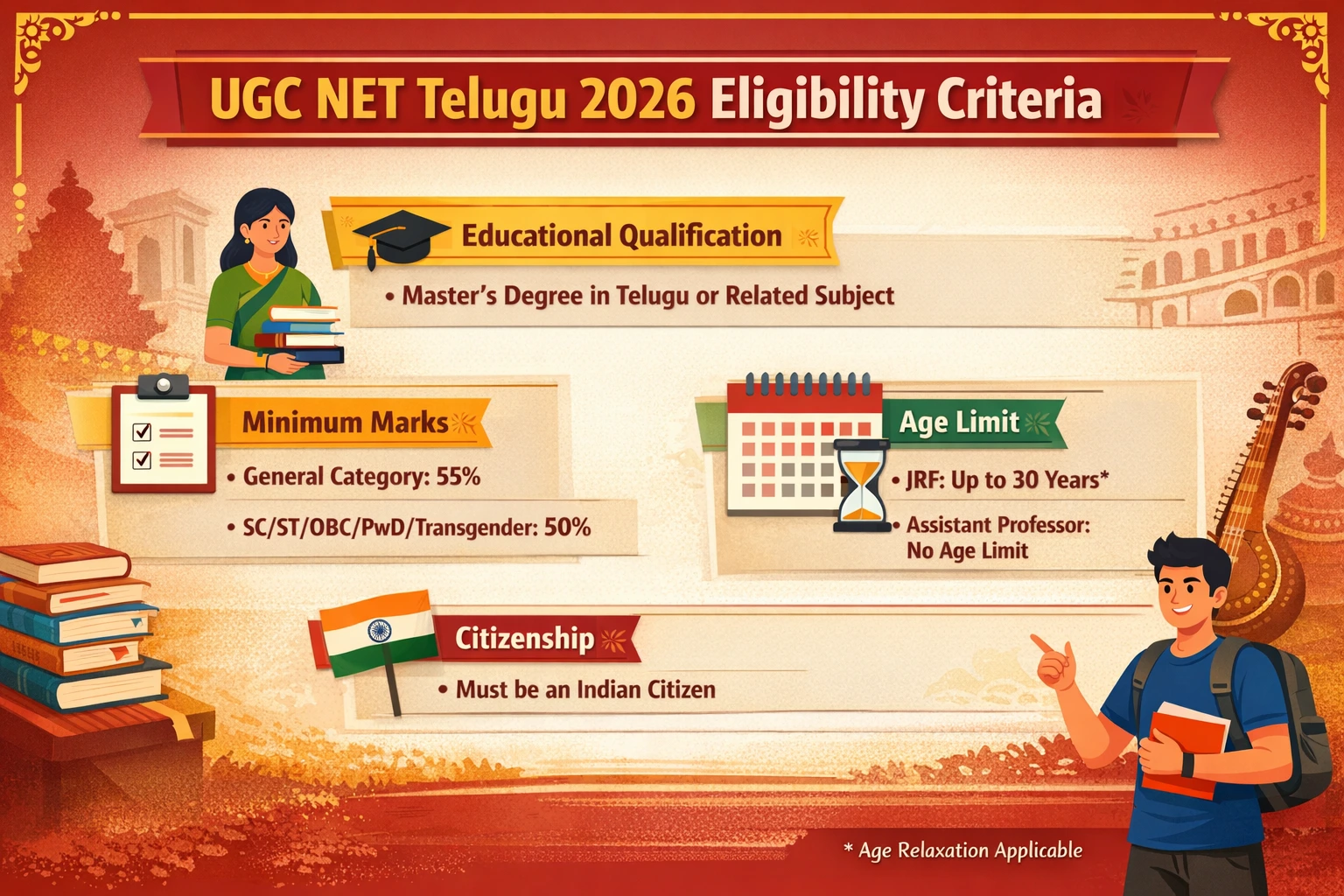
The UGC NET Telugu 2026 eligibility criteria, set by the National Testing Agency, define the essential requirements related to education, marks, age, and citizenship. Candidates must fulfill these conditions to apply for Assistant Professor and Junior Research Fellowship (JRF) positions in Telugu.
[metaslider id=”15521″]
UGC NET Telugu 2026 Key Eligibility Points
-
Educational Qualification: Master’s degree in Telugu or a related subject from a recognized university
-
Minimum Marks:
-
General Category: 55%
-
SC/ST/OBC/PwD/Transgender: 50%
-
-
Age Limit:
-
JRF: Maximum 30 years (age relaxation applicable)
-
Assistant Professor: No upper age limit
-
-
Citizenship: Must be an Indian citizen
Also Read: UGC NET Exam 2026
UGC NET Telugu Exam Pattern 2026
The UGC NET Telugu 2026 exam is an objective-type test in the form of MCQs, which is conducted by the National Testing Agency. The test is divided into two papers, which are conducted in a single session without any break. The total time for the test is 3 hours. There is no negative marking in the test. Thus, it is important for candidates to attempt all the questions in the test strategically.
| Paper | Subject | Number of Questions | Marks |
|---|---|---|---|
| Paper 1 | General Aptitude | 50 | 100 |
| Paper 2 | Telugu | 100 | 200 |
| Total | — | 150 | 300 |
UGC NET Telugu 2026 Syllabus
The UGC NET Telugu 2026 Paper 2 is designed to assess the candidate’s in-depth knowledge of Telugu language, literature, grammar, criticism, and translation studies. Below is a topic-wise description of the major areas covered in the UGC NET Telugu 2026 Syllabus.
[metaslider id=”15521″]
History of Telugu Literature (Ancient to Modern)
This section covers the evolution of Telugu literature from the earliest times to the contemporary period. It includes:
- Contributions of major poets and writers such as Nannaya, Tikkana, Errana, Srinatha, Potana, Gurajada Apparao, Viswanatha Satyanarayana, Sri Sri, and others.
- Literary movements, Bhakti literature, court poetry, reformist literature, and post-independence trends.
- Influence of religion, society, and political contexts on Telugu literary traditions.
Classical and Modern Poetry
This part deals with various genres and trends in Telugu poetry, including:
- Classical poetry such as Prabandhas, Satakas, and devotional works.
- Modern poetry influenced by social and political ideologies like Romanticism, Progressivism, and Modernism.
- Study of prominent modern poets like Sri Sri, Devulapalli Krishna Sastry, C. Narayana Reddy, and others.
Telugu Grammar and Linguistics
This unit focuses on both traditional and modern aspects of Telugu grammar and linguistics:
- Topics include Sandhi, Samasa, Karaka, Taddhita, Kriyapada (verbs), etc.
- Concepts of phonology, morphology, syntax, and semantics in Telugu.
- Study of language structure, dialects, word formation, and linguistic variations within Telugu.
Literary Criticism and Prosody
This section aims to provide insights into:
- Indian literary theories such as Rasa, Dhvani, Vakrokti, Alankara, and Aucitya.
- Western literary theories including Formalism, Structuralism, Marxism, Feminism, and Postmodernism.
- Study of Telugu prosody (Chandas) – different meters and their significance in classical and modern poetry.
Drama, Fiction, Prose, and Modern Movements
This area covers:
- Development of Telugu drama from traditional theatre to modern stage plays.
- Growth of fiction and prose, including short stories, novels, essays, biographies, and travelogues.
- Key literary movements such as Abhyudaya Sahityam, Navya Sahityam, Dalit and Feminist literature, and Postmodernism in Telugu.
Comparative Literature & Translation
This section highlights:
- Comparative study of Telugu literature with other Indian and world literatures.
- Understanding translation theories and challenges in literary translation.
- Role of translations in shaping modern Telugu literature and major works translated into and from Telugu.
Also Read: UGC NET Syllabus 2026 PDF Download
UGC NET Telugu 2026 Syllabus PDF Link
Candidates preparing for the UGC NET Telugu 2026 exam must thoroughly understand the updated syllabus prescribed by the University Grants Commission (UGC). The syllabus outlines the key topics and sub-topics from which questions will be asked in Paper 2 (Telugu Subject). To aid in your preparation, the official syllabus is available in downloadable PDF format.
| UGC NET Telugu 2026 syllabus PDF Link | |
|---|---|
| UGC NET Telugu 2026 syllabus PDF | Download PDF |
UGC NET Telugu Previous Year Question Papers PDF Link
Practicing the UGC NET Telugu Previous Year Question Papers PDF helps candidates in multiple ways, such as improving time management, identifying important topics, and gaining familiarity with the exam structure.
[metaslider id=”15521″]
| Exam Name | Year | Download PDF |
| UGC NET Telugu | 2024 | Download PDF |
| UGC NET Telugu | 2023 | Download PDF |
| UGC NET Telugu | 2022 | Download PDF |
| UGC NET Telugu | 2021 | Download PDF |
| UGC NET Telugu | 2020 | Download PDF |
Also Read: UGC NET Previous Question Papers, Last 5 Years’ PDF
Preparation Tips for UGC NET Telugu 2026
- Make a study timetable and revise regularly.
- Practice PYQs & mock tests weekly.
- Refer to standard books on Telugu literature.
- Strengthen Paper 1 with reasoning, comprehension & teaching aptitude.
- Join online coaching or discussion groups for motivation and doubt-solving.
Conclusion
UGC NET Telugu 2026 FAQs
The UGC NET Telugu 2026 exam consists of two papers: Paper 1 (50 questions, 100 marks) and Paper 2 (100 questions, 200 marks), conducted in a single session of 3 hours.
Candidates must have a Master’s degree in Telugu or a related subject with at least 55% marks (50% for reserved categories). The JRF age limit is 30 years.