


The Vedic period is one of the most fascinating eras in ancient Indian history. It is divided into two phases: the Early Vedic Period (1500 BCE to 1000 BCE) and the Later Vedic Period (1000 BCE to 600 BCE). These phases witnessed significant cultural, social, and political changes, driven by the Aryans’ settlement and their interactions with local communities.
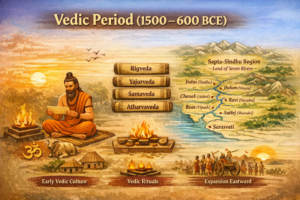
Vedic Period (1500 – 600 BCE)
The Vedic Civilization, also called the Vedic period or Vedic culture, emerged in ancient India between 1500 BCE and 600 BCE. This era was marked by the practice of Vedic religion and the creation of the Vedas, a collection of sacred texts forming the foundation of Hinduism. The Vedas preserved the knowledge, wisdom, traditions, and cultural practices of this remarkable civilization. These texts, passed down orally for generations, contain insights into cosmic knowledge and human life. Beyond being religious scriptures, the Vedas are a cornerstone of Indian culture and a significant contribution to human civilization.
What is a Veda?
The term Veda is derived from the Sanskrit root vid, meaning ‘to know’. It refers to the sacred knowledge preserved in Vedic texts, forming the spiritual and cultural foundation of ancient India. There are four Vedas Rigveda, Yajurveda, Samaveda, and Atharvaveda also called Samhitas, passed down orally for generations.
The Four Vedas
| Veda | Key Features | Priest | Notes |
| Rigveda | Oldest Veda; 10 mandalas; includes Gayatri Mantra & Purusha Sukta | Hotri | Contains hymns, prayers, and mantras for rituals |
| Yajurveda | Prose text; ritual manual for Adhvaryu priest; divided into Black (Krishna) & White (Shukla) | Adhvaryu | Guides execution of sacrificial rituals |
| Samaveda | Shortest Veda; Rigvedic verses arranged as songs | Udgatar | Meant for chanting during rituals |
| Atharvaveda | Contains spells, charms, hymns against evil, disease, misfortune | Atharvan | Latest Veda; includes some Rigvedic hymns |
Structure of Each Veda
| Section | Content & Purpose |
| Samhitas | Oldest part; contains hymns, prayers, mantras, and chants addressed to deities |
| Brahmanas | Prose interpretation of Samhitas; explains sacrificial rituals and outcomes |
| Aranyakas | Texts on forest life and meditation; symbolic and philosophical interpretations of rituals |
| Upanishads | Philosophical teachings on Atman, Brahman, sacrifice, the body, and the universe; 108 Upanishads, 13 most significant |
Aryan Debates Origins and Migration Theories for UGC NET
The Aryans were a group of people whose arrival in India shaped the course of ancient history. However, their origin and migration remain subjects of debate. Here are the key theories:
Top UGC NET Offline Coaching in Jaipur
Where Did the Aryans Come From?
Linguistic studies suggest that the Aryans spoke an early Indo-European language, which later evolved into Sanskrit. Many scholars believe that they originated from the Central Asian steppes or regions around modern-day Russia.
Migration Theories Explained
- Invasion Theory: Early historians proposed that the Aryans invaded India around 1500 BCE, leading to the fall of the Indus Valley Civilization. However, modern evidence suggests this “invasion” may have been a gradual migration rather than a military conquest.
- Migration Theory: Today, scholars generally agree that the Aryans migrated into India in waves, settling first in the Punjab region and later moving eastward into the fertile Ganges valley.
- Cultural Assimilation: Some experts argue that the Aryans blended their culture with the local populations, creating a fusion of traditions rather than a scenario of conflict.
Aryan Migration Theories
| Theory | Key Points | ||
| Invasion Theory |
|
||
| Migration Theory | Gradual settlement in Punjab and the Ganges valley. | ||
|
Aryans integrated with locals through cultural exchange. |
Top UGC NET Offline Classes in Jaipur
Geographical Horizons of Vedic Aryans
The early Vedic Aryans initially settled in a region called Sapta-Sindhu, meaning “land of seven rivers.” This area roughly covered the Punjab region and parts of Haryana, extending into the Gomal plains, southern Afghanistan, and southern Jammu and Kashmir according to Rigvedic references.
The seven rivers of Sapta-Sindhu were:
| River Name (Vedic) | Modern Name |
| Sindhu | Indus |
| Vitasta | Jhelum |
| Asikni | Chenab |
| Parushni | Ravi |
| Vipash | Beas |
| Shutudri | Sutlej |
| Sarasvati | Unknown / possibly Ghaggar-Hakra |
Vedic and Later Vedic Periods Political and Social Institutions
The Vedic period witnessed the evolution of political systems and social structures, shaping the foundations of Indian society.
Political Changes: From Chiefdoms to Kingdoms
Early Vedic Period:
- The political system was tribal and centered around small chiefdoms.
- Chiefs, known as rajan, were elected by tribal assemblies such as the Sabha (council of elders) and Samiti (general assembly).
- Power was shared, and decision-making was collective.
Later Vedic Period:
- The political structure transitioned to larger kingdoms, known as Mahajanapadas.
- Kings became powerful and started performing grand sacrifices like the Rajasuya (royal consecration) and Ashwamedha (horse sacrifice) to legitimize their rule.
- Assemblies like the Sabha and Samiti lost their influence as royal authority grew.
Political Evolution in Vedic Society
| Period | Political Structure | Key Features | ||||||
|
Tribal chiefdoms |
|
||||||
|
|
|
Social Institutions: The Varna System and Family Life
The Later Vedic Period saw the emergence of a more structured society. Let’s break it down:
The Varna System: Society was divided into four social groups or varnas:
- Brahmanas (Priests): Performed religious rituals and gained significant influence.
- Kshatriyas (Warriors): Protected the kingdom and maintained law and order.
- Vaishyas (Traders and Agriculturists): Engaged in trade, commerce, and agriculture.
- Shudras (Laborers): Provided manual labor and served the upper varnas.
The Four Varnas
| Varna | Role in Society |
| Brahmanas | Performed rituals and upheld religious order. |
| Kshatriyas | Warriors and administrators. |
| Vaishyas | Traders, merchants, and farmers. |
| Shudras | Laborers and service providers. |
Family and Gender Roles:
- Families were patriarchal, with the grihapati (male head of the household) holding authority.
- Monogamy was preferred, though polygamy was also practiced among the elite.
- Women played significant roles in the household but had limited public roles.
Shift in Religious Practices:
- Early Vedic worship centered on nature gods like Indra (god of rain and thunder) and Agni (fire god).
- During the Later Vedic Period, rituals became more elaborate, and the Brahmanas (priests) gained control over religious practices. Sacrifices such as Somayajna (Soma ritual) became central to worship.
Key points UGC NET Aspirants
- Early Vedic Period: A time of simple tribal societies with a focus on nature worship and shared political power.
- Later Vedic Period: Marked by centralized kingdoms, a rigid social hierarchy, and the dominance of priests in religion.
- Aryan Migration: A gradual cultural assimilation that shaped the Vedic civilization.
Vedic and Later Vedic Periods UGC NET State Structure and Theories of State Formation
The Vedic and Later Vedic periods (around 1500 BCE to 500 BCE) were crucial phases in Indian history. These eras saw the growth of political systems and social institutions that shaped the foundation of ancient Indian governance. Let’s explore how political structures evolved and understand the theories behind the formation of states during these periods.
Vedic Period: Political Structure in Ancient India
Early Vedic Period (1500 BCE – 1000 BCE)
- Tribal Organization:
- During this time, society was organized into tribes, known as Janas.
- The leader of the tribe was called the Rajan (chief), and he led the tribe during wars and important decisions.
- Decision-making was supported by tribal assemblies such as the Sabha (council of elders) and Samiti (general assembly).
- Shared Power and Equality:
- Power was decentralized, and the tribe’s leadership was relatively egalitarian.
- Men and women participated in the assemblies, and decisions were made collectively.
- For example, in a hypothetical Jana, a Rajan might consult elders in the Sabha before deciding on a new grazing area for cattle.
Best UGC NET Online Test Series
| Feature | Description |
| Leadership Role | Rajan led the tribe and consulted assemblies |
| Decision-Making Bodies | Sabha (elders) and Samiti (general assembly) |
| Social Organization | Tribes with equal participation |
Later Vedic Period (1000 BCE – 500 BCE)
As the early Vedic Aryans expanded eastward from the Sapta-Sindhu region, their society, economy, and religious practices evolved, giving rise to the Later Vedic Period (1000 BCE – 500 BCE).
Formation of Kingdoms:
- Tribal chiefdoms evolved into larger political units called Mahajanapadas (great kingdoms).
- Kings gained greater power and began to consolidate territories, leading to organized governance.
Rise of Kingship:
- The king’s role became more formalized, with titles such as Samrat (supreme ruler) becoming common.
- Kings enhanced their authority through grand rituals like the Ashwamedha Yajna (horse sacrifice), symbolizing their dominance over territories.
- For example, a king might release a ceremonial horse, and any territory it roamed became part of his domain if unchallenged.
Decline of Assemblies:
- Over time, assemblies like the Sabha and Samiti lost influence.
- These gatherings became dominated by nobles and priests, sidelining commoners and women from political decision-making.
| Feature | Early Vedic Period | Later Vedic Period |
| Leadership | Rajan with limited power | Kings with centralized authority |
| Political Units | Tribes (Janas) | Kingdoms (Mahajanapadas) |
| Assemblies | Active role of Sabha and Samiti | Reduced role, dominated by elites |
How Did Kingdoms Emerge in Ancient India?
The transition from small tribal groups to larger kingdoms in the Later Vedic period can be explained through several theories. These highlight the role of social, economic, and religious changes in shaping state structures.
Evolutionary Theory
- This theory suggests that states gradually developed as societies became more complex.
- With the shift from nomadic lifestyles to settled agriculture, people needed organized governance to manage land, surplus food, and defense.
- For instance, as villages formed around fertile river valleys, leaders were chosen to oversee irrigation and resolve disputes.
Conflict Theory
- This theory argues that states emerged from conflicts over resources like fertile land and water.
- Tribes competed with one another, and stronger leaders rose to power, organizing armies to protect their territories.
- For example, a powerful tribe in the Ganges valley might conquer smaller neighboring tribes to form a kingdom.
| Theory | Key Idea | Example Scenario | ||||||
|
|
|
||||||
| Conflict Theory |
|
Tribes fighting over fertile land |
Religious and Ideological Factors
- Religion played a big role in legitimizing kingship.
- Kings worked closely with Brahmins (priests) who conducted elaborate rituals to establish their divine right to rule.
- For example, the Rajasuya Yajna (royal consecration) elevated a king’s status as a representative of the gods on earth.
Economic Factors
- The transition to settled agriculture and the production of surplus food created the need for organized governance.
- Kings collected taxes or tributes to fund administrative and military activities.
- Trade also expanded during this period, requiring centralized authority to regulate markets and protect trade routes.
| Factor | Contribution to State Formation | Example | ||||
| Religion | Legitimized kingship |
|
||||
| Economy |
|
|
Legacy of the Vedic and Later Vedic Periods
The Vedic and Later Vedic periods laid the foundation for political and social systems in ancient India. The evolution from tribal chiefdoms to centralized kingdoms highlights the dynamic changes in governance, influenced by economic needs, conflicts, and religious practices. These developments not only shaped the Mahajanapadas but also provided a framework for the classical Indian political system. For UGC NET aspirants, understanding the theories of state formation offers valuable insights into how ancient societies evolved and governed themselves.
Conclusion
The Vedic and Later Vedic periods represent transformative phases in ancient Indian history, showcasing the shift from tribal societies to organized kingdoms. These eras laid the groundwork for India’s political, social, and religious structures. The evolution of governance, the emergence of the Varna system, and the interplay of economic, religious, and cultural factors highlight the dynamic development of early Indian civilization. Understanding these transitions is crucial for grasping the foundational elements of ancient Indian history for UGC NET preparation.
Vedic and Later Vedic Periods FAQs

Who were the Aryans, and how did they influence Indian history?
The Aryans were Indo-European-speaking people who migrated to India, shaping its history through cultural assimilation and the development of the Vedic civilization.
What changes occurred in political systems during the Vedic period?
Early Vedic society was tribal and decentralized, while the Later Vedic period saw the rise of centralized kingdoms (Mahajanapadas) and powerful kingship.
What was the Varna system, and how did it structure society?
The Varna system divided society into four groups: Brahmanas (priests), Kshatriyas (warriors), Vaishyas (traders), and Shudras (laborers), establishing a hierarchical social order.
What role did religion play in state formation during the Vedic period?
Religion legitimized kingship, with rituals like the Rajasuya and Ashwamedha Yajnas elevating the king's divine status and reinforcing centralized power.