
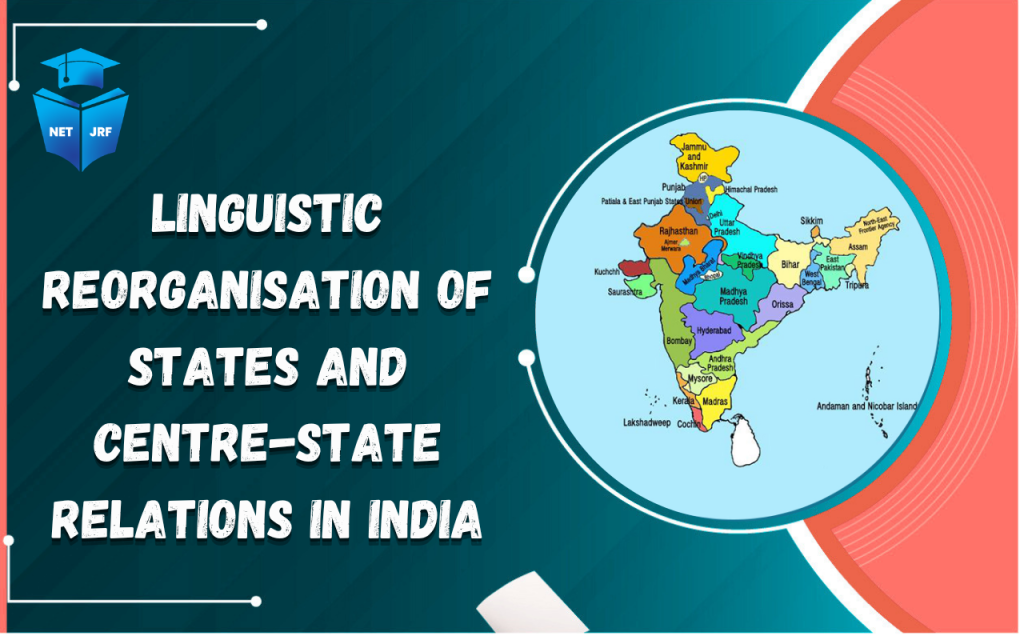

Linguistic Reorganisation of States and Centre became one of the most important developments in the political history of independent India. After independence in 1947, the Indian Union inherited provincial boundaries created by the British administration. These boundaries often ignored linguistic identities and cultural traditions of local populations. As a result, strong public movements demanded the creation of states based on language. The policy known as Linguistic Reorganisation of States and Centre attempted to address these demands while maintaining national unity and administrative stability.
Enroll UGC NET Online Coaching
The Indian leadership faced a difficult challenge. They needed to respect regional linguistic identities without weakening the federal structure of the country. Through debates, commissions, and legislative reforms, the government reorganized state boundaries in several phases.

State Reorganisation
At the time of independence, India consisted of former British provinces and princely states that had recently joined the Indian Union. The boundaries of these regions did not correspond with linguistic or cultural identities.
- Many leaders initially feared that linguistic states could encourage regional divisions. However, public movements across different regions demanded administrative units that reflected linguistic communities.
- The growing debate about regional identity gradually led to discussions regarding Linguistic Reorganisation of States and Centre.
Early Demands for Linguistic States
Language has always played a central role in Indian social and cultural life. Many communities believed that administration in their own language would improve governance and education.
- Several regions started demanding separate states based on linguistic identity. One of the earliest examples involved the Telugu speaking population of the Madras Presidency.
- The movement led by Potti Sriramulu became a turning point in the debate over Linguistic Reorganisation of States and Centre.
- Sriramulu began a hunger strike demanding the creation of a separate Telugu speaking state. After his death in 1952, large protests forced the government to respond.
Creation of Andhra State
The government eventually agreed to create a separate state for Telugu speaking people.
- In 1953, Andhra State was formed from the Telugu speaking regions of the Madras Presidency.
- This event marked the first major step toward Linguistic Reorganisation of States and Centre in independent India.
- The creation of Andhra State demonstrated the strength of linguistic identity in Indian politics.
Formation States Reorganisation Commission
Following the creation of Andhra State, demands for linguistic states emerged across the country.
To study the issue carefully, the government established the States Reorganisation Commission.
The commission included three members:
- Fazl Ali
- K. M. Panikkar
- H. N. Kunzru
Their report played a decisive role in shaping the Linguistic Reorganisation of States and Centre.
Principles Suggested by Commission
The commission examined social, cultural, administrative, and economic factors before recommending changes.
Important principles included:
- Linguistic identity should receive recognition
- Administrative efficiency should remain a priority
- Economic viability of states must be considered
- National unity should remain protected
These principles guided the policy decisions related to Linguistic Reorganisation of States and Centre.
Linguistic Reorganisation of States and Centre Timeline
major milestones in Linguistic Reorganisation of States and Centre.
| Year | Event | Significance |
| 1953 | Andhra State created | First linguistic state |
| 1953 | States Reorganisation Commission formed | Study of state boundaries |
| 1956 | States Reorganisation Act passed | Major restructuring of states |
| 1960 | Gujarat and Maharashtra created | Division of Bombay State |
States Reorganisation Act of 1956
The States Reorganisation Act of 1956 was one of the most important political reforms in post-independence India. After independence in 1947, many regions demanded that state boundaries be reorganized according to linguistic identity.
- People believed that administration would be more effective if states were formed where the majority of people spoke the same language.
- To examine these demands, the government appointed the States Reorganisation Commission under the leadership of Fazl Ali.
- Based on its recommendations, the government passed the States Reorganisation Act, which reorganized the boundaries of Indian states primarily on linguistic lines.
Important changes included:
- Reduction of administrative complexity by reorganizing provinces
- Formation of states based on dominant regional languages
- Redrawing of state boundaries for more efficient governance
This Act significantly transformed the political map of India and strengthened the process of Linguistic Reorganisation of States and Centre.
Major Linguistic States Created
After the reorganisation process, several states were created or reorganized according to linguistic identity.
Examples include:
- Andhra Pradesh for Telugu speakers (earlier created in 1953 after the movement led by Potti Sriramulu)
- Kerala for Malayalam speakers
- Karnataka (earlier Mysore) for Kannada speakers
- Maharashtra for Marathi speakers
- Gujarat for Gujarati speakers
These changes reflected the growing recognition of linguistic identity in Indian politics and governance.
Impact on the Indian Federal Structure
The reorganisation of states had a significant influence on the federal structure of India.
- Strengthening Regional Identity
Linguistic states allowed people to use their native languages in administration, education, and political participation. This made governance more accessible and strengthened regional cultural identity. - Administrative Efficiency
When government officials communicated with citizens in the same language, administration became more efficient. Policies and programs could be implemented more effectively at the local level. - Political Representation
Regional political parties gained stronger representation in state politics. This strengthened democratic participation and allowed regional issues to be better represented in governance.

Centre–State Relations in India
The reorganisation of states also affected the relationship between the central government and state governments. India follows a federal system where powers are shared between the Union and the states under the Constitution of India.
Important aspects of centre–state relations include:
- Legislative powers divided between Union, State, and Concurrent Lists
- Financial relations, including taxation powers and financial transfers from the centre to states
- Administrative coordination between national and regional governments
The process of linguistic reorganisation helped strengthen the federal framework by accommodating regional aspirations within the national political system.
Challenges Linguistic Reorganisation
Although linguistic reorganisation solved several political tensions, it also created new challenges.
Major concerns included:
- Regional political competition between states
- Presence of minority language groups within linguistically defined states
- Boundary disputes between neighboring states
Some disputes, such as the border issue between Maharashtra and Karnataka over the Belagavi region, show that linguistic boundaries were not always easy to determine.
Role in National Integration
Despite these challenges, the creation of linguistic states ultimately strengthened national unity. By recognizing linguistic identities, the Indian government reduced regional dissatisfaction and prevented larger separatist movements.
Citizens felt that their languages and cultures were respected within the democratic framework established through the Linguistic Reorganisation of States and Centre.
Enroll UGC NET Coaching in Jaipur
Long-Term Political Impact
The reorganisation of states continues to influence Indian politics even today. Over time, new states have been created based on administrative efficiency and regional demands, such as:
- Chhattisgarh
- Jharkhand
- Uttarakhand
These developments demonstrate how the principles of linguistic and regional reorganisation have shaped the evolution of Indian federalism and governance.
Enroll UGC NET Offline Coaching in Jaipur

Conclusion
The Linguistic Reorganisation of States and Centre represents a major milestone in the democratic evolution of India. By reorganizing states according to linguistic identities, the government responded to popular demands while preserving national unity. The work of the States Reorganisation Commission and the passage of the States Reorganisation Act transformed the political map of the country.