

UGC NET Philosophy Syllabus 2026 is prescribed by the National Testing Agency (NTA) for candidates appearing in the December session of the UGC NET examination. Philosophy is one of the oldest and most conceptual subjects offered in UGC NET under Subject Code 03. Candidates preparing for the examination must have a thorough understanding of both Paper 1 (Teaching & Research Aptitude) and Paper 2 (Philosophy) to qualify for Assistant Professor, Junior Research Fellowship (JRF), and PhD admission.
The UGC NET Philosophy syllabus focuses on Indian and Western philosophical traditions, ethics, logic, social and political philosophy, philosophy of religion, and applied philosophy. Since the syllabus is vast and concept-oriented, candidates should begin preparation early and follow a structured study plan.
UGC NET Philosophy Syllabus 2026 Overview
The UGC NET Philosophy exam 2026 is conducted by the National Testing Agency (NTA) to evaluate candidates for Assistant Professor and Junior Research Fellowship (JRF) positions. The test is conducted online (CBT) twice a year throughout India. It is conducted in both English and Hindi languages. The exam duration is 3 hours and consists of two papers. Check the UGC NET Philosophy 2026 overview:
| Feature | Details |
| Exam Name | UGC NET December 2026 |
| Conducting Authority | National Testing Agency (NTA) |
| Purpose | Eligibility for Assistant Professor & Junior Research Fellowship (JRF) |
| Exam Frequency | Twice a year |
| Exam Mode | Computer-Based Test (CBT) |
| Medium of Exam | English and Hindi |
| Total Duration | 3 Hours (180 Minutes) |
| Papers | Paper I (General) & Paper II (Subject-specific) |
| Subject Code for Philosophy | 03 |
| Official Website | https://ugcnet.nta.nic.in |

UGC NET Philosophy Syllabus 2026 PDF Download
The UGC NET Philosophy exam 2026 official syllabus is available to candidates in PDF format for efficient study. Key subjects and subtopics discussed in Paper I (Teaching & Research Aptitude) and Paper II (Philosophy subject-specific content) are listed in the syllabus. Aspirants can better arrange their study schedule and review key ideas at any time with the help of a downloadable PDF. The University Grants Commission’s (UGC) and the National Testing Agency’s (NTA) official websites offer the UGC NET Philosophy Syllabus 2026 PDF for download or click the link below for quick access.
Download UGC NET Philosophy Syllabus 2026
UGC NET Philosophy Syllabus 2026 PDF in Hindi
The syllabus being available in Hindi will be very helpful to candidates getting ready for the UGC NET Philosophy Exam 2026. It improves understanding of difficult ideas in their mother tongue, increasing the efficiency of preparation. In a structured manner, the UGC NET Philosophy Syllabus 2026 in Hindi covers every significant topic from Paper I (Teaching and Research Aptitude) and Paper II (Subject-specific – Philosophy). Candidates can use the following link to download the syllabus in Hindi:
यूजीसी नेट दर्शनशास्त्र सिलेबस 2026 डाउनलोड करें
UGC NET Syllabus Paper 1 PDF Download
All candidates, including those attempting to take the Philosophy (Subject Code: 03) exam, must take the UGC NET Paper 1. It evaluates general awareness, reasoning skills, comprehension, divergent thinking, and general teaching and research aptitude. This paper, which consists of 50 compulsory questions and 100 marks, is essential to overall exam performance. The official UGC NET Paper 1 Syllabus PDF is available for download through the link provided below.
Check UGC NET Syllabus Paper 1 PDF Download

UGC NET Philosophy Syllabus Breakdown (Subject Code: 03)
The objective of the UGC NET Philosophy Paper 2 syllabus is to assess a candidate’s thorough comprehension of various schools of Western and Indian philosophy, ethics, logic and sociopolitical thought.
UGC NET Paper 1 Topic Wise Syllabus
The UGC NET Paper 1, which is the same for all subjects, is to evaluate candidates’ research and teaching skills. It has 50 multiple-choice questions and 100 marks, and while it is not subject-specific, it is equally important. The syllabus is divided into units below to help you in effectively planning your preparation:
Know About UGC NET Philosophy Online Coaching 2026
| Unit No. | Topics | Key Areas Covered |
| 1 | Teaching Aptitude | Teaching nature, objectives, learner characteristics, teaching methods, aids, and evaluation systems |
| 2 | Research Aptitude | Research types and methods, steps, thesis writing, ICT in research, ethics |
| 3 | Comprehension | Reading comprehension passages with interpretation-based questions |
| 4 | Communication | Types, characteristics, barriers, effective classroom communication |
| 5 | Mathematical Reasoning and Aptitude | Number/letter series, coding, percentages, time-work, profit-loss |
| 6 | Logical Reasoning | Argument structure, deductive/inductive reasoning, analogies, Indian logic |
| 7 | Data Interpretation | Data sources, classification, quantitative & qualitative data, charts, graphs |
| 8 | Information and Communication Technology (ICT) | Basics of computers, internet, ICT in education, digital initiatives |
| 9 | People, Development and Environment | Environment issues, interaction, hazards, sustainable development |
| 10 | Higher Education System: Governance, Polity & Administration | Higher education policies, governance structure, commissions, reforms |
UGC NET Philosophy Paper 2 Topic Wise Syllabus
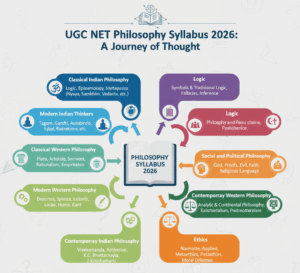
The UGC NET Philosophy Paper 2 syllabus is designed to test candidates’ in-depth knowledge of philosophical traditions, critical thinking, analytical ability, and awareness of both Indian and Western schools of thought. The syllabus is divided into ten comprehensive units, each covering key areas of philosophical inquiry and traditions Here’s a detailed topic-wise breakdown of the UGC NET Philosophy Paper 2 Syllabus:
| Unit No. | Unit Title | Key Topics Covered |
| Unit I | Classical Indian Philosophy | Nyaya, Vaisheshika, Samkhya, Yoga, Mimamsa, Vedanta (Advaita, Visistadvaita, Dvaita), Charvaka, Jainism, Buddhism, Pramanas, Moksha, Karma, Causation |
| Unit II | Modern Indian Thinkers | Vivekananda, Sri Aurobindo, Gandhi, Tagore, Ambedkar, J. Krishnamurti – Philosophy, Nationalism, Non-violence, Integral Yoga, Social Justice |
| Unit III | Classical Western Philosophy | Pre-Socratics, Socrates, Plato (Forms), Aristotle (Substance, Ethics), Descartes, Spinoza, Leibniz, Locke, Berkeley, Hume, Kant |
| Unit IV | Modern Western Philosophy | Hegel (Dialectics), Marx (Materialism), Nietzsche, Kierkegaard, Sartre, Husserl, Heidegger |
| Unit V | Contemporary Indian Philosophy | Radhakrishnan, Aurobindo, Gandhi, Krishnamurti, Ambedkar – Modern relevance, Ethical and Social thought |
| Unit VI | Contemporary Western Philosophy | Russell, Wittgenstein, Ayer, Austin, Ryle, Quine, Putnam – Logic, Language, Positivism, Analytical Trends |
| Unit VII | Ethics | Utilitarianism, Deontology, Virtue Ethics, Bioethics, Environmental Ethics, Indian Ethical Thought (Gita, Jainism, Buddhism, Charvaka) |
| Unit VIII | Social and Political Philosophy | Justice, Rights, Liberty, Equality, Democracy, Plato, Rousseau, Marx, Ambedkar, Caste, Nationalism, Secularism |
| Unit IX | Philosophy of Religion | God’s existence, Evil, Religious experience, Mysticism, Bhakti, Advaita, Interfaith dialogue, Pluralism |
| Unit X | Logic | Indian Logic (Nyaya, Navya-Nyaya), Western Logic (Propositional, Predicate), Truth tables, Syllogism, Symbolic Logic, Fallacies |
Check UGC NET Syllabus 2026 Here
UGC NET Philosophy Exam Pattern 2026
The National Testing Agency (NTA) conducts the UGC NET Philosophy Exam 2026 using a computer-based test (CBT) format. The purpose of the test is to determine a candidate’s eligibility for a Junior Research Fellowship (JRF) or Assistant Professorship in Philosophy (Subject Code: 03). The examination consists of two papers, both of which are mandatory.
Check UGC NET Exam Pattern 2026 Here
| Paper | No. of Questions | Total Marks | Duration | Type of Questions | Marks per Question |
| Paper I | 50 | 100 | 3 Hours | General Teaching & Research Aptitude | 2 |
| Paper II | 100 | 200 | Subject-Specific (Philosophy) | 2 | |
| Total | 150 | 300 | 3 Hours (Combined) |

Conclusion
The UGC NET Philosophy Syllabus 2026 provides a comprehensive roadmap for candidates preparing for the December session examination. Since Philosophy is a concept-based subject, success depends on building a strong understanding of Indian and Western philosophical traditions, ethics, logic, and socio-political thought. Candidates should complete the official syllabus, revise regularly, practice previous year papers, and attempt mock tests to improve performance. Consistent preparation with standard reference books and regular revision can significantly increase the chances of qualifying for Assistant Professor, JRF, and PhD admission through UGC NET.
UGC NET Philosophy Syllabus 2026 FAQs

Are UGC NET Philosophy candidates required to take Paper I?
Yes, regardless of subject, all UGC NET candidates must give Paper I.
In which languages is the UGC NET Philosophy exam conducted?
The exam is conducted in both English and Hindi.
Where can I download the UGC NET Philosophy syllabus PDF?
The official syllabus PDF is available for download via the article’s direct links or on the UGC NET website.
Which subjects are covered in UGC NET Philosophy Paper II?
Paper II covers detailed philosophical topics including Indian and Western philosophy, ethics, logic, contemporary thinkers, social and political philosophy, and philosophy of religion.