

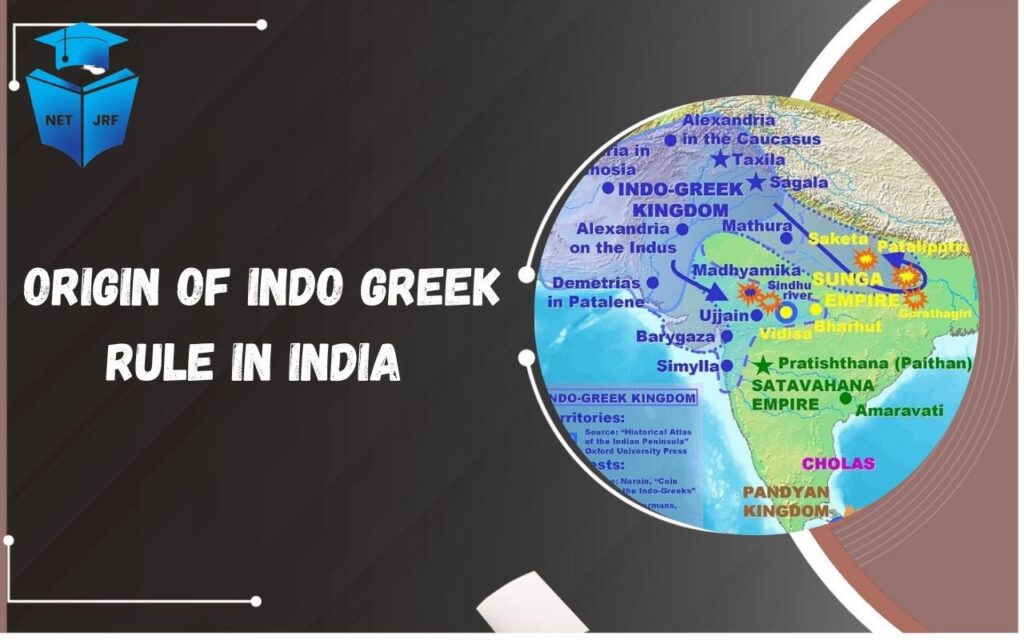
Origin of Indo-Greek rule in India begins with the expansion of Greek power into north-western regions after the decline of strong Indian empires. This phase represents an important turning point where foreign rulers entered Indian political space and established their authority.
Origin of Indo-Greek rule in India Background
The Origin of Indo-Greek rule in India can be traced back to the invasion of Alexander the Great in 326 BCE. Although Alexander did not stay long in India, his campaign opened the north-western gates for future Greek rulers. After Alexander’s death, his empire was divided among his generals. One of them, Seleucus Nicator, tried to control Indian territories but later made a treaty with Chandragupta Maurya. This limited Greek control in India for some time. However, after the decline of the Mauryan Empire, especially in the 2nd century BCE, the political situation became unstable. This created an opportunity for Greek rulers from Bactria to invade India. This situation led to the origin of Indo-Greek rule in India.
Causes behind Origin of Indo-Greek rule in India
There were several important reasons that led to the Origin of Indo-Greek rule in India.
-
Political weakness in India
-
-
- After Ashoka’s death, the Mauryan Empire weakened. Later rulers were not strong enough to maintain control. Regional governors started becoming independent. This political fragmentation made invasions easier.
-
-
Expansion policy of Bactrian Greeks
-
-
- The Greek rulers of Bactria were ambitious. They wanted to expand their territory towards India because of its wealth and resources. Their military strength helped them cross the Hindu Kush.
-
-
Economic attraction
-
-
- India was famous for its rich resources, trade routes, and fertile land. These factors attracted Greek rulers. Control over trade routes meant economic benefits.
-
-
Strategic location
North-western India was geographically accessible through passes like the Khyber Pass. This made invasion easier. These reasons together explain the Origin of Indo-Greek rule in India.
Best UGC NET Offline Classes in Jaipur
Establishment of Indo-Greek rule
The Origin of Indo-Greek rule in India is closely linked with the rule of Demetrius, the king of Bactria. He is considered the first Indo-Greek ruler who invaded India around 200 BCE.
- Demetrius crossed the Hindu Kush mountains and entered north-western India. He captured regions like Gandhara and Punjab. This marked the beginning of Indo-Greek political control.
- Later rulers expanded their territories further into India. They established a strong presence in the north-west. This phase clearly shows how the Origin of Indo-Greek rule in India developed into a stable political system.
Important Indo-Greek rulers
The Origin of Indo-Greek rule in India becomes clearer when we study its important rulers.
-
Demetrius
-
-
- Demetrius was the founder of Indo-Greek rule in India. He initiated the invasion and laid the foundation of Greek power in Indian regions.
-
-
Menander
-
-
- Menander, also known as Milinda, was one of the most famous Indo-Greek rulers. He ruled a large territory and is known for his interaction with Buddhism.
- The text Milinda Panha describes his discussions with a Buddhist monk named Nagasena. This shows cultural interaction during the Origin of Indo-Greek rule in India.
-
-
Other rulers
-
- There were many other rulers like Apollodotus and Antialcidas. They ruled different regions and issued coins. Their rule reflects the expansion phase after the Origin of Indo-Greek rule in India.
Administration under Indo-Greeks
The administration developed after the Origin of Indo-Greek rule in India was a mix of Greek and Indian systems.
- The rulers used Greek titles but also adopted local practices. They allowed local governance to continue. This helped them maintain control over diverse regions.
- Coins played an important role in administration. Indo-Greek coins were bilingual, using both Greek and Prakrit languages. This reflects their effort to connect with Indian subjects.
Top UGC NET Coaching in Jaipur
Economic impact
The Origin of Indo-Greek rule in India had a strong economic impact. Trade increased significantly during this period.
- The Indo-Greeks controlled important trade routes connecting India with Central Asia and the Mediterranean. Goods like spices, textiles, and precious stones were traded.
- Coins were widely used, which improved trade efficiency. Markets expanded, and urban centers grew. This shows that the Origin of Indo-Greek rule in India contributed to economic development.
Cultural interaction
One of the most important aspects of the Origin of Indo-Greek rule in India is cultural interaction.
-
Art and architecture
-
-
- Greek influence can be seen in Gandhara art. This style combined Greek realism with Indian themes. Buddha statues in this style show Greek artistic features.
-
-
Religion
-
-
- Many Indo-Greek rulers supported Indian religions. Menander is believed to have adopted Buddhism. This shows religious tolerance.
-
-
Language
-
- Greek and Prakrit languages were used together. Inscriptions and coins reflect this bilingual tradition.
- These cultural exchanges make the Origin of Indo-Greek rule in India a unique phase.
Decline of Indo-Greek rule
The decline started after internal conflicts and external invasions. The Indo-Greek rulers were divided into smaller kingdoms, which weakened their power.
- New groups like the Sakas and Parthians invaded India. They replaced Indo-Greek rulers in many regions.
- By the 1st century BCE, Indo-Greek power had almost disappeared. However, their influence continued in culture and trade. This completes the historical cycle of the Origin of Indo-Greek rule in India.
Enroll UGC NET Online Test Series
Indo-Greek Significance in Indian history
The Origin of Indo-Greek rule in India is significant because it marks the beginning of foreign rule in Indian history after the Mauryas.
- It shows how India interacted with other cultures. It also highlights the adaptability of Indian society in accepting new influences.
- This period laid the foundation for future interactions with Central Asian powers.
- The Origin of Indo-Greek rule in India represents a major transition in ancient Indian history. It began due to political weakness and foreign ambition, but it resulted in cultural growth and economic expansion.
Enroll UGC NET Foundation Course
|
Read UGC Notes |
||
| Unit | Topic | Link |
| Archaeological | Archaeological Sources for UGC NET | Open |
| Archaeological | Exploration in Archaeology | Open |
| Archaeological | Excavation Techniques in Archaeology | Open |
| Archaeological | Dating of Archaeological Sites | Open |
| Archaeological | Epigraphy — Study of Inscriptions | Open |
| Archaeological | Inscriptions in Reconstructing History | Open |
| Archaeological | Numismatics in History | Open |
| Archaeological | Importance of Coins in History | Open |
| Literary Sources | Meaning of Historical Sources | Open |
| Literary Sources | Literary Sources in History | Open |
| Literary Sources | Indigenous Literature | Open |
| Literary Sources | Dating Ancient Literary Sources | Open |
| Literary Sources | Secular Literature as Historical Source | Open |
| Literary Sources | Role of Myths & Legends in Historical Reconstruction | Open |
| Foreign Accounts | Foreign Accounts of India — Overview | Open |
| Foreign Accounts | Greek Accounts on Ancient India | Open |
| Foreign Accounts | Chinese Accounts on India | Open |
| Foreign Accounts | Arabic Accounts on India | Open |
| Neolithic & Chalcolithic | Neolithic and Chalcolithic Phases | Open |
| Neolithic & Chalcolithic | Hunting, Gathering & Food Production | Open |
| Neolithic & Chalcolithic | Neolithic Revolution in India | Open |
| Neolithic & Chalcolithic | Neolithic Settlements in India | Open |
| Neolithic & Chalcolithic | Distribution of Neolithic Cultures in India | Open |
| Neolithic & Chalcolithic | Tools and Technology in Neolithic Period | Open |
| Neolithic & Chalcolithic | Chalcolithic Culture in India | Open |
| Neolithic & Chalcolithic | Settlement Pattern & Economy in Chalcolithic Phase | Open |
| Neolithic & Chalcolithic | Trade & Exchange Networks in Chalcolithic Societies | Open |
| Indus Valley | Indus Valley Civilization — Overview | Open |
| Indus Valley | Major Sites of Indus Civilization | Open |
| Indus Valley | Urban Planning in Harappan Civilization | Open |
| Indus Valley | Architecture and Town Planning | Open |
| Indus Valley | Agriculture and Food Economy | Open |
| Indus Valley | Craft Specialization & Industrial Activities | Open |
| Indus Valley | Internal Trade of Harappan Civilization | Open |
| Indus Valley | Internal and External Trade | Open |
| Indus Valley | Social Structure of Indus Civilization | Open |
| Indus Valley | Political Organization of Harappan Civilization | Open |
| Indus Valley | Religion and Beliefs in Indus Civilization | Open |
| Indus Valley | Decline of Indus Civilization | Open |
| Indus Valley | Indus Civilization as First Urbanization | Open |
| Vedic Period | Vedic and Later Vedic Periods — Overview | Open |
| Vedic Period | Origin of Vedic Civilization | Open |
| Vedic Period | Aryan Debate — Migration, Invasion & Indigenous Theories | Open |
| Vedic Period | Early Vedic Society and Economy | Open |
| Vedic Period | Political Institutions in Early Vedic Period | Open |
| Vedic Period | Social Structure in Early Vedic Period | Open |
| Vedic Period | Later Vedic Society and Economy | Open |
| Vedic Period | Emergence of Varnas and Social Stratification | Open |
| Vedic Period | Emergence of Heterodox Sects in India | Open |
| Vedic Period | Impact of Iron Technology in India | Open |
| Miscellaneous | Megalithic Culture of South India | Open |
| Miscellaneous | Religious and Philosophical Vedic Ideas | Open |
| Miscellaneous | State System in Ancient India | Open |
Origin of Indo-Greek rule in India FAQs

How did Alexander influence Indo-Greek rule?
Alexander the Great invaded India in 326 BCE, opening north-western routes. His campaign created contact between India, Greek world. This later helped Greek rulers enter India.
Who was founder of Indo-Greek rule in India?
Demetrius I is considered founder of Indo-Greek rule in India. He invaded around 200 BCE from Bactria. He established Greek control in regions like Gandhara.
Why did Indo-Greeks invade India?
They were attracted by India’s wealth, trade routes, fertile land. Political weakness after Mauryas made invasion easier. Strategic passes like Khyber helped entry into India.
Who was Menander in Indo-Greek history?
Menander was a powerful Indo-Greek king also known as Milinda. He ruled large territories in north-west India. He is linked with Buddhism through Milinda Panha.