

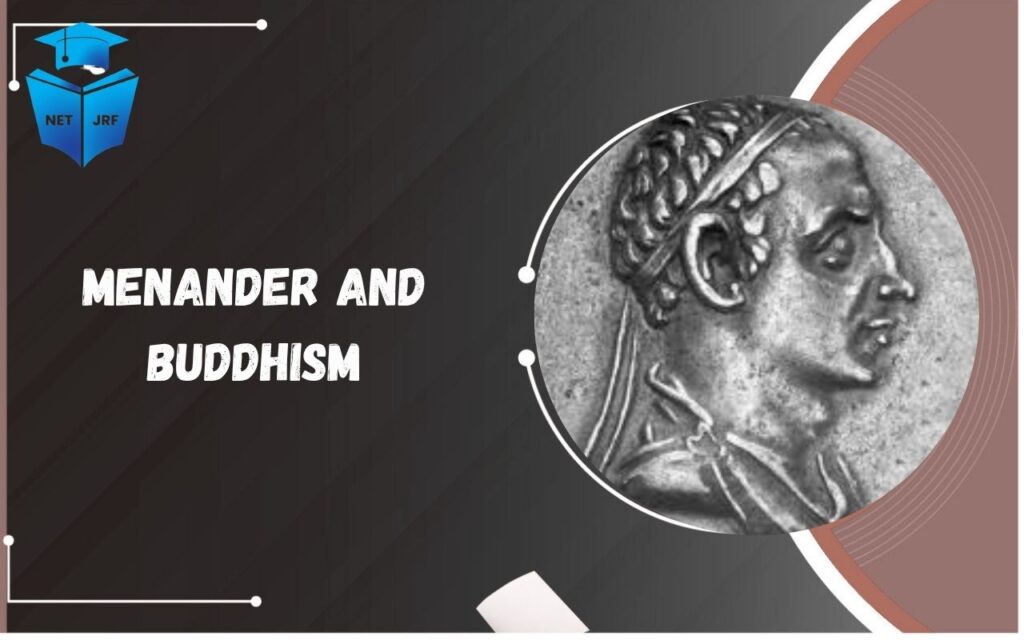
Menander and Buddhism is very important in ancient Indian history. The Menander and Buddhism relationship shows how a foreign ruler accepted Indian philosophical ideas, which created a strong bridge between Greek culture and Indian traditions.
Who was Menander?
Menander I, also known as Milinda, was one of the most powerful Indo-Greek kings who ruled in north-western India.
Basic Information
- He ruled around the 2nd century BCE when Indo-Greek power was strong
- His capital was Sagala, which is believed to be modern Sialkot
- His empire covered parts of Punjab, Afghanistan, and north-west India
Menander was not just a military ruler. He was also known for his interest in philosophy and learning. This made him different from many other kings of his time.
Historical Background of Indo-Greek Period
To understand Menander and Buddhism, we must first understand the Indo-Greek environment.
After the invasion of Alexander, many Greek rulers stayed in the north-western part of India. Over time, they mixed with local culture.
Best UGC NET Offline Coaching in Jaipur
Features of Indo-Greek Society
- There was a blending of Greek and Indian traditions
- Trade routes connected India with Central Asia and the Mediterranean
- New ideas and religions spread easily
This environment created the perfect condition for philosophical discussions and religious change.
Menander and Buddhism
The Menander and Buddhism relationship is mainly based on intellectual curiosity and philosophical dialogue.
Menander did not accept Buddhism blindly. He asked questions, challenged ideas, and tried to understand the deeper meaning of life. This shows that his connection with Buddhism was based on reasoning, not just belief.
Conversion of Menander
The Menander and Buddhism connection becomes stronger when we study his conversion story.
Role of Nagasena
Menander was deeply influenced by Nagasena, a learned Buddhist monk.
How the Conversion Happened
- Menander asked complex philosophical questions
- Nagasena answered them in a simple and logical way
- The discussion continued over many topics
These discussions impressed Menander so much that he accepted Buddhist teachings.
This type of conversion is very rare in history because it happened through debate and logic rather than force.
Milinda Panha
The Menander and Buddhism relationship is mainly known through a famous text called Milinda Panha.
What is Milinda Panha?
It is a Buddhist text that records the dialogue between King Menander and Nagasena.
Main Topics Discussed
- What is the self
- How karma works
- What is Nirvana
- Nature of rebirth
Best UGC NET Offline Classes in Jaipur
Menander and Buddhism Key Facts
Menander’s engagement with Buddhism illustrates how cross-cultural exchanges helped the teachings of the Buddha reach beyond India, gaining recognition and support from foreign rulers.
| Aspect | Description |
| Ruler | Menander (Milinda), Indo-Greek king |
| Teacher | Nagasena, Buddhist monk |
| Source | Milinda Panha text |
| Region | North-west India |
| Impact | Spread of Buddhist philosophy |
Nature of Dialogue
The Menander and Buddhism story is special because it is based on dialogue.
Features of Dialogue
- Question and answer format
- Logical reasoning
- Use of examples for clarity
For example, Nagasena explained the idea of no-self using the example of a chariot. This made it easy to understand.
This method shows that Buddhism encouraged questioning and thinking.
Philosophical Depth
The Menander and Buddhism interaction shows deep philosophical thinking.
Key Concepts Explained
- There is no permanent soul
- Everything changes with time
- Actions have consequences
- Liberation is possible through right path
Menander asked practical questions like a student. This makes the discussion very relatable.
Acceptance of Buddhism
The Menander and Buddhism relationship suggests that he became a follower of Buddhism.
Evidence
- Buddhist texts mention his conversion
- Traditions say his relics were distributed like Buddha’s
Debate
Some historians say he may not have fully converted but supported Buddhism.
Still, his respect for Buddhism is clearly visible.
Spread of Buddhism
The Menander and Buddhism connection helped Buddhism grow.
How It Spread
- Royal support increased acceptance
- Greek population became familiar with Buddhism
- Cultural exchange helped ideas travel
This shows how rulers play an important role in spreading religion.
Coins and Archaeological Evidence
The Menander and Buddhism link is also seen in material evidence.
Features of Coins
- Greek language on one side
- Indian symbols on the other
- Cultural fusion clearly visible
These coins show how cultures mixed during his rule.
Join UGC NET Online Test Series
Cultural Exchange
The Menander and Buddhism relationship is a great example of cultural exchange.
Key Elements
- Greek art influenced Indian sculpture
- Indian philosophy influenced Greek rulers
- Gandhara art developed from this mix
This period shows how cultures grow when they interact.
Strengths of Menander’s Contribution
The Menander and Buddhism story shows many positive aspects.
Contributions Explained
- He promoted open discussion, which encouraged learning
- He respected Indian traditions, which created harmony
- He helped spread Buddhist ideas beyond India
These contributions make him a unique historical figure.
Limitations and Historical Debate
The Menander and Buddhism topic also has some debates.
Key Issues
- Lack of direct archaeological proof of conversion
- Different interpretations by historians
Some scholars believe the story is symbolic rather than fully historical.
Long-Term Impact
The Menander and Buddhism connection had long-term effects.
Major Impacts
- Growth of Buddhism in north-west India
- Development of Gandhara art
- Influence on future cultural exchange
This shows that his role was not temporary.
Comparison with Ashoka
Menander and Buddhism can be compared with Ashoka.
Key Differences
- Ashoka spread Buddhism through state policy
- Menander spread it through discussion
Both approaches were different but effective.
In conclusion, the Menander and Buddhism relationship is a powerful example of cultural interaction and intellectual exchange. It shows how dialogue, reasoning, and openness can influence beliefs.
|
Read UGC Notes |
||
| Unit | Topic | Link |
| Archaeological | Archaeological Sources for UGC NET | Open |
| Archaeological | Exploration in Archaeology | Open |
| Archaeological | Excavation Techniques in Archaeology | Open |
| Archaeological | Dating of Archaeological Sites | Open |
| Archaeological | Epigraphy — Study of Inscriptions | Open |
| Archaeological | Inscriptions in Reconstructing History | Open |
| Archaeological | Numismatics in History | Open |
| Archaeological | Importance of Coins in History | Open |
| Literary Sources | Meaning of Historical Sources | Open |
| Literary Sources | Literary Sources in History | Open |
| Literary Sources | Indigenous Literature | Open |
| Literary Sources | Dating Ancient Literary Sources | Open |
| Literary Sources | Secular Literature as Historical Source | Open |
| Literary Sources | Role of Myths & Legends in Historical Reconstruction | Open |
| Foreign Accounts | Foreign Accounts of India — Overview | Open |
| Foreign Accounts | Greek Accounts on Ancient India | Open |
| Foreign Accounts | Chinese Accounts on India | Open |
| Foreign Accounts | Arabic Accounts on India | Open |
| Neolithic & Chalcolithic | Neolithic and Chalcolithic Phases | Open |
| Neolithic & Chalcolithic | Hunting, Gathering & Food Production | Open |
| Neolithic & Chalcolithic | Neolithic Revolution in India | Open |
| Neolithic & Chalcolithic | Neolithic Settlements in India | Open |
| Neolithic & Chalcolithic | Distribution of Neolithic Cultures in India | Open |
| Neolithic & Chalcolithic | Tools and Technology in Neolithic Period | Open |
| Neolithic & Chalcolithic | Chalcolithic Culture in India | Open |
| Neolithic & Chalcolithic | Settlement Pattern & Economy in Chalcolithic Phase | Open |
| Neolithic & Chalcolithic | Trade & Exchange Networks in Chalcolithic Societies | Open |
| Indus Valley | Indus Valley Civilization — Overview | Open |
| Indus Valley | Major Sites of Indus Civilization | Open |
| Indus Valley | Urban Planning in Harappan Civilization | Open |
| Indus Valley | Architecture and Town Planning | Open |
| Indus Valley | Agriculture and Food Economy | Open |
| Indus Valley | Craft Specialization & Industrial Activities | Open |
| Indus Valley | Internal Trade of Harappan Civilization | Open |
| Indus Valley | Internal and External Trade | Open |
| Indus Valley | Social Structure of Indus Civilization | Open |
| Indus Valley | Political Organization of Harappan Civilization | Open |
| Indus Valley | Religion and Beliefs in Indus Civilization | Open |
| Indus Valley | Decline of Indus Civilization | Open |
| Indus Valley | Indus Civilization as First Urbanization | Open |
| Vedic Period | Vedic and Later Vedic Periods — Overview | Open |
| Vedic Period | Origin of Vedic Civilization | Open |
| Vedic Period | Aryan Debate — Migration, Invasion & Indigenous Theories | Open |
| Vedic Period | Early Vedic Society and Economy | Open |
| Vedic Period | Political Institutions in Early Vedic Period | Open |
| Vedic Period | Social Structure in Early Vedic Period | Open |
| Vedic Period | Later Vedic Society and Economy | Open |
| Vedic Period | Emergence of Varnas and Social Stratification | Open |
| Vedic Period | Emergence of Heterodox Sects in India | Open |
| Vedic Period | Impact of Iron Technology in India | Open |
| Miscellaneous | Megalithic Culture of South India | Open |
| Miscellaneous | Religious and Philosophical Vedic Ideas | Open |
| Miscellaneous | State System in Ancient India | Open |
Menander and Buddhism FAQs

What is connection between Menander and Buddhism?
The connection is based on philosophical discussions with Nagasena. Menander asked deep questions about life, karma, Nirvana. These dialogues show intellectual engagement with Buddhism.
What is Milinda Panha?
Milinda Panha is a famous text recording dialogue between Menander, Nagasena. It explains Buddhist ideas in simple question-answer format. It is main source for this topic.
Did Menander convert to Buddhism?
Some traditions say Menander accepted Buddhism after discussions. His relics were treated like Buddhist tradition. However, some historians debate full conversion.
Who was Nagasena?
Nagasena was a learned Buddhist teacher. He explained complex ideas using logic, examples. His discussion influenced Menander deeply.
What topics were discussed in their dialogue?
They discussed self, karma, rebirth, Nirvana. Questions were practical, logical in nature. This made Buddhist philosophy easier to understand.
How did Menander help spread Buddhism?
Royal support increased acceptance of Buddhism. Greek population became aware of Buddhist teachings. Cultural exchange helped ideas spread beyond regions.
What is importance of this interaction?
It shows peaceful cultural exchange between Greek, Indian traditions. Philosophy was spread through debate, reasoning. It reflects openness of ancient society.