
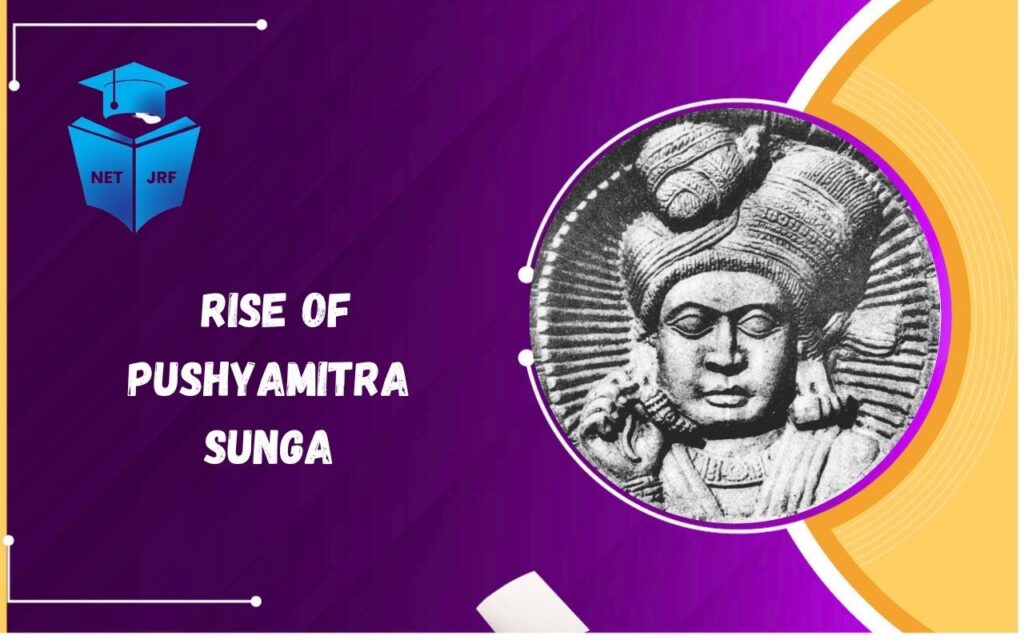

The Rise of Pushyamitra Sunga is one of the most important turning points in ancient Indian history. The Rise of Pushyamitra Sunga shows how a powerful empire like the Mauryas declined and a new political system emerged in India.
Political Situation Before the Rise
To understand the Rise of Pushyamitra Sunga, we must first look at the condition of India after Ashoka.
After Ashoka’s death, the Mauryan Empire started losing its strength slowly. The empire had once been very large, but now it became difficult to manage.
Reasons for Weakening
- The rulers after Ashoka were not strong leaders
- Administration became loose and ineffective
- Communication across the empire became slow
- Provincial governors started acting independently
This situation created confusion and instability, which prepared the ground for the Rise of Pushyamitra Sunga.
Join UGC NET Coaching in Jaipur
Rise of Pushyamitra Sunga
The Rise of Pushyamitra Sunga began with a dramatic political event.
Pushyamitra Sunga was a commander-in-chief of the Mauryan army under Brihadratha Maurya.
The Power Seizure
- During a military parade, Pushyamitra killed Brihadratha
- He immediately took control of the throne
- Around 185 BCE, he founded the Sunga dynasty
This moment clearly marks the Rise of Pushyamitra Sunga and the end of Mauryan rule.
Causes Behind Rise of Pushyamitra Sunga
The Rise of Pushyamitra Sunga was not sudden. Many long-term factors played a role.
Weak Mauryan Rulers
After Ashoka, rulers failed to maintain control.
- No strong central authority
- Weak leadership in provinces
- Declining respect for the king
This created an opportunity for a military leader.
Strong Position of the Army
Pushyamitra controlled the army, which gave him power.
- Soldiers were loyal to him
- He had direct command over military forces
- He used this strength to overthrow the king
This factor was very important in the Rise of Pushyamitra Sunga.
Administrative Breakdown
The Mauryan system was highly centralized.
- Once it weakened, administration collapsed
- Local officials gained more power
- Law and order became weak
This made it easier for new rulers to emerge.
Religious and Social Factors
Some historians connect the Rise of Pushyamitra Sunga with religious changes.
- Mauryan rulers supported Buddhism
- Brahmanical groups wanted revival of Vedic traditions
Pushyamitra supported Brahmanical practices, which gained him support.
Establishment of Sunga Dynasty
The Rise of Pushyamitra Sunga led to the formation of a new ruling dynasty.
Main Features
- Capital remained at Pataliputra
- Control over northern and central India
- Strong focus on military power
This marked the beginning of the post-Mauryan political phase.
Join UGC NET Offline Coaching in Jaipur
Political Impact of Rise of Pushyamitra Sunga
The rise of Pushyamitra Shunga marked a significant turning point in Indian politics after the decline of the Maurya Empire. His ascent reshaped the political landscape and initiated a new era of regional powers.
Major Changes
End of a Centralized Empire
- The fall of the last Mauryan ruler ended strong central authority.
- Political control shifted from a single emperor to multiple regional powers.
Beginning of Regional Political Powers
- Provinces and local rulers gained independence.
- Several kingdoms emerged, such as the Shungas in Magadha and others across northern and central India.
Decline of Strong Imperial Authority
- The central government lost its ability to enforce law and governance across the subcontinent.
- Regional rulers now exercised power based on local resources and military strength.
Fragmented Political Structure
- India transitioned from a unified empire to a collection of smaller, often competing states.
- This period set the stage for the rise of new dynasties and regional cultures.
Military Strength and Achievements
The rise of Pushyamitra Shunga underscores the critical role of military power in establishing and maintaining authority in Post-Mauryan India. His reign demonstrated how strong military leadership could stabilize a fragmented political landscape.
Key Achievements
Maintained Control over Northern India
- Pushyamitra Sunga secured key regions of the former Mauryan Empire.
- His military campaigns ensured dominance over strategic territories.
Defended Against Foreign Invasions
- Actively repelled incursions from foreign powers attempting to enter India from the northwest.
- This safeguarded the cultural and political integrity of the region.
Strengthened Internal Security
- Suppressed rebellions and revolts within the empire.
- Maintained law and order, ensuring stability across his territories.
Conflict with Indo-Greeks
The rise of Pushyamitra Shunga played a crucial role in defending India’s north-western territories during the Post-Mauryan period. His actions ensured political stability and protected regional sovereignty.
Importance
Indo-Greek Expansion Attempts
- The Indo-Greeks sought to extend their control into Indian territories, particularly in the northwest.
- Their ambitions threatened the security of Indian kingdoms.
Resistance by Pushyamitra Sunga
- Pushyamitra actively opposed Indo-Greek advances.
- Military campaigns and strategic defense prevented their penetration into key regions.
Protection of Indian Regions
- By repelling foreign invasions, he safeguarded political, cultural, and economic centers.
- His resistance ensured the continuity of local governance and regional stability.
Best UGC NET Foundation Course
Religious Policy of Pushyamitra
The rise of Pushyamitra Shunga brought notable religious changes in Post-Mauryan India. His reign reflected a shift in royal patronage and ritual practices, which influenced the religious landscape of the time.
Key Points
Support for Brahmanism
- Pushyamitra patronized Brahmanical traditions and priests.
- His policies strengthened the influence of the Brahmin community in political and social spheres.
Performance of Ashvamedha Yajna
- He conducted the Ashvamedha (horse sacrifice) ritual to assert imperial authority and legitimacy.
- This demonstrated his power and reinforced traditional Vedic practices.
Promotion of Vedic Rituals
- Vedic ceremonies and sacrifices were actively encouraged during his reign.
- This emphasized the continuity of ancient Hindu rituals after the Mauryan decline.
Relationship with Buddhism
- Some historical texts suggest Pushyamitra may have opposed Buddhist institutions.
- However, modern historians debate the extent of this conflict, and evidence remains inconclusive.
Administration Under Sunga Rule
The Rise of Pushyamitra Sunga led to a different administrative system.
Features
- Less centralized than Mauryan administration
- More power to local rulers
- Strong role of military officials
This system suited the changing political conditions.
Economic Conditions
The Rise of Pushyamitra Sunga did not harm the economy.
Key Features
- Agriculture remained strong
- Trade routes continued
- Local markets developed
Economic life stayed stable during his rule.
Cultural Developments
The Rise of Pushyamitra Sunga also influenced culture.
Contributions
- Growth of Sanskrit language
- Development of art forms
- Support for Brahmanical traditions
This period saw a cultural shift.
Strengths of Pushyamitra’s Rule
The rise of Pushyamitra Shunga highlights the strengths that enabled him to establish and maintain the Shunga dynasty after the fall of the Mauryan Empire.
Key Advantages
Strong Military Leadership
- Maintained control over northern India and frontier regions.
- Repelled foreign invasions, including attempts by Indo-Greeks to expand into Indian territories.
Stable Governance in Core Regions
- Consolidated power in Magadha and central areas.
- Established effective local administration and law enforcement.
Clear Political Control
- Asserted authority through rituals like Ashvamedha Yajna and administrative measures.
- Strengthened the legitimacy of the new dynasty and centralized decision-making.
Establishment of a New Dynasty
- Successfully founded the Shunga dynasty, replacing the Mauryan Empire.
- Created a political framework that lasted several decades in Post-Mauryan India.
Best UGC NET Foundation Batch Online
Limitations of His Rule
The rise of Pushyamitra Shunga, while successful in establishing the Shunga dynasty, also revealed several limitations that affected the long-term stability of his rule.
Key Problems
Limited Territorial Control
- The Shunga Empire did not cover as vast a region as the Mauryan Empire.
- Control was mainly over Magadha and central India, leaving peripheral regions less secure.
Weak Political Unity
- The empire lacked cohesion, with regional governors and smaller kingdoms retaining significant autonomy.
- Central authority was limited, which reduced long-term political stability.
Continuous Conflicts with Neighbors
- Frequent skirmishes with Indo-Greek rulers and other regional powers drained resources.
- Ongoing military engagements prevented full consolidation of power.
The Rise of Pushyamitra Sunga marks the end of Mauryan dominance and the beginning of a new political phase in India. It highlights the role of military power, weak leadership, and social changes.
|
Read UGC Notes |
||
| Unit | Topic | Link |
| Archaeological | Archaeological Sources for UGC NET | Open |
| Archaeological | Exploration in Archaeology | Open |
| Archaeological | Excavation Techniques in Archaeology | Open |
| Archaeological | Dating of Archaeological Sites | Open |
| Archaeological | Epigraphy — Study of Inscriptions | Open |
| Archaeological | Inscriptions in Reconstructing History | Open |
| Archaeological | Numismatics in History | Open |
| Archaeological | Importance of Coins in History | Open |
| Literary Sources | Meaning of Historical Sources | Open |
| Literary Sources | Literary Sources in History | Open |
| Literary Sources | Indigenous Literature | Open |
| Literary Sources | Dating Ancient Literary Sources | Open |
| Literary Sources | Secular Literature as Historical Source | Open |
| Literary Sources | Role of Myths & Legends in Historical Reconstruction | Open |
| Foreign Accounts | Foreign Accounts of India — Overview | Open |
| Foreign Accounts | Greek Accounts on Ancient India | Open |
| Foreign Accounts | Chinese Accounts on India | Open |
| Foreign Accounts | Arabic Accounts on India | Open |
| Neolithic & Chalcolithic | Neolithic and Chalcolithic Phases | Open |
| Neolithic & Chalcolithic | Hunting, Gathering & Food Production | Open |
| Neolithic & Chalcolithic | Neolithic Revolution in India | Open |
| Neolithic & Chalcolithic | Neolithic Settlements in India | Open |
| Neolithic & Chalcolithic | Distribution of Neolithic Cultures in India | Open |
| Neolithic & Chalcolithic | Tools and Technology in Neolithic Period | Open |
| Neolithic & Chalcolithic | Chalcolithic Culture in India | Open |
| Neolithic & Chalcolithic | Settlement Pattern & Economy in Chalcolithic Phase | Open |
| Neolithic & Chalcolithic | Trade & Exchange Networks in Chalcolithic Societies | Open |
| Indus Valley | Indus Valley Civilization — Overview | Open |
| Indus Valley | Major Sites of Indus Civilization | Open |
| Indus Valley | Urban Planning in Harappan Civilization | Open |
| Indus Valley | Architecture and Town Planning | Open |
| Indus Valley | Agriculture and Food Economy | Open |
| Indus Valley | Craft Specialization & Industrial Activities | Open |
| Indus Valley | Internal Trade of Harappan Civilization | Open |
| Indus Valley | Internal and External Trade | Open |
| Indus Valley | Social Structure of Indus Civilization | Open |
| Indus Valley | Political Organization of Harappan Civilization | Open |
| Indus Valley | Religion and Beliefs in Indus Civilization | Open |
| Indus Valley | Decline of Indus Civilization | Open |
| Indus Valley | Indus Civilization as First Urbanization | Open |
| Vedic Period | Vedic and Later Vedic Periods — Overview | Open |
| Vedic Period | Origin of Vedic Civilization | Open |
| Vedic Period | Aryan Debate — Migration, Invasion & Indigenous Theories | Open |
| Vedic Period | Early Vedic Society and Economy | Open |
| Vedic Period | Political Institutions in Early Vedic Period | Open |
| Vedic Period | Social Structure in Early Vedic Period | Open |
| Vedic Period | Later Vedic Society and Economy | Open |
| Vedic Period | Emergence of Varnas and Social Stratification | Open |
| Vedic Period | Emergence of Heterodox Sects in India | Open |
| Vedic Period | Impact of Iron Technology in India | Open |
| Miscellaneous | Megalithic Culture of South India | Open |
| Miscellaneous | Religious and Philosophical Vedic Ideas | Open |
| Miscellaneous | State System in Ancient India | Open |