
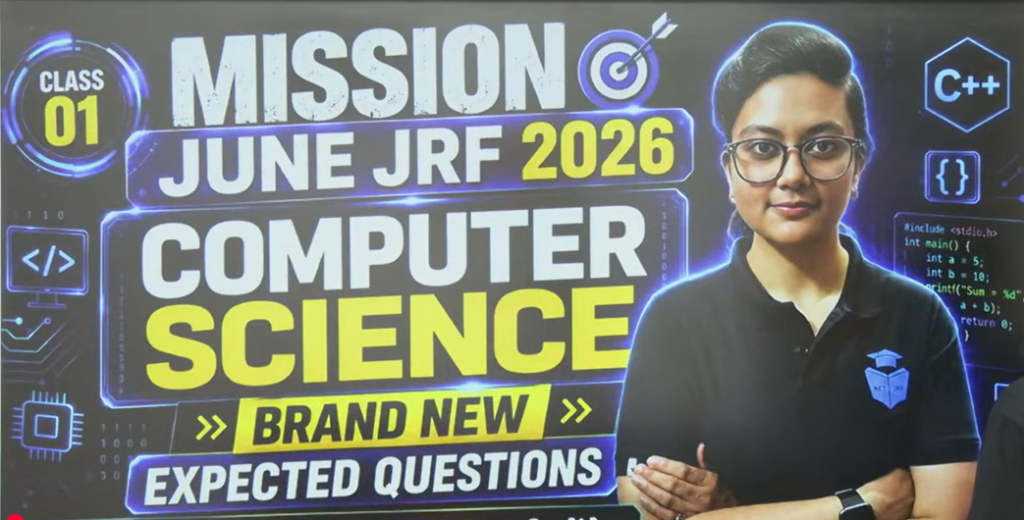

Preparing for the UGC NET Computer Science examination requires a smart strategy that combines conceptual clarity, previous year question analysis, and regular practice. Over the last few years, a noticeable trend has emerged in the exam pattern—many questions are either directly repeated from previous papers or are asked from the same concepts with slight modifications.
For UGC NET Computer Science 2026 aspirants, focusing on Previous Year Paper (PYP)-based expected questions can significantly improve performance. Topics such as Database Management Systems, Operating Systems, Computer Networks, Theory of Computation, Compiler Design, Data Structures, Algorithms, and Computer Organization continue to dominate the examination.
In this article, we will discuss some of the most important concepts and expected question areas that are highly likely to appear in the upcoming UGC NET Computer Science examination.
Attempt Free UGC NET 2026 Mock Test Series
Why Previous Year Papers Are Important for UGC NET Computer Science
Previous Year Papers help candidates understand:
- The pattern and difficulty level of questions.
- Frequently repeated concepts.
- Important topics across all units.
- Time management strategies.
- Exam-oriented preparation techniques.
Many questions appearing in SET examinations and GATE examinations are also being asked in UGC NET. Therefore, solving previous year questions from multiple examinations provides a strong competitive advantage.
Download UGC NET Computer Science Previous Year Question
Database Management System (DBMS) Important Questions
Functional Dependency and Relational Schema
Questions based on Functional Dependency remain one of the most frequently asked topics in UGC NET.
Candidates should focus on:
- Armstrong’s Axioms
- Functional Dependencies
- Attribute Closure
- Candidate Keys
- Normalization
- Lossless Join Decomposition
- Dependency Preservation
Check UGC NET Computer Science Notes 2026
Expected Question Type
If P, Q, R, and S are attributes of a relational schema and certain functional dependencies are given, identify which dependency inference is valid.
Such questions test the understanding of:
- Augmentation Rule
- Reflexivity Rule
- Transitivity Rule
These concepts are regularly asked in both NET and SET examinations.
UGC NET Computer Science Syllabus 2026 Download PDF
Operating Systems Important Questions
Process States and Context Switching
Questions related to process management are among the most repeated topics.
Important areas include:
- Process State Diagram
- Context Switching
- CPU Scheduling
- Ready State
- Running State
- Waiting State
- Blocked State

Expected Question Type
A process is currently executing on the CPU. Which event will definitely result in the process moving to a non-running state?
Candidates must understand scenarios involving:
- I/O Requests
- Page Faults
- Interrupts
- Timer Expiry
Attempt Free UGC NET 2026 Mock Test Series
Process State Diagram Revision
Every candidate should revise:
- New State
- Ready State
- Running State
- Waiting State
- Terminated State
- Suspended Ready State
- Suspended Blocked State
These concepts frequently appear in both theoretical and numerical questions.
Computer Networks Important Questions
TCP Connection and DNS Resolution
Questions involving TCP/IP communication and packet transmission are highly important.
Candidates should understand:
- DNS Resolution
- TCP Three-Way Handshake
- SYN Packets
- ACK Packets
- HTTP Requests
- Web Page Retrieval Process
Expected Question Type
Arrange the following events in chronological order when a user accesses a website:
- DNS Request
- TCP Handshake
- HTTP Request
- Web Page Download
Such questions test conceptual understanding rather than memorization.
TCP Sequence Number Questions
Numerical problems based on:
- Bandwidth
- RTT (Round Trip Time)
- Maximum Segment Lifetime
- Sequence Number Length
are frequently asked in UGC NET.
Students should practice calculations involving:
- Mbps to Bits Conversion
- Byte Addressing
- TCP Window Size
- Sequence Number Space
Theory of Computation (TOC)
Context-Free Grammar (CFG)
CFG-based questions remain one of the highest-weightage topics in Theory of Computation.
Important concepts include:
- Grammar Derivation
- Language Generation
- Parse Trees
- Ambiguity
- Context-Free Languages
Expected Question Type
Given a Context-Free Grammar, identify the language generated by it.
To solve such questions, students should:
- Generate sample strings.
- Identify recurring patterns.
- Eliminate incorrect options.
Attempt Free UGC NET 2026 Mock Test Series
Closure Properties
Another highly important topic is Closure Properties.
Candidates must remember:
| Operation | CFL Closed? |
| Union | Yes |
| Concatenation | Yes |
| Kleene Star | Yes |
| Intersection with Regular Language | Yes |
| Complement | No |
| Difference | No |
| Intersection of Two CFLs | No |
Questions based on these properties are asked repeatedly.
Concurrency Control and Transactions
Conflict Serializability
Transaction scheduling questions continue to appear regularly in UGC NET.
Important concepts include:
- Read-Write Conflict
- Write-Write Conflict
- Precedence Graph
- Conflict Serializable Schedules
- Recoverability
Expected Question Type
Given a transaction schedule, determine whether it is conflict serializable and identify the equivalent serial schedule.
Students should practice:
- Drawing Precedence Graphs
- Detecting Cycles
- Finding Valid Serial Orders
Algorithms and Analysis
Master Theorem
Master Theorem is one of the most important numerical topics.
Students must revise all cases:
- Case 1
- Case 2
- Case 3
Common questions involve solving recurrence relations such as:
- T(n) = 2T(n/2) + n
- T(n) = 3T(n/2) + n
- T(n) = T(n/2) + n
Regular practice can help solve these questions within seconds.
Attempt Free UGC NET 2026 Mock Test Series
Data Structures and Graph Theory
Minimum Spanning Tree (MST)
MST remains a favorite topic in competitive examinations.
Important algorithms:
- Prim’s Algorithm
- Kruskal’s Algorithm
Candidates should understand the difference between:
- Shortest Path
- Minimum Spanning Tree
Many students confuse these concepts, leading to incorrect answers.
Breadth First Search and Depth First Search
Important applications include:
Breadth First Search (BFS)
- Connected Components
- Shortest Path in Unweighted Graphs
- Level Order Traversal
Depth First Search (DFS)
- Topological Sorting
- Cycle Detection
- Graph Traversal
Questions comparing BFS and DFS are extremely common in NET examinations.
Computer Organization and Architecture
Cache Memory
Questions related to cache write policies are frequently repeated.
Important topics:
- Write Through Policy
- Write Back Policy
- Write Allocate
- No Write Allocate
Candidates should clearly understand the relationship between these policies and cache performance.
Translation Lookaside Buffer (TLB)
TLB-based numerical problems often appear in the exam.
Focus on:
- Virtual Address Space
- Physical Address Space
- Page Size
- Frame Number
- Address Translation
These questions usually require simple calculations but strong conceptual understanding.
Important Preparation Strategy for UGC NET Computer Science 2026
To maximize your score, follow this preparation plan:
Step 1: Solve Previous Year Questions
Complete at least:
- UGC NET PYPs
- SET PYPs
- GATE Previous Year Questions
Step 2: Revise High-Weightage Topics
Focus on:
- DBMS
- Operating Systems
- Computer Networks
- Theory of Computation
- Algorithms
- Data Structures
Attempt Free UGC NET 2026 Mock Test Series
Step 3: Attempt Mock Tests
Regular mock tests help in:
- Speed Improvement
- Accuracy Enhancement
- Concept Reinforcement
- Time Management
Step 4: Practice Numerical Problems Daily
Numerical questions from:
- TCP/IP
- TLB
- Master Theorem
- CPU Scheduling
- Semaphore

UGC NET Computer Science Most Expected Questions Based on Previous Year Papers FAQs

Which topics are most important for UGC NET Computer Science 2026?
Some of the most important topics include Functional Dependency and Normalization (DBMS), Process Scheduling and Context Switching (Operating Systems), TCP/IP and DNS (Computer Networks), Context-Free Grammar (TOC), Conflict Serializability (DBMS), Master Theorem (Algorithms), BFS and DFS (Graph Theory), and TLB and Cache Memory (Computer Organization).
How should I prepare numerical questions for UGC NET Computer Science?
Candidates should regularly practice numerical problems from TCP/IP, CPU Scheduling, Semaphore, TLB, Cache Memory, and Master Theorem. Understanding the underlying concepts and solving multiple practice questions can significantly improve speed and accuracy in the examination.
Is solving GATE and SET previous year questions useful for UGC NET Computer Science?
Yes, many concepts and question patterns from GATE and SET examinations are frequently seen in UGC NET Computer Science. Solving these papers helps candidates gain exposure to diverse question types and strengthens conceptual understanding.
What is the best revision strategy for UGC NET Computer Science 2026?
The best revision strategy includes solving previous year papers, revising high-weightage topics, attempting regular mock tests, and practicing numerical questions daily. Consistent revision of core subjects such as DBMS, Operating Systems, Computer Networks, Theory of Computation, Data Structures, and Algorithms can greatly improve exam performance.