Difference Between JRF, SRF and RA, Eligibility, Stipend, Roles
Understand the difference between JRF, SRF and RA, including eligibility criteria, stipend structure, roles, and career progression in research. This guide explains how these fellowships support PhD and postdoctoral research for UGC NET aspirants.
Rajesh Charnwal
Get in Touch with JRFAdda for All Your Needs!
Table of Contents
The difference between JRF, SRF, and RA is related to the hierarchy of research fellow positions that are generally offered in Indian universities and research organizations. These positions mark various stages of an academic research career, with distinct requirements and remuneration packages.
For candidates who are appearing for UGC NET or are about to pursue a PhD, it is important to know the difference between Junior Research Fellowship (JRF), Senior Research Fellowship (SRF), and Research Associate (RA). These positions indicate a definite career progression—from beginning research to becoming an independent researcher or project investigator.
The difference between JRF, SRF and RA can be understood based on eligibility, role, stipend, duration, and level of research responsibility. Each stage represents a higher level of research expertise and independence.
JRF full form is Junior Research Fellowship, which is the first research career for the postgraduate students who desire to carry out doctoral research in PhD in various fields. The University Grants Commission (UGC), Council of Scientific and Industrial Research (CSIR), and other government as well as private organizations are offering such JRF fellowships.
Aspect
Details
Eligibility Criteria
– Must have a Master’s degree or equivalent in the relevant subject.
– Must have qualified an entrance exam (e.g., UGC-NET, CSIR-JRF).
Age Limit
– General: 30 years.
– Relaxation for SC/ST/OBC/PWD/Women candidates (up to 5 years).
Duration
2 years (extendable to 5 years based on progress and evaluation).
Fellowship Amount
– Rs. 31,000 per month (for the first 2 years).
– Rs. 35,000 per month (for subsequent years after conversion to SRF).
Research Focus
Candidates are expected to engage in original research work in their respective fields of study.
Application Process
Apply through respective funding agencies (e.g., UGC, CSIR) based on their exam and fellowship guidelines.
Selection Process
Based on performance in the entrance exam, academic qualifications, and interview (if applicable).
Benefits
– Financial research support.
– Opportunity to gain experience in academia or research.
– Potential for further academic and career development.
A Senior Research Fellowship (SRF) is the next stage after JRF. It is granted to those researchers who have made satisfactory progress in their research work during the tenure of their JRF.
A research associate is a postdoctoral research position offered to those who have completed their PhD or have equivalent research experience. It continues the research of the scholar either academically or in industry.
Feature
Details
Eligibility
Must have completed a PhD in a relevant field.
Age Limit
Generally no specific age limit, but it may vary based on the institution’s or funding agency’s policy.
Duration
Typically 1-3 years, often extendable based on project requirements and funding availability.
Stipend
Varies widely, usually starting from INR 47,000/month up to INR 54,000/month, depending on the research project and funding.
Purpose
To conduct postdoctoral research, contribute to academic publications, mentor students, and lead research projects.
Selection Process
Based on academic qualifications, relevant research experience, and sometimes a personal interview.
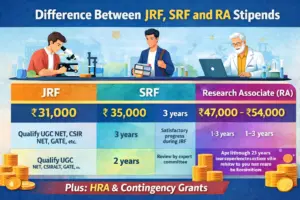
Difference between JRF, SRF and RA is clearly reflected in the stipend structure, which varies according to the level of fellowship and research experience. A JRF fellowship generally receives a fixed stipend, which increases upon promotion to SRF as the candidate demonstrates satisfactory progress and gains academic maturity. At the RA stage, the stipend is the highest, considering the advanced level of expertise, independent research responsibilities, and specialized contributions involved.
The candidates also receive additional benefits such as House Rent Allowance (HRA) and contingency grants to support research expenses. Therefore, the difference between JRF, SRF and RA is not only academic and experiential but also financial, reflecting progressive growth in responsibility and specialization.
Position
Stipend per Month
Duration
Eligibility
JRF
₹31,000
2 years
Qualify UGC NET, CSIR NET, GATE, etc.
SRF
₹35,000
3 years
Satisfactory progress during JRF, review by expert committee
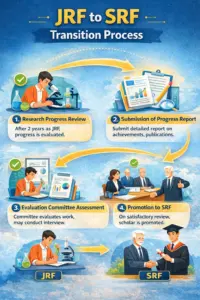
The transition from JRF to SRF is not an automatic process. The scholars have to show satisfactory research progress and then go through the evaluation process conducted by a committee.
Review of Research Progress
After two years of service as a JRF, the research progress of the scholar is assessed.
Submission of Progress Report
The scholar submits a progress report detailing research progress, publications, and current work.
Assessment by Evaluation Committee
The scholar’s work is assessed by an expert committee, which may also include an interview or presentation.
Promotion to SRF
If the scholar’s research is satisfactory, then the scholar is promoted to Senior Research Fellowship (SRF) with a higher stipend.
Understanding the difference between JRF, SRF and RA is essential for candidates who aspire to have a research and academic career. These posts symbolize various levels of a research career, beginning from entry-level research (JRF) to advanced doctoral research (SRF), and culminating in postdoctoral research leadership (RA). Each level provides enhanced responsibilities, increased salaries, and greater autonomy in research tasks. For candidates who are preparing for exams like UGC NET, this sequence offers a clear-cut way to become a researcher, academician, or professor.
JRF is the entrance level research position, SRF is for more experienced researchers while RA is for postdoctoral researchers with a PhD or experience of similar degree.
Aditi Sharma, founder of JRFAdda, is a Computer Science educator with an MCA degree and JRF qualification (99.91 percentile, Dec 2019). Her experience includes roles as an SBI SO (DBA), work at Cognizant, and over 5 years of teaching online and offline. She has also served as a Government Computer Teacher in Rajasthan.
Crack UGC NET With Us!
Get an Instant Callback from our Mentors!
Check Our Recommended Course
Get in Touch with JRFAdda for All Your Needs!
Talk to a Counsellor Now!
Have doubts? Our support team will be happy to assist you!