

The Lecturer vs Professor comparison is common in the academic world, especially for candidates preparing for the UGC NET. Both roles exist in universities and colleges, but they differ significantly in terms of qualifications, responsibilities, research involvement, career progression, and salary. In general, lecturers primarily focus on teaching and student guidance, whereas professors hold senior academic positions that combine teaching, research, publications, and institutional leadership. Understanding these differences is important for candidates planning a long-term academic career.
Also Read: UGC NET Assistant Professor 2026
Also Read: UGC NET Syllabus 2026
Lecturer vs Professor Overview
The Lecturer vs Professor Overview highlights the key differences between these two academic roles in higher education. A lecturer is generally an entry-level teaching professional who primarily focuses on delivering lectures, guiding students, and supporting undergraduate education. In contrast, a professor holds a senior academic rank and is responsible for a broader range of duties, including teaching at undergraduate and postgraduate levels, conducting research, publishing scholarly work, and contributing to institutional leadership.
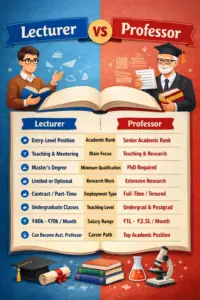
| Aspect | Lecturer | Professor |
|---|---|---|
| Academic Rank | Entry-level teaching position | Senior-most academic rank |
| Main Focus | Teaching and student mentoring | Teaching, research, publications, leadership |
| Minimum Qualification | Master’s Degree | PhD required |
| Research Work | Limited or optional | Extensive research required |
| Employment Type | Often contract or part-time | Full-time permanent position |
| Teaching Level | Mostly undergraduate | Undergraduate & postgraduate |
| Salary Range | ₹40,000 – ₹70,000/month | ₹1,00,000 – ₹2,50,000+/month |
| Career Progression | Can become Assistant Professor | Highest academic position |
What is a Lecturer?
A lecturer is an academic professional responsible primarily for teaching students in colleges or universities. They deliver lectures, prepare course materials, design assignments, and evaluate student performance.Lecturers play a vital role in helping students understand academic concepts and develop their subject knowledge.
Also Read: Best UGC NET Books 2026
They may also teach on short-term contracts or as adjunct faculty in any institution. The teaching position may differ by country and institution, but fundamentally, it is a teaching position responsible for facilitating student learning.
JRFAdda Gold June 2026 Political Science Batch (Paper1+Paper2)- Join Today!
Role of a Lecturer in Higher Education 2026
- Primary Responsibility: Teaching and Instructing
- Lecturers spend most of their time lecturing and tutoring, teaching complex ideas, and keeping students interested through innovative teaching techniques.
- Course Design and Curriculum Design
- They will frequently prepare course materials, assignment materials, and exam materials, all of which they ensure are at an academic level and also match the objectives and aims of the program.
- Student Support and Coaching
- The role of lecturers would primarily be to provide students with academic guidance through replying to their questions, making comments on assignments, and facilitating improvement in the understanding of a subject.
- Fewer Research Obligations
- Lecturers, unlike professors, usually have fewer research responsibilities. Their main concern remains teaching, although some lecturers may still conduct research based on the institution.
- Tenure and Employment Status
- Lecturers are mainly contracted on a temporary or fixed-term contract and, more often, are not tenured; hence, their appointment is more fluid but insecure than professors.
- Impact on Student Experience
- Lecturers are important in the creation of student academic experience due to providing direct interaction, mentorship, and attention to the student.

UGC NET Eligibility Criteria for Lecturer 2026
The UGC NET Eligibility criteria 2026 to become a lecturer are sometimes dependent upon the country, institution, or even the subject one teaches. Generally, the common expectations for the position of a lecturer are as follows:
- Educational Qualifications
- Master’s Degree: The minimum qualification for the position of lecturer in colleges or universities is usually a master’s degree in the relevant subject.
- Ph.D. (Optional, but Preferred): Many institutions prefer candidates with a Ph.D. or equivalent research qualifications, especially for positions in research-focused universities or prestigious institutions.
- NET or Equivalent Exam
- For Example, qualifying in the NET held by the UGC is a must for students who are seeking a lecturer position in the universities and colleges in India. Other countries may vary in that a student would have to qualify for certain examinations that might include the GRE or even national examination tests in other countries.
- Teaching Experience
- While not always a prerequisite, any teaching experience in the role of assistant lecturer, teaching assistant or similar could be beneficial.
- Subject Matter Requirements
- Some lecturing positions demand more than the minimum qualification. For example, in certain fields like engineering, medicine, or law, professional qualifications or experience may be demanded.
- Skills and Competencies
- Strong communication and presentation skills are essential. Lecturers must make simple complex concepts to an ordinary student.
- Organisational skills, research capacity and passion for teaching and learning are highly sought among those candidates.
- Age Limit
- Some institutions or a body of the government would fix certain age limits to join in an institution as lecturers when it is for a direct appointment or tenure track.
- Additional Requirements (For Some Institutions)
- Publications: Depending on the university, there may be a prerequisite for a certain number of research papers or publications as well, especially if this position is more research-oriented.
- Interview and Presentation: The candidates undergo personal interviews or sometimes an interview in the form of a demonstration lecture.
Also Read: UGC NET Eligibility 2026
What is a Professor?
A professor is a higher rank of senior academic professional in a college or university. Besides teaching, professors are also more engaged in research, scholarly activity and contributing to the field. They have most often higher degrees, high experience and high-level academic backgrounds. Professors generally teach both graduate and undergraduate students, supervising postdoctoral researchers or doctoral students.
Roles of a Professor 2026
- Teaching and Mentoring
- Professors teach a variety of courses, advise students, oversee theses or dissertations and help students develop academically and professionally.
- Research and Scholarship
- They conduct original research in their field of specialty, publish scholarly articles in refereed journals, and publish books and present papers at conferences to create new knowledge and contribute to the discipline.
JRFAdda Premium June 2026 Public Administration Batch Paper 2- Join Today!
- Academic Leadership
- Professors frequently take on departmental leadership positions that allow them to help determine curriculum, participate in the development of university policies and support junior faculty.
- Tenure and Job Security
- Professors are permanently employed, with academic freedom to conduct their research free from the threat of dismissal or loss of job.
- Long-Term Career and Specialization
- It is a career in academic professorship that normally takes many years of education and even more professional experience to attain. It is still one of the more prestigious careers in universities and other institutions of higher learning.
- Contributions to the Academic Community
- Professors can play important roles in altering the direction of their discipline in several aspects, including research, teaching and service to the university or academic community.
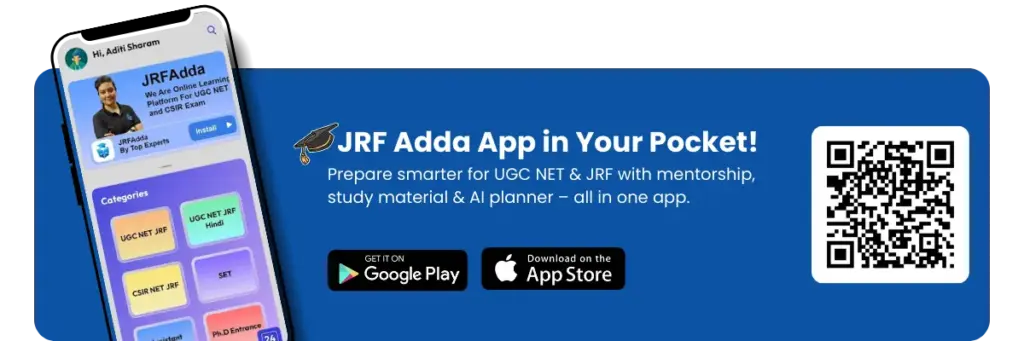
Eligibility Criteria for Professors 2026
The process to become a professor is pretty rigorous and involves strict academic and professional standards:
- Education Qualifications:
- Ph.D. in an appropriate subject area.
- Continuous scholarly activity, for example, by publishing articles in peer-reviewed journals.
- Teaching Experience:
- A minimum of 8-10 years of teaching experience, mostly as assistant or associate professors.
- Research Contributions:
- Published works, research projects and citations.
- Guiding Ph.D. students is sometimes an added requirement.
- Scholarly Accomplishments:
- Presence of recognition by academic groups and attendance at conferences and symposia.
Salary Differences Between Lecturer and Professor 2026
The salary difference between lecturers and professors depends on factors such as experience, institution, and academic rank.
| Position | Average Salary (Per Month) |
|---|---|
| Lecturer | ₹40,000 – ₹70,000 |
| Assistant Professor | ₹70,000 – ₹1,20,000 |
| Associate Professor | ₹1,20,000 – ₹1,80,000 |
| Professor | ₹1,00,000 – ₹2,50,000+ |
Also Read: UGC NET Salary 2026
Also Read: UGC NET Exam 2026
Career Path from Lecturer to Professor 2026
The lecturer-to-professor career path is an orderly but step-by-step process that involves the attainment of academic experience, enhanced qualifications and professional landmarks. Here’s a normal process:
- Lecturer: That would start with teaching and mentoring, focusing on developing subject expertise and gaining experience.
- Assistant Professor: An assistant professorship on the tenure track, combining teaching with research and publishing requirements.
- Associate professor: To be granted tenure based on excellence with regard to teaching, research and service; taking on leadership roles in the department.
- Professor: Attain the topmost rank by becoming a recognized expert, by leading research projects, mentoring at all levels and contributing to university governance.
Also Read: Job Opportunities After Qualifying UGC NET
Responsibilities of Teaching vs Research 2026
While both teaching and research are important, the time dedicated to these activities might become unbalanced. Teaching involves time and energy invested in interacting with students; conversely, research necessitates focused effort and creativity. Successful academics manage the compatibility of these two activities, utilizing research findings to inform teaching and vice versa, ensuring that they make meaningful contributions both to student development and the advancement of knowledge.
Also Read: Best UGC NET Test Series 2026
Comparison of Teaching and Research Responsibilities
| Aspect | Teaching Responsibilities | Research Responsibilities |
| Primary Objective | Knowledge transfer and developing critical thinking skills. | New knowledge and advancement. |
| Activities | Lecture delivery, seminar facilitation and discussions. | Design experiments, analyze data and submit papers for research. |
| Output | Taught and competent students with enhanced learning outcomes. | Publications, conference presentations, new discoveries. |
| Focus Area | Curriculum development, student evaluation and mentoring. | Testing hypotheses, fund research, interdisciplinary studies. |
| Time Devoted | Classes, grading and interaction with students. | Independent, flexible time and long project time. |
| Interaction | High involvement with students and academic peers. | Work with research groups, funding agencies, journals. |
| Evaluation Criteria | Student feedback, teaching efficacy and course results. | Publication impact, research grants and peer recognition. |
| Contribution | Direct contribution to the development of students and academic growth. | Advancements of knowledge, policy decision making and social and community development. |
JRFAdda Silver June 2026 Sociology Batch (Paper1+Paper2)- Join Today!

UGC NET Preparation Tips 2026
Below are some UGC NET preparation tips 2026 described:
- Understand the Syllabus: Get familiar with both Paper 1 and Paper 2 syllabi and their exam patterns.
- Plan for Study: Divide your time wisely and concentrate on high-weightage topics.
- Study Material: Reliable sources will be JRFAdda and standard books.
- Practice Mock Tests: Practice papers and online test series are attempted in order to increase the speed of accuracy.
- Master Paper 1: Teaching aptitude, research methods, and reasoning.
- Master Paper 2: Study the subject very deeply, but mainly focus on highlighting key concepts and theories.
- Revision Continuous: Note-making will help with quick revision and repeated revision
- Latest current affairs concerning education as well as research work.
- Online Sources: Use test series and video lectures for focused practice.
- Self – Motivation: Be Regular in your time management skills and make it less stressful as well.
Also Read: UGC NET Preparation Tips 2026
Also Read: Best UGC NET Preparation App for June 2026
Conclusion
The Lecturer vs Professor comparison highlights the progression within the academic profession. Lecturers primarily focus on teaching and student engagement, while professors take on broader responsibilities that include research, publications, mentoring, and academic leadership. Although lecturers play an essential role in shaping student learning, professors contribute significantly to knowledge creation and academic development. For candidates aspiring to build a career in higher education, clearing the UGC NET, gaining teaching experience, and pursuing research are key steps toward achieving the prestigious position of a professor.
Lecturer vs Professor FAQs

What are the requirements for becoming a Lecturer?
A Master’s degree in the subject area is essential. A Ph.D. is not mandatory but would be desirable.
How to become a Professor?
You require a Ph.D., a good teaching experience of at least 8-10 years and a research and publication record.
Can I become a Lecturer without teaching experience?
The experience in teaching is given much value, but it isn’t compulsory in becoming a Lecturer.
What preparation should be done to qualify in UGC NET examination?
Understand the syllabus, solve many mock tests and follow some valid resources like JRFAdda.