

Difference Between UGC NET and CSIR NET is an important topic for candidates planning a career in teaching and research in India. The UGC NET (University Grants Commission National Eligibility Test) and CSIR NET (Council of Scientific and Industrial Research National Eligibility Test) are two prestigious national-level examinations that determine eligibility for Assistant Professor positions and Junior Research Fellowship (JRF) in universities and research institutions. Both exams are conducted by the National Testing Agency (NTA) and are held twice a year.
Although the objective of both exams is similar, there are significant differences in their subjects, eligibility criteria, exam pattern, and career opportunities. The UGC NET mainly covers humanities, social sciences, commerce, management, and interdisciplinary subjects, while the CSIR NET focuses on core science disciplines such as Life Sciences, Chemical Sciences, Physical Sciences, Mathematical Sciences, and Earth Sciences. Understanding the difference between UGC NET and CSIR NET helps candidates choose the right exam based on their academic background, research interests, and long-term career goals.
Also Read: Difference Between UGC NET and SET Exam
Also Read: UGC NET Study Material 2026

Difference Between CSIR NET and UGC NET Overview
CSIR NET (Council of Scientific and Industrial Research National Eligibility Test) and UGC NET (University Grants Commission National Eligibility Test) are two of India’s most well-known eligibility tests that qualify candidates who want to become researchers or professors. The UGC NET and CSIR NET are prestigious exams that open doors to PhD programs, research fellowships, and academic careers. Although both tests are conducted by the NTA, they serve different academic.
Also Read: UGC NET Cutoff 2026
| Feature | CSIR NET | UGC NET |
| Conducting Body | National Testing Agency (NTA) | National Testing Agency (NTA) |
| Subjects Covered | Life Sciences, Physical Sciences, Chemical Sciences, Mathematical Sciences, Earth Sciences | Humanities, Social Sciences, Commerce, Management, Education, Computer Science, etc. |
| Purpose | For Junior Research Fellowship (JRF) and Lectureship in science subjects | For Assistant Professorship and JRF in various subjects |
| Eligibility Criteria | Master’s degree in related science fields with minimum 55% (50% for reserved categories) | Master’s degree in any UGC-recognized subject with minimum 55% (50% for reserved categories) |
| Exam Pattern | Subject-specific, multiple-choice questions, negative marking | Two papers: Paper 1 (General Teaching & Research Aptitude) and Paper 2 (subject-specific) |
| Fellowship Amount | ₹37,000/month for JRF (initially), increased in subsequent years | ₹37,000/month for JRF (initially), increased later |
| Research Scope | Provides direct entry into scientific research, lab-based projects, and PhD programs | Offers opportunities in social sciences, humanities research, and higher education |
| Career Prospects | Research in CSIR labs, IITs, IISc, universities, and private R&D | Teaching, research, and administrative roles in universities and colleges |
| Difficulty Level | Moderate to High due to subject-specific scientific knowledge | Moderate, focusing on conceptual understanding and general aptitude |
| Exam Frequency | Conducted twice a year (June & December) | Conducted twice a year (June & December) |
Also Read: UGC NET Lecturer Vs Professor
CSIR NET vs UGC NET Eligibility Criteria 2026
The eligibility requirements for CSIR NET (Council of Scientific and Industrial Research National Eligibility Test) and UGC NET (University Grants Commission National Eligibility Test) are different, as both of these tests are for different academic streams and professional pursuits. Below is a comprehensive comparison of the eligibility requirements for both tests.
CSIR NET vs UGC NET Educational Qualification
The main differences between the education qualifications for CSIR NET and UGC NET are as follows:
| Aspect | CSIR NET | UGC NET |
| Required Degree | Candidates must have an M.Sc. or equivalent degree in Science subjects such as Life Sciences, Physical Sciences, Chemical Sciences, Mathematical Sciences, or Earth, Atmospheric, Ocean, and Planetary Sciences. | Candidates must have a Master’s degree or equivalent in Humanities, Social Sciences, Commerce, Electronic Science, etc. |
| Minimum Marks | – 55% marks for General/OBC candidates. | – 55% marks for General/OBC candidates. |
| – 50% marks for SC/ST/PwD candidates. | – 50% marks for SC/ST/PwD candidates. | |
| Final Year Candidates | Candidates in the final year of M.Sc. or equivalent degree are also eligible to apply. | Candidates in the final year of Master’s degree are also eligible to apply. |
Also Read: UGC NET Eligibility 2026
CSIR NET vs UGC NET Age Limit
The CSIR NET and UGC NET age limits for the fellowship and professorship roles are as follows:
| Aspect | CSIR NET | UGC NET |
| Junior Research Fellowship (JRF) | – Maximum age limit: 28 years. | – Maximum age limit: 30 years. |
| – Age relaxation: Up to 5 years for SC/ST/PwD/female candidates. | – Age relaxation: Up to 5 years for SC/ST/PwD/female candidates. | |
| Assistant Professor | – No upper age limit for applying for Lectureship (LS). | – No upper age limit for applying for Assistant Professor. |
Also Read: UGC NET Age Limit 2026
Also Read: UGC NET New Rules 2026
CSIR NET vs UGC NET Subject-Specific Eligibility
Some of the key subjects covered under the CSIR NET and UGC NET are listed below:
| Aspect | CSIR NET | UGC NET |
| Subjects Covered | – Life Sciences | – Humanities (e.g., History, Political Science, English). |
| – Physical Sciences | – Social Sciences (e.g., Sociology, Economics, Psychology). | |
| – Chemical Sciences | – Commerce. | |
| – Mathematical Sciences | – Electronic Science. | |
| – Earth, Atmospheric, Ocean, and Planetary Sciences | – 82+ other subjects. |
CSIR NET vs UGC NET Other Eligibility Conditions
Some of the other eligibility conditions between CSIR NET and UGC NET are mentioned in the table below:
| Aspect | CSIR NET | UGC NET |
| Nationality | – Indian nationals only. | – Indian nationals only. |
| Number of Attempts | – No restriction on the number of attempts. | – No restriction on the number of attempts. |
| Ph.D. Candidates | – Candidates with a Ph.D. degree are eligible for a 5% relaxation in marks. | – Candidates with a Ph.D. degree are eligible for a 5% relaxation in marks. |
Also Read: Best UGC NET Test Series 2026
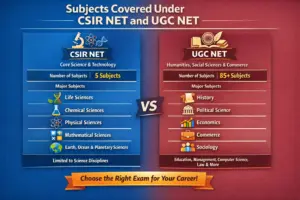
Subjects Covered Under CSIR NET and UGC NET
One of the key differences between CSIR NET and UGC NET (University Grants Commission National Eligibility Test) is the range of subjects offered. CSIR NET is specifically designed for candidates from core science backgrounds, while UGC NET includes a wide variety of humanities, social sciences, commerce, and interdisciplinary subjects. This difference allows candidates to choose the exam based on their academic specialization and career goals in teaching or research.
Also Read: UGC NET Exam 2026
| Aspect | CSIR NET | UGC NET |
|---|---|---|
| Focus Area | Core Science and Technology | Humanities, Social Sciences, Commerce |
| Number of Subjects | 5 Subjects | 85+ Subjects |
| Major Subjects | Life Sciences | History |
| Chemical Sciences | Political Science | |
| Physical Sciences | Economics | |
| Mathematical Sciences | Commerce | |
| Earth, Atmospheric, Ocean & Planetary Sciences | Sociology | |
| Other Subjects | Limited to science disciplines | Education, Management, Computer Science, Law, and many more |
Also Read: UGC NET Subject Weightage 2026
Also Read: UGC NET Assistant Professor 2026
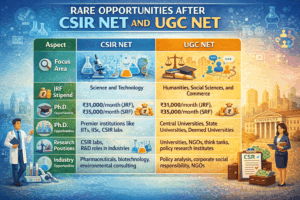
Research Opportunities After CSIR NET and UGC NET
Qualifying the CSIR NET (Council of Scientific and Industrial Research National Eligibility Test) or the UGC NET (University Grants Commission National Eligibility Test) opens several career opportunities in research, academia, and higher education. Both exams provide eligibility for Junior Research Fellowship (JRF) and help candidates pursue PhD programs in reputed institutions. However, the research pathways differ slightly because CSIR NET is mainly focused on scientific research, while UGC NET offers opportunities in teaching, humanities research, and academic administration.
Research Opportunities After CSIR NET and UGC NET
| Aspect | CSIR NET | UGC NET |
|---|---|---|
| Focus Area | Scientific and technological research | Teaching and academic research |
| PhD Opportunities | IITs, IISc, CSIR labs, research institutes | Central universities, state universities, deemed universities |
| Research Fellowships | Junior Research Fellowship (JRF) in CSIR-funded projects | JRF for research in universities and research institutions |
| Research Roles | Scientist positions in R&D organizations | Research roles in policy institutes and NGOs |
| Industry Opportunities | Biotechnology, pharmaceuticals, environmental research | Academic publishing, content development, education sector |
| Teaching Opportunities | Assistant Professor in science departments | Assistant Professor in universities and colleges |
Also Read: Job Opportunities After Qualifying UGC NET
CSIR NET and UGC NET Exam Pattern 2026
The CSIR NET (Council of Scientific and Industrial Research National Eligibility Test) and UGC NET (University Grants Commission National Eligibility Test) are two most sought-after examinations in India for testing eligibility for Junior Research Fellowship (JRF) and Assistant Professorships. Although both examinations have similar motives, their exam patterns are quite different from each other. The following is a point-to-point comparison of the exam patterns for CSIR NET and UGC NET:
| Aspect | CSIR NET | UGC NET |
| Mode of Exam | Computer-Based Test (CBT). | Computer-Based Test (CBT). |
| Number of Papers | Single paper divided into 3 parts. | Two separate papers (Paper 1 and Paper 2). |
| Total Marks | 200 | 300 (Paper 1: 100, Paper 2: 200). |
| Total Questions | 145 (Part A: 20, Part B: 50, Part C: 75). | 150 (Paper 1: 50, Paper 2: 100). |
| Duration | 3 hours. | 3 hours (Paper 1: 1 hour, Paper 2: 2 hours). |
| Marking Scheme | – Part A: No negative marking. | No negative marking for both papers. |
| – Parts B and C: 25% negative marking. | ||
| Focus Areas | – Part A: General aptitude and reasoning. | – Paper 1: Teaching and research aptitude. |
| – Part B: Core subject knowledge. | – Paper 2: Subject-specific knowledge. | |
| – Part C: Application-based questions. |
Also Read: UGC NET Exam Pattern 2026
Fellowship Benefits for CSIR NET and UGC NET
Qualifying the CSIR NET or UGC NET makes the aspirants eligible for Junior Research Fellowship (JRF) and Assistant Professor posts. Both examinations provide lucrative fellowship schemes to reward the aspirants in pursuing their academic and research studies. A comprehensive comparison of fellowship schemes for CSIR NET and UGC NET follows below:
| Aspect | CSIR NET | UGC NET |
| JRF Stipend | ₹31,000 per month. | ₹31,000 per month. |
| SRF Stipend | ₹35,000 per month. | ₹35,000 per month. |
| Contingency Grant (JRF) | ₹20,000 per annum (Science subjects). | ₹10,000 per annum (Humanities/Social Sciences). |
| Contingency Grant (SRF) | ₹28,000 per annum (Science subjects). | ₹20,500 per annum (Humanities/Social Sciences). |
| Duration | – JRF: 2 years | – JRF: 2 years |
| – SRF: 3 years | – SRF: 3 years | |
| Additional Benefits | – HRA and medical benefits. | – HRA and medical benefits. |
| Research Funding | Use of CSIR labs and research grants. | Use of UGC, ICSSR, and other research grants. |
| Opportunities for Ph.D. | Top institutions such as IITs, IISc, CSIR labs. | Central universities, state universities, deemed universities. |
| Career Opportunities | CSIR labs, R&D roles in industries. | Universities, NGOs, think tanks, policy research institutes. |
Also Read: UGC NET Salary 2026
Preparation Tips for CSIR NET and UGC NET
Preparation of CSIR NET or UGC NET needs a systematic approach, a planned study schedule, and regular efforts. Below are some tips to assist the candidates in their respective exams:
Preparation Tips for CSIR NET
- Understanding the Syllabus: Concentrate on the syllabus specific to the concerned subject and study the weightage of various topics.
- Refer to Standard Textbooks: For advanced conceptual understanding, one must consult textbooks written by luminaries and standard study materials.
- Practice Past Question Papers: It helps in getting accustomed to the exam format and the level of difficulty involved.
- Enhance Your Problem-Solving Skill: Problem-solving in numerical and analytical methods is very important for the CSIR NET; therefore, practice these as much as possible.
- Give Mock Tests and Work on Time Management: Consistently give mock tests and constantly pay attention to improving your speed and accuracy.
- Revise Regularly: Prepare short notes and revise them religiously for important concepts.
- Focus on General Aptitude: Part A (General Aptitude) is common for all CSIR NET subjects; practice logical reasoning and data interpretation.

Preparation Tips for UGC NET
- Know the Exam Pattern: Familiarize yourself with the pattern of Paper 1 and Paper 2 and the marking scheme.
- Concentrate on Teaching & Research Aptitude: Paper 1 tests these abilities, so keep practicing multiple-choice questions on a regular basis.
- Prepare Subject-Specific Topics: Paper 2 is subject-specific; make sure to prepare the necessary concepts properly.
- Practice Online Resources: Enroll in online courses, watch video lectures, and read online material.
- Practice Mock Tests: Practice full-length mock tests and evaluate your performance to improve it.
- Create a Study Plan: Allocate specific time periods for each topic and follow a disciplined study schedule.
- Stay Up-to-Date with Current Affairs: Read news on research and education subjects to increase overall awareness.
Also Read: UGC NET Preparation Tips 2026
Conclusion
Difference Between CSIR NET and UGC NET FAQs

Can I apply for CSIR NET as well as UGC NET?
Yes, if you have the right qualifications for both the exams, you may sit for both, as your subject falls in their respective domains.
What are the career prospects after qualifying in CSIR NET?
CSIR NET qualifiers may engage in research in CSIR labs, be lecturers in universities, or work in R&D units of industries.
What are the career prospects after qualifying in UGC NET?
UGC NET passers are entitled to Assistant Professorships and are able to apply for research scholarships in other universities, think tanks, and policy institutes.
Does CSIR NET and UGC NET involve negative marking?
Yes, there is negative marking in Parts B and C of CSIR NET. No negative marking in UGC NET.