

Preparing for the UGC NET December 2026 examination is not just about covering the syllabus—it is about building consistency, conceptual clarity, discipline, and the right exam temperament. Based on Aditi Ma’am’s guidance, the next 150–160 days should be viewed as an opportunity to transform yourself into a confident NET/JRF aspirant rather than simply preparing for an exam.
Whether you are preparing for the first time or reappearing after the June 2026 exam, this detailed strategy will help you create a structured study plan, improve accuracy, and maximize your chances of qualifying UGC NET or securing JRF.

Why You Should Start Preparing for UGC NET December 2026 Today
Many aspirants wait for notifications, answer keys, or previous exam results before restarting their preparation. However, successful candidates know that every day counts.
According to Aditi Ma’am, you effectively have around 150–160 productive study days before the December 2026 examination. Festivals, family functions, and unexpected interruptions reduce the actual preparation time. Therefore, beginning your preparation immediately gives you a significant advantage over other candidates.
Instead of asking:
- Should I wait for the notification?
- Should I wait for the result?
- Should I start next month?
Ask yourself:
“How can I make every day count?”
UGC NET December 2026 Foundation Batch
Understand the UGC NET Exam Before You Prepare
Before creating any study schedule, understand the examination pattern.
| Paper | Number of Questions | Marks |
| Paper 1 | 50 | 100 |
| Paper 2 | 100 | 200 |
| Total | 150 | 300 |
Important points:
- Every question carries 2 marks.
- There is no negative marking.
- Paper 1 tests Teaching & Research Aptitude, ICT, Communication, Higher Education, Reasoning, Data Interpretation, Environment, People Development, etc.
- Paper 2 is based on your chosen subject.
The goal is not to score 300/300.
The goal is to score above the expected cutoff with maximum accuracy.

What Makes Aditi Ma’am’s Preparation Strategy Different?
Most preparation plans focus only on completing the syllabus.
Aditi Ma’am emphasizes something much broader:
- Building discipline
- Personality development
- Consistency
- Career awareness
- Problem-solving ability
- Long-term academic growth
According to her, qualifying UGC NET is important, but developing yourself into an employable academic professional is equally important.
Set Your Target Before Opening Your Books
Every successful preparation begins with a clear target.
Instead of saying:
“I want to clear UGC NET.”
Define measurable goals like:
- Target score in Paper 1
- Target score in Paper 2
- Number of mock tests
- Daily study hours
- Weekly revision targets
When your destination is clear, planning becomes easier.
UGC NET Exam Date 2026 December Session
Aditi Ma’am’s 150-Day Preparation Strategy
Rather than studying randomly, divide your preparation into different phases.
Each phase has a separate purpose.
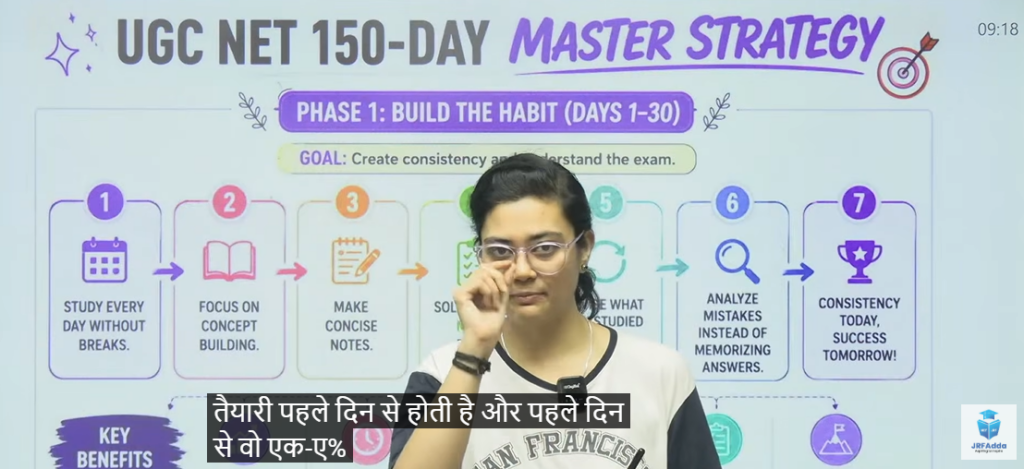
Phase 1: Days 1–30 – Build Your Study Habit
The first month is not about studying for 10–12 hours.
It is about creating a routine.
Most students struggle because they try to do too much in the beginning and burn out within a few weeks.
Instead, focus on:
- Developing consistency
- Fixing study timings
- Choosing your study resources
- Selecting your mentor or platform
- Organizing your notes
- Creating a distraction-free environment

What should you study?
During this phase:
- Start Paper 1 basics.
- Begin Paper 2 Unit 1.
- Watch conceptual lectures.
- Read standard notes.
- Solve basic questions.
The aim is to build momentum.
Create a Fixed Daily Routine
Avoid changing your timetable every day.
Example:
| Activity | Time |
| Paper 1 | 2 Hours |
| Paper 2 | 4 Hours |
| Revision | 1 Hour |
| MCQs | 45 Minutes |
| Short Notes | 30 Minutes |
Consistency matters more than long study hours.
Focus on Conceptual Learning
One of the biggest observations from the June 2026 examination was that both Paper 1 and Paper 2 focused heavily on basic concepts rather than extremely advanced topics.
This means:
Do not memorize.
Understand.
Instead of remembering definitions, understand:
- Why?
- How?
- Where can it be applied?
Start Solving Previous Year Questions Immediately
Many students wait until syllabus completion.
That is a mistake.
Previous Year Questions help you understand:
- Question framing
- Important topics
- Difficulty level
- Frequently asked concepts
Initially, even observing solved PYQs is enough.
Gradually begin solving them independently.
UGC NET December 2026 Foundation Batch
Maintain Short Notes from Day One
Don’t create beautiful notes.
Create useful notes.
Your notes should:
- Be handwritten
- Use simple language
- Include diagrams
- Include keywords
- Include formulas
- Include examples
Remember:
Notes are for revision—not decoration.
Phase 2: Days 31–60 – Build a Strong Foundation
Once your routine becomes stable, the second month focuses on strengthening concepts.
This is where serious preparation begins.
Your priorities should be:
- Finish foundational units.
- Revise old topics.
- Increase question practice.
- Improve retention.
UGC NET December 2026 Foundation Batch
Increase Your Study Hours Gradually
Don’t suddenly jump from 4 hours to 10 hours.
Instead:
Week 1 → 4 Hours
Week 2 → 5 Hours
Week 3 → 6 Hours
Week 4 → 7 Hours
A gradual increase prevents burnout and helps you maintain consistency throughout the preparation journey.
Solve 20–30 MCQs Daily
After completing each topic:
- Solve topic-wise MCQs.
- Revise mistakes.
- Identify weak concepts.
- Revisit theory.
Question practice should become a daily habit.
Build Conceptual Clarity Instead of Memorization
According to Aditi Ma’am, students don’t need to know 1,000 topics superficially.
Instead,
Know 100 topics so well that any question from them can be answered confidently.
That is exactly how NET and JRF qualifiers prepare.
Identify Your Strong and Weak Areas
Create two lists.
Strong Areas
Examples:
- ICT
- Communication
- Teaching Aptitude
- Your favorite Paper 2 units
Aim to make these even stronger.
Weak Areas
Examples:
- Statistics
- Research Aptitude
- Mathematical Reasoning
- Difficult subject units
Don’t ignore them.
Instead:
Improve them gradually.
The goal is progress—not perfection.
End of Part 1
In the next part, we’ll cover:
Phase 3: Days 61–90 – Convert Knowledge into Confidence
By the time you complete the first 60 days, you should have built a strong foundation in both Paper 1 and Paper 2. The next phase is about improving application skills and increasing your confidence.
Many aspirants reach a stage where they know the concepts but struggle to answer questions accurately in the examination. This happens because they spend more time reading than practicing.
According to Aditi Ma’am, this phase should focus on converting your knowledge into exam-ready performance through revision, question practice, and regular self-evaluation.
Revise Every Topic Before Moving Ahead
One of the biggest mistakes aspirants make is continuously studying new topics while forgetting the old ones.
During this phase:
- Revise every completed unit.
- Strengthen conceptual understanding.
- Improve retention through active recall.
- Avoid piling up unfinished revisions.
Remember, revision is what converts information into long-term memory.
UGC NET December 2026 Foundation Batch
Practice Mixed MCQs Instead of Topic-wise Questions
Initially, topic-wise questions help you understand concepts.
Now, it is time to solve mixed-topic questions because the actual UGC NET examination does not ask questions unit by unit.
Mixed practice helps improve:
- Question selection
- Concentration
- Topic switching ability
- Time management
- Concept application
This also prepares your brain to think quickly during the actual examination.
Increase the Difficulty Level
Now begin solving:
- Mixed MCQs
- Higher-order conceptual questions
- Assertion and Reason-based questions
- Statement-based questions
- PYQs from multiple years together
This phase gradually prepares you for unpredictable questions asked by NTA.
Start Daily Revision Sessions
Every day should include a dedicated revision session.
An ideal schedule may look like this:
| Activity | Duration |
| Learn New Topics | 4 Hours |
| Revision | 2 Hours |
| MCQ Practice | 1 Hour |
| Error Analysis | 30 Minutes |
Daily revision prevents information overload and improves recall speed.
Develop the Habit of Self-Study
Coaching classes, YouTube lectures, and online courses can guide you, but self-study is what ultimately determines your success.
Aditi Ma’am repeatedly emphasizes that no mentor can replace your own effort. Learning happens only when you revise, practice, and apply concepts independently.
Maintain an Error Notebook
One of the most effective techniques recommended by Aditi Ma’am is maintaining an Error Notebook.
Instead of recording only what you know, write down every mistake you make during practice.
Your notebook should include:
- Incorrect questions
- Correct explanation
- Why you made the mistake
- Related concept
- Revision date
Over time, this notebook becomes one of your most valuable revision resources.

Strengthen Your Strong Areas While Improving Weak Ones
Many students spend all their time fixing weak subjects and ignore the topics they already perform well in.
A better strategy is to maintain balance.
Strengthen Your Strong Areas
For example:
- ICT
- Teaching Aptitude
- Communication
- Reading Comprehension
- Subject-specific favorite units
Aim for nearly 100% accuracy in these areas.
Improve Weak Areas Gradually
Weak areas should not be ignored, but they also shouldn’t consume your entire preparation time.
Focus on gradual improvement through:
- Daily revision
- Additional MCQ practice
- Concept videos
- Short notes
Progress is more important than perfection.
Phase 4: Days 91–120 – Enter Complete Exam Mode
The fourth phase is where your preparation becomes examination-oriented.
By now, most of your syllabus should be completed.
The focus shifts from studying to performing.
Start Giving Sectional Tests
Rather than only reading theory, begin attempting sectional tests every week.
These tests help you evaluate:
- Concept clarity
- Speed
- Accuracy
- Revision quality
- Time management
Treat every test like the actual UGC NET examination.
Increase Daily Question Practice
During this phase, increase your daily practice.
Instead of solving 20–30 questions, gradually solve:
- 50 MCQs
- 75 MCQs
- 100 MCQs
The objective is not merely completing questions but improving speed while maintaining accuracy.
Analyse Every Mock Test Thoroughly
Giving mock tests is only half the job.
The real improvement comes from analyzing them.
After every mock test, ask yourself:
- Which questions were incorrect?
- Why were they incorrect?
- Was it a conceptual mistake?
- Was it due to lack of revision?
- Was it because of time pressure?
- Was it a silly mistake?
This analysis helps prevent repeated errors.
Improve Time Management
Time management becomes extremely important in the last two months.
Practice completing:
- Paper 1 within your target time.
- Paper 2 with maximum accuracy.
- Full-length tests under strict exam conditions.
The more realistic your practice, the more comfortable you will feel on the exam day.
Focus on Accuracy Instead of Speed
Many students rush through the paper and make avoidable mistakes.
Aditi Ma’am advises improving accuracy first and speed later because one incorrect answer is often the result of unnecessary haste during practice.
Phase 5: Last 30 Days – Revision and Mock Test Marathon
The final month should not be used for studying completely new topics.
Instead, concentrate on revision and exam simulation.
Give Full-Length Mock Tests
Attempt at least one full-length mock test every week initially.
As the examination approaches, increase the frequency based on your preparation level.
Mock tests help improve:
- Confidence
- Exam temperament
- Time management
- Mental stamina
- Question selection strategy
Revise Previous Year Questions Again
Previous Year Questions should be revised multiple times.
By the final month, you should have solved them at least two to three times.
This helps you recognize repeated concepts and understand NTA’s questioning style.
Revise Short Notes
Avoid reading bulky books repeatedly.
Instead, revise:
- Handwritten notes
- Formula sheets
- One-page summaries
- Mind maps
- Important diagrams
These resources help in quick revision before the examination.
Avoid New Study Material
The last month is not the time to experiment with new books, new teachers, or new coaching resources.
Stick to:
- Your existing notes
- PYQs
- Mock tests
- Previously studied material
Consistency is far more valuable than collecting additional resources.
UGC NET Previous Year Question Papers 2026, Download
Daily Study Routine Recommended by Aditi Ma’am
A disciplined routine ensures continuous progress without burnout.
A sample daily routine can include:
| Activity | Time Allocation |
| Learn New Concepts | 4–5 Hours |
| Revision | 2 Hours |
| Topic-wise MCQs | 1 Hour |
| Previous Year Questions | 30–45 Minutes |
| Error Notebook Review | 20 Minutes |
| Short Notes Preparation | 20 Minutes |
The exact timings can be adjusted according to your schedule, but every day should include learning, revision, and practice.
Weekly Preparation Strategy
Aditi Ma’am recommends following a structured weekly cycle instead of studying randomly.
Monday to Friday
- Learn new concepts.
- Solve topic-wise MCQs.
- Revise previous lessons.
- Update notes.
Saturday
Keep Saturdays dedicated to revision.
Revise:
- Entire week’s notes
- PYQs
- Important formulas
- Weak concepts
Sunday
Use Sundays for assessment.
Attempt:
- One full-length mock test
- Detailed analysis of mistakes
- Planning for the upcoming week
This weekly review helps maintain consistency throughout the preparation journey.
Monthly Progress Review
At the end of every month, evaluate your preparation honestly.
Ask yourself:
- How much syllabus is completed?
- Which units are still weak?
- Has my accuracy improved?
- Am I managing time effectively?
- Which mistakes are recurring?
Maintain a study journal to record your progress.
Writing down your strengths and weaknesses every month makes it easier to adjust your preparation strategy.
UGC NET Books 2026-27 — Paper 1, Paper 2 & PYQs
Why Journaling Can Improve Your Preparation
Aditi Ma’am also encourages aspirants to write regularly about their preparation journey.
Your journal can include:
- Daily targets
- Completed topics
- Mock test scores
- Mistakes
- Weekly achievements
- Areas requiring improvement
This habit keeps you accountable and motivated throughout the 150-day preparation period.
UGC NET December 2026 Foundation Batch

UGC NET December 2026 Preparation Strategy by Aditi Ma’am FAQs

How many days are enough to prepare for UGC NET December 2026?
A preparation period of around 150–160 productive days is sufficient if you follow a structured study plan with daily revision, regular practice, and consistent mock test analysis.
How many hours should I study daily for UGC NET?
Most aspirants should study 6–8 focused hours daily. Beginners can start with 4–5 hours and gradually increase their study time while maintaining consistency.
Should I prepare Paper 1 and Paper 2 together?
Yes. Preparing Paper 1 and Paper 2 simultaneously ensures balanced preparation and prevents unnecessary pressure during the final months before the examination.
How important are Previous Year Questions for UGC NET?
Previous Year Questions are extremely important because they help you understand the exam pattern, identify frequently asked topics, improve conceptual clarity, and build confidence.
Can I crack UGC NET December 2026 in my first attempt?
Yes. With a disciplined study routine, conceptual understanding, regular revision, consistent question practice, and effective time management, first-time aspirants can successfully qualify UGC NET and even secure JRF.