
UGC NET vs JRF is a popular confusion among the aspirants who are studying for the UGC NET exam 2026. Although both certifications are offered through the same test held by the National Testing Agency (NTA), they are for distinct purposes. UGC NET prepares candidates for the role of Assistant Professor, while JRF (Junior Research Fellowship) offers scholarships for research and Ph.D. studies.
Knowing the main UGC NET vs JRF differences in eligibility, benefits, and career opportunities will assist the candidates in choosing their academic and professional direction successfully.
Check UGC NET Online Courses Here
UGC NET vs JRF- Understanding the Difference
UGC NET (University Grants Commission National Eligibility Test) and JRF (Junior Research Fellowship) are two key qualifications awarded via the same examination. Though both are conferred on the basis of performance, they are for different uses in academic and research life. Here is what both UGC NET vs JRF mean:
What is UGC NET?
UGC NET is a national-level exam conducted by the National Testing Agency (NTA) in charge of the University Grants Commission (UGC). It is a bi-annual examination (twice a year: June and December) to become eligible for appointment as an Assistant Professor at Indian universities and colleges.
Check UGC NET Online Batches Here

What is JRF (Junior Research Fellowship)?
JRF is a scholarship awarded to high scorers of the UGC NET, enabling them to pursue a Ph.D. and conduct research with financial support. UGC NET JRF holders are paid a monthly allowance to carry out their research work in prestigious institutions.
UGC NET vs JRF – Eligibility and Career Options
The UGC NET vs JRF each individually serves as the gateway for candidates seeking academic and research careers. Both UGC NET vs JRF differ in their eligibility, scope, and career implications. Understanding the distinctions between the NTA UGC NET and JRF eligibility requirements, along with their two qualifications and career options, is crucial for aspiring candidates to make informed decisions that align with their professional goals.
UGC NET vs JRF Eligibility Criteria 2026
The UGC NET vs JRF eligibility criteria for 2026 define the foundational requirements for candidates aspiring to pursue a career in academia and research. The UGC NET vs JRF eligibility criteria are as follows:
| Details | UGC NET | JRF |
| Education Qualification | A Master’s degree in the respective subject | A Master’s degree in the respective subject |
| Minimum passing marks in Master’s | General/EWS: 55% marks
OBC-NCL/SC/ST/PwD: 50% marks |
General/EWS: 55% marks
OBC-NCL/SC/ST/PwD: 50% marks |
| Age Limit | No age restriction is for the UGC NET Assistant Professor | 30 years (General), relaxed by 5 years for OBC-NCL, SC, ST, PwD, and female applicants |
UGC NET Eligibility Criteria 2026
Career Opportunities after JRF 2026:
- Ph.D. Admission: Direct admission in Ph.D. courses in the best universities.
- Research Stipend: ₹37,000 per month for the first two years; increased to ₹42,000 after evaluation.
- Postdoctoral Fellowships: After Ph.D., JRF holders are eligible for senior fellowships.
- Government Research Jobs: Work in ICSSR, ICMR, CSIR, and similar research centers.
- Teaching Career: JRF candidates may also apply for Assistant Professor positions.
Check UGC NET Online Batches Here
Difference Between UGC NET and JRF
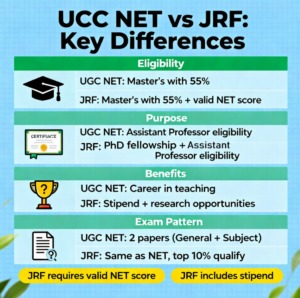
Below is a summarised table for the difference between NTA UGC NET and JRF:
| Criteria | UGC NET Assistant Professor | Junior Research Fellowship |
| Purpose | Qualifies for Assistant Professor roles | Provides fellowship for research and a Ph.D. |
| Age Limit | No age limit | 30 years (General), relaxation for reserved categories |
| Cutoff Marks | Lower than JRF cutoff | Higher cutoff than Assistant Professor |
| Financial Benefit | No stipend | ₹37,000/month (first 2 years), ₹42,000/month after evaluation |
| Career Path | Teaching in universities and colleges | Research, Ph.D., and teaching |
| Validity | Lifetime | Valid for 3 years (for Ph.D. admission) |
Which One Should You Choose – UGC NET or JRF?
The decision in choosing between UGC NET vs JRF is based on your career aspirations:
Go for UGC NET if:
- You wish to become an Assistant Professor at a university or college.
- You don’t want to pursue research or a PhD.
- You are above the age limit of JRF (30 years).
Go for JRF if:
- You have an interest in pursuing a PhD and a research career.
- You are under the age of JRF (30 years).
- You wish to be given a monthly stipend for your research activities.
How to Qualify for JRF 2026?
To be eligible for JRF, you must:
Score Above the Cutoff of JRF:
- The JRF cutoff is more than the cutoff for Assistant Professor position. Work on scoring high in both Paper 1 and Paper 2.
Satisfy Age Criteria:
- Make sure you fall under the age limit of 30 years (relaxation for reserved categories).
Work on Research Aptitude:
- Paper 1 contains a section on Research Aptitude, which is very important for JRF candidates.
Prepare Well:
- Use standard study material, practice previous question papers, and conduct mock tests to improve your score.
Read More: Difference Between CSIR NET and UGC NET

Benefits of UGC NET and JRF
Passing the UGC NET (University Grants Commission National Eligibility Test) and achieving the JRF (Junior Research Fellowship) are considered achievements that open the gates to future opportunities for scholars and researchers. UGC NET as well as JRF are associated with their respective advantages, suiting various career goals. The following is a comprehensive analysis of the advantages of UGC NET as well as JRF.
| Parameter | UGC NET Benefits | JRF Benefits |
| Eligibility | Qualifies for Assistant Professor role in universities/colleges. | Qualifies for Junior Research Fellowship (JRF) and PhD admission. |
| Financial Support | No stipend. | Monthly stipend: ₹31,000 (first 2 years), ₹35,000 (3rd year as SRF). |
| Career Opportunities | Teaching roles in universities/colleges. | Research roles, PhD programs, and academic careers. |
| Validity | Lifetime validity for Assistant Professor role. | JRF valid for 2 years (extendable to SRF). |
| Age Limit | No upper age limit for Assistant Professor role. | Upper age limit of 30 years (relaxation for reserved categories). |
| Research Opportunities | Limited to teaching; research depends on individual efforts. | Access to funded research projects, collaborations, and publications. |
| PhD Admission | Eligible to pursue PhD but no financial support. | Direct admission to PhD programs with financial support. |
| Recognition | Recognized by all Indian universities and colleges for teaching roles. | Recognized by research organizations and universities for research roles. |
| Skill Development | Focus on teaching and academic skills. | Focus on research, analytical, and technical skills. |
| Career Growth | Promotions to Associate Professor, Professor, and administrative roles. | Opportunities for postdoctoral research, senior research roles, and academia. |
Benefits of Clearing UGC NET/JRF Examination
Preparation Tips for UGC NET & JRF
To become eligible for UGC NET or JRF, consistent preparation and strategic planning are of utmost importance. Follow the following expert advice to boost your chances of success:
Familiarize yourself with the Exam Pattern & Syllabus
- Understand the UGC NET syllabus for Paper 1 (Teaching & Research Aptitude) and Paper 2 (Subject-Specific).
- Assign significant weightage to highly scoring subjects such as Teaching Aptitude, Research Aptitude, and Logical Reasoning.
- Use official syllabus PDFs to download for a well-planned study schedule.
Create a Timetable & Follow It
- Schedule daily time slots for Paper 1 and Paper 2 preparation.
- Leave time for revision, mock tests, and solving UGC NET previous year question papers.
- Prioritize tough topics first and revise them on a regular basis.
Check UGC NET Online Courses Here
Select the Right Study Material
- Use common books such as Trueman’s UGC NET and KVS Madaan for Paper 1.
- Take online coaching and study material from JRFAdda for guidance.
- Download PDFs for UGC NET preparation for easy memorization and last-minute revision.
Practice Previous Year Question Papers & Practice Mock Tests
- Practice previous 5–10 year question papers to understand examination trends.
- Keep practicing mock tests regularly to gain better time management and accuracy.
- Review errors and practice weak concepts.
Enhance Research & Teaching Ability for JRF
- Practice topics on Research Methodology since the candidates for JRF need efficient research skills.
- Read research articles, research journals, and research publications.
UGC NET Last Minute Preparation

Build Analytical Ability to read data effectively.
Be Up to Date with Current Affairs & Trends in Higher Education
- Read higher education news, government publications, and newspapers for Paper 1.
- Monitor UGC, NTA, and educational policies.
Stay Consistent & Inspired
- Rewrite on a regular basis to maintain concepts.
- Take part in online UGC NET forums or coaching sites such as JRFAdda for discussions and mentorship from peers.
- Remain self-assured and be mindful of managing stress levels for the exams.
Conclusion
UGC NET and JRF both lead to academic success, either in teaching or research. While UGC NET prepares candidates for Assistant Professor posts, JRF offers financial support and research work. Your decision between the two is based on your career aspirations—whether you want a secure teaching career or higher studies and research. With proper preparation, study material, and strategy, clearing UGC NET or JRF in 2026 is possible.
UGC NET vs JRF FAQs

How is the cutoff difference between UGC NET and JRF?
The cutoffs of JRF are greater than UGC NET as fewer students are given JRF on the basis of merit.
Can a candidate qualified for JRF apply for Assistant Professor posts?
Yes, candidates with JRF qualification are also considered for Assistant Professor posts.
Is UGC NET compulsory for admission to PhD?
No, but JRF is helpful as it gives financial assistance and enhances your chances of getting admission in prestigious universities.
Can I apply for JRF at the age of 30 and above?
No, JRF has an age limit of 30 years for general category candidates, and 5 years relaxation is available for reserved category candidates.