
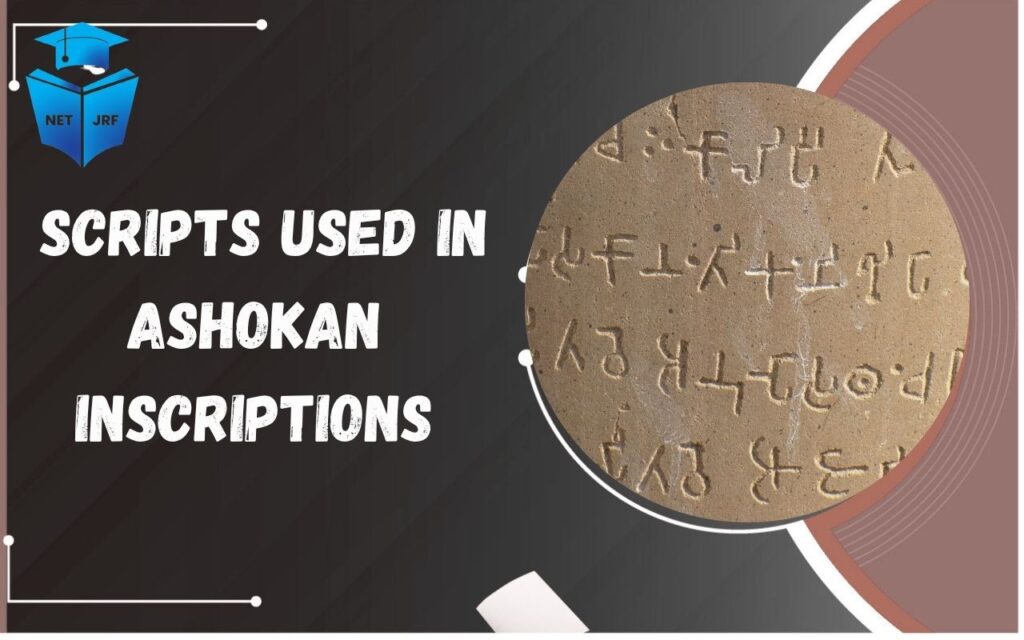

The Scripts used in Ashokan inscriptions form a key part of ancient Indian history. These inscriptions help us understand how Ashoka the Great communicated with people across his vast empire. They also show the diversity of languages, regions, and writing systems during the Mauryan period. Ashoka ruled in the 3rd century BCE, and his inscriptions appear on rocks and pillars across India and nearby regions. These records were written in different scripts depending on the location.

Scripts used in Ashokan inscriptions Meaning
The Scripts used in Ashokan inscriptions refer to the writing systems chosen by Ashoka to spread his ideas of Dhamma. Instead of using one uniform script, he adapted his communication based on regional needs.
Why multiple scripts were used
Ashoka ruled a very large empire. People spoke different languages and followed different traditions. So, using one script would not work everywhere.
Key reasons include:
- Regional diversity of languages
- Need for clear communication with common people
- Administrative convenience
- Cultural adaptation
This shows that Scripts used in Ashokan inscriptions were not random. They were carefully selected to make messages accessible.
Best UGC NET Coaching in Jaipur
Major Scripts Used by Ashoka
The Scripts used in Ashokan inscriptions can be grouped into three main types. Each had its own region and style.
1. Brahmi Script
Brahmi was the most widely used script in Ashoka’s inscriptions.
Key features:
- Written from left to right
- Used in most parts of India
- Simple and clear writing style
- Basis for many modern Indian scripts
Most of Ashoka’s rock edicts and pillar edicts in central, eastern, and southern India were written in Brahmi. Because of its wide use, many historians consider Brahmi the most important among the Scripts used in Ashokan inscriptions.
2. Kharosthi Script
Kharosthi was used mainly in the north-western regions.
Key features:
- Written from right to left
- Influenced by Aramaic script
- Found in areas like Gandhara (modern Pakistan region)
This script shows foreign influence due to earlier Persian and Greek contact. The presence of Kharosthi among the Scripts used in Ashokan inscriptions reflects cultural exchange.
3. Greek and Aramaic Scripts
Ashoka also used foreign scripts in border regions.
Key features:
- Used in Afghanistan region
- Greek used for Greek-speaking population
- Aramaic used for administrative communication
These inscriptions prove that Ashoka ruled over diverse populations. Including these in the Scripts used in Ashokan inscriptions shows his inclusive governance.
Best UGC NET Offline Coaching in Jaipur
Languages Used Along with Scripts
Scripts and languages are different. Ashoka used mainly Prakrit language but wrote it in different scripts.
Common combinations:
- Prakrit + Brahmi
- Prakrit + Kharosthi
- Greek language + Greek script
- Aramaic language + Aramaic script
This combination helped people understand the message easily. So, the Scripts used in Ashokan inscriptions were always connected to local language use.
Scripts used in Ashokan inscriptions Overview
Scripts used in Ashokan inscriptions varied across regions.
| Script Name | Region | Writing Direction | Language Used | Importance |
| Brahmi | Most of India | Left to Right | Prakrit | Most common script |
| Kharosthi | North-West | Right to Left | Prakrit | Foreign influence |
| Greek | Afghanistan | Left to Right | Greek | For Greek population |
| Aramaic | Afghanistan | Right to Left | Aramaic | Administrative use |
Importance of Ashokan Inscriptions
The Scripts used in Ashokan inscriptions are not just about writing. They give deep historical insights.
Political Importance
- Show centralized administration
- Reflect Ashoka’s authority
- Help track empire boundaries
Social Importance
- Promote moral values (Dhamma)
- Encourage non-violence
- Support religious tolerance
Cultural Importance
- Show diversity in language
- Indicate cultural exchange
- Preserve early writing systems
Best UGC NET Foundation Course
Decipherment of Brahmi Script
One major breakthrough in history was the decoding of Brahmi script by James Prinsep in 1837.
Why it matters:
- Helped read Ashokan edicts
- Confirmed Ashoka’s identity
- Opened new research areas
Without this discovery, the Scripts used in Ashokan inscriptions would remain unknown.
Ashoka’s Purpose Behind Using Different Scripts
Ashoka did not randomly choose scripts. He had clear goals.
Key purposes:
- Reach maximum people
- Spread Dhamma effectively
- Maintain unity in diversity
- Ensure administrative clarity
Because of this, the Scripts used in Ashokan inscriptions became a powerful tool of governance.
Comparison Between Brahmi and Kharosthi
understand differences within the Scripts used in Ashokan inscriptions.
| Feature | Brahmi | Kharosthi |
| Direction | Left to Right | Right to Left |
| Region | Most of India | North-West |
| Origin | Indigenous | Foreign influence |
| Importance | Basis of Indian scripts | Limited regional use |

Historical Significance
The Scripts used in Ashokan inscriptions show how advanced administration was during the Mauryan period.
They prove:
- Early literacy development
- Organized communication system
- Cultural interaction across regions
Ashoka’s inscriptions are among the earliest written records in Indian history. That is why the study of Scripts used in Ashokan inscriptions is very important.
Best UGC NET Foundation Batch Online

Conclusion
The Scripts used in Ashokan inscriptions reflect the intelligence and vision of Ashoka the Great. He used different scripts to connect with people across regions, languages, and cultures. This approach made his message of Dhamma effective and long-lasting.
|
Read UGC Notes |
||
| Unit | Topic | Link |
| Archaeological | Archaeological Sources for UGC NET | Open |
| Archaeological | Exploration in Archaeology | Open |
| Archaeological | Excavation Techniques in Archaeology | Open |
| Archaeological | Dating of Archaeological Sites | Open |
| Archaeological | Epigraphy — Study of Inscriptions | Open |
| Archaeological | Inscriptions in Reconstructing History | Open |
| Archaeological | Numismatics in History | Open |
| Archaeological | Importance of Coins in History | Open |
| Literary Sources | Meaning of Historical Sources | Open |
| Literary Sources | Literary Sources in History | Open |
| Literary Sources | Indigenous Literature | Open |
| Literary Sources | Dating Ancient Literary Sources | Open |
| Literary Sources | Secular Literature as Historical Source | Open |
| Literary Sources | Role of Myths & Legends in Historical Reconstruction | Open |
| Foreign Accounts | Foreign Accounts of India — Overview | Open |
| Foreign Accounts | Greek Accounts on Ancient India | Open |
| Foreign Accounts | Chinese Accounts on India | Open |
| Foreign Accounts | Arabic Accounts on India | Open |
| Neolithic & Chalcolithic | Neolithic and Chalcolithic Phases | Open |
| Neolithic & Chalcolithic | Hunting, Gathering & Food Production | Open |
| Neolithic & Chalcolithic | Neolithic Revolution in India | Open |
| Neolithic & Chalcolithic | Neolithic Settlements in India | Open |
| Neolithic & Chalcolithic | Distribution of Neolithic Cultures in India | Open |
| Neolithic & Chalcolithic | Tools and Technology in Neolithic Period | Open |
| Neolithic & Chalcolithic | Chalcolithic Culture in India | Open |
| Neolithic & Chalcolithic | Settlement Pattern & Economy in Chalcolithic Phase | Open |
| Neolithic & Chalcolithic | Trade & Exchange Networks in Chalcolithic Societies | Open |
| Indus Valley | Indus Valley Civilization — Overview | Open |
| Indus Valley | Major Sites of Indus Civilization | Open |
| Indus Valley | Urban Planning in Harappan Civilization | Open |
| Indus Valley | Architecture and Town Planning | Open |
| Indus Valley | Agriculture and Food Economy | Open |
| Indus Valley | Craft Specialization & Industrial Activities | Open |
| Indus Valley | Internal Trade of Harappan Civilization | Open |
| Indus Valley | Internal and External Trade | Open |
| Indus Valley | Social Structure of Indus Civilization | Open |
| Indus Valley | Political Organization of Harappan Civilization | Open |
| Indus Valley | Religion and Beliefs in Indus Civilization | Open |
| Indus Valley | Decline of Indus Civilization | Open |
| Indus Valley | Indus Civilization as First Urbanization | Open |
| Vedic Period | Vedic and Later Vedic Periods — Overview | Open |
| Vedic Period | Origin of Vedic Civilization | Open |
| Vedic Period | Aryan Debate — Migration, Invasion & Indigenous Theories | Open |
| Vedic Period | Early Vedic Society and Economy | Open |
| Vedic Period | Political Institutions in Early Vedic Period | Open |
| Vedic Period | Social Structure in Early Vedic Period | Open |
| Vedic Period | Later Vedic Society and Economy | Open |
| Vedic Period | Emergence of Varnas and Social Stratification | Open |
| Vedic Period | Emergence of Heterodox Sects in India | Open |
| Vedic Period | Impact of Iron Technology in India | Open |
| Miscellaneous | Megalithic Culture of South India | Open |
| Miscellaneous | Religious and Philosophical Vedic Ideas | Open |
| Miscellaneous | State System in Ancient India | Open |