


UGC NET Commerce Important Topics 2026 are the most frequently asked and high-scoring concepts that every aspirant should prepare for the UGC NET December 2026 Examination. Conducted by the National Testing Agency (NTA), the UGC NET Commerce examination evaluates candidates for Assistant Professor, Junior Research Fellowship (JRF), and PhD Admission.
With the increasing emphasis on conceptual understanding, numerical problem-solving, and application-based MCQs, candidates should prioritize the UGC NET Commerce Important Topics 2026, repeated PYQ themes, and high-weightage units instead of studying the syllabus randomly.
This article provides the latest unit-wise important topics, expected weightage, preparation strategy, previous year trends, and frequently asked areas to help candidates maximize their scores in the December 2026 examination.
Check ATOM Dec 2026 Commerce Batch Paper 2 Here
Enroll UGC NET Foundation Batch Online

UGC NET Commerce Important Topics 2026 Overview
The UGC NET Exam is conducted twice a year by the National Testing Agency (NTA) for the eligibility of Assistant Professor and Junior Research Fellowship (JRF) in commerce. As the UGC NET Commerce exam is approaching for the December 2026 session, candidates must review all the Important topics for UGC NET Commerce (Accounting, Auditing, International Business, Business Economics, Corporate Tax-Planning, Banking) beforehand to prepare. First, let’s check out the UGC NET Commerce Important Topics 2026 Overview:
ATOM 2026 Batch Commerce Batch (Paper1+Paper2) – Dec 2026
|
UGC NET Commerce Important Topics 2026 |
|
| Conducting Body | National Testing Agency (NTA) |
| Exam Mode | Computer-Based Test (CBT) |
| Duration | 3 hours (No breaks between papers) |
| Papers | Paper 1 (General) and Paper 2 (Commerce) |
| Total Questions | 150 (Paper 1: 50, Paper 2: 100) |
| Total Marks | 300 (Paper 1: 100, Paper 2: 200) |
| Marking Scheme | +2 for each correct answer, No negative marking |
| Eligibility | Master’s Degree with 55% marks for General candidates, 50% for reserved categories |
| Official Website | ugcnet.nta.ac.in |
UGC NET Commerce Important Topics 2026 Topic-Wise Probability List
The UGC NET December 2026 exam requires the candidates to have a comprehensive knowledge of the UGC NET Commerce Important Topics 2026 and the high-weightage topics of UGC NET Commerce subject. Here, we have provided the UGC NET Commerce topic-wise probability list for the candidates to go through and understand the high-scoring units and prepare them better.
UGC NET Commerce Topic-Wise Probability List (2023-2026 Avg.)
| Unit | Avg. Qs | Probability (%) | Trend |
| Business Environment | 9-11 | High | WTO, FDI stable |
| Accounting & Auditing | 10-13 | Very High | Shares, AS/IFRS |
| Business Economics | 8-10 | High | Elasticity, markets |
| Business Finance | 8-10 | High | Capital structure |
| Statistics & Research | 9-11 | High | Probability, tests |
| Management & HRM | 9-10 | Medium | Motivation theories |
| Banking | 7-9 | Medium | RBI functions |
| Marketing | 9-12 | Very High | 4Ps, consumer behaviour |
| Legal Aspects | 8-10 | High | Companies Act, GST |
| Taxation | 8-10 | High | Corporate tax planning |

UGC NET Commerce Syllabus vs Important Topics Mapping
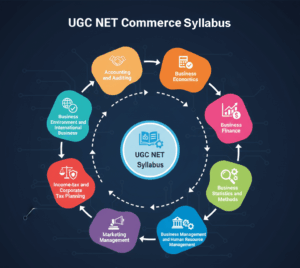
UGC NET Commerce 2026 Paper 2 has 10 units, and each unit contains some subtopics that are more frequently asked and are of higher scoring based on recent exams. Such topics are considered the UGC NET Commerce Important Topics 2026. The Important topics for UGC NET Commerce (Accounting, Auditing, International Business, Business Economics, Corporate Tax-Planning, Banking) are listed in more detail in the UGC NET Commerce important topics vs syllabus mapping in the table below.
| UGC NET Commerce Syllabus Unit | UGC NET Commerce Important Topics 2026 | Exam Relevance | |
| Business Environment and International Business | FDI & FPI concepts; WTO, IMF, World Bank; Business environment components; BEP and VC concepts; Balance of payments; Trade Blocks. | Frequently 4–6 questions combined from environment, FDI/FPI & international institutions; conceptual and numerical mix. | |
| Accounting and Auditing | Accounting standards (AS/Ind AS/IFRS) basics; Depreciation methods; Final accounts; Cash flow statement; Ratio analysis; Audit planning, vouching, verification, types of audit. | One of the most important units with around 6–8 questions, including numerical problems and theory on standards/audit concepts. | |
| Business Economics | Law of demand and its exceptions; Elasticity of demand and measurement; Consumer behaviour; Production laws; Cost concepts and curves; Market structures. | Regular appearance of 5–6 questions from demand, elasticity, cost and market structures; microeconomics is more frequently asked. | |
| Business Finance | Time value of money; Capital structure theories; Cost of capital; Leverage analysis; Capital budgeting techniques (NPV, IRR, PI, payback); Working capital management. | High‑weightage unit with about 7–8 questions, mostly from capital structure, TVM and capital budgeting. | |
| Business Statistics and Research Methods | Measures of central tendency and dispersion; Correlation and regression; Probability basics and distributions; Hypothesis testing (Z, t, chi‑square, F); Sampling techniques. | Consistent 5–6 questions, often from probability distributions, correlation/regression and basic research concepts. | |
| Business Management and Human Resource Management | Functions of management; Planning, organizing, directing, controlling. Motivation & leadership theories; Organizational behaviour basics; HRM functions – recruitment, selection, training; Span of management. | Around 6–7 questions commonly asked; conceptual and application‑based, especially on OB and core HR processes. | |
| Banking and Financial Institutions | Indian financial system structure; Money market & capital market instruments; Commercial banks, RBI and development banks; Banking sector reforms; Financial markets. | Typically 6–7 questions from financial markets, banking concepts and regulatory framework. | |
| Marketing Management | Marketing concepts; STP; Marketing mix and 4Ps/7Ps; Product life cycle; BCG matrix; Branding and brand equity basics; Services marketing and CRM. | High‑weightage unit with about 7–8 questions, especially on STP, marketing mix and PLC/BCG applications. | |
| Legal Aspects of Business | Indian Contract Act basics; Companies Act essentials; Negotiable Instruments; Consumer Protection law basics; Competition Act overview; Intellectual property rights basics. | Generally 4–6 questions, mostly conceptual, testing sections/principles of core commercial laws. | |
| Income‑tax and Corporate Tax Planning | Residential status and scope of total income; Exempt incomes; Heads of income basics; Deductions; Basic tax computation; Corporate tax planning overview. | Around 5–6 questions combining direct tax concepts and simple computations, with some focus on planning aspects. | |
Check UGC NET Commerce Syllabus 2026 Here
Importance of UGC NET Commerce Important Topics 2026
Using the UGC NET Commerce Important Topics 2026 has a lot of benefits, some of which are listed below:
Saves time and energy
- By going through the UGC NET Commerce Important Topics 2026, you don’t waste time reading every line of the syllabus.
- You study the units and sub-topics that are asked repeatedly over the years in the exam.
Helps cover high-weightage areas
- UGC NET Commerce Important topics are mostly from high-scoring units like Accounting, Finance, Management, and Marketing.
- Focusing on these first increases your chances of getting more correct answers in less time.
Gives a clear study direction
- A short list of UGC NET Commerce Important topics 2026 makes daily planning easy and clear.
- You know exactly what to read, what to revise, and which questions to practice.
Improves score in mock tests
- When you practice MCQs mainly from the UGC NET Commerce Important topics, your accuracy starts to improve quickly.
- This also helps you analyze your weak areas and revise them on priority.
Reduces stress and confusion
- A filtered list of UGC NET Commerce Important topics 2026 feels manageable compared to the full syllabus.
- It helps you build confidence because you know you are preparing for what actually matters for the exam.

Conclusion
The UGC NET Commerce Important Topics 2026 provide a focused roadmap for success in the December 2026 examination. Units such as Accounting & Auditing, Business Finance, Marketing Management, Business Statistics & Research Methods, Business Economics, and Income Tax consistently contribute the highest number of questions in Paper 2. Candidates should combine these high-weightage topics with regular revision, previous year question papers, mock tests, and numerical practice to maximize their chances of qualifying for Assistant Professor, Junior Research Fellowship (JRF), and PhD Admission. A strategic, topic-wise preparation approach will significantly improve both accuracy and overall score.
UGC NET Commerce Important Topics 2026 FAQs

Is preparing with the UGC NET Commerce Important Topics 2026 enough for success?
While preparing using the UGC NET Commerce important topics is crucial, it is still best to supplement these with JRFAdda’s Commerce notes, test series, and previous year papers to succeed.
What are the UGC NET Commerce frequently asked topics?
Some of the frequently asked UGC NET Commerce Important Topics include Market structures, capital structure, and GST (70% repeat).
How should I use the UGC NET Commerce important topics 2026 for June exam?
You can use the UGC NET Commerce Important Topics to identify the high-weightage, repeating topics for quick revisions and to cover all vital topics systematically, especially in the final stages of preparation.
How does the UGC NET Commerce syllabus vs important topics mapping help in exam preparation?
The UGC NET Commerce syllabus vs important topics mapping helps focus your study plan with UGC NET syllabus units, focusing on UGC NET Commerce important topics from each unit to maximize scoring.