


UGC NET Computer Science Eligibility Criteria 2026
To pass the UGC NET for Computer Science eligibility 2026, the candidates must meet a certain criterion. The UGC NET Computer Science eligibility criteria 2026 are as follows:
| Criteria | Details |
| Educational Qualification | Master’s degree or equivalent in Computer Science and Applications or a closely related discipline from a recognized university. |
| Minimum Marks (General) | At least 55% aggregate marks in Master’s degree. |
| Minimum Marks (Reserved) | At least 50% aggregate marks for SC, ST, OBC, and PwD categories. |
| Final Year Students | Candidates in the final year of their Master’s degree and awaiting results are eligible to apply. |
| Age Limit (Assistant Professor) | No upper age limit. |
| Age Limit (JRF) | Upper age limit generally 30 years; relaxations applicable for reserved categories as per government norms. |
Check Your Eligibility for UGC NET June 2026 Here
UGC NET Computer Science 2026 Exam Pattern
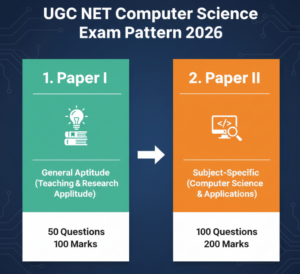
The UGC NET Computer Science and Applications 2026 exam is conducted in two papers, both of which are mandatory and held together in a single session lasting three hours.
| Paper | Subject | No. of Questions | Marks | Duration |
| Paper I | General Aptitude (Teaching & Research Aptitude) | 50 | 100 | 3 Hours (Combined) |
| Paper II | Subject-Specific: Computer Science & Applications | 100 | 200 |
Check UGC NET Exam Pattern 2026 for Paper 1 & 2 Here
UGC NET Computer Science Syllabus 2026 PDF
The UGC NET Computer Science PDF with the latest syllabus offers a comprehensive outline of the exam topics, organized into ten major units. These units cover core areas such as discrete structures, programming languages, computer networks, database management systems, and such. This latest UGC NET Computer Science syllabus PDF serves as a crucial guide for candidates preparing for the UGC NET in Computer Science and Applications (Subject Code 87). Download the UGC NET Computer Science PDF for the latest 2026 syllabus from the table below:
| UGC NET Computer Science Syllabus 2026 PDF Link | |
|---|---|
| UGC NET Computer Science and Applications Syllabus 2026 PDF (English) | Download Link |
Download Latest UGC NET Syllabus 2026 PDF Here
UGC NET Computer Science and Applications Syllabus 2026
UGC NET Computer Science and Application Syllabus 2026, as mandated by the National Testing Agency (NTA), will evaluate a candidate’s overall knowledge of Computer Science and Applications. This UGC NET Computer Science and Applications Syllabus will be for those candidates who want to become Assistant Professors or qualify for Junior Research Fellowships (JRF) in the subject of Computer Science and Applications in Indian colleges and universities. The UGC NET Computer Science syllabus is designed under Paper I and Paper II.
JRFAdda Silver June 2026 CS Batch (Paper 1 + Paper 2) – Join Now!
| Unit No. | Unit Name |
| Unit 1 | Discrete Structures and Optimization |
| Unit 2 | Computer Arithmetic and Architecture |
| Unit 3 | Programming Languages and Computer Graphics |
| Unit 4 | Database Management Systems |
| Unit 5 | System Software and Operating System |
| Unit 6 | Software Engineering |
| Unit 7 | Data Structures and Algorithms |
| Unit 8 | Theory of Computation and Compilers |
| Unit 9 | Data Communication and Computer Networks |
| Unit 10 | Artificial Intelligence (AI), Machine Learning (ML), and Emerging Technologies |
Join UGC NET Coaching in Jaipur
UGC NET Computer Science Previous Year Question Papers
Preparing for the UGC NET in Computer Science and Applications is a lot simpler once you practice using previous years’ question papers. The UGC NET Question Paper in Computer Science and Applications is created to evaluate the aspirants’ knowledge in programming, data structures, operating systems, networks, databases, software engineering, and emerging technologies.
| Exam Name | Year | Download PDF Link |
| UGC NET Computer Science and Applications Question Paper (December) | 2025 | Download Link |
| UGC NET Computer Science and Applications previous year question papers (June) | 2025 | Download Link |
| UGC NET Computer Science and Applications previous year question papers | 2024 | Download Link |
| UGC NET Computer Science and Applications previous year question papers | 2023 | Download Link |
| UGC NET Computer Science and Applications previous year question papers | 2022 | Download Link |
| UGC NET Computer Science and Applications previous year question papers | 2020 | Download Link |
| UGC NET Computer Science and Applications previous year question papers | 2018 | Download Link |
Download Previous Years UGC NET Computer Science Question Paper PDFs
UGC NET Computer Science 2026 Preparation Tips
Preparing for the UGC NET Computer Science and Applications 2026 exam requires a strategic and disciplined approach. The UGC NET JRF Computer Science syllabus is vast and covers both general teaching aptitude (Paper I) and subject-specific topics (Paper II). In order to successfully qualify for this exam, there should be a well-laid-out and disciplined preparation plan.
Best UGC NET Coaching in Jaipur
- Understand the Syllabus: Divide the UGC NET JRF Computer Science syllabus according to its units and difficulty level.
- Make Use of Good Study Material: Go through books such as JRFAdda’s UGC NET Computer Science Handwritten book notes for conceptual clarity and exam-oriented preparation.
- Practice PYQs: Practice previous year papers to know trends.
- Revise Regularly: Create short notes for each topic for quick revision.
- Balance Paper I & II: Do not ignore the General Paper (Teaching & Research Aptitude).
- Take Mock Tests Weekly: Evaluate performance and enhance time management.
- Stay Consistent: Study on a daily basis, even for shorter hours.
View UGC NET Preparation Tips 2026
Conclusion
UGC NET Computer Science and Applications 2026 FAQs

What is the UGC NET Computer Science eligibility criteria 2026?
To meet the requirements of UGC NET for Computer Science eligibility, candidates must hold a Master’s degree in Computer Science & Applications or a related discipline with at least 55% marks for General category and 50% for SC/ST/OBC/PwD. Final-year postgraduates may also apply.
Are there any previous year question papers available for UGC NET Computer Science and Applications 2026?
Yes, you can access UGC NET Computer Science and Applications previous year question papers for 2022-2025 and more from official sources and educational websites. These are essential for understanding the exam pattern and improving preparation.
Is there any negative marking in the UGC NET Computer Science and Applications 2026 exam?
No, there is no negative marking in the UGC NET Computer Science and Applications 2026 exam. Candidates are encouraged to attempt all questions to maximise their scores without fear of penalties for incorrect answers.
What topics are covered in the UGC NET Computer Science and Application syllabus 2026?
The UGC NET Computer Science and Application syllabus 2026 includes 10 units, covering topics such as Discrete Structures, Programming, DBMS, Software Engineering, Operating Systems, Networks, AI & ML, and Emerging Technologies.