
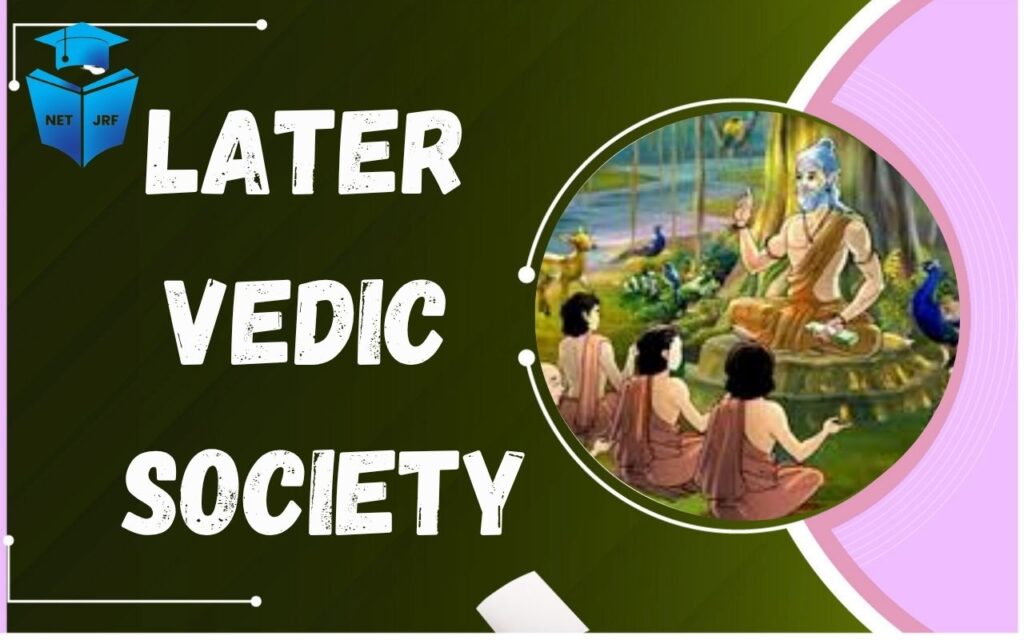

Later Vedic Society and Economy describes the social and economic transformation that occurred in northern India between about 1000 BCE and 600 BCE. During this period Vedic communities moved from the northwestern region toward the fertile plains of the Ganga it explains the development of agriculture, social hierarchy political power and economic activities that later shaped early Indian civilization.
Many sources such as the Yajurveda, Samaveda, Atharvaveda, Brahmanas, Aranyakas, and Upanishads provide important information about the society and economy of this period.

Best UGC NET Foundation Course
Later Vedic Society Background
The later Vedic phase followed the early Vedic age. During this time Aryan tribes expanded eastward from the Sapta Sindhu region toward the Ganga Yamuna plains.
Several important changes occurred during this expansion.
Major Developments
- Growth of agriculture due to fertile soil
- Use of iron tools in farming
- Establishment of permanent settlements
- Rise of powerful kingdoms
- Development of social hierarchy
These changes gradually transformed tribal society into a more complex structure. The transition marked the evolution of Later Vedic Society and Economy in ancient India.
Later Vedic Expansion of Agriculture
Agriculture became the most important economic activity in the later Vedic period. Earlier pastoral life slowly changed into settled farming.
Main Agricultural Features
- Clearing of forests for cultivation
- Use of iron ploughshare
- Production of crops such as rice barley wheat
- Use of cattle for ploughing fields
The fertile land of the Ganga valley supported large agricultural production.
Agricultural development played a major role in shaping Later Vedic Society and Economy because surplus food allowed population growth and social complexity.
Later Vedic Period Social Structure
Society during this period became more stratified compared with the early Vedic age.
Growth of Varna System
The four varna divisions became more rigid.
- Brahmana served as priests teachers religious leaders
- Kshatriya controlled political power warfare
- Vaishya worked as farmers traders artisans
- Shudra performed service labor work
Unlike the early period these divisions became hereditary.
The strengthening of caste hierarchy became one of the most important features of Later Vedic Society and Economy.
Best UGC NET Foundation Batch Online
Later Vedic Family System
The family continued to remain the basic unit of society.
Key Characteristics
- Patriarchal family structure
- Father acted as head of household
- Joint family system common
- Property inherited through male line
Family authority strengthened during this period.
These social changes also formed a significant part of Later Vedic Society and Economy because property ownership influenced social status.
Later Vedic Position of Women
The status of women declined compared with the early Vedic period.
Important Changes
- Limited access to education
- Reduced participation in religious rituals
- Early marriage became common
- Women lost some social freedom
Although women still participated in family life their public role decreased.
These changes reveal the transformation of Later Vedic Society and Economy toward a more patriarchal structure.
Later Vedic Growth of Kingship
Political organization changed significantly in the later Vedic period.
Features of Kingship
- Tribal chiefs became powerful kings
- Authority of king increased
- Royal rituals such as Rajasuya and Ashvamedha performed
- Administrative officials appointed
Kingship became hereditary and more centralized.
This political transformation also influenced Later Vedic Society and Economy by strengthening social hierarchy and taxation.
Later Vedic Development of Trade and Crafts
Economic activities expanded beyond agriculture.
Main Economic Activities
- Craft production
- Metal work
- Pottery making
- Textile production
Trade developed between different regions. Merchants exchanged goods through barter system.
The expansion of economic activities strengthened Later Vedic Society and Economy and supported urban growth in later centuries.
Best UGC NET Offline Classes in Jaipur
Later Vedic Role of Iron Technology
The introduction of iron tools became an important turning point.
Importance of Iron
- Efficient clearing of forests
- Better agricultural tools
- Improved weapons for warfare
Iron technology helped communities settle in the dense forests of eastern India.
This technological development played a key role in shaping Later Vedic Society and Economy.

Key Features of Later Vedic Society and Economy
Building on the foundations of the Early Vedic period, the Later Vedic period saw significant changes in social organization, economic practices, and political structures, marking the transition to a more complex and hierarchical society.
| Aspect of Later Vedic Society and Economy | Description |
| Main economic activity | Agriculture |
| Important crops | Rice barley wheat |
| Social system | Rigid varna hierarchy |
| Political organization | Powerful hereditary kings |
| Technology | Use of iron tools |
Later Vedic Religious Changes
Religion became more complex during the later Vedic period.
Major Religious Developments
- Increase in ritual ceremonies
- Greater importance of Brahman priests
- Emergence of philosophical ideas in Upanishads
Complex rituals such as Ashvamedha yajna required large resources.
Religion therefore influenced both the social structure and economic activities within Later Vedic Society and Economy.
Later Vedic Emergence of Social Inequality
As society grew more complex differences between social groups increased.
Reasons for Social Inequality
- Control of land resources
- Growth of hereditary caste divisions
- Power of priestly class
- Wealth differences among communities
These factors created stronger social hierarchy.
The emergence of inequality became a defining characteristic of Later Vedic Society and Economy.

Later Vedic Urban Growth and Settlement Expansion
Large agricultural production supported population growth.
Settlement Patterns
- Permanent villages expanded
- New settlements in eastern regions
- Development of trade routes
These developments gradually prepared the ground for the rise of cities during the later historical period.
Such transformations illustrate the evolving nature of Later Vedic Society and Economy.
The Later Vedic Society and Economy represents a major stage in the evolution of ancient Indian civilization. Society became more complex due to agricultural expansion, technological progress and growth of political power.
Rigid caste hierarchy, powerful kingship, decline of women status and expansion of trade characterized this period. These developments gradually transformed tribal communities into structured kingdoms.
- Explain the causes of social inequality in the later Vedic period.
- Discuss religious developments during the later Vedic period.
- Evaluate the transition from early Vedic to later Vedic society.
Best UGC NET Offline Coaching in Jaipur
Later Vedic Society and Economy FAQs

2. What was the main occupation in later Vedic period?
Agriculture became the primary occupation. Farmers cultivated crops such as rice wheat and barley using iron tools.
3. Why did the varna system become rigid in later Vedic society?
Social expansion wealth differences and priestly authority strengthened hereditary caste divisions.
4. What role did iron technology play?
Iron tools helped clear forests improve farming increase production which supported settlement expansion.
5. How did trade develop in the later Vedic period?
Merchants exchanged agricultural goods crafts metals through local trade networks mostly using barter system.