
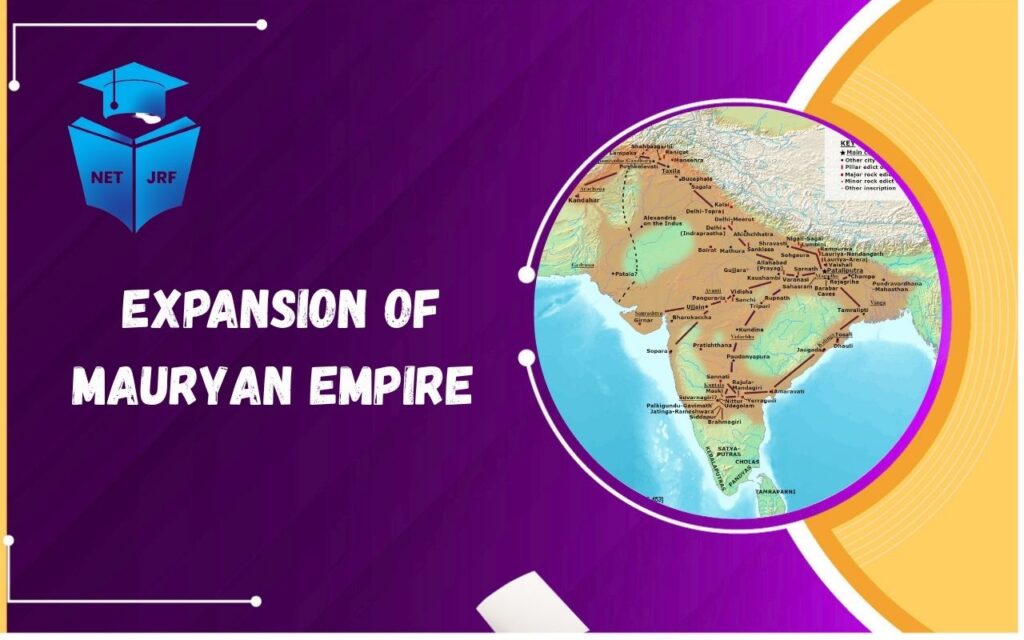

The expansion of the Mauryan Empire was one of the most important phases in ancient Indian history. It transformed a regional kingdom into a vast and powerful empire covering most of the Indian subcontinent. Under Chandragupta Maurya, the empire began expanding by defeating the Nanda rulers and consolidating control over Magadha. He later extended his authority into north-western regions after conflicts with the successors of Alexander the Great, which strengthened Indo-Greek political relations.

Background of Mauryan Empire
Before discussing the Expansion of the Mauryan empire, it is important to understand the background.
- The fall of the Nanda dynasty created a power vacuum in Magadha. Chandragupta Maurya, with the guidance of Chanakya, took advantage of this situation.
- Magadha already had strong resources like fertile land, iron mines, and river networks. These factors helped in the early Expansion of Mauryan empire.
Best UGC NET Offline Coaching in Jaipur
Expansion of Mauryan Empire under Chandragupta Maurya
The expansion of the Mauryan Empire began with Chandragupta Maurya, who was determined to build a vast and powerful empire. His approach combined strategic military campaigns, smart diplomacy, and efficient administration.
Early Conquests:
Chandragupta’s first major step was capturing Magadha by defeating the Nanda dynasty. Magadha was already a strong and prosperous kingdom, making its capture both symbolically and strategically important. This victory laid the foundation for the Mauryan Empire and gave Chandragupta a strong power base.
Northwestern Expansion:
Once Magadha was secured, Chandragupta turned his attention to northwestern India, which had been fragmented after Alexander the Great’s campaigns. The Greek satraps left behind were defeated, further consolidating Mauryan power. This not only expanded the empire but also secured its borders against potential foreign threats.
Treaty with Seleucus Nicator:
Around 305 BCE, Chandragupta signed a treaty with Seleucus Nicator, a former general of Alexander. This was a turning point in the peaceful expansion of the empire:
- Chandragupta received strategic territories like Afghanistan and Baluchistan, securing the northwestern frontier.
- Seleucus obtained 500 war elephants, which later strengthened his own forces.
- A marriage alliance was also established, ensuring long-term peace.
This treaty allowed Chandragupta to expand his empire without engaging in continuous warfare, showing his ability to combine diplomacy with military power.
Expansion under Bindusara
Bindusara, Chandragupta’s son, continued the expansion of the Mauryan Empire, though his reign is less famous in comparison. He focused on consolidating and extending the empire further into the south.
Southern Campaigns:
Bindusara expanded the empire toward the Deccan region, steadily integrating new territories into Mauryan control. Greek sources referred to him as Amitrochates, meaning “slayer of enemies,” highlighting his military prowess. His campaigns ensured the steady expansion of the Mauryan Empire into peninsular India, making it one of the largest empires of its time.
Administrative Control:
Bindusara placed emphasis on efficient administration and governance over newly conquered regions. By maintaining stability and order, he ensured that the empire remained strong and could continue expanding without internal disruptions.
Best UGC NET Coaching in Jaipur
Expansion under Ashoka
Ashoka, the grandson of Chandragupta Maurya, brought the Mauryan Empire to its peak, both in size and influence. Unlike his predecessors, Ashoka’s reign is marked by a unique combination of military conquest and moral transformation.
Conquest of Kalinga:
The most famous event of Ashoka’s expansion was the Kalinga War, which was a turning point in his life and in the Mauryan Empire’s history:
- Strategic Importance: Kalinga was located on the eastern coast of India, controlling trade and access to the Bay of Bengal. Its conquest was essential for unifying India under Mauryan control.
- Victory and Destruction: Ashoka successfully defeated Kalinga after a fierce battle, but the war caused massive loss of life and suffering.
- Moral Transformation: Witnessing the human cost of war deeply affected Ashoka. After Kalinga, he embraced Dhamma (moral and ethical governance) and abandoned aggressive military expansion.
Despite Ashoka’s shift toward peace, the Mauryan Empire reached its maximum territorial extent during his reign, stretching across most of the Indian subcontinent.
Factors Responsible for Expansion of the Mauryan Empire
The expansion of the Mauryan Empire was not accidental. It was the result of careful planning, strong leadership, economic power, and military strength.
- Strong Leadership:
The Mauryan Empire owed much of its success to visionary leaders:
- Chandragupta Maurya: Laid the foundation through conquest and strategic alliances.
- Chanakya (Kautilya): Provided political strategy, economic guidance, and administrative planning.
- Ashoka: Expanded the empire while also ensuring stability and moral governance.
- Efficient Administration:
A well-organized governance system supported the empire’s expansion:
- Centralized Government: Kings maintained direct control over provinces.
- Strong Bureaucracy: Officials managed taxation, law, and public welfare.
- Intelligence Network: Spies and messengers kept the empire informed of internal and external threats.
- Economic Strength:
A strong economy provided the resources necessary for conquest and administration:
- Fertile Land: The Gangetic plains produced abundant food to support a large population and army.
- Iron Resources: Enabled production of weapons and tools, crucial for both agriculture and military.
- Trade Routes: Internal and external trade routes increased wealth and facilitated cultural exchange.
- Military Power:
The Mauryan army was a key instrument of expansion:
- Large Standing Army: Enabled rapid deployment across vast regions.
- War Elephants: Provided a psychological and tactical advantage in battles.
- Advanced Strategy: Coordinated use of infantry, cavalry, and elephants ensured effective campaigns.
Administrative Support in Expansion
Administration played a silent but powerful role in the expansion of Mauryan empire.
While military conquests and strong leadership grab the headlines, the administration was the silent but powerful force behind the Mauryan Empire’s expansion. A well-organized administrative system allowed the Mauryans to maintain control over vast territories while supporting military campaigns.
Provincial System:
- The empire was divided into provinces (Janapadas), each governed by a trusted governor or viceroy.
- These governors were responsible for maintaining law and order, collecting revenue, and managing local administration.
- This system ensured that even distant regions remained under central control, preventing rebellions and enabling smooth governance during expansion.
Revenue System:
- The Mauryan state had an efficient taxation mechanism, collecting revenue from agriculture, trade, and other economic activities.
- These revenues were directly used to support the army, fund infrastructure, and maintain the bureaucracy.
- A strong treasury ensured that the empire could sustain long-term campaigns without economic strain, making the expansion both possible and sustainable.
Impact of Expansion
The Expansion of the Mauryan Empire was more than just territorial growth—it had deep and lasting effects on India’s political, economic, and cultural landscape.
Political Unity:
- For the first time in Indian history, a vast region came under centralized authority.
- This political unity reduced constant wars between smaller kingdoms and created a stable environment for administration and development.
Economic Growth:
- Expansion brought many regions under Mauryan control, improving trade networks and connecting distant areas.
- The increase in internal trade led to prosperity, strengthened the treasury, and funded both governance and the army.
- This economic strength made the empire resilient and self-sustaining during long campaigns.
Cultural Exchange:
- Bringing diverse regions together led to interactions between different cultures, languages, and traditions.
- Ideas, art, and religions like Buddhism and Jainism spread more widely, creating a rich cultural mosaic across the empire.

Limitations of Expansion
Despite its achievements, the expansion of the Mauryan Empire faced significant challenges:
Large Size:
- Controlling such a vast territory was inherently difficult. Governors and officials sometimes struggled to maintain direct authority.
Communication Problems:
- Without modern transportation, messages and orders took time to reach distant regions, delaying administrative decisions.

Revolts in Distant Areas:
- Local populations occasionally resisted, leading to rebellions and uprisings in far-flung provinces.
- Managing these conflicts required constant attention, draining resources and attention from other priorities.
The Expansion of Mauryan empire was a gradual process built on strong leadership, economic strength, and effective administration. From Chandragupta’s conquests to Ashoka’s moral rule, the empire showed both power and transformation.
| Read UGC Notes | ||
| Unit | Topic | Link |
| Archaeological | Archaeological Sources for UGC NET | Open |
| Archaeological | Exploration in Archaeology | Open |
| Archaeological | Excavation Techniques in Archaeology | Open |
| Archaeological | Dating of Archaeological Sites | Open |
| Archaeological | Epigraphy — Study of Inscriptions | Open |
| Archaeological | Inscriptions in Reconstructing History | Open |
| Archaeological | Numismatics in History | Open |
| Archaeological | Importance of Coins in History | Open |
| Literary Sources | Meaning of Historical Sources | Open |
| Literary Sources | Literary Sources in History | Open |
| Literary Sources | Indigenous Literature | Open |
| Literary Sources | Dating Ancient Literary Sources | Open |
| Literary Sources | Secular Literature as Historical Source | Open |
| Literary Sources | Role of Myths & Legends in Historical Reconstruction | Open |
| Foreign Accounts | Foreign Accounts of India — Overview | Open |
| Foreign Accounts | Greek Accounts on Ancient India | Open |
| Foreign Accounts | Chinese Accounts on India | Open |
| Foreign Accounts | Arabic Accounts on India | Open |
| Neolithic & Chalcolithic | Neolithic and Chalcolithic Phases | Open |
| Neolithic & Chalcolithic | Hunting, Gathering & Food Production | Open |
| Neolithic & Chalcolithic | Neolithic Revolution in India | Open |
| Neolithic & Chalcolithic | Neolithic Settlements in India | Open |
| Neolithic & Chalcolithic | Distribution of Neolithic Cultures in India | Open |
| Neolithic & Chalcolithic | Tools and Technology in Neolithic Period | Open |
| Neolithic & Chalcolithic | Chalcolithic Culture in India | Open |
| Neolithic & Chalcolithic | Settlement Pattern & Economy in Chalcolithic Phase | Open |
| Neolithic & Chalcolithic | Trade & Exchange Networks in Chalcolithic Societies | Open |
| Indus Valley | Indus Valley Civilization — Overview | Open |
| Indus Valley | Major Sites of Indus Civilization | Open |
| Indus Valley | Urban Planning in Harappan Civilization | Open |
| Indus Valley | Architecture and Town Planning | Open |
| Indus Valley | Agriculture and Food Economy | Open |
| Indus Valley | Craft Specialization & Industrial Activities | Open |
| Indus Valley | Internal Trade of Harappan Civilization | Open |
| Indus Valley | Internal and External Trade | Open |
| Indus Valley | Social Structure of Indus Civilization | Open |
| Indus Valley | Political Organization of Harappan Civilization | Open |
| Indus Valley | Religion and Beliefs in Indus Civilization | Open |
| Indus Valley | Decline of Indus Civilization | Open |
| Indus Valley | Indus Civilization as First Urbanization | Open |
| Vedic Period | Vedic and Later Vedic Periods — Overview | Open |
| Vedic Period | Origin of Vedic Civilization | Open |
| Vedic Period | Aryan Debate — Migration, Invasion & Indigenous Theories | Open |
| Vedic Period | Early Vedic Society and Economy | Open |
| Vedic Period | Political Institutions in Early Vedic Period | Open |
| Vedic Period | Social Structure in Early Vedic Period | Open |
| Vedic Period | Later Vedic Society and Economy | Open |
| Vedic Period | Emergence of Varnas and Social Stratification | Open |
| Vedic Period | Emergence of Heterodox Sects in India | Open |
| Vedic Period | Impact of Iron Technology in India | Open |
| Miscellaneous | Megalithic Culture of South India | Open |
| Miscellaneous | Religious and Philosophical Vedic Ideas | Open |
| Miscellaneous | State System in Ancient India | Open |