
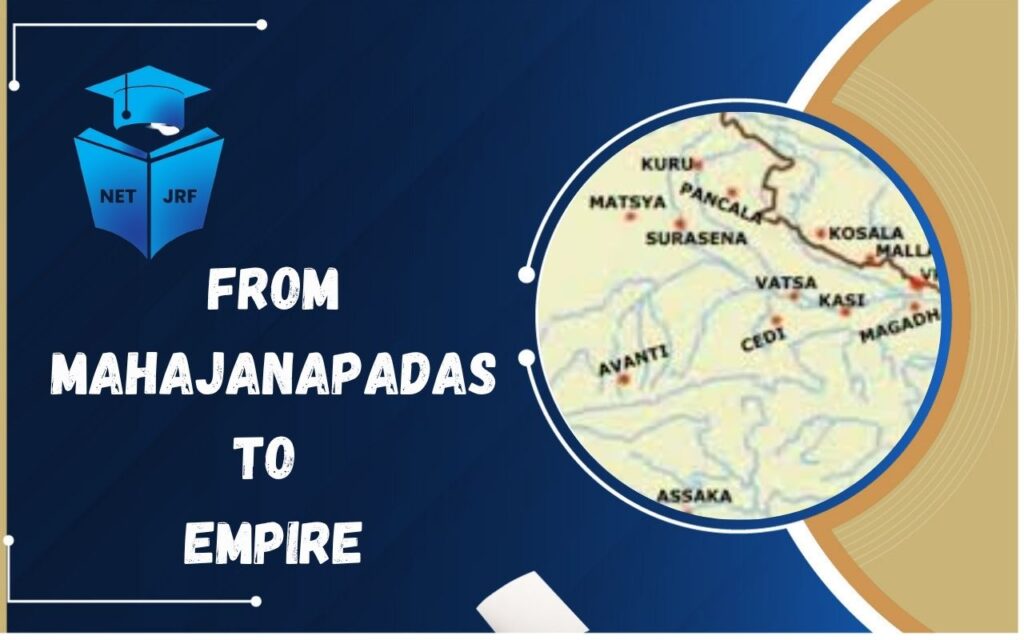

From Mahajanapadas to Empire is one of the most important topics in ancient Indian history. It explains how small states slowly developed into large empires like Magadha. The journey from Mahajanapadas to the Empire shows changes in politics, economy, society, and warfare.

Mahajanapadas Meaning
The term Mahajanapada literally means “great state” or “large territorial unit”. Around the 6th century BCE, northern India saw the rise of numerous small kingdoms and republics, which were the early forms of organized states.
These Mahajanapadas represented a significant transition from tribal and clan-based societies to structured political systems, with defined territories, rulers, and administrative mechanisms.
They formed the foundation for the evolution of empires, marking the beginning of centralized authority, territorial expansion, and state governance in ancient India.
Sixteen Mahajanapadas
Ancient texts like the Buddhist Anguttara Nikaya mention sixteen major Mahajanapadas, which were the most important states in northern India around the 6th century BCE.
Major States
There were sixteen important Mahajanapadas mentioned in ancient texts like Buddhist Anguttara Nikaya.
Some important ones were:
- Magadha
- Kosala
- Vatsa
- Avanti
- Vajji
- Kuru
- Panchala
These states played a key role in the journey of From Mahajanapadas to Empire.
Types of Mahajanapadas
The sixteen Mahajanapadas were not all governed the same way; they exhibited diverse political systems, reflecting the complexity of early state formation in ancient India.
There were two main types:
- Monarchies ruled by kings
- Republics governed by assemblies
This diversity shows the complexity of early political systems.
Monarchies
- Ruled by Kings: Most Mahajanapadas, such as Magadha and Kosala, were monarchies.
- Centralized Power: The king held supreme authority over administration, military, and justice.
- Dynastic Rule: Power was typically inherited, with succession passing within royal families.
- Example: Magadha under rulers like Bimbisara and Ajatashatru became a model of centralized governance.
Republics (Ganas or Sanghas)
- Governed by Assemblies: Some states, like Vajji, were republics where decisions were made collectively.
- Shared Authority: Councils or assemblies of nobles and elders managed political, military, and economic affairs.
- Consensus-Based Governance: Policies were determined through discussion and agreement rather than single-person rule.
- Example: Vajji, with its confederation system, emphasized collaboration among clans.
From Mahajanapadas to Empire Key Features
The transition from Mahajanapadas to empire marked a significant transformation in ancient India, involving political, economic, and social changes that laid the foundation for large, centralized states.
Political Changes
- Rise of Powerful Kings: Strong rulers, such as those in Magadha, expanded territories and established authority.
- Decline of Republics: Many smaller assemblies or republican states lost independence to expanding monarchies.
- Centralization of Power: Authority shifted from local councils to a centralized king, enabling efficient governance and military control.
Economic Changes
- Growth of Agriculture: Improved farming techniques and expansion of arable land increased food production.
- Use of Iron Tools: Iron ploughs and weapons enhanced both agriculture and military efficiency.
- Increase in Trade: Development of trade routes and markets promoted wealth accumulation and urban growth.
Social Changes
- Rise of Cities: Urban centers became hubs of administration, trade, and culture.
- Emergence of New Social Groups: Merchants, artisans, and administrators gained prominence in society.
- Spread of Religions: Buddhism and Jainism influenced moral, social, and political life across these states.
Enroll UGC NET Online Coaching

Rise of Magadha
Magadha became the most powerful state during the transition from Mahajanapadas to empire, playing a central role in shaping ancient Indian political history.
Why Magadha Became Powerful
- Fertile Land
-
-
- The Gangetic plains supported high agricultural productivity, ensuring food security and population growth.
-
- Availability of Iron
-
-
- Iron resources allowed better weapons, tools, and military equipment, strengthening both army and agriculture.
-
- Strategic Location
-
-
- Surrounded by rivers and connected by trade routes, Magadha controlled commerce, transport, and defense effectively.
-
- Strong Rulers
-
- Leadership under capable kings ensured territorial expansion, central administration, and military dominance.
| Read UGC Notes | ||
| Unit | Topic | Link |
| Archaeological | Archaeological Sources for UGC NET | Open |
| Archaeological | Exploration in Archaeology | Open |
| Archaeological | Excavation Techniques in Archaeology | Open |
| Archaeological | Dating of Archaeological Sites | Open |
| Archaeological | Epigraphy — Study of Inscriptions | Open |
| Archaeological | Inscriptions in Reconstructing History | Open |
| Archaeological | Numismatics in History | Open |
| Archaeological | Importance of Coins in History | Open |
| Literary Sources | Meaning of Historical Sources | Open |
| Literary Sources | Literary Sources in History | Open |
| Literary Sources | Indigenous Literature | Open |
| Literary Sources | Dating Ancient Literary Sources | Open |
| Literary Sources | Secular Literature as Historical Source | Open |
| Literary Sources | Role of Myths & Legends in Historical Reconstruction | Open |
| Foreign Accounts | Foreign Accounts of India — Overview | Open |
| Foreign Accounts | Greek Accounts on Ancient India | Open |
| Foreign Accounts | Chinese Accounts on India | Open |
| Foreign Accounts | Arabic Accounts on India | Open |
| Neolithic & Chalcolithic | Neolithic and Chalcolithic Phases | Open |
| Neolithic & Chalcolithic | Hunting, Gathering & Food Production | Open |
| Neolithic & Chalcolithic | Neolithic Revolution in India | Open |
| Neolithic & Chalcolithic | Neolithic Settlements in India | Open |
| Neolithic & Chalcolithic | Distribution of Neolithic Cultures in India | Open |
| Neolithic & Chalcolithic | Tools and Technology in Neolithic Period | Open |
| Neolithic & Chalcolithic | Chalcolithic Culture in India | Open |
| Neolithic & Chalcolithic | Settlement Pattern & Economy in Chalcolithic Phase | Open |
| Neolithic & Chalcolithic | Trade & Exchange Networks in Chalcolithic Societies | Open |
| Indus Valley | Indus Valley Civilization — Overview | Open |
| Indus Valley | Major Sites of Indus Civilization | Open |
| Indus Valley | Urban Planning in Harappan Civilization | Open |
| Indus Valley | Architecture and Town Planning | Open |
| Indus Valley | Agriculture and Food Economy | Open |
| Indus Valley | Craft Specialization & Industrial Activities | Open |
| Indus Valley | Internal Trade of Harappan Civilization | Open |
| Indus Valley | Internal and External Trade | Open |
| Indus Valley | Social Structure of Indus Civilization | Open |
| Indus Valley | Political Organization of Harappan Civilization | Open |
| Indus Valley | Religion and Beliefs in Indus Civilization | Open |
| Indus Valley | Decline of Indus Civilization | Open |
| Indus Valley | Indus Civilization as First Urbanization | Open |
| Vedic Period | Vedic and Later Vedic Periods — Overview | Open |
| Vedic Period | Origin of Vedic Civilization | Open |
| Vedic Period | Aryan Debate — Migration, Invasion & Indigenous Theories | Open |
| Vedic Period | Early Vedic Society and Economy | Open |
| Vedic Period | Political Institutions in Early Vedic Period | Open |
| Vedic Period | Social Structure in Early Vedic Period | Open |
| Vedic Period | Later Vedic Society and Economy | Open |
| Vedic Period | Emergence of Varnas and Social Stratification | Open |
| Vedic Period | Emergence of Heterodox Sects in India | Open |
| Vedic Period | Impact of Iron Technology in India | Open |
| Miscellaneous | Megalithic Culture of South India | Open |
| Miscellaneous | Religious and Philosophical Vedic Ideas | Open |
| Miscellaneous | State System in Ancient India | Open |
Important Rulers
- Bimbisara: Expanded territory through alliances and conquests, strengthened economy and administration.
- Ajatashatru: Defeated neighboring states and fortified the kingdom, introducing military innovations.
- Mahapadma Nanda: Established a centralized empire with a strong army and efficient governance, making Magadha dominant in northern India.
From Mahajanapadas to Empire Overview
The transition from Mahajanapadas to empire represents a key phase in ancient Indian history, marking the shift from small kingdoms and republics to large, centralized empires.
| Stage | Features | Importance |
| Mahajanapadas | Small states | Beginning of political systems |
| Magadha Rise | Strong kingdom | Expansion of power |
| Nanda Rule | Centralized control | Large empire formation |
| Transition | Political unity | Base for Mauryan Empire |
Enroll UGC NET Coaching in Jaipur
Political Evolution From Small States to Large Kingdoms
The political evolution of ancient India involved the transformation of numerous small states into powerful, centralized kingdoms, a process central to the transition from Mahajanapadas to empire.
From Small States to Large Kingdoms
- Initially, northern India consisted of many small kingdoms and republics.
- Over time, stronger states conquered weaker ones, expanding their territories and consolidating power.
- This gradual unification under dominant rulers laid the foundation for larger empires like Magadha.
Decline of Republics
- Republics such as Vajji gradually lost independence because monarchies were more organized and centralized.
- Kings had better control over resources, armies, and administration, enabling them to absorb smaller states efficiently.
Role of Economy in Transition from Mahajanapadas to Empire
The economy played a crucial role in transforming small states into large kingdoms, providing the resources needed for administration, military, and urban growth.
Agricultural Growth
- The use of iron tools improved farming efficiency and productivity.
- Increased food production supported population growth, urbanization, and a stable workforce.
Trade and Urbanization
- Expansion of trade led to the growth of cities as hubs of commerce, administration, and culture.
- Development of markets and trade routes facilitated wealth accumulation and connectivity between regions.
Role of Warfare in Transition from Mahajanapadas to Empire
Warfare played a critical role in shaping ancient Indian states, enabling strong kingdoms to expand territory, control resources, and establish centralized authority.
Key Aspects of Warfare
- Strong Armies
- States maintained large and well-organized armies ready for defense and conquest.
- Use of Elephants
- War elephants provided a decisive advantage in battles, breaking enemy lines and intimidating opponents.
- Conquest Strategy
- Kings strategically used military campaigns to absorb smaller states and expand their empires.
Administrative Development
Administrative development was a key factor in transforming small states into large, organized kingdoms, enabling rulers to govern efficiently and maintain control over vast territories.
Centralized Administration
- Kings exercised direct control over administration, ensuring uniform policies and decisions across the state.
- Centralization strengthened the authority of the ruler and reduced regional fragmentation.
Officials and Tax System
- Appointed officials were responsible for collecting taxes, maintaining law and order, and managing local governance.
- A structured tax system ensured steady revenue to support the army, infrastructure, and administration.
Role of Nandas in Empire Formation
The Nanda dynasty played a crucial role in transforming Magadha from a regional kingdom into a large empire, bridging the gap between Mahajanapadas and the Mauryan Empire.
Expansion under Nandas
- The Nanda rulers expanded Magadha to its greatest territorial extent, absorbing neighboring kingdoms.
- Their conquests established Magadha as the dominant power in northern India.
Strong Economy and Army
- The Nandas maintained a rich treasury from agriculture, trade, and taxes.
- A large, well-organized army, including infantry, cavalry, and war elephants, ensured both defense and territorial control.
Importance
- The Nandas laid the administrative, economic, and military foundations that Chandragupta Maurya later used to establish the Mauryan Empire.
- Their policies demonstrated the shift from small states to centralized empire-building, making their contribution vital in the process from Mahajanapadas to empire.
Transition to Mauryan Empire
The final stage of the transition from Mahajanapadas to empire was marked by the rise of the Mauryan Empire, which united large parts of northern India under a single, centralized authority.
Rise of Chandragupta Maurya
- Chandragupta Maurya overthrew the Nanda dynasty with guidance from Chanakya, establishing a new imperial structure.
- This event marked the beginning of a truly pan-Indian empire, setting a precedent for centralized governance, strong administration, and military organization.
Key Factors Behind Transformation
Geography
- Fertile plains of the Ganga provided abundant agricultural produce, supporting population growth and state revenue.
Resources
- Iron was crucial for weapons, tools, and construction, enhancing military and economic strength.
Leadership
- Strong rulers like Chandragupta Maurya provided strategic vision, military leadership, and administrative control.
Strategy
- Expansion combined conquests, alliances, and diplomacy, allowing consolidation of diverse regions under one empire.

Challenges in Process from Mahajanapadas to Empire
The transition from small states to large empires faced several challenges, yet it continued due to strong leadership, economic resources, and military power.
Political Conflicts
- Frequent wars between neighboring states caused instability and territorial disputes.
- Competition for dominance sometimes delayed unification of larger kingdoms.
Economic Pressure
- Maintaining large armies, administration, and infrastructure required substantial resources.
- High costs often placed pressure on taxation systems and state revenues.
Social Changes
- Emergence of new social groups, urban centers, and administrative structures created tensions with traditional tribal and clan-based systems.
- People had to adapt to centralized authority and new governance rules, causing occasional resistance.
In conclusion, the journey of From Mahajanapadas to Empire shows how early Indian states evolved into powerful empires. This process involved political centralization, economic growth, military expansion, and administrative development.
Enroll UGC NET Offline Coaching in Jaipur