

The Sources for Mauryan history help us understand one of the greatest empires in ancient India. They provide detailed information about rulers, administration, society, economy, culture, and foreign relations. By studying these sources, historians can reconstruct the political strategies of Chandragupta Maurya, the administrative systems established by his successors, and the social and economic life of the people.

Meaning of Historical Sources
Historical sources are materials that give us information about events, people, and societies of the past. They are the tools through which historians reconstruct history and understand how civilizations developed over time.
Types of Sources
The Sources for Mauryan history can be broadly classified into three main types:
Literary sources – Written texts that describe events, rulers, society, and administration.
Archaeological sources – Physical remains such as inscriptions, monuments, coins, and artifacts that provide material evidence.
Foreign accounts – Writings of travelers and ambassadors from other countries that give an outsider’s perspective on Mauryan India.
Together, these sources form the backbone of our understanding of the Mauryan Empire, helping us piece together its political, economic, and cultural history.
Sources for Mauryan History: Classification
The Sources for Mauryan history can be broadly divided into two major categories:
Literary Sources
Archaeological Sources
Each type provides different kinds of information, and together, they help historians reconstruct a comprehensive picture of the Mauryan Empire.
Literary Sources
Literary sources consist of written texts that describe events, rulers, society, and administration during the Mauryan period. They are further classified into religious texts and secular texts.
Best UGC NET Offline Classes in Jaipur
Religious Texts
These texts often provide indirect insights into Mauryan rulers and their policies. They reflect the cultural and moral environment of the time.
- Examples:
- Tripitaka – Buddhist scriptures providing glimpses into the society and rulers.
- Parishishtaparvan – Jain texts that shed light on historical events and administration.
Secular Texts
Secular literary sources focus directly on governance, politics, and the economy of the Mauryan Empire. They are crucial for understanding how the empire functioned administratively and economically.
- Key Examples:
- Arthashastra – Written by Chanakya, it explains statecraft, economy, administration, and law.
- Indica – Written by the Greek ambassador Megasthenes, it provides a detailed account of Mauryan society, administration, and the capital Pataliputra.
These literary sources are essential in the Sources for Mauryan history, as they provide both internal and external perspectives on one of India’s greatest empires.
Archaeological Sources
Archaeological sources consist of physical remains from the past that provide direct evidence of the Mauryan Empire’s administration, society, economy, and culture. These sources are crucial for complementing literary accounts and offer tangible proof of historical developments.
Inscriptions
Inscriptions are writings engraved on stone, pillars, or metal surfaces. They often contain official messages, orders, or moral teachings. Among these, the Ashokan Edicts are the most significant.
Best UGC NET Offline Coaching in Jaipur
Features of Ashokan Edicts:
- Written mostly in Prakrit language for wider public understanding.
- Found across different regions of India, showing the extent of Ashoka’s influence.
- Provide moral instructions, political directives, and administrative guidelines.
These inscriptions form a major part of the Sources for Mauryan history, offering firsthand insight into the thoughts and policies of the rulers.
Monuments and Architecture
Mauryan-era monuments reflect the artistic, religious, and cultural aspects of the period. They also indicate the administrative capability and organizational skills of the empire.
Examples:
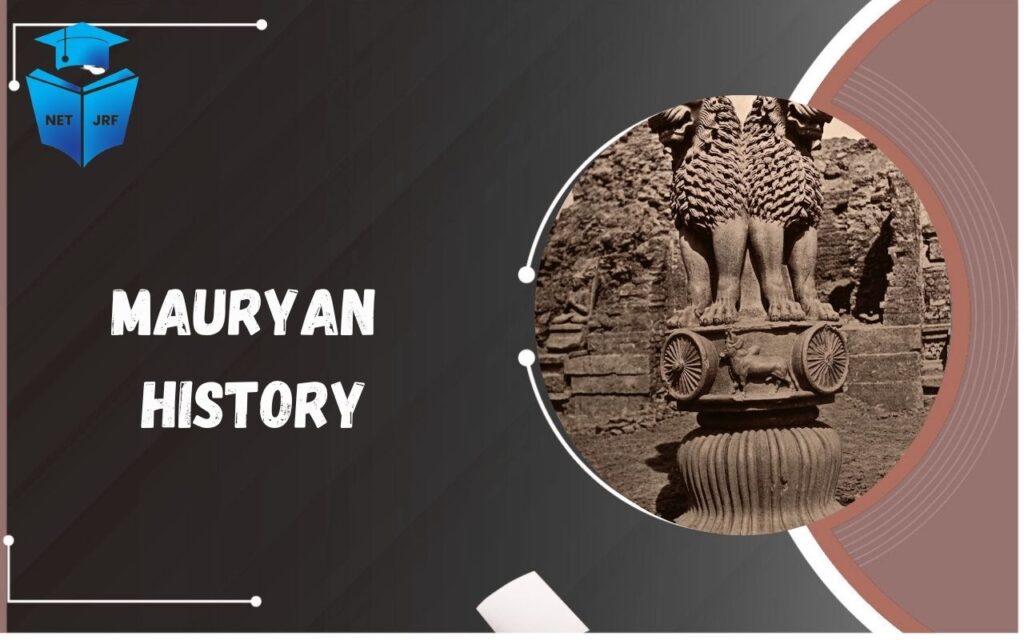
- Pillars of Ashoka – Carved with edicts and symbols like the Lion Capital.
- Stupas like Sanchi – Religious structures that show Buddhist influence and architectural sophistication.
These structures are valuable because they provide clues about religion, art, society, and governance in Mauryan times.
Coins
Coins are an important archaeological source for understanding the economy and trade during the Mauryan Empire.
Importance of Coins:
- Reflect the economic condition of the empire.
- Show patterns of trade relations, both internal and with neighboring regions.
- Help historians study currency systems, taxation, and state control over resources.
Coins, inscriptions, and monuments together form a strong archaeological base that complements literary sources, giving us a well-rounded understanding of the Mauryan period.
Sources for Mauryan history Overview
| Source Type | Examples | Information Provided |
| Literary | Arthashastra, Indica | Administration, society |
| Inscriptions | Ashokan edicts | Policies, religion |
| Monuments | Stupas, pillars | Art, culture |
| Coins | Punch-marked coins | Economy |

Foreign Accounts
Foreign accounts are historical records written by travelers, ambassadors, or historians from outside India. These sources provide an outsider’s perspective, often highlighting aspects of the Mauryan Empire that local sources may overlook. They are particularly useful for understanding society, administration, and international relations.
Top UGC NET Online Test Series
Greek Writers
The most famous among these is Megasthenes, the Greek ambassador sent by Seleucus Nicator to Chandragupta Maurya’s court in Pataliputra.
Contributions of Megasthenes:
- Described Pataliputra: He provided detailed accounts of the Mauryan capital, its urban planning, fortifications, and civic life.
- Explained Administration: His observations give insights into the centralized bureaucracy, the roles of officials, and the efficiency of governance.
- Detailed Society: Megasthenes recorded information about social classes, occupations, economy, and cultural practices of the time.
These foreign accounts serve as valuable sources for Mauryan history, offering a comparative view that complements Indian literary and archaeological evidence.
Importance of Arthashastra
The Arthashastra, written by Chanakya (Kautilya), is one of the most significant sources for understanding the Mauryan Empire.
- Detailed Governance: It provides in-depth insights into administration, law, revenue collection, and economic management.
- Practical Approach: Unlike theoretical treatises, Arthashastra focuses on real-life governance, strategies, and the practical challenges of ruling an empire.
- Historical Importance: Historians use it to understand the political organization, statecraft, and administrative mechanisms during Chandragupta Maurya’s reign.
Importance of Ashokan Edicts
The Ashokan Edicts are inscriptions engraved on pillars and rocks by Emperor Ashoka. They are crucial sources for Mauryan history.
- Direct Evidence: Written by the ruler himself, these edicts provide firsthand information about policies and decisions.
- Moral Teachings: They explain Ashoka’s Dhamma, promoting ethical conduct, non-violence, and social welfare.
- Wide Spread: Found across India, they reflect the reach and influence of the Mauryan administration.
- Historical Significance: They help us understand political, social, and religious aspects of the Mauryan period.
Role of Megasthenes
Megasthenes, the Greek ambassador to Chandragupta Maurya’s court, wrote Indica, which is a key literary source for the Mauryan period.
- Greek Ambassador: His presence in the Mauryan court allowed him to record observations about Indian politics, society, and culture.
- Book Indica: Provides detailed descriptions of Pataliputra, administrative practices, social classes, and economy.
- Historical Importance: His account offers a foreign perspective, complementing Indian literary and archaeological sources.
Strengths of These Sources
Many sources, like Ashokan Edicts, provide direct evidence from the period.
- Variety of Data: Different types of sources—literary, archaeological, foreign—cover diverse aspects like governance, economy, and culture.
- Cross Verification: Comparing multiple sources helps historians ensure accuracy and reliability.
These strengths make the sources invaluable for reconstructing Mauryan history.

Limitations of Sources
Writers may have personal or political motives influencing their accounts.
- Incomplete Information: Not all details have survived; some aspects of Mauryan life remain unclear.
- Interpretation Issues: Historians may interpret the same source differently, leading to multiple viewpoints.
Conclusion
In conclusion, the Sources for Mauryan history play a very important role in understanding the Mauryan Empire. They include literary texts, inscriptions, monuments, and foreign accounts. Each source gives unique information. When combined, they provide a clear and detailed view of the past.
|
Read UGC Notes |
||
| Unit | Topic | Link |
| Archaeological | Archaeological Sources for UGC NET | Open |
| Archaeological | Exploration in Archaeology | Open |
| Archaeological | Excavation Techniques in Archaeology | Open |
| Archaeological | Dating of Archaeological Sites | Open |
| Archaeological | Epigraphy — Study of Inscriptions | Open |
| Archaeological | Inscriptions in Reconstructing History | Open |
| Archaeological | Numismatics in History | Open |
| Archaeological | Importance of Coins in History | Open |
| Literary Sources | Meaning of Historical Sources | Open |
| Literary Sources | Literary Sources in History | Open |
| Literary Sources | Indigenous Literature | Open |
| Literary Sources | Dating Ancient Literary Sources | Open |
| Literary Sources | Secular Literature as Historical Source | Open |
| Literary Sources | Role of Myths & Legends in Historical Reconstruction | Open |
| Foreign Accounts | Foreign Accounts of India — Overview | Open |
| Foreign Accounts | Greek Accounts on Ancient India | Open |
| Foreign Accounts | Chinese Accounts on India | Open |
| Foreign Accounts | Arabic Accounts on India | Open |
| Neolithic & Chalcolithic | Neolithic and Chalcolithic Phases | Open |
| Neolithic & Chalcolithic | Hunting, Gathering & Food Production | Open |
| Neolithic & Chalcolithic | Neolithic Revolution in India | Open |
| Neolithic & Chalcolithic | Neolithic Settlements in India | Open |
| Neolithic & Chalcolithic | Distribution of Neolithic Cultures in India | Open |
| Neolithic & Chalcolithic | Tools and Technology in Neolithic Period | Open |
| Neolithic & Chalcolithic | Chalcolithic Culture in India | Open |
| Neolithic & Chalcolithic | Settlement Pattern & Economy in Chalcolithic Phase | Open |
| Neolithic & Chalcolithic | Trade & Exchange Networks in Chalcolithic Societies | Open |
| Indus Valley | Indus Valley Civilization — Overview | Open |
| Indus Valley | Major Sites of Indus Civilization | Open |
| Indus Valley | Urban Planning in Harappan Civilization | Open |
| Indus Valley | Architecture and Town Planning | Open |
| Indus Valley | Agriculture and Food Economy | Open |
| Indus Valley | Craft Specialization & Industrial Activities | Open |
| Indus Valley | Internal Trade of Harappan Civilization | Open |
| Indus Valley | Internal and External Trade | Open |
| Indus Valley | Social Structure of Indus Civilization | Open |
| Indus Valley | Political Organization of Harappan Civilization | Open |
| Indus Valley | Religion and Beliefs in Indus Civilization | Open |
| Indus Valley | Decline of Indus Civilization | Open |
| Indus Valley | Indus Civilization as First Urbanization | Open |
| Vedic Period | Vedic and Later Vedic Periods — Overview | Open |
| Vedic Period | Origin of Vedic Civilization | Open |
| Vedic Period | Aryan Debate — Migration, Invasion & Indigenous Theories | Open |
| Vedic Period | Early Vedic Society and Economy | Open |
| Vedic Period | Political Institutions in Early Vedic Period | Open |
| Vedic Period | Social Structure in Early Vedic Period | Open |
| Vedic Period | Later Vedic Society and Economy | Open |
| Vedic Period | Emergence of Varnas and Social Stratification | Open |
| Vedic Period | Emergence of Heterodox Sects in India | Open |
| Vedic Period | Impact of Iron Technology in India | Open |
| Miscellaneous | Megalithic Culture of South India | Open |
| Miscellaneous | Religious and Philosophical Vedic Ideas | Open |
| Miscellaneous | State System in Ancient India | Open |