
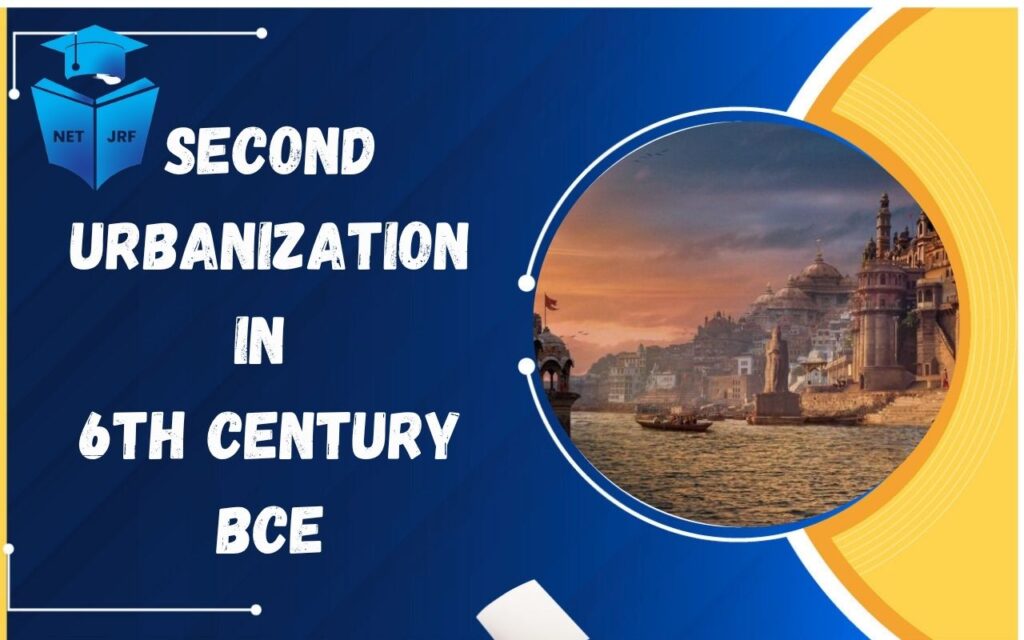

Second Urbanization in 6th Century BCE: Cities, Trade, Mahajanapadas & Economy

Second Urbanization in 6th Century BCE transformed northern India through rapid urban growth, expansion of trade networks, craft specialization, and the emergence of Mahajanapadas, making cities centers of economic activity, social stratification, political organization, and cultural development.

vishal

Second Urbanization in 6th Century BCE

Table of Contents

Second Urbanization in 6th Century BCE, a period when northern India witnessed rapid urban growth, flourishing trade, and emerging political states. Unlike earlier rural settlements, towns now became centers of economic activity, administration, and cultural exchange. s.

Study Planner


Join UGC NET Online Coaching

Historical Context

After the decline of smaller urban settlements, the 6th century BCE brought new energy to city-building. Fertile plains, especially along the Ganga and its tributaries, supported dense populations. This period saw:

  • Growth in agriculture, providing steady food surpluses.
  • Expansion of trade routes, both local and long-distance.
  • Emergence of politically organized territories, later called Mahajanapadas.

The combination of these factors encouraged larger settlements and more complex social organization.

Urban Features and City Life

Urban centers during this period showed remarkable planning and organization:

  • Fortifications: Walls protected towns from raids and floods.
  • Distinct zones: Residential areas, marketplaces, and public halls were separated.
  • Infrastructure: Streets, drainage systems, and water management reflected civic planning.

Cities like Rajagriha, Vaishali, and Shravasti became hubs for commerce, administration, and religion, illustrating the spread of urban culture.

Population and Settlement Patterns

  • Urban populations included merchants, artisans, farmers, priests, and administrators.
  • Rural hinterlands supported towns by supplying grain, timber, and raw materials.
  • Some towns saw higher social stratification, evident in housing, burial practices, and craft specialization.

This mixture of urban and rural life created a dynamic economy and society, a key feature of the Second Urbanization in 6th Century BCE.

Economy and Trade

Economic developments played a central role in shaping urban growth and social complexity in ancient India. As agriculture improved, and trade networks expanded, cities became more than just living spaces they turned into hubs of culture, craft, and commerce.

Agriculture

Agriculture was the backbone of the economy. The main crops grown included rice, wheat, barley, and pulses, which provided staple food for both rural and urban populations. Farmers gradually adopted new techniques, such as the iron plough, which made tilling heavier soils easier and more productive. The introduction of iron tools also allowed clearing forests and preparing more land for cultivation, supporting larger populations.

  • Surplus Production: As farming became more efficient, surplus crops were produced. These surpluses fed the growing city populations, supported non-farming communities, and created goods that could be traded.
  • Irrigation and Storage: Simple irrigation systems and storage techniques helped farmers maintain food security and manage seasonal shortages.

This combination of innovation and resource management allowed agriculture to not just sustain life but to actively fuel urban and trade expansion.

Trade and Commerce

Trade acted as a bridge between villages, towns, and even distant regions. Local trade connected small towns with nearby villages, allowing surplus agricultural produce and crafts to reach wider markets.

  • External Trade: Many communities engaged in long-distance trade, reaching regions far beyond India’s borders. Goods were transported using rivers, carts, and caravan routes, which enabled cultural and economic exchanges.
  • Standardization: Merchants used standardized weights and measures to ensure fairness in transactions. This standardization helped build trust and encouraged wider commercial activity.
  • Trade Centers: Certain cities and towns became prominent trade hubs, attracting artisans, traders, and even political attention because controlling trade routes meant wealth and influence.

Trade was not only an economic activity but also a social one, shaping urban lifestyles, professions, and networks of cooperation.

Read More Notes On Archaeological Sources UGC NET
Meaning of Historical Sources Archaeological Sources for UGC NET Exploration in Archaeology
Excavation Techniques in Archaeology Epigraphy: Study of Inscriptions Inscriptions in Reconstructing History
Numismatics in History Importance of Coins in History Dating of Archaeological Sites
Dating Ancient Literary Sources for UGC NET Literary Sources in History for UGC NET Foreign Accounts of India for UGC NET
Greek Accounts on Ancient India Secular Literature as Historical Source Role of Myths and Legends in Historical Reconstruction
Greek Accounts on Ancient India (Repeat Link) Chinese Accounts on India Arabic Accounts on India

Craft and Industry

Craft production flourished alongside agriculture and trade. Communities specialized in producing pottery, metalwork, weaving, and bead-making, often reflecting local styles and resources.

  • Specialized Craftsmen: Certain families or guilds dedicated themselves entirely to a craft, producing goods for local use as well as trade. This specialization improved quality and efficiency.
  • Urban Demand: Urban centers created consistent demand for craft products, from functional items like pots and tools to decorative objects such as beads and ornaments.
  • Trade Integration: Crafts were often integrated into trade networks, with goods moving from production centers to marketplaces far away.

This specialization of labor marked a shift toward a more complex economy, where agriculture, trade, and craft production were closely linked and mutually dependent.

Join UGC NET Online Course

Economic Features of Second Urbanization in 6th Century BCE

Building on the growth of cities, social hierarchies, and emerging political institutions, economic features played a central role in shaping the Second Urbanization in 6th Century BCE. The rise of urban centers was closely tied to agriculture, trade, craft specialization, and the circulation of wealth, which together supported city populations and fostered regional networks. Understanding these economic aspects helps explain how cities became hubs of prosperity, innovation, and social complexity.

Feature Details
Agriculture Rice, wheat, barley, pulses; iron tools used
Trade Local and long-distance trade; standardized weights
Crafts Metalwork, pottery, weaving, beads
Urban Markets Centralized bazaars and trading hubs
Rural Support Hinterlands provided food, timber, and raw materials

Social Organization

The growth of cities during the Second Urbanization in 6th Century BCE had a profound effect on social structures. As urban centers expanded, occupational specialization became more important. Artisans, traders, and administrators developed distinct roles that supported city life, creating new social identities beyond the traditional rural village roles.

  • Urban Elites: Wealth accumulation and political influence gave rise to urban elites who often lived in larger houses and controlled trade and craft production.
  • Rural Communities: Despite urban growth, rural areas remained critical for food production. Farmers supplied the surplus that fed city populations, making rural-urban connections vital.
  • Visible Social Differences: Social distinctions became more apparent through housing patterns, burial practices, and the quality of goods people could afford, indicating an increasingly stratified society.

This period demonstrates how urbanization reshaped social relationships and introduced new forms of organization, balancing elite dominance with the continuing importance of rural support systems.

App JRF Adda


Political Institutions

State Formation

The Second Urbanization saw the rise of Mahajanapadas, early large states such as Magadha, Kosala, and Vatsa. Kings in these states gained more authority as political and economic power concentrated in urban centers.

  • Role of Assemblies: Councils and assemblies often participated in decision-making, ensuring that governance was not purely autocratic.
  • Administrative Officials: Specialized officials managed taxation, trade regulation, law enforcement, and civic responsibilities, reflecting early bureaucratic organization.

Top UGC NET Offline Classes in Jaipur

Assemblies and Governance

Some states, particularly republican ones like the Vajji confederacy, functioned through councils of elders and tribal assemblies. Decision-making combined the input of rulers and representatives, a participatory model of governance.

  • Military Organization: Armed forces protected cities and trade routes. This military presence ensured stability, defended resources, and strengthened the authority of rulers.

These political developments illustrate how urbanization encouraged more structured, organized, and resilient governance systems, blending monarchy with representative participation in certain regions.

Cultural and Religious Developments

Urban growth also influenced cultural life. New religious movements, including Buddhism and Jainism, arose during this period, impacting both city culture and political life.

  • Religious Centers: Monasteries and sacred complexes served multiple roles—they were religious hubs, centers of learning, and even economic nodes supporting local trade.
  • Art and Literature: Urban centers nurtured artistic expression, literary composition, and ritual practices. These reflected both the sophistication of city life and the persistence of rural traditions.

Through these changes, cities became intellectual and cultural centers, not just economic hubs, shaping social norms, education, and artistic development.

Technological Advancements

Iron technology revolutionized multiple aspects of life during this period. It was widely applied in:

  • Agriculture: Iron ploughs and tools increased crop yields and expanded arable land.
  • Weapons: Iron swords, spears, and arrowheads improved military capabilities, helping rulers defend cities and control trade routes.
  • Urban Planning: Cities featured fortifications, marketplaces, drainage systems, and carefully laid-out streets, reflecting advanced civic engineering.
  • Transport Networks: Boats, carts, and improved roads facilitated trade and communication, linking urban centers with villages and distant regions.

These technological improvements integrated cities into broader economic and political networks, enabling growth, stability, and cultural exchange.

Long-Term Legacy

The Second Urbanization in 6th Century BCE had lasting impacts on Indian society:

  • Urban Planning Principles: Early designs of streets, fortifications, and drainage influenced later cities and even the Mauryan urban model.
  • Trade Networks: The period fostered long-distance trade that connected cities, villages, and neighboring regions, promoting economic interdependence.
  • Political Foundations: The rise of Mahajanapadas laid the groundwork for larger, centralized states, culminating in the Mauryan Empire.
  • Social and Cultural Influence: Urbanization encouraged occupational specialization, cultural institutions, and religious diversity, shaping social and economic patterns for centuries.

Understanding these developments allows students to assess the significance of city planning, governance, and economic integration in early Indian history.

JRF Adda Book


Conclusion

The Second Urbanization in 6th Century BCE marked a major shift in Indian history. Cities became centers of economic, social, and political activity, while trade, craft production, and iron technology supported population growth. Governance evolved with both monarchies and assemblies.

Top UGC NET Offline Coaching in Jaipur

Read UGC NET Notes
1 Archaeological Sources for UGC NET Epigraphy – Study of Inscriptions Meaning of Historical Sources Archaeological
2 Meaning of Historical Sources Archaeological Sources for UGC NET Literary Sources in History Archaeological
3 Exploration in Archaeology Excavation Techniques in Archaeology Dating of Archaeological Sites Archaeological
4 Excavation Techniques in Archaeology Exploration in Archaeology Dating of Archaeological Sites Archaeological
5 Epigraphy – Study of Inscriptions Inscriptions in Reconstructing History Numismatics in History Archaeological
6 Inscriptions in Reconstructing History Epigraphy – Study of Inscriptions Archaeological Sources for UGC NET Archaeological
7 Numismatics in History Importance of Coins in History Epigraphy – Study of Inscriptions Archaeological
8 Importance of Coins in History Numismatics in History Archaeological Sources for UGC NET Archaeological
9 Dating of Archaeological Sites Excavation Techniques in Archaeology Dating Ancient Literary Sources Archaeological
10 Indigenous Literature Literary Sources in History Secular Literature as Historical Source Literary
11 Dating Ancient Literary Sources Literary Sources in History Dating of Archaeological Sites Literary
12 Literary Sources in History Indigenous Literature Foreign Accounts of India Literary
13 Foreign Accounts of India Greek Accounts on Ancient India Chinese Accounts on India Literary
14 Greek Accounts on Ancient India Foreign Accounts of India Chinese Accounts on India Literary
15 Secular Literature as Historical Source Literary Sources in History Indigenous Literature Literary
16 Role of Myths and Legends in Historical Reconstruction Literary Sources in History Secular Literature as Historical Source Literary
17 Chinese Accounts on India Foreign Accounts of India Greek Accounts on Ancient India Literary
18 Arabic Accounts on India Foreign Accounts of India Chinese Accounts on India Literary
19 Neolithic and Chalcolithic Phases Neolithic Revolution in India Chalcolithic Culture in India Neolithic
20 Hunting, Gathering & Food Production Neolithic Revolution in India Neolithic Settlements in India Neolithic
21 Neolithic Revolution in India Neolithic Settlements in India Tools and Technology in Neolithic Period Neolithic
22 Neolithic Settlements in India Distribution of Neolithic Cultures in India Neolithic Revolution in India Neolithic
23 Distribution of Neolithic Cultures in India Neolithic Settlements in India Tools and Technology in Neolithic Period Neolithic
24 Tools and Technology in Neolithic Period Neolithic Revolution in India Chalcolithic Culture in India Neolithic
25 Chalcolithic Culture in India Settlement Pattern & Economy in Chalcolithic Phase Trade & Exchange Networks in Chalcolithic Societies Neolithic
26 Settlement Pattern & Economy – Chalcolithic Phase Chalcolithic Culture in India Trade & Exchange Networks in Chalcolithic Societies Neolithic
27 Trade & Exchange Networks – Chalcolithic Societies Chalcolithic Culture in India IVC Internal & External Trade Neolithic
28 Indus Valley Civilization – UGC NET Major Sites of Indus Civilization Urban Planning in Harappan Civilization IVC
29 IVC Internal & External Trade Internal Trade – Harappan Civilization Craft Specialization in Harappan Civilization IVC
30 Political Organization – Harappan Civilization Social Structure – Indus Civilization Urban Planning in Harappan Civilization IVC
31 Major Sites of Indus Civilization Indus Valley Civilization – UGC NET Urban Planning in Harappan Civilization IVC
32 Urban Planning & Settlement – Harappan Civilization Architecture & Town Planning – Harappan Cities IVC as First Urbanization in India IVC
33 Architecture & Town Planning – Harappan Cities Urban Planning in Harappan Civilization Major Sites of Indus Civilization IVC
34 Craft Specialization & Industrial Activities – Harappan Agriculture & Food Economy – Harappans IVC Internal & External Trade IVC
35 Agriculture & Food Economy – Harappans Craft Specialization in Harappan Civilization Internal Trade – Harappan Civilization IVC
36 Internal Trade – Harappan Civilization IVC Internal & External Trade Craft Specialization in Harappan Civilization IVC
37 Religion & Beliefs – Indus Civilization Social Structure – Indus Civilization Indus Valley Civilization – UGC NET IVC
38 Social Structure – Indus Civilization Political Organization – Harappan Civilization Religion & Beliefs – Indus Civilization IVC
39 Decline of Indus Civilization Indus Valley Civilization – UGC NET IVC as First Urbanization in India IVC
40 IVC as First Urbanization in India Urban Planning in Harappan Civilization Second Urbanization in India IVC
41 Vedic & Later Vedic Periods – Aryan Varna System Early Vedic Society and Economy Later Vedic Society and Economy Vedic
42 Origin of Vedic Civilization Aryan Debate – Migration, Invasion & Indigenous Theories Early Vedic Society and Economy Vedic
43 Aryan Debate – Migration, Invasion & Indigenous Theories Origin of Vedic Civilization Early Vedic Society and Economy Vedic
44 Early Vedic Society and Economy Political Institutions – Early Vedic Period Social Structure – Early Vedic Period Vedic
45 Political Institutions – Early Vedic Period Early Vedic Society and Economy Monarchical States in Ancient India Vedic
46 Social Structure – Early Vedic Period Emergence of Varnas & Social Stratification Early Vedic Society and Economy Vedic
47 Later Vedic Society and Economy Emergence of Varnas & Social Stratification Impact of Iron Technology in India Vedic
48 Emergence of Varnas & Social Stratification Social Structure – Early Vedic Period Later Vedic Society and Economy Vedic
49 Emergence of Heterodox Sects in India Jainism, Buddhism & Ajivikas – Origins & Teachings Later Vedic Society and Economy Vedic
50 Impact of Iron Technology in India Later Vedic Society and Economy Agricultural Expansion & Economic Changes – Ancient India Vedic
51 Religious & Philosophical Vedic Ideas Emergence of Varnas & Social Stratification Emergence of Heterodox Sects in India Vedic
52 Megalithic Culture of South India Neolithic and Chalcolithic Phases Agricultural Expansion & Economic Changes General
53 State System in Ancient India Rise of Mahajanapadas Transition: Tribal Polities to Territorial States General
54 Transition: Tribal Polities to Territorial States Rise of Mahajanapadas Later Vedic Society and Economy General
55 Rise of Mahajanapadas Monarchical States in Ancient India Republican States (Gana-Sanghas) – Ancient India Magadha
56 Monarchical States in Ancient India Rise of Mahajanapadas Emergence of Magadha Magadha
57 Republican States (Gana-Sanghas) – Ancient India Rise of Mahajanapadas Monarchical States in Ancient India Magadha
58 Agricultural Expansion & Economic Changes – Ancient India Second Urbanization in India Impact of Iron Technology in India General
59 Second Urbanization in India IVC as First Urbanization in India Rise of Mahajanapadas General
60 Jainism, Buddhism & Ajivikas – Origins & Teachings Emergence of Heterodox Sects in India Ashoka’s Policy of Dhamma General
61 Emergence of Magadha Geographical Advantages of Magadha Early Rulers of Magadha Magadha
62 Geographical Advantages of Magadha Natural Resources & Economic Strength of Magadha Reasons for Success of Magadha Magadha
63 Natural Resources & Economic Strength of Magadha Geographical Advantages of Magadha Economic Policies of the Nandas Magadha
64 Early Rulers of Magadha Haryanka Dynasty – Rise of Magadha Emergence of Magadha Magadha
65 Haryanka Dynasty – Rise of Magadha Expansion Policy of Bimbisara Early Rulers of Magadha Magadha
66 Expansion Policy of Bimbisara Ajatashatru – Military Reforms Haryanka Dynasty – Rise of Magadha Magadha
67 Ajatashatru – Military Reforms Wars of Ajatashatru Expansion Policy of Bimbisara Magadha
68 Wars of Ajatashatru Ajatashatru – Military Reforms Udayin & Establishment of Pataliputra Magadha
69 Udayin & Establishment of Pataliputra Wars of Ajatashatru Shishunaga Dynasty Magadha
70 Shishunaga Dynasty Administrative Structure of the Shishunagas Nanda Dynasty Magadha
71 Administrative Structure of the Shishunagas Shishunaga Dynasty Central Administration Under Mauryas Magadha
72 Nanda Dynasty Mahapadma Nanda – Imperial Expansion Shishunaga Dynasty Magadha
73 Mahapadma Nanda – Imperial Expansion Military Strength of the Nandas Nanda Dynasty Magadha
74 Economic Policies of the Nandas Nanda Dynasty Taxation System – Mauryan State Magadha
75 Military Strength of the Nandas Mahapadma Nanda – Imperial Expansion Defeat of Nandas & Rise of Mauryan Empire Magadha
76 Reasons for Success of Magadha Geographical Advantages of Magadha Natural Resources & Economic Strength of Magadha Magadha
77 Mahajanapadas to Empire – Evolution & Rise of Magadha Rise of Mahajanapadas Emergence of Magadha Magadha
78 Mauryan Empire – Expansion Rise of Chandragupta Maurya Expansion of Mauryan Empire Maurya
79 Rise of Chandragupta Maurya Role of Chanakya in Rise of Mauryan Empire Defeat of Nandas & Rise of Mauryan Empire Maurya
80 Role of Chanakya in Rise of Mauryan Empire Rise of Chandragupta Maurya Defeat of Nandas & Rise of Mauryan Empire Maurya
81 Defeat of Nandas & Rise of Mauryan Empire Military Strength of the Nandas Rise of Chandragupta Maurya Maurya
82 Chandragupta Maurya – Seleucus Treaty & Diplomacy Expansion of Mauryan Empire Greek Accounts on Ancient India Maurya
83 Expansion of Mauryan Empire Chandragupta Maurya – Seleucus Treaty & Diplomacy Kalinga War Maurya
84 Administration of Chandragupta Maurya Central Administration Under Mauryas Mauryan Bureaucracy Maurya
85 Sources for Mauryan History Archaeological Sources for UGC NET Greek Accounts on Ancient India Maurya
86 Central Administration Under Mauryas Provincial Administration – Mauryan Empire Mauryan Bureaucracy Maurya
87 Provincial Administration – Mauryan Empire Local Administration – Mauryan Empire Central Administration Under Mauryas Maurya
88 Local Administration – Mauryan Empire Provincial Administration – Mauryan Empire Mauryan Bureaucracy Maurya
89 Mauryan Bureaucracy Central Administration Under Mauryas Espionage System – Mauryan Empire Maurya
90 Espionage System – Mauryan Empire Mauryan Bureaucracy Central Administration Under Mauryas Maurya
91 Ancient India – Trade and Commerce Trade and Commerce Under Mauryas Agrarian Economy – Mauryan Period Maurya
92 Agrarian Economy – Mauryan Period Taxation System – Mauryan State Trade and Commerce Under Mauryas Maurya
93 Trade and Commerce Under Mauryas Ancient India – Trade and Commerce Agrarian Economy – Mauryan Period Maurya
94 Taxation System – Mauryan State Agrarian Economy – Mauryan Period Economic Policies of the Nandas Maurya
95 Kalinga War Ashoka’s Policy of Dhamma Expansion of Mauryan Empire Maurya
96 Ashoka’s Policy of Dhamma Nature & Philosophy of Dhamma Kalinga War Maurya
97 Nature & Philosophy of Dhamma Ashoka’s Policy of Dhamma Jainism, Buddhism & Ajivikas Maurya

Second Urbanization in 6th Century BCE  FAQs

Loader image

The Gangetic plains, with towns like Rajagriha, Vaishali, and Shravasti.

Merchants, artisans, priests, farmers, and administrators dominated city life.

It improved agriculture, tools, and weapons, enabling population growth and urban expansion.

They acted as territorial states, providing political stability and economic organization.

Leave a Reply

Recent Posts
Aditi

Aditi Sharma, founder of JRFAdda, is a Computer Science educator with an MCA degree and JRF qualification (99.91 percentile, Dec 2019). Her experience includes roles as an SBI SO (DBA), work at Cognizant, and over 5 years of teaching online and offline. She has also served as a Government Computer Teacher in Rajasthan.