
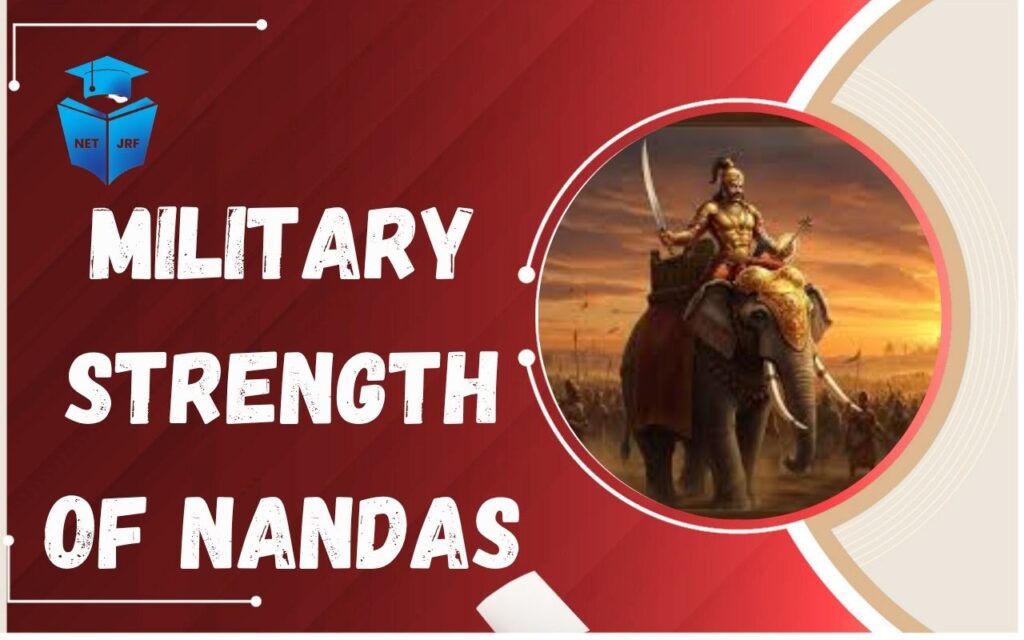

The military strength of the Nanda dynasty was one of the most remarkable features of their rule. Under Mahapadma Nanda, Magadha developed a large, well-organized, and disciplined army that became the backbone of imperial power. This military capability enabled the Nandas to conquer neighboring kingdoms, maintain internal stability, and protect their empire from external threats.

The army’s size, advanced organization, and use of specialized units such as infantry, cavalry, and war elephants set a new standard in northern India. Its effectiveness not only consolidated the Nanda dynasty’s authority but also provided a model for later rulers, including the Mauryas.
The military strength of the Nandas thus represented both a tool of expansion and a symbol of centralized authority, making it a key factor in the dynasty’s rise and influence.
Background of Nanda Power
Before understanding the Military strength of Nandas, we need to look at the background. The Nanda rulers came after the Shishunaga dynasty and inherited a strong base.
They used this base and focused heavily on building a powerful army. This decision changed the political map of northern India.
Military strength of Nandas Core Features
The Military strength of Nandas was unique for its time. It combined large numbers with effective management.
Main Features
- Largest Standing Army
-
-
- The Nandas maintained a massive permanent army, ensuring both defense and offensive capability.
- Greek sources like Megasthenes highlight the army’s extraordinary size.
-
- Strong Use of War Elephants
-
-
- War elephants were a key feature, used for shock tactics and battlefield dominance.
- They enhanced both offensive and defensive operations during campaigns.
-
- Well-Organized Infantry and Cavalry
-
-
- Infantry formed the backbone of the army, providing discipline and stability in battles.
- Cavalry units added mobility and strategic advantage, allowing quick response to threats.
-
- Central Control over Military Forces
-
- The king had direct authority over army deployment, organization, and command.
- This central control ensured coordinated campaigns and effective governance across conquered territories.
- These features made the Military strength of Nandas unmatched.
Composition of Army
-
Infantry
-
-
- Infantry formed the backbone of the army. Soldiers fought on foot and used basic weapons like swords, spears, and bows.
- They were trained to fight in large groups, which made them effective in battles.
-
-
Cavalry
-
-
- Cavalry units used horses for fast movement. They played an important role in attacking enemies quickly.
- This added speed and flexibility to the Military strength of Nandas.
-
-
War Elephants
-
-
- War elephants were the most powerful part of the army. They created fear among enemies and helped in breaking enemy lines.
- Greek accounts mention a very large number of elephants in the Nanda army.
-
-
Chariots
-
- Chariots were used in battles for movement and attack. Though their importance reduced over time, they still played a role.
Army Size
The Military strength of Nandas is often described in Greek sources. According to these sources, the army included:
- Around 200,000 infantry
- 20,000 cavalry
- 2,000 chariots
- 3,000 elephants
This huge size shows how powerful the Military strength of Nandas was.
Such a large army required strong economic support, which the Nandas had.
Economic Base of Military Power
The military strength of the Nanda dynasty was closely tied to its economic foundation. A strong and well-managed treasury provided the resources necessary to maintain one of the largest and most formidable armies in ancient India.
Strong Treasury
-
- The Nanda rulers collected heavy taxes from agriculture, trade, and crafts.
- Revenue was carefully managed to create a rich royal treasury capable of supporting long-term military campaigns.
- Wealth accumulation ensured financial stability and enabled centralized control over the empire.
-
Funding the Army
-
-
- The treasury played a direct role in building and sustaining the military:
-
- Payment of Soldiers
-
-
- Salaries for infantry, cavalry, and specialized troops ensured loyalty and readiness.
-
- Maintenance of Weapons
-
-
- Funds were used to procure and maintain arms, armor, and war elephants.
-
- Training of Troops
-
- Resources supported regular drills and preparation, increasing army efficiency and discipline.
Military Organization of Nandas
The Nanda dynasty built a well-organized and disciplined military that was essential for maintaining their empire and expanding Magadha’s territories. Strong organization, central control, and systematic training made their army highly effective.
Central Control
- The king exercised full authority over the army, including deployment, strategy, and discipline.
- Centralized control ensured quick decision-making during battles and efficient coordination across units.
Officers and Command Structure
- Specialized officers were appointed to manage different divisions of the army, including infantry, cavalry, and war elephants.
- A clear hierarchy maintained order, accountability, and smooth execution of campaigns.
Training
- Soldiers underwent regular training and drills to maintain readiness for war.
- Training emphasized coordination between infantry, cavalry, and elephant units, enhancing battlefield efficiency.
Role of Nanda Military in Imperial Expansion
The military strength of the Nandas played a central role in expanding Magadha into a dominant power in northern India. A large, disciplined, and well-equipped army enabled the dynasty to conquer territories, control strategic resources, and assert imperial authority.
How Expansion Happened
- Conquest of Small Kingdoms
-
-
- The Nandas defeated numerous neighboring states, absorbing their lands into Magadha.
- Military campaigns weakened rival powers and reduced regional competition.
-
- Control over Trade Routes
-
-
- Capturing strategic trade centers ensured revenue flow and strengthened economic dominance.
- Control of trade routes also helped maintain political influence across northern India.
-
- Use of War Elephants in Battles
-
- Elephants were deployed as shock troops, breaking enemy formations and instilling fear.
- Their strategic use gave the Nanda army a decisive advantage in warfare.

Psychological Impact of Army
The Military strength of Nandas created fear among enemies.
Why Enemies Feared Them
- Huge army size
- Powerful elephants
- Strong defense system
Even foreign invaders like Alexander’s army hesitated to move further into India due to such strong forces.
Comparison with Other Dynasties
The military strength of the Nandas was significantly superior to that of earlier dynasties, reflecting the shift from small regional powers to a centralized imperial state. Their army, organization, and economic support set them apart in ancient Indian history.
Larger Army than Haryanka Rulers
- While Haryanka kings maintained smaller armies for defense, the Nandas had a vast standing force capable of large-scale campaigns.
Better Organization than Shishunagas
- Shishunaga armies lacked a highly structured command system.
- Nandas introduced centralized control, appointed officers, and disciplined units including infantry, cavalry, and war elephants.
Stronger Economic Support
- Earlier dynasties relied on limited revenue sources, restricting military capability.
- Nandas used heavy taxation and treasury management to fund and sustain a large, well-equipped army.
Enroll UGC NET Offline Coaching in Jaipur
Role of Nanda Military in Internal Control
The military strength of the Nandas was crucial not only for expansion but also for maintaining internal stability and governance within the empire. A well-equipped and disciplined army helped the rulers enforce authority and secure their territories.
Functions
- Controlling Rebellions
-
-
- The army was deployed to suppress uprisings by dissatisfied local rulers or communities.
- This ensured that regions remained loyal to the central authority.
-
- Protecting Borders
-
-
- Frontier defense prevented invasions from neighboring kingdoms and tribal groups.
- Continuous vigilance maintained the integrity of the empire.
-
- Maintaining Law and Order
-
- Military forces assisted in enforcing laws and supporting administrative officials.
- Their presence deterred criminal activity and ensured compliance with royal policies.
Decline Despite Strong Military
Although the Nanda dynasty possessed one of the largest and most organized armies in ancient India, military strength alone could not prevent the fall of the empire. Political, social, and economic factors played a decisive role in their decline.
Reasons for Decline
- Heavy Taxation and Public Anger
-
-
- Excessive land, trade, and craft taxes caused widespread resentment among farmers, traders, and townspeople.
- Public dissatisfaction weakened loyalty to the dynasty, making the empire vulnerable despite military might.
-
- Weak Later Rulers
-
-
- After Mahapadma Nanda, subsequent kings lacked strong leadership and strategic vision.
- Ineffective governance reduced the army’s operational efficiency and the cohesion of the empire.
-
- Rise of Chandragupta Maurya
-
- Chandragupta Maurya, guided by Chanakya, exploited internal weaknesses to overthrow the Nandas.
- The dynasty’s internal issues outweighed the advantages of its military strength.
Significance
- The decline demonstrates that military power alone cannot sustain an empire.
- Political stability, popular support, and effective leadership are equally crucial for the survival of a dynasty.
- Despite a strong army, neglect of administrative and social factors contributed to the fall of the Nanda dynasty.
Enroll UGC NET Coaching in Jaipur
Conclusion
In conclusion, the Military strength of Nandas was the backbone of their power. It helped them expand, control, and dominate large parts of India. However, internal weaknesses led to their fall.
|
Read UGC Notes |
||
| Unit | Topic | Link |
| Archaeological | Archaeological Sources for UGC NET | Open |
| Archaeological | Exploration in Archaeology | Open |
| Archaeological | Excavation Techniques in Archaeology | Open |
| Archaeological | Dating of Archaeological Sites | Open |
| Archaeological | Epigraphy — Study of Inscriptions | Open |
| Archaeological | Inscriptions in Reconstructing History | Open |
| Archaeological | Numismatics in History | Open |
| Archaeological | Importance of Coins in History | Open |
| Literary Sources | Meaning of Historical Sources | Open |
| Literary Sources | Literary Sources in History | Open |
| Literary Sources | Indigenous Literature | Open |
| Literary Sources | Dating Ancient Literary Sources | Open |
| Literary Sources | Secular Literature as Historical Source | Open |
| Literary Sources | Role of Myths & Legends in Historical Reconstruction | Open |
| Foreign Accounts | Foreign Accounts of India — Overview | Open |
| Foreign Accounts | Greek Accounts on Ancient India | Open |
| Foreign Accounts | Chinese Accounts on India | Open |
| Foreign Accounts | Arabic Accounts on India | Open |
| Neolithic & Chalcolithic | Neolithic and Chalcolithic Phases | Open |
| Neolithic & Chalcolithic | Hunting, Gathering & Food Production | Open |
| Neolithic & Chalcolithic | Neolithic Revolution in India | Open |
| Neolithic & Chalcolithic | Neolithic Settlements in India | Open |
| Neolithic & Chalcolithic | Distribution of Neolithic Cultures in India | Open |
| Neolithic & Chalcolithic | Tools and Technology in Neolithic Period | Open |
| Neolithic & Chalcolithic | Chalcolithic Culture in India | Open |
| Neolithic & Chalcolithic | Settlement Pattern & Economy in Chalcolithic Phase | Open |
| Neolithic & Chalcolithic | Trade & Exchange Networks in Chalcolithic Societies | Open |
| Indus Valley | Indus Valley Civilization — Overview | Open |
| Indus Valley | Major Sites of Indus Civilization | Open |
| Indus Valley | Urban Planning in Harappan Civilization | Open |
| Indus Valley | Architecture and Town Planning | Open |
| Indus Valley | Agriculture and Food Economy | Open |
| Indus Valley | Craft Specialization & Industrial Activities | Open |
| Indus Valley | Internal Trade of Harappan Civilization | Open |
| Indus Valley | Internal and External Trade | Open |
| Indus Valley | Social Structure of Indus Civilization | Open |
| Indus Valley | Political Organization of Harappan Civilization | Open |
| Indus Valley | Religion and Beliefs in Indus Civilization | Open |
| Indus Valley | Decline of Indus Civilization | Open |
| Indus Valley | Indus Civilization as First Urbanization | Open |
| Vedic Period | Vedic and Later Vedic Periods — Overview | Open |
| Vedic Period | Origin of Vedic Civilization | Open |
| Vedic Period | Aryan Debate — Migration, Invasion & Indigenous Theories | Open |
| Vedic Period | Early Vedic Society and Economy | Open |
| Vedic Period | Political Institutions in Early Vedic Period | Open |
| Vedic Period | Social Structure in Early Vedic Period | Open |
| Vedic Period | Later Vedic Society and Economy | Open |
| Vedic Period | Emergence of Varnas and Social Stratification | Open |
| Vedic Period | Emergence of Heterodox Sects in India | Open |
| Vedic Period | Impact of Iron Technology in India | Open |
| Miscellaneous | Megalithic Culture of South India | Open |
| Miscellaneous | Religious and Philosophical Vedic Ideas | Open |
| Miscellaneous | State System in Ancient India | Open |