
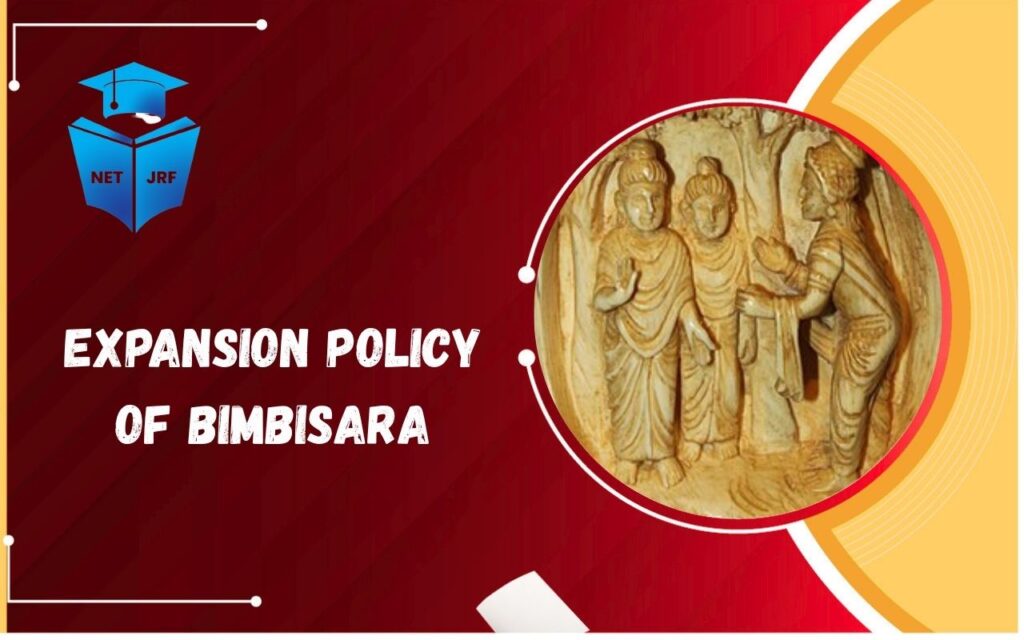

The expansion policy of Bimbisara played a crucial role in transforming Magadha into a powerful kingdom in ancient India. Bimbisara, one of the earliest kings of Magadha, followed a balanced approach. He combined diplomacy, marriage alliances, and military action. His methods created a strong base for future rulers.

Expansion policy of Bimbisara Overview
The Expansion policy of Bimbisara was unique because it did not depend only on war. He used peaceful methods whenever possible and fought only when necessary.
Main features of his policy:
- Use of marriage alliances
- Strategic military conquest
- Diplomatic relations
- Economic strengthening
This balanced approach made the Expansion policy of Bimbisara very successful.
Join UGC NET Offline Coaching in Jaipur
Timeline Expansion policy of Bimbisara
The expansion policy of Bimbisara can be clearly understood through the following timeline
| Strategy Type | Method Used | Result |
| Marriage alliances | Kosala, Lichchhavi marriages | Peaceful expansion |
| Military conquest | Conquest of Anga | Territorial growth |
| Diplomacy | Friendly relations with neighbors | Stability |
| Administration | Strong governance | Economic strength |
Role of Bimbisara in Expansion
Bimbisara came to power around 544 BCE. He ruled Magadha during a time when many kingdoms were competing for power.
Bimbisara’s rule marked the beginning of Magadha’s steady and well-planned expansion.
Early Rule and Political Situation
Bimbisara came to power around 544 BCE, at a time when many Mahajanapadas were competing for dominance.
- The political environment was unstable, and rulers were constantly fighting for territory.
- Instead of depending only on wars, Bimbisara adopted a balanced and practical approach. He understood that continuous fighting could weaken the kingdom.
Policy of Diplomacy and Alliances
One of the most important features of Bimbisara’s expansion policy was diplomacy. He used marriage alliances to build strong political relationships.
- Married a princess of Kosala to gain friendly relations
- Formed alliances with powerful neighboring states
- Avoided unnecessary conflicts
This helped him expand influence without spending resources on war.
Territorial Expansion
Although Bimbisara preferred peaceful methods, he did not completely avoid warfare. He expanded Magadha when necessary.
- Conquered the kingdom of Anga
- Increased control over important regions
- Strengthened Magadha’s position among Mahajanapadas
This balanced use of war and diplomacy made his policy effective.
Join UGC NET Offline Classes in Jaipur
Administrative Strength
Bimbisara also focused on strengthening internal administration. A strong administration was necessary for managing a growing kingdom.
- Organized governance system
- Efficient tax collection
- Better control over regions
This ensured stability within the kingdom.
Strategic Capital at Rajgir
Bimbisara ruled from Rajgir, which was surrounded by hills. This location provided natural protection and made administration easier.
- Safe from enemy attacks
- Centrally located for control
- Supported expansion plans
Long-Term Vision
The expansion policy of Bimbisara was not about quick victories. It was focused on long-term growth and stability.
- Built strong political relations
- Avoided unnecessary wars
- Strengthened the foundation of the empire
This vision helped Magadha grow steadily.

Marriage Alliances as a Strategy
One of the most important parts of the Expansion policy of Bimbisara was marriage alliances.
Key alliances:
Marriage with Kosala princess
- Received Kashi as dowry
- Strengthened relations with Kosala
Marriage with Lichchhavi princess
- Built connection with Vajji confederacy
- Reduced chances of conflict
Marriage with Madra princess
- Expanded influence in northwest regions
Why this strategy worked
- Avoided unnecessary wars
- Built trust among kingdoms
- Expanded territory peacefully
This shows how the Expansion policy of Bimbisara was based on intelligence rather than aggression.
| Read UGC Notes | ||
| Unit | Topic | Link |
| Archaeological | Archaeological Sources for UGC NET | Open |
| Archaeological | Exploration in Archaeology | Open |
| Archaeological | Excavation Techniques in Archaeology | Open |
| Archaeological | Dating of Archaeological Sites | Open |
| Archaeological | Epigraphy — Study of Inscriptions | Open |
| Archaeological | Inscriptions in Reconstructing History | Open |
| Archaeological | Numismatics in History | Open |
| Archaeological | Importance of Coins in History | Open |
| Literary Sources | Meaning of Historical Sources | Open |
| Literary Sources | Literary Sources in History | Open |
| Literary Sources | Indigenous Literature | Open |
| Literary Sources | Dating Ancient Literary Sources | Open |
| Literary Sources | Secular Literature as Historical Source | Open |
| Literary Sources | Role of Myths & Legends in Historical Reconstruction | Open |
| Foreign Accounts | Foreign Accounts of India — Overview | Open |
| Foreign Accounts | Greek Accounts on Ancient India | Open |
| Foreign Accounts | Chinese Accounts on India | Open |
| Foreign Accounts | Arabic Accounts on India | Open |
| Neolithic & Chalcolithic | Neolithic and Chalcolithic Phases | Open |
| Neolithic & Chalcolithic | Hunting, Gathering & Food Production | Open |
| Neolithic & Chalcolithic | Neolithic Revolution in India | Open |
| Neolithic & Chalcolithic | Neolithic Settlements in India | Open |
| Neolithic & Chalcolithic | Distribution of Neolithic Cultures in India | Open |
| Neolithic & Chalcolithic | Tools and Technology in Neolithic Period | Open |
| Neolithic & Chalcolithic | Chalcolithic Culture in India | Open |
| Neolithic & Chalcolithic | Settlement Pattern & Economy in Chalcolithic Phase | Open |
| Neolithic & Chalcolithic | Trade & Exchange Networks in Chalcolithic Societies | Open |
| Indus Valley | Indus Valley Civilization — Overview | Open |
| Indus Valley | Major Sites of Indus Civilization | Open |
| Indus Valley | Urban Planning in Harappan Civilization | Open |
| Indus Valley | Architecture and Town Planning | Open |
| Indus Valley | Agriculture and Food Economy | Open |
| Indus Valley | Craft Specialization & Industrial Activities | Open |
| Indus Valley | Internal Trade of Harappan Civilization | Open |
| Indus Valley | Internal and External Trade | Open |
| Indus Valley | Social Structure of Indus Civilization | Open |
| Indus Valley | Political Organization of Harappan Civilization | Open |
| Indus Valley | Religion and Beliefs in Indus Civilization | Open |
| Indus Valley | Decline of Indus Civilization | Open |
| Indus Valley | Indus Civilization as First Urbanization | Open |
| Vedic Period | Vedic and Later Vedic Periods — Overview | Open |
| Vedic Period | Origin of Vedic Civilization | Open |
| Vedic Period | Aryan Debate — Migration, Invasion & Indigenous Theories | Open |
| Vedic Period | Early Vedic Society and Economy | Open |
| Vedic Period | Political Institutions in Early Vedic Period | Open |
| Vedic Period | Social Structure in Early Vedic Period | Open |
| Vedic Period | Later Vedic Society and Economy | Open |
| Vedic Period | Emergence of Varnas and Social Stratification | Open |
| Vedic Period | Emergence of Heterodox Sects in India | Open |
| Vedic Period | Impact of Iron Technology in India | Open |
| Miscellaneous | Megalithic Culture of South India | Open |
| Miscellaneous | Religious and Philosophical Vedic Ideas | Open |
| Miscellaneous | State System in Ancient India | Open |
Military Conquest Control over Anga
Although Bimbisara preferred peace, he did not avoid war when needed.
Conquest of Anga
- Anga was located in eastern India
- Important for trade and economy
- Bimbisara defeated its ruler
Importance of Anga conquest
- Increased revenue
- Control over trade routes
- Strengthened Magadha’s position
This proves that the Expansion policy of Bimbisara included both war and diplomacy.
Diplomatic Relations with Other States
Diplomacy was another key feature of the Expansion policy of Bimbisara.
Key aspects:
- Maintained friendly relations with neighboring states
- Avoided unnecessary conflicts
- Focused on internal development
Diplomatic relations helped Magadha remain stable. This stability allowed growth in economy and administration under the Expansion policy of Bimbisara.
Enroll UGC NET Foundation Course
Administrative Strength Supporting Expansion
Expansion is not possible without strong administration. The Expansion policy of Bimbisara included efficient governance.
Administrative features:
Centralized control
- King had strong authority
- Decisions were quick
Efficient officers
- Officials managed regions
- Ensured law and order
Tax system
- Regular revenue collection
- Supported army and development
A strong administration made the Expansion policy of Bimbisara sustainable.
Enroll UGC NET Foundation Batch Online
Economic Base of Expansion
Economic strength supported the Expansion policy of Bimbisara.
Key economic factors:
- Fertile land of Ganga plains
- Agricultural surplus
- Growth of trade routes
How economy helped expansion
- Funded military campaigns
- Supported large population
- Encouraged urban growth
Without economic strength, the Expansion policy of Bimbisara would not have succeeded.

Strategic Importance of Geography
Geography also played a role in the Expansion policy of Bimbisara.
Advantages:
- Rivers for transport
- Natural defense
- Fertile soil
These factors made expansion easier and more effective under the Expansion policy of Bimbisara.