
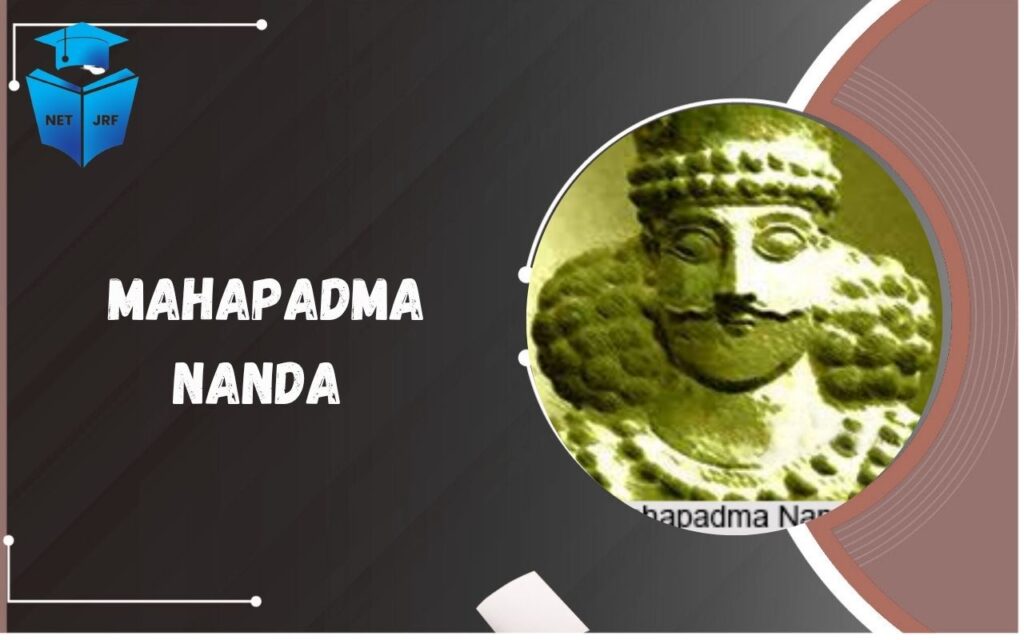

Mahapadma Nanda and Imperial Expansion marks a decisive turning point in ancient Indian political history, as Mahapadma Nanda transformed Magadha from a regional kingdom into a powerful imperial state. Rising from a non-traditional background, he broke the dominance of established Kshatriya dynasties and asserted centralized authority over vast territories. Through systematic military campaigns, strategic annexations, and strong administrative control, he expanded his empire across large parts of northern India. His ambition earned him the title “destroyer of Kshatriyas,” reflecting both his military success and political transformation of power structures. This phase of imperial expansion not only strengthened Magadha’s supremacy but also laid the foundation for future large-scale empires, especially under the Mauryas.

Nanda Dynasty Background
The rise of the Nanda Dynasty marked a significant transition in ancient Indian history, bridging the gap between the declining mahajanapadas and the emergence of a powerful centralized empire.
Decline of Earlier Dynasties
Before the Nandas, Magadha was ruled by the Haryanka dynasty (famous for rulers like Bimbisara and Ajatashatru) and later by the Shishunaga dynasty. These dynasties had already:
- Expanded Magadha’s territory
- Strengthened administrative structures
- Established Pataliputra as a major political center
However, over time, the later rulers of the Shishunaga dynasty became weak and ineffective. This led to:
- Political instability
- Power struggles within the ruling class
- Decline in central authority
Such conditions created an opportunity for a new and more powerful ruler to take control.
Rise of Nandas in Magadha
It was in this context that the Nanda dynasty emerged. Mahapadma Nanda seized power and established a new ruling line in Magadha.
Key aspects of this transition:
- The Nandas replaced the Shishunaga rulers
- They inherited a strong and resource-rich kingdom
- Magadha already had fertile land, trade routes, and strategic advantages
Because of this strong base, the Nandas were able to quickly consolidate power and begin expansion.
Importance of Magadha as a Base
Magadha was not an ordinary kingdom. it was the most powerful mahajanapada of its time due to:
- Fertile Gangetic plains (agricultural surplus)
- Rich mineral resources (especially iron)
- Strategic location for trade and communication
The Nandas effectively used these advantages to build a large empire.
Top UGC NET Coaching in Jaipur
Nandas Social Background
One of the most unique aspects of the Nanda dynasty was its social origin, which marked a major shift in ancient Indian society.
Non-Traditional Royal Origin
Ancient sources (including Puranas and Greek accounts) suggest that the Nandas did not belong to the traditional Kshatriya (warrior) class. Instead:
- They are often described as coming from a lower social background
- Some traditions mention humble or mixed origins
This made their rise highly unusual in a society where kingship was usually limited to Kshatriyas.
Why Their Rise Was Unique
The uniqueness of the Nanda dynasty lies in:
- First major dynasty from a non-Kshatriya background
- Shift toward centralized monarchy
- Expansion based on power, not tradition
This marked the beginning of a new phase in Indian political history.
Mahapadma Nanda and Imperial Expansion
The rise of Mahapadma Nanda marks a turning point in ancient Indian history, as Magadha transformed from a powerful kingdom into an expansive empire with unprecedented territorial control.
Who Was Mahapadma Nanda?
Mahapadma Nanda was the founder of the Nanda dynasty and ruled Magadha around the 4th century BCE. He is known for destroying many older ruling families and expanding his empire widely.
Meaning of His Title
- He is called Ekachatra meaning sole ruler
- Also called destroyer of Kshatriyas in some texts
This shows how powerful Mahapadma Nanda became during his reign.
Best UGC NET Offline Classes in Jaipur
Rise to Power
The rise of Mahapadma Nanda was not simple. It involved struggle and strong leadership.
Key Points of His Rise
- He took control after weakening earlier rulers
- Established authority over Magadha
- Built a strong army to secure his rule
Why His Rise Was Important
- It marked the beginning of a new political order
- Showed that power was not limited to traditional elites
Rise of Mahapadma Nanda
Mahapadma Nanda, founder of the Nanda Dynasty, is often described in Puranic sources as the “destroyer of Kshatriyas” (Sarva-Kshatrantaka).
He is believed to have come from a non-Kshatriya background, which indicates a major social shift in political power during this period.
This reflects the gradual breakdown of traditional varna-based political dominance and the rise of new ruling elites.
Imperial Expansion: From Kingdom to Empire
Mahapadma Nanda carried out aggressive expansion policies that laid the foundation of the first large empire in northern India.
Major Conquests
He defeated and annexed several prominent kingdoms, including:
- Kashi
- Kosala
- Avanti
- Kalinga
These conquests helped Magadha extend from eastern India to central regions, making it the most powerful state of its time.

Empire Extent
The empire of the Nanda Dynasty was centered in Magadha (modern Bihar), with its capital at Pataliputra (present-day Patna). This region formed the political and administrative heart of the empire.
Regions Under Control
- Magadha (core region)
- Parts of northern India
- Eastern regions
- Some areas of central India
Expansion Strategy
Mahapadma Nanda used both military strength and political strategy:
- Defeated smaller kingdoms
- Controlled trade routes
- Maintained strong administration
Mahapadma Nanda Empire
The empire built by Mahapadma Nanda represents the first major attempt at large-scale political unification in northern India. He transformed Magadha from a regional power into a vast and centralized empire.
| Feature | Description |
| Ruler | Mahapadma Nanda |
| Dynasty | Nanda Dynasty |
| Period | 4th century BCE |
| Capital | Pataliputra |
| Title | Ekachatra |
| Expansion | Northern and central India |
Military Strength
One of the most significant aspects of Mahapadma Nanda’s rule was his formidable military power, which played a crucial role in establishing and expanding the Nanda Empire. His army was not only large in size but also well-organized, making Magadha a dominant force in northern India.
Features of the Army
- Large number of soldiers
- Strong infantry
- War elephants
- Well-organized system
Importance
- Helped in conquering territories
- Maintained control over regions
Greek sources also mention that the Nanda army was very large, which shows the power of Mahapadma Nanda.
-
Foundation of the Empire
-
- Mahapadma Nanda, founder of the Nanda Dynasty, overthrew the Shishunaga rulers and established a new ruling line.
His rise signifies a shift from traditional Kshatriya rule to new social groups in सत्ता (power).
- Mahapadma Nanda, founder of the Nanda Dynasty, overthrew the Shishunaga rulers and established a new ruling line.
Territorial Expansion
Mahapadma Nanda pursued an aggressive policy of conquest, leading to rapid expansion:
- Defeated major Mahajanapadas like Kashi, Kosala, Avanti, and Kalinga
- Brought central and eastern India under control
- Extended influence possibly towards the Deccan region
- These conquests made his empire the largest political unit in India before the Mauryas.
|
Read UGC Notes |
||
| Unit | Topic | Link |
| Archaeological | Archaeological Sources for UGC NET | Open |
| Archaeological | Exploration in Archaeology | Open |
| Archaeological | Excavation Techniques in Archaeology | Open |
| Archaeological | Dating of Archaeological Sites | Open |
| Archaeological | Epigraphy — Study of Inscriptions | Open |
| Archaeological | Inscriptions in Reconstructing History | Open |
| Archaeological | Numismatics in History | Open |
| Archaeological | Importance of Coins in History | Open |
| Literary Sources | Meaning of Historical Sources | Open |
| Literary Sources | Literary Sources in History | Open |
| Literary Sources | Indigenous Literature | Open |
| Literary Sources | Dating Ancient Literary Sources | Open |
| Literary Sources | Secular Literature as Historical Source | Open |
| Literary Sources | Role of Myths & Legends in Historical Reconstruction | Open |
| Foreign Accounts | Foreign Accounts of India — Overview | Open |
| Foreign Accounts | Greek Accounts on Ancient India | Open |
| Foreign Accounts | Chinese Accounts on India | Open |
| Foreign Accounts | Arabic Accounts on India | Open |
| Neolithic & Chalcolithic | Neolithic and Chalcolithic Phases | Open |
| Neolithic & Chalcolithic | Hunting, Gathering & Food Production | Open |
| Neolithic & Chalcolithic | Neolithic Revolution in India | Open |
| Neolithic & Chalcolithic | Neolithic Settlements in India | Open |
| Neolithic & Chalcolithic | Distribution of Neolithic Cultures in India | Open |
| Neolithic & Chalcolithic | Tools and Technology in Neolithic Period | Open |
| Neolithic & Chalcolithic | Chalcolithic Culture in India | Open |
| Neolithic & Chalcolithic | Settlement Pattern & Economy in Chalcolithic Phase | Open |
| Neolithic & Chalcolithic | Trade & Exchange Networks in Chalcolithic Societies | Open |
| Indus Valley | Indus Valley Civilization — Overview | Open |
| Indus Valley | Major Sites of Indus Civilization | Open |
| Indus Valley | Urban Planning in Harappan Civilization | Open |
| Indus Valley | Architecture and Town Planning | Open |
| Indus Valley | Agriculture and Food Economy | Open |
| Indus Valley | Craft Specialization & Industrial Activities | Open |
| Indus Valley | Internal Trade of Harappan Civilization | Open |
| Indus Valley | Internal and External Trade | Open |
| Indus Valley | Social Structure of Indus Civilization | Open |
| Indus Valley | Political Organization of Harappan Civilization | Open |
| Indus Valley | Religion and Beliefs in Indus Civilization | Open |
| Indus Valley | Decline of Indus Civilization | Open |
| Indus Valley | Indus Civilization as First Urbanization | Open |
| Vedic Period | Vedic and Later Vedic Periods — Overview | Open |
| Vedic Period | Origin of Vedic Civilization | Open |
| Vedic Period | Aryan Debate — Migration, Invasion & Indigenous Theories | Open |
| Vedic Period | Early Vedic Society and Economy | Open |
| Vedic Period | Political Institutions in Early Vedic Period | Open |
| Vedic Period | Social Structure in Early Vedic Period | Open |
| Vedic Period | Later Vedic Society and Economy | Open |
| Vedic Period | Emergence of Varnas and Social Stratification | Open |
| Vedic Period | Emergence of Heterodox Sects in India | Open |
| Vedic Period | Impact of Iron Technology in India | Open |
| Miscellaneous | Megalithic Culture of South India | Open |
| Miscellaneous | Religious and Philosophical Vedic Ideas | Open |
| Miscellaneous | State System in Ancient India | Open |
Administrative System under Mahapadma Nanda
The success of Mahapadma Nanda in creating a powerful empire was not only due to his military strength but also a highly organized and centralized administrative system. This system allowed Magadha to function efficiently, maintain internal stability, and support expansion.
Key Features of Nanda Administration
Direct Control by the King
- Mahapadma Nanda held absolute authority over the empire.
- Major decisions regarding governance, military campaigns, and state policies were taken at the central level.
Efficient Use of Officials
- The king appointed capable officials to manage different regions of the empire.
- These officials ensured law enforcement, resource management, and smooth administration across distant territories.
Systematic Governance
- Regions were divided for administrative efficiency.
- Clear hierarchies and responsibilities helped maintain order and control.
Tax System under the Nandas
Heavy Tax Collection
- Taxes were imposed on agriculture, trade, crafts, and towns.
- Land revenue from fertile Magadha plains contributed the largest share.
Support for Military
- Collected revenue helped maintain a large standing army.
- Enabled funding for war elephants, infantry, and cavalry units.
Increase in State Wealth
- Efficient taxation ensured a strong treasury.
- Wealth supported infrastructure, administration, and further territorial expansion.
Significance of the Administrative System
- Stability and Order: Centralized control and efficient officials prevented rebellions and maintained peace.
- Sustained Power: Strong financial base and organized bureaucracy allowed long-term governance.
- Foundation for Future Empires: The administrative model became a template for the Mauryan Empire under Chandragupta Maurya.
Best UGC NET Foundation Course
Mahapadma Nanda Economic Policies
The remarkable success of Mahapadma Nanda in building a powerful empire was strongly supported by his robust economic policies. A strong economy provided the resources needed for a large army, efficient administration, and territorial expansion.
Sources of Income
Agriculture
- Fertile lands of Magadha provided abundant harvests.
- Land revenue formed the largest portion of the state’s income.
Trade
- Both local and long-distance trade were encouraged.
- Trade taxes contributed significantly to the royal treasury.
- Development of trade routes enhanced commercial activity across northern India.
Taxes
- Levies were collected from craftsmen, towns, and merchants.
- A systematic tax system ensured continuous revenue for the state.
Economic Impact
Growth in Wealth
- Steady revenue streams filled the treasury, allowing Mahapadma Nanda to invest in army, administration, and infrastructure.
Development of Trade Routes
- Improved connectivity supported commerce and economic integration of newly conquered territories.
Strong Treasury
- The wealth of the state provided financial stability.
- Enabled sustained governance, expansion campaigns, and support for officials.
Destruction of Kshatriya Power under Mahapadma Nanda
One of the most notable features of Mahapadma Nanda’s rule was the decline of traditional Kshatriya dynasties. By challenging the established warrior elites, he fundamentally changed the political landscape of northern India.
What Does It Mean?
- Defeat of Traditional Rulers
-
-
- Mahapadma Nanda overthrew several Kshatriya kings who had controlled small kingdoms surrounding Magadha.
- His military campaigns weakened the power of hereditary rulers.
-
- Reduction of Kshatriya Influence
-
-
- With the decline of Kshatriya families, political power shifted to a centralized monarchy under Mahapadma Nanda.
-
- Establishment of Authority
-
- This allowed him to consolidate Magadha’s territories and assert control over a vast empire.
- The title “destroyer of Kshatriyas” reflects both his ambition and success in changing traditional power structures.
Challenges Faced by Mahapadma Nanda
Even a strong and ambitious ruler faced difficulties while managing a large empire:
- Managing a Vast Empire
-
-
- Controlling distant provinces and newly conquered regions required an efficient administrative system.
-
- Handling Heavy Taxation Complaints
-
-
- Heavy taxes, necessary for funding the army and administration, caused dissatisfaction among citizens and regional elites.
-
- Maintaining Central Control
-
- Ensuring loyalty and obedience from officials in far-off areas was a constant challenge.
Long-Term Consequences
- While the destruction of Kshatriya power strengthened Mahapadma Nanda’s empire, it also created vulnerabilities:
- Public discontent over taxes and administration
- Difficulty in managing loyalty across vast territories
- These issues contributed to the eventual decline of the Nanda dynasty, paving the way for the rise of .
Best UGC NET Online Test Series
Mahapadma Nanda Long-Term Impact
The rule of Mahapadma Nanda left a lasting impact on Indian political history, shaping the structure and strategies of future empires. His policies in administration, military organization, and economic management provided a blueprint for subsequent rulers.
Influence on the Mauryas
Transition to Mauryan Rule
- Chandragupta Maurya overthrew the last Nanda ruler to establish the Mauryan Empire.
- He inherited the capital city of Pataliputra, the bureaucratic structure, and the wealth of the Nanda treasury.
Use of Established Resources
- Chandragupta and his advisor Chanakya utilized the existing army, administration, and trade networks laid by the Nandas.
- This continuity allowed the Mauryas to rapidly consolidate power and expand the empire across northern India.
Legacy of Mahapadma Nanda
Early Model of Empire Building
- Centralized authority and territorial expansion under Mahapadma Nanda provided an early blueprint for large-scale empire management in India.
Strong Governance System
- Efficient administrative practices, organized taxation, and control over distant regions influenced Mauryan governance.
- His policies demonstrated the importance of a strong treasury, disciplined army, and competent officials in sustaining empire power.
Conclusion
The reign of Mahapadma Nanda was pivotal in setting political, military, and administrative precedents in ancient India. By consolidating Magadha into a powerful empire, he created the conditions for the rise of the Mauryas and left a legacy of centralized governance, economic strength, and military efficiency that shaped Indian empires for generations.