

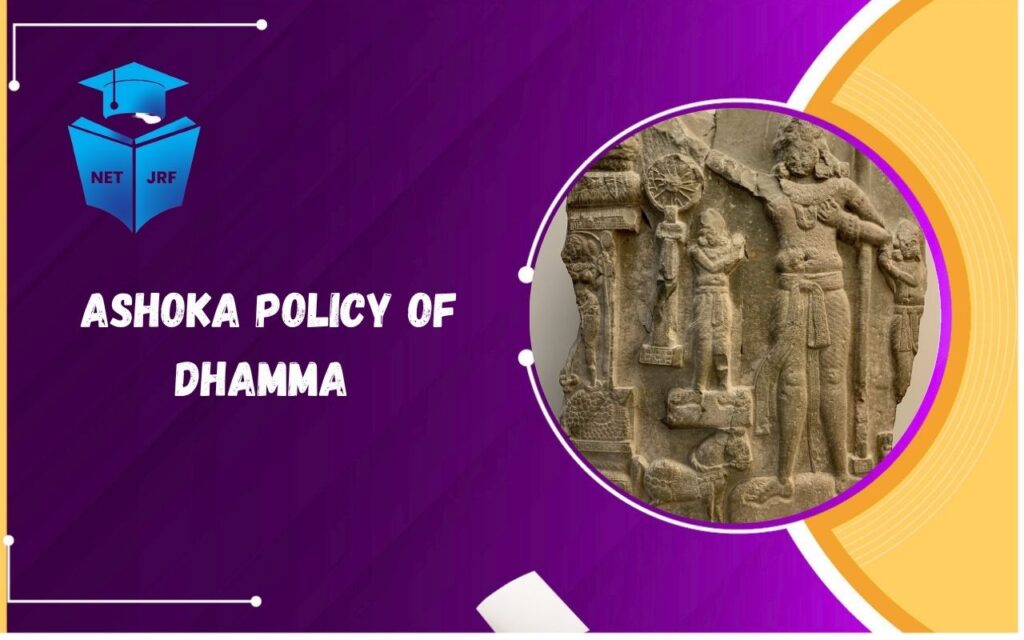
After the Kalinga War, Ashoka underwent a profound transformation, turning from a conqueror into a ruler guided by moral and ethical principles. To promote peace, welfare, and harmony within his empire, he introduced the policy of Dhamma.
The term “Dhamma” referred to a set of moral guidelines emphasizing non-violence, tolerance, compassion, and righteous conduct. Through this policy, Ashoka sought not only to govern effectively but also to encourage ethical behavior among his subjects, ensuring the well-being of all communities in the Mauryan Empire

Ashoka Policy of Dhamma Background
The origin of Ashoka’s policy of Dhamma is closely linked with the Kalinga war.
-
Impact of Kalinga War
-
- The war caused massive destruction and loss of life. Ashoka felt deep regret after seeing the suffering. This emotional change led to the formation of Ashoka’s policy of Dhamma.
-
Shift in Governance
- Instead of military expansion, Ashoka focused on moral rule. This shift marked the beginning of Ashoka’s policy of Dhamma.
Meaning of Dhamma
The word Dhamma in Ashoka’s policy of Dhamma does not refer to a specific religion.
-
Universal Moral Code
-
- It means a set of ethical principles that everyone should follow. These values formed the base of Ashoka’s policy of Dhamma.
-
Practical Approach
- Ashoka did not promote rituals. He focused on daily behavior. This made Ashoka’s policy of Dhamma simple and practical.
Ashoka Policy of Dhamma Features
The Ashoka’s policy of Dhamma included several important features.
Moral Values
- Respect for elders
- Kindness towards others
- Truthfulness
These values were central to Ashoka’s policy of Dhamma.
-
Religious Tolerance
-
- Ashoka encouraged respect for all religions. This promoted unity under Ashoka’s policy of Dhamma.
-
Non-Violence
- He reduced violence and promoted peace. This idea was a key part of Ashoka’s policy of Dhamma.
Administration under Dhamma
The Ashoka’s policy of Dhamma was implemented through administration.
-
Dhamma Mahamatras
-
- Special officers were appointed to spread Dhamma. They worked to ensure that people followed Ashoka’s policy of Dhamma.
-
Role of Officials
- Officials were instructed to act with kindness and fairness. This strengthened Ashoka’s policy of Dhamma.
Spread of Dhamma
Ashoka used different methods to spread Ashoka’s policy of Dhamma.
-
Rock and Pillar Edicts
-
- He inscribed messages on rocks and pillars. These edicts explained Ashoka’s policy of Dhamma to the public.
-
Communication with People
- Ashoka personally communicated with his subjects. This helped in spreading Ashoka’s policy of Dhamma.
Best UGC NET Coaching in Jaipur
Social Impact
The Ashoka’s policy of Dhamma had a deep impact on society.
-
Improvement in Social Life
-
- People followed ethical values. This improved social relations under Ashoka’s policy of Dhamma.
-
Reduction in Conflict
- Religious tolerance reduced conflicts. This was a major success of Ashoka’s policy of Dhamma.
Welfare Measures
The Ashoka’s policy of Dhamma also included welfare activities.
Public Services
- Hospitals for humans and animals
- Roads and rest houses
- Water facilities
These works reflected the humanitarian aspect of Ashoka’s policy of Dhamma.
Best UGC NET Offline Coaching in Jaipur

Criticism of Dhamma
The Ashoka’s policy of Dhamma also faced some criticism.
-
Limited Effect
-
- Some scholars believe it had limited practical impact. This affected the success of Ashoka’s policy of Dhamma.
-
Idealistic Nature
- The policy was more moral than practical. This made Ashoka’s policy of Dhamma difficult to fully implement.
The Ashoka’s policy of Dhamma was a remarkable attempt to rule an empire through moral values and ethical principles. It focused on peace, tolerance, and welfare of people.
|
Read UGC Notes |
||
| Unit | Topic | Link |
| Archaeological | Archaeological Sources for UGC NET | Open |
| Archaeological | Exploration in Archaeology | Open |
| Archaeological | Excavation Techniques in Archaeology | Open |
| Archaeological | Dating of Archaeological Sites | Open |
| Archaeological | Epigraphy — Study of Inscriptions | Open |
| Archaeological | Inscriptions in Reconstructing History | Open |
| Archaeological | Numismatics in History | Open |
| Archaeological | Importance of Coins in History | Open |
| Literary Sources | Meaning of Historical Sources | Open |
| Literary Sources | Literary Sources in History | Open |
| Literary Sources | Indigenous Literature | Open |
| Literary Sources | Dating Ancient Literary Sources | Open |
| Literary Sources | Secular Literature as Historical Source | Open |
| Literary Sources | Role of Myths & Legends in Historical Reconstruction | Open |
| Foreign Accounts | Foreign Accounts of India — Overview | Open |
| Foreign Accounts | Greek Accounts on Ancient India | Open |
| Foreign Accounts | Chinese Accounts on India | Open |
| Foreign Accounts | Arabic Accounts on India | Open |
| Neolithic & Chalcolithic | Neolithic and Chalcolithic Phases | Open |
| Neolithic & Chalcolithic | Hunting, Gathering & Food Production | Open |
| Neolithic & Chalcolithic | Neolithic Revolution in India | Open |
| Neolithic & Chalcolithic | Neolithic Settlements in India | Open |
| Neolithic & Chalcolithic | Distribution of Neolithic Cultures in India | Open |
| Neolithic & Chalcolithic | Tools and Technology in Neolithic Period | Open |
| Neolithic & Chalcolithic | Chalcolithic Culture in India | Open |
| Neolithic & Chalcolithic | Settlement Pattern & Economy in Chalcolithic Phase | Open |
| Neolithic & Chalcolithic | Trade & Exchange Networks in Chalcolithic Societies | Open |
| Indus Valley | Indus Valley Civilization — Overview | Open |
| Indus Valley | Major Sites of Indus Civilization | Open |
| Indus Valley | Urban Planning in Harappan Civilization | Open |
| Indus Valley | Architecture and Town Planning | Open |
| Indus Valley | Agriculture and Food Economy | Open |
| Indus Valley | Craft Specialization & Industrial Activities | Open |
| Indus Valley | Internal Trade of Harappan Civilization | Open |
| Indus Valley | Internal and External Trade | Open |
| Indus Valley | Social Structure of Indus Civilization | Open |
| Indus Valley | Political Organization of Harappan Civilization | Open |
| Indus Valley | Religion and Beliefs in Indus Civilization | Open |
| Indus Valley | Decline of Indus Civilization | Open |
| Indus Valley | Indus Civilization as First Urbanization | Open |
| Vedic Period | Vedic and Later Vedic Periods — Overview | Open |
| Vedic Period | Origin of Vedic Civilization | Open |
| Vedic Period | Aryan Debate — Migration, Invasion & Indigenous Theories | Open |
| Vedic Period | Early Vedic Society and Economy | Open |
| Vedic Period | Political Institutions in Early Vedic Period | Open |
| Vedic Period | Social Structure in Early Vedic Period | Open |
| Vedic Period | Later Vedic Society and Economy | Open |
| Vedic Period | Emergence of Varnas and Social Stratification | Open |
| Vedic Period | Emergence of Heterodox Sects in India | Open |
| Vedic Period | Impact of Iron Technology in India | Open |
| Miscellaneous | Megalithic Culture of South India | Open |
| Miscellaneous | Religious and Philosophical Vedic Ideas | Open |
| Miscellaneous | State System in Ancient India | Open |

Ashoka Policy of Dhamma FAQs

2. Why did Ashoka introduce Dhamma?
Ashoka introduced Dhamma after witnessing the destruction of the Kalinga War, which created a sense of regret and motivated him to adopt a policy based on moral values rather than conquest.
3. What is the meaning of Dhamma?
Dhamma refers to a universal moral code based on values like truthfulness, compassion, respect for elders, non-violence, rather than a specific religion.
4. What were main features of Ashoka’s Dhamma?
Main features included non-violence, religious tolerance, moral conduct, kindness, respect for all living beings, ethical governance.
5. Who were Dhamma Mahamatras?
Dhamma Mahamatras were special officers appointed by Ashoka to promote Dhamma, ensure welfare of people, maintain moral order in society.