

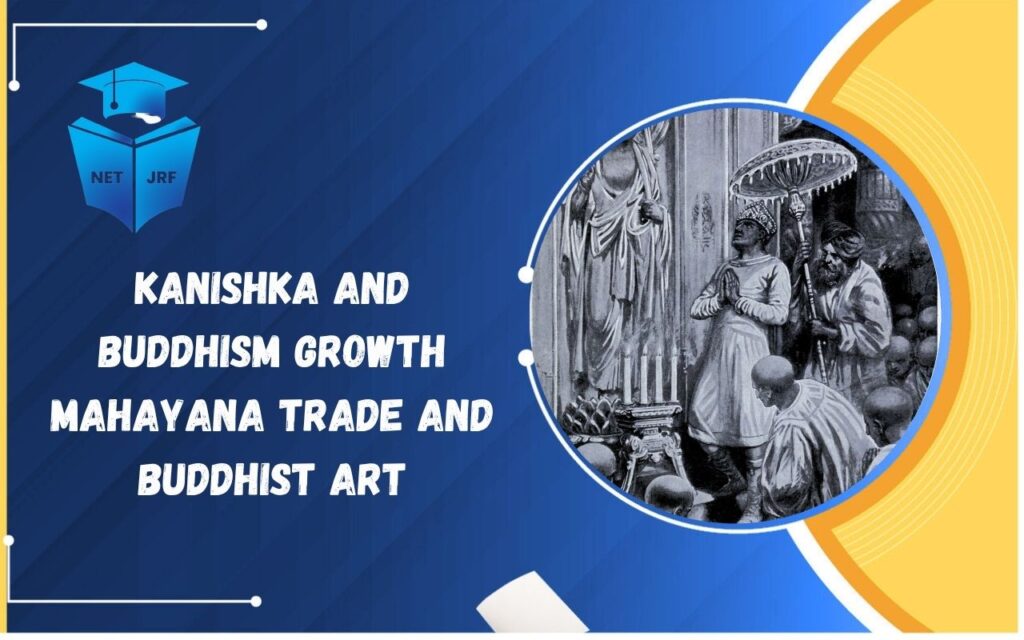
Kanishka and Buddhism Growth Mahayana Trade and Buddhist Art

Kanishka and Buddhism in this topic you learn how he promoted Mahayana Buddhism Fourth Buddhist Council role trade routes spread of religion development of Gandhara and Mathura art monasteries coinage and lasting impact on society and culture

vishal

kanishka and buddhism growth

Table of Contents

Kanishka and Buddhism is one of the most important topics in ancient Indian history because it shows how a powerful ruler helped a religion grow across regions. Development in a clear and simple way. The Kushan emperor Kanishka played a major role in promoting Buddhism, especially the Mahayana form. His support helped Buddhism spread beyond India into Central Asia and China. Let us understand this in detail, step by step.

Study Planner

Kanishka and Buddhism Background

To understand Kanishka and Buddhism, we need to look at the religious environment before his rule.

Religious situation before Kanishka

  • Buddhism already existed since the time of Gautama Buddha
  • It had divided into different schools
  • Hinayana was the earlier form

During this time, Buddhism needed strong support to expand further.

Enroll UGC NET Online Test Series

Rise of Kanishka as a Patron

Kanishka and Buddhism became closely connected when the ruler started supporting the religion.

Why Kanishka supported Buddhism

  • He wanted to unify his empire
  • Buddhism had wide acceptance
  • It promoted peace and moral values

His patronage gave a new direction to Buddhism.

Kanishka and Buddhism Development

Kanishka and Buddhism saw major development during his reign, especially in terms of ideas and practices.

Growth of Mahayana Buddhism

  • Mahayana became popular during his rule
  • It focused on worship of Buddha as a god
  • Introduced concept of Bodhisattva

This was different from earlier simpler practices.


Fourth Buddhist Council

The Fourth Buddhist Council was one of the most significant religious events during the reign of Kanishka, highlighting his role as a patron of Buddhism.

Key Details:

  • Location: Held in Kashmir, a central and accessible region for scholars and monks.
  • Organized by: King Kanishka, who provided royal support and resources.
  • Led by Scholars: Eminent Buddhist scholars such as Vasumitra guided the discussions and decisions.

Main Objectives:

  • Compilation of Buddhist Texts: Collected and preserved important scriptures to ensure their accuracy and continuity.
  • Promotion of Mahayana Buddhism: Strengthened the Mahayana tradition, which emphasized compassion, the Bodhisattva ideal, and philosophical development.
  • Clarification of Doctrines: Addressed doctrinal disputes, providing a more unified understanding of Buddhist teachings.

Importance:

  • Played a major role in shaping Buddhist philosophy.
  • Helped spread Buddhism from India to Central Asia and China.
  • Demonstrated Kanishka’s commitment to religious patronage and intellectual growth.

 Spread of Buddhism

Kanishka’s reign played a crucial role in transforming Buddhism from a regional religion into a global faith. His support helped the religion flourish both within India and beyond.

Regions of Spread:

  • Central Asia – Buddhist teachings reached the Sogdian and Kushan territories.
  • China – Monks and missionaries carried texts and practices, laying the foundation for Chinese Buddhism.
  • Parts of East Asia – The influence extended to Korea, Japan, and other regions over time.

How Buddhism Spread:

  • Trade Routes: The Silk Route facilitated cultural and religious exchange, allowing Buddhist ideas to travel alongside commerce.
  • Missionaries and Scholars: Buddhist monks and teachers traveled to distant lands to establish monasteries and teach the Dharma.
  • Monasteries as Learning Centers: Monasteries became hubs of education, scriptural study, and meditation, attracting students from across Asia.

Enroll UGC NET Offline Classes in Jaipur

Role of Trade in Spread of Buddhism

During Kanishka’s reign, trade was not just an economic activity it also became a vehicle for cultural and religious exchange, helping Buddhism reach far beyond India.

Trade Connections:

  • The Kushan Empire controlled major sections of the Silk Route, linking India with Central Asia, China, and even the Roman world.
  • Merchants and traders traveled along these routes, carrying goods as well as ideas, art, and religious teachings.

Impact on Buddhism:

  • The movement of people and goods facilitated cultural exchange, introducing Buddhist concepts to new regions.
  • Monasteries along trade routes served as rest stops and centers of learning for traveling monks and traders.
  • As a result, Buddhism spread to Central Asia, China, and parts of East Asia, becoming a truly international religion.

App JRF Adda

Buddhist Art under Kanishka

Kanishka’s reign marked a golden period for Buddhist art, where visual culture became a key medium for spreading Buddhist teachings.

Gandhara School of Art:

  • Influence: Strongly influenced by Greek (Hellenistic) artistic style, a legacy of earlier Indo-Greek interactions.
  • Representation of Buddha: Buddha was depicted in human form for the first time, with realistic facial expressions, drapery, and posture.
  • Features: Emphasized naturalism, detailed clothing, and lifelike gestures.

Mathura School of Art:

  • Indian Style: Rooted in traditional Indian artistic sensibilities.
  • Material: Used red sandstone for sculptures.
  • Focus: Religious sculptures, including Buddha, Bodhisattvas, and other deities, often with symbolic gestures (mudras).

Impact:

  • These art forms made Buddhist ideas accessible visually, helping devotees and travelers understand the teachings.
  • Gandhara and Mathura styles together reflected a fusion of cultural influences, showcasing the Kushana Empire as a hub of cross-cultural exchange.
  • Artistic patronage by Kanishka reinforced the spread of Mahayana Buddhism and inspired artistic traditions in Central Asia and China.

Monasteries and Learning Centers

Kanishka’s reign not only supported Buddhism spiritually but also promoted education and scholarship.

Role of Monasteries:

  • Acted as centers for learning, attracting students and scholars from across the empire.
  • Training of monks ensured a disciplined and knowledgeable religious community.
  • Preservation of Buddhist texts allowed teachings to survive and be transmitted to future generations.

These institutions played a key role in maintaining Buddhist philosophy and practice, both locally and along trade routes.

Kanishka Coins and Religious Symbols

Coins from Kanishka’s period provide valuable insights into religion, culture, and economy.

Features of Coins:

  • Images of Buddha appeared on some coins, highlighting royal support for Buddhism.
  • Different scripts (Greek, Kharosthi, Brahmi) reflected cultural diversity.
  • Symbols of multiple religions indicate acknowledgment of Hindu, Persian, and Greek deities.

Coins served not only as economic tools but also as political and religious symbols, showcasing Kanishka’s patronage and the empire’s pluralistic nature.

Religious Tolerance

Kanishka practiced a policy of religious tolerance, ensuring harmony in a multi-religious empire.

Key Points:

  • Worshiped Greek, Persian, and Indian gods alongside Buddhism.
  • Respected multiple religions, allowing different communities to coexist peacefully.
  • This approach helped maintain stability and social cohesion across a vast and diverse empire.

This combination of monasteries, coins, and religious tolerance highlights how Kanishka supported religion, learning, and cultural integration, making his reign a period of intellectual and spiritual prosperity.

Kanishka Impact on Society

Kanishka and Buddhism influenced society in many ways.

Social effects

  • Growth of monasteries
  • Increase in education
  • Moral teachings spread

Religion became part of daily life.

Join UGC NET Coaching in Jaipur

JRF Adda Book

Strengths of Kanishka’s Patronage

Kanishka’s reign is remembered not only for political and military achievements but also for his exceptional support to religion, art, and culture.

Key Strengths:

  • Strong Support to Religion: Kanishka actively patronized Buddhism, organized the Fourth Buddhist Council, and established monasteries as centers of learning. This helped preserve and spread Buddhist teachings.
  • Promotion of Art and Culture: Under his rule, Gandhara and Mathura art flourished, combining Greek, Persian, and Indian styles. Literature and scholarship also received royal encouragement, making the empire a cultural hub.
  • Expansion of Buddhism Globally: Through trade routes like the Silk Route and support to missionaries, Kanishka enabled Buddhism to reach Central Asia, China, and East Asia, giving the religion a lasting international presence.:

Legacy of Kanishka in Buddhism

Kanishka and Buddhism left a lasting impact on history.

Long-term effects

  • Buddhism spread to Asia
  • Development of new ideas
  • Growth of cultural exchange

His role is often compared with Ashoka, who also promoted Buddhism.

Conclusion

Kanishka and Buddhism show how a powerful ruler can influence religion and culture. His support helped Buddhism grow beyond India and become a major world religion. 

Read UGC NET Notes
1 Archaeological Sources for UGC NET Epigraphy – Study of Inscriptions Meaning of Historical Sources Archaeological
2 Meaning of Historical Sources Archaeological Sources for UGC NET Literary Sources in History Archaeological
3 Exploration in Archaeology Excavation Techniques in Archaeology Dating of Archaeological Sites Archaeological
4 Excavation Techniques in Archaeology Exploration in Archaeology Dating of Archaeological Sites Archaeological
5 Epigraphy – Study of Inscriptions Inscriptions in Reconstructing History Numismatics in History Archaeological
6 Inscriptions in Reconstructing History Epigraphy – Study of Inscriptions Archaeological Sources for UGC NET Archaeological
7 Numismatics in History Importance of Coins in History Epigraphy – Study of Inscriptions Archaeological
8 Importance of Coins in History Numismatics in History Archaeological Sources for UGC NET Archaeological
9 Dating of Archaeological Sites Excavation Techniques in Archaeology Dating Ancient Literary Sources Archaeological
10 Indigenous Literature Literary Sources in History Secular Literature as Historical Source Literary
11 Dating Ancient Literary Sources Literary Sources in History Dating of Archaeological Sites Literary
12 Literary Sources in History Indigenous Literature Foreign Accounts of India Literary
13 Foreign Accounts of India Greek Accounts on Ancient India Chinese Accounts on India Literary
14 Greek Accounts on Ancient India Foreign Accounts of India Chinese Accounts on India Literary
15 Secular Literature as Historical Source Literary Sources in History Indigenous Literature Literary
16 Role of Myths and Legends in Historical Reconstruction Literary Sources in History Secular Literature as Historical Source Literary
17 Chinese Accounts on India Foreign Accounts of India Greek Accounts on Ancient India Literary
18 Arabic Accounts on India Foreign Accounts of India Chinese Accounts on India Literary
19 Neolithic and Chalcolithic Phases Neolithic Revolution in India Chalcolithic Culture in India Neolithic
20 Hunting, Gathering & Food Production Neolithic Revolution in India Neolithic Settlements in India Neolithic
21 Neolithic Revolution in India Neolithic Settlements in India Tools and Technology in Neolithic Period Neolithic
22 Neolithic Settlements in India Distribution of Neolithic Cultures in India Neolithic Revolution in India Neolithic
23 Distribution of Neolithic Cultures in India Neolithic Settlements in India Tools and Technology in Neolithic Period Neolithic
24 Tools and Technology in Neolithic Period Neolithic Revolution in India Chalcolithic Culture in India Neolithic
25 Chalcolithic Culture in India Settlement Pattern & Economy in Chalcolithic Phase Trade & Exchange Networks in Chalcolithic Societies Neolithic
26 Settlement Pattern & Economy – Chalcolithic Phase Chalcolithic Culture in India Trade & Exchange Networks in Chalcolithic Societies Neolithic
27 Trade & Exchange Networks – Chalcolithic Societies Chalcolithic Culture in India IVC Internal & External Trade Neolithic
28 Indus Valley Civilization – UGC NET Major Sites of Indus Civilization Urban Planning in Harappan Civilization IVC
29 IVC Internal & External Trade Internal Trade – Harappan Civilization Craft Specialization in Harappan Civilization IVC
30 Political Organization – Harappan Civilization Social Structure – Indus Civilization Urban Planning in Harappan Civilization IVC
31 Major Sites of Indus Civilization Indus Valley Civilization – UGC NET Urban Planning in Harappan Civilization IVC
32 Urban Planning & Settlement – Harappan Civilization Architecture & Town Planning – Harappan Cities IVC as First Urbanization in India IVC
33 Architecture & Town Planning – Harappan Cities Urban Planning in Harappan Civilization Major Sites of Indus Civilization IVC
34 Craft Specialization & Industrial Activities – Harappan Agriculture & Food Economy – Harappans IVC Internal & External Trade IVC
35 Agriculture & Food Economy – Harappans Craft Specialization in Harappan Civilization Internal Trade – Harappan Civilization IVC
36 Internal Trade – Harappan Civilization IVC Internal & External Trade Craft Specialization in Harappan Civilization IVC
37 Religion & Beliefs – Indus Civilization Social Structure – Indus Civilization Indus Valley Civilization – UGC NET IVC
38 Social Structure – Indus Civilization Political Organization – Harappan Civilization Religion & Beliefs – Indus Civilization IVC
39 Decline of Indus Civilization Indus Valley Civilization – UGC NET IVC as First Urbanization in India IVC
40 IVC as First Urbanization in India Urban Planning in Harappan Civilization Second Urbanization in India IVC
41 Vedic & Later Vedic Periods – Aryan Varna System Early Vedic Society and Economy Later Vedic Society and Economy Vedic
42 Origin of Vedic Civilization Aryan Debate – Migration, Invasion & Indigenous Theories Early Vedic Society and Economy Vedic
43 Aryan Debate – Migration, Invasion & Indigenous Theories Origin of Vedic Civilization Early Vedic Society and Economy Vedic
44 Early Vedic Society and Economy Political Institutions – Early Vedic Period Social Structure – Early Vedic Period Vedic
45 Political Institutions – Early Vedic Period Early Vedic Society and Economy Monarchical States in Ancient India Vedic
46 Social Structure – Early Vedic Period Emergence of Varnas & Social Stratification Early Vedic Society and Economy Vedic
47 Later Vedic Society and Economy Emergence of Varnas & Social Stratification Impact of Iron Technology in India Vedic
48 Emergence of Varnas & Social Stratification Social Structure – Early Vedic Period Later Vedic Society and Economy Vedic
49 Emergence of Heterodox Sects in India Jainism, Buddhism & Ajivikas – Origins & Teachings Later Vedic Society and Economy Vedic
50 Impact of Iron Technology in India Later Vedic Society and Economy Agricultural Expansion & Economic Changes – Ancient India Vedic
51 Religious & Philosophical Vedic Ideas Emergence of Varnas & Social Stratification Emergence of Heterodox Sects in India Vedic
52 Megalithic Culture of South India Neolithic and Chalcolithic Phases Agricultural Expansion & Economic Changes General
53 State System in Ancient India Rise of Mahajanapadas Transition: Tribal Polities to Territorial States General
54 Transition: Tribal Polities to Territorial States Rise of Mahajanapadas Later Vedic Society and Economy General
55 Rise of Mahajanapadas Monarchical States in Ancient India Republican States (Gana-Sanghas) – Ancient India Magadha
56 Monarchical States in Ancient India Rise of Mahajanapadas Emergence of Magadha Magadha
57 Republican States (Gana-Sanghas) – Ancient India Rise of Mahajanapadas Monarchical States in Ancient India Magadha
58 Agricultural Expansion & Economic Changes – Ancient India Second Urbanization in India Impact of Iron Technology in India General
59 Second Urbanization in India IVC as First Urbanization in India Rise of Mahajanapadas General
60 Jainism, Buddhism & Ajivikas – Origins & Teachings Emergence of Heterodox Sects in India Ashoka’s Policy of Dhamma General
61 Emergence of Magadha Geographical Advantages of Magadha Early Rulers of Magadha Magadha
62 Geographical Advantages of Magadha Natural Resources & Economic Strength of Magadha Reasons for Success of Magadha Magadha
63 Natural Resources & Economic Strength of Magadha Geographical Advantages of Magadha Economic Policies of the Nandas Magadha
64 Early Rulers of Magadha Haryanka Dynasty – Rise of Magadha Emergence of Magadha Magadha
65 Haryanka Dynasty – Rise of Magadha Expansion Policy of Bimbisara Early Rulers of Magadha Magadha
66 Expansion Policy of Bimbisara Ajatashatru – Military Reforms Haryanka Dynasty – Rise of Magadha Magadha
67 Ajatashatru – Military Reforms Wars of Ajatashatru Expansion Policy of Bimbisara Magadha
68 Wars of Ajatashatru Ajatashatru – Military Reforms Udayin & Establishment of Pataliputra Magadha
69 Udayin & Establishment of Pataliputra Wars of Ajatashatru Shishunaga Dynasty Magadha
70 Shishunaga Dynasty Administrative Structure of the Shishunagas Nanda Dynasty Magadha
71 Administrative Structure of the Shishunagas Shishunaga Dynasty Central Administration Under Mauryas Magadha
72 Nanda Dynasty Mahapadma Nanda – Imperial Expansion Shishunaga Dynasty Magadha
73 Mahapadma Nanda – Imperial Expansion Military Strength of the Nandas Nanda Dynasty Magadha
74 Economic Policies of the Nandas Nanda Dynasty Taxation System – Mauryan State Magadha
75 Military Strength of the Nandas Mahapadma Nanda – Imperial Expansion Defeat of Nandas & Rise of Mauryan Empire Magadha
76 Reasons for Success of Magadha Geographical Advantages of Magadha Natural Resources & Economic Strength of Magadha Magadha
77 Mahajanapadas to Empire – Evolution & Rise of Magadha Rise of Mahajanapadas Emergence of Magadha Magadha
78 Mauryan Empire – Expansion Rise of Chandragupta Maurya Expansion of Mauryan Empire Maurya
79 Rise of Chandragupta Maurya Role of Chanakya in Rise of Mauryan Empire Defeat of Nandas & Rise of Mauryan Empire Maurya
80 Role of Chanakya in Rise of Mauryan Empire Rise of Chandragupta Maurya Defeat of Nandas & Rise of Mauryan Empire Maurya
81 Defeat of Nandas & Rise of Mauryan Empire Military Strength of the Nandas Rise of Chandragupta Maurya Maurya
82 Chandragupta Maurya – Seleucus Treaty & Diplomacy Expansion of Mauryan Empire Greek Accounts on Ancient India Maurya
83 Expansion of Mauryan Empire Chandragupta Maurya – Seleucus Treaty & Diplomacy Kalinga War Maurya
84 Administration of Chandragupta Maurya Central Administration Under Mauryas Mauryan Bureaucracy Maurya
85 Sources for Mauryan History Archaeological Sources for UGC NET Greek Accounts on Ancient India Maurya
86 Central Administration Under Mauryas Provincial Administration – Mauryan Empire Mauryan Bureaucracy Maurya
87 Provincial Administration – Mauryan Empire Local Administration – Mauryan Empire Central Administration Under Mauryas Maurya
88 Local Administration – Mauryan Empire Provincial Administration – Mauryan Empire Mauryan Bureaucracy Maurya
89 Mauryan Bureaucracy Central Administration Under Mauryas Espionage System – Mauryan Empire Maurya
90 Espionage System – Mauryan Empire Mauryan Bureaucracy Central Administration Under Mauryas Maurya
91 Ancient India – Trade and Commerce Trade and Commerce Under Mauryas Agrarian Economy – Mauryan Period Maurya
92 Agrarian Economy – Mauryan Period Taxation System – Mauryan State Trade and Commerce Under Mauryas Maurya
93 Trade and Commerce Under Mauryas Ancient India – Trade and Commerce Agrarian Economy – Mauryan Period Maurya
94 Taxation System – Mauryan State Agrarian Economy – Mauryan Period Economic Policies of the Nandas Maurya
95 Kalinga War Ashoka’s Policy of Dhamma Expansion of Mauryan Empire Maurya
96 Ashoka’s Policy of Dhamma Nature & Philosophy of Dhamma Kalinga War Maurya
97 Nature & Philosophy of Dhamma Ashoka’s Policy of Dhamma Jainism, Buddhism & Ajivikas Maurya

Kanishka and Buddhism FAQs

Loader image

Held in Kashmir under Kanishka’s patronage, the council compiled Buddhist texts. It clarified doctrines and promoted Mahayana practices. The council helped Buddhism expand to Central Asia and China.

Mahayana emphasizes worship of Buddha as a god and introduced Bodhisattvas. It focused on compassion and spiritual guidance for all beings. Kanishka’s reign helped this form flourish across his empire.

Buddhism spread through trade routes, missionaries, and monasteries. The Silk Route carried teachings to Central Asia and China. Monasteries acted as learning hubs for scholars and travelers.

 Kushan control of the Silk Route allowed merchants and monks to exchange goods and religious ideas. Monasteries along trade routes served as rest stops and teaching centers. Trade helped Buddhism become international.


Leave a Reply

Recent Posts
Aditi

Aditi Sharma, founder of JRFAdda, is a Computer Science educator with an MCA degree and JRF qualification (99.91 percentile, Dec 2019). Her experience includes roles as an SBI SO (DBA), work at Cognizant, and over 5 years of teaching online and offline. She has also served as a Government Computer Teacher in Rajasthan.