
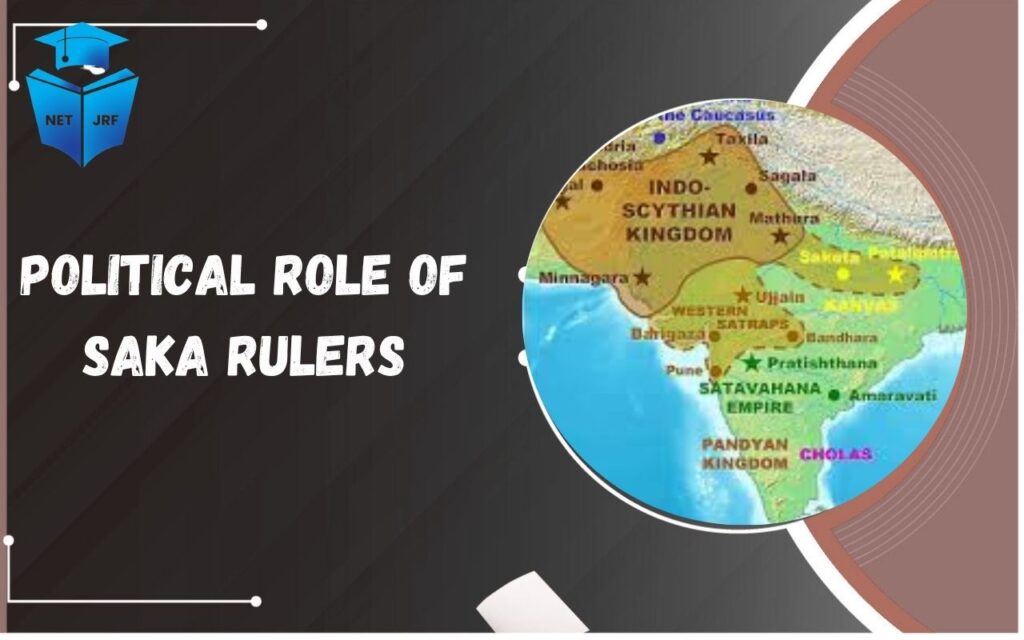
The political role of Saka rulers played a very important role in shaping early Indian political history. These rulers came from Central Asia, but after entering India, they successfully established their rule in many regions. Over time, they became powerful political leaders and adapted to Indian traditions. The Sakas, also known as Indo-Scythians, entered India around the 2nd century BCE. Initially, they came as migrants due to pressure from other tribes, but gradually they settled and formed strong kingdoms. Their rule is especially important in western and north-western India.

Background of Sakas
The political role of Saka rulers becomes clearer when we understand their origin, migration, and settlement pattern.
Enroll UGC NET Online Coaching
Origin and migration explained in detail
- Central Asian origin
The Sakas originally lived in Central Asia. They were nomadic people, which means they moved from one place to another in search of better living conditions. Due to attacks from other powerful tribes like the Yuezhi, they were forced to migrate. - Entry into India
The Sakas entered India through the north-western mountain passes. These routes were commonly used by many foreign groups such as Greeks and Kushanas. After entering India, they first settled in regions like Gandhara and Punjab. - Gradual settlement and expansion
Instead of leaving, they slowly moved towards western India and established permanent kingdoms. Over time, they gained control over important areas like Gujarat and Malwa.
This journey shows how migration turned into political domination.
Political role of Saka rulers in India
Political role of Saka rulers in India was very significant because they created stable regional powers and contributed to political organization.
Key political contributions explained deeply
- Establishment of regional kingdoms
The Sakas did not create one single empire. Instead, they divided their rule into different regions. Each region was governed separately, which made administration easier and more efficient. - Control over trade routes
They understood the importance of trade routes. They controlled major land and sea routes that connected India with Central Asia and the Roman Empire. This control increased their wealth and political strength. - Introduction of new administrative titles
They introduced titles like Kshatrapa (governor) and Mahakshatrapa (chief ruler). These titles helped organize administration in a structured way. - Military expansion and consolidation
They expanded their territories through wars and also maintained control by building a strong army.
These contributions show that the Sakas were not just rulers but skilled administrators.
Administrative System
Political role of Saka rulers is clearly visible in their administrative system, which was both organized and flexible.
Features explained in detail
- Kshatrapa system
The empire was divided into provinces. Each province was ruled by a Kshatrapa, who acted like a governor. He was responsible for collecting taxes, maintaining law and order, and managing local issues. - Mahakshatrapa authority
Above the Kshatrapas was the Mahakshatrapa, who was the supreme ruler. He controlled the entire region and ensured that all governors worked properly. - Decentralized governance
The system allowed local rulers to take decisions. This reduced the burden on the central authority and made administration more practical.
This system was very useful for managing large territories.
Important Saka Rulers
Political role of Saka rulers becomes clearer when we study their important leaders.
Major rulers explained deeply
- Maues (Moga)
He was one of the earliest Saka rulers in India. He established control in the north-western region. His rule marked the beginning of Saka political presence in India. - Nahapana
He ruled western India and became very powerful. He controlled important trade routes and issued a large number of coins, which show his economic strength. - Rudradaman I
He was the greatest Saka ruler. He expanded his territory, defeated enemies, and promoted Sanskrit language. His Junagadh inscription is an important historical source.
These rulers helped strengthen the political system.
Expansion of Territory
Political role of Saka rulers included continuous expansion of their territories.
Key points explained deeply
-
Expansion from North-Western India to Western India
-
-
- The Saka rulers originally entered India through the north-western frontiers, which include present-day regions of Punjab and Sindh. From these strategic entry points, they gradually pushed deeper into western India. Their expansion was not just a matter of conquest; it involved careful planning, understanding local geographies, and establishing control over important trade routes. This allowed them to consolidate power step by step, turning border territories into well-administered regions under their authority.
-
-
Capturing Key Regions like Gujarat and Malwa
-
-
- The Sakas were strategic in choosing which regions to conquer. Gujarat and Malwa were economically and politically significant. Gujarat had thriving ports and trade links with the Middle East, while Malwa was fertile and rich in resources. By gaining control over these regions, the Saka rulers secured access to wealth, trade revenues, and manpower. This helped them strengthen their state and project power more confidently across western India.
-
-
Wars with Local Dynasties
-
-
- The Sakas’ territorial expansion was not peaceful. They frequently clashed with local rulers and dynasties who resisted their authority. These conflicts were intense, but the Sakas demonstrated military skill, strategic planning, and adaptability in warfare. Their ability to fight and win against established dynasties not only expanded their boundaries but also sent a strong message to neighboring kingdoms about their strength and resilience.
-
-
Expansion Increased Power and Resources
-
- Every new territory brought the Saka rulers greater political influence and material resources. Control over fertile lands, trade routes, and urban centers allowed them to collect taxes and strengthen the administration. Their growing power helped in building armies, funding infrastructure, and supporting cultural activities, which in turn reinforced their legitimacy and appeal as rulers. This cycle of conquest, consolidation, and resource accumulation became a hallmark of their reign.
- Expansion increased their power and resources.
Relations with Other Dynasties
Political role of Saka rulers involved both conflict and cooperation with other dynasties.
Key relations explained in detail
-
Conflict with the Satavahanas
-
-
- One of the most significant political challenges for the Sakas was their conflict with the Satavahana dynasty. The two powers often clashed over control of fertile territories and important trade routes that connected northern and western India. These trade routes were lifelines for wealth and resources, so dominance over them was crucial for both sides. The wars were not just battles for land—they were struggles for economic supremacy and political prestige. The Sakas’ repeated confrontations with the Satavahanas helped shape their military strategies, forcing them to strengthen their armies, fortifications, and administrative organization.
-
-
Interaction with the Kushanas
-
-
- The Sakas and the Kushanas had a unique relationship shaped by their common foreign origins. Both were Central Asian groups who had migrated into India, and this shared background allowed for some cultural and political similarities. While they were not always allies, their interactions included exchanges of ideas, administrative practices, and sometimes even mutual recognition of power. This relationship influenced the Sakas in adopting certain governance models, coinage styles, and cultural elements, helping them establish legitimacy in a land far from their original homelands.
-
-
Alliances with Local Rulers
-
-
- The Saka rulers were not always at war they also understood the importance of diplomacy. At times, they formed alliances with local kings and chieftains to maintain peace and secure their rule over newly conquered regions. These alliances were mutually beneficial: the Sakas gained local support and stability, while the allied rulers retained some autonomy and protection from rival powers. By combining military strength with strategic alliances, the Sakas were able to extend their influence without relying solely on conquest.
-
-
How These Relations Shaped Their Political Strategy
-
- The Sakas’ network of conflicts, interactions, and alliances was central to their political strategy. Wars with the Satavahanas taught them the value of military preparedness and control over trade. Cultural and political interactions with the Kushanas provided models for governance and legitimacy. Alliances with local rulers helped them stabilize territories and prevent uprisings. Together, these relations allowed the Sakas to balance force with diplomacy, making their rule sustainable and strategically effective across a diverse and often contested landscape.
These relations shaped their political strategies.
Saka Era
The Saka Era is one of the most lasting contributions linked to the political role of Saka rulers.
Key features explained deeply
-
It Started in 78 CE
-
-
- The Saka Era began in 78 CE, marking the rise of a new chronological system in India. This starting point was significant because it coincided with the establishment of Saka power in parts of western and central India. By initiating their own era, the Sakas asserted political and cultural influence, signaling that their rule and achievements were important enough to mark time by. This was not just a calendar—it was a statement of identity and authority that distinguished them from other contemporary dynasties.
-
-
Used for Official Records and Inscriptions
-
-
- The Saka Era became the standard for official documentation. Rulers and administrators used it to record land grants, royal decrees, inscriptions, and other legal or administrative activities. This practical adoption gave the era authority and widespread recognition. Inscriptions in temples, monuments, and public works often mentioned the year according to the Saka calendar, which helped ensure accurate historical records and reinforced the legitimacy of the Saka rulers in the eyes of their subjects.
-
-
Still Used in the Indian National Calendar
-
-
- The Saka Era’s influence did not end with the decline of the Sakas. It was later adopted as the basis for the Indian national calendar, which was officially introduced in 1957 alongside the Gregorian calendar. This continuity demonstrates the enduring significance of the Saka system in Indian history, culture, and administration. It shows how a historical dynasty’s innovation can leave a legacy that lasts for millennia.
-
-
Long-Lasting Influence on Indian History
-
- The adoption and continued use of the Saka Era highlight the long-term impact of the Saka rulers. By introducing a reliable, structured calendar system, they contributed not only to administration and record-keeping but also to the cultural fabric of India. Their era became a reference point for historians, scholars, and governments, reflecting how even centuries-old political and cultural innovations can shape the future.
- This shows their long-lasting influence on Indian history.
Political role of Saka rulers Overview
The Saka rulers played a significant role in shaping the political landscape of western and central India during the early centuries of the Common Era. Originally of Central Asian origin, they established themselves as powerful leaders who were not only warriors but also skilled administrators and diplomats. Their political influence can be understood through several key aspects:
| Aspect | Details |
| Origin | Central Asia |
| Entry | 2nd century BCE |
| Titles | Kshatrapa, Mahakshatrapa |
| Important Ruler | Rudradaman I |
| Regions | Gujarat, Malwa |
| Era | Saka Era (78 CE) |
| Economy | Trade-based |
Military System
The political role of Saka rulers depended heavily on military strength.
Features explained deeply
-
Strong Cavalry Forces
-
-
- The Saka rulers were renowned for their highly skilled cavalry. Horses were central to their military strength, giving them speed, mobility, and a tactical advantage over enemies who relied mainly on infantry. Their cavalry units could conduct swift raids, flank opponents, and chase down retreating forces, making them formidable on the battlefield. This focus on mounted troops reflected their Central Asian roots, where horse warfare was a key part of military tradition.
-
-
Effective War Strategies
-
-
- The Sakas were not just brave fighters—they were also clever strategists. They employed well-planned tactics such as surprise attacks, ambushes, and battlefield maneuvers that allowed smaller forces to defeat larger armies. Their leaders studied the terrain, used local knowledge, and adapted to different styles of warfare depending on the enemy. This combination of skill, planning, and flexibility made the Sakas a persistent and threatening power in western India.
-
-
Maintaining Control Over Large Territories
-
-
- A strong military allowed the Sakas to hold onto vast regions. They could protect trade routes, suppress rebellions, and ensure loyalty among local chiefs. By maintaining garrisons and using military patrols strategically, they kept distant provinces under control without overextending themselves. This balance between conquest and administration was crucial for the stability of their kingdom.
-
-
Military Power Enabled Defense and Expansion
-
- The strength of the Saka military was both defensive and offensive. On one hand, it protected their kingdom from invasions by rival dynasties like the Satavahanas or foreign invaders. On the other hand, it allowed the Sakas to expand their territories, capture new regions, and increase wealth and resources. Their ability to combine defense with expansion ensured that the Saka rulers could grow in power while maintaining security at home.
Economic Policies
The political role of Saka rulers was supported by strong economic planning.
Key aspects explained deeply
-
Promotion of Trade Within and Outside India
-
-
- The Saka rulers actively promoted trade, both within their territories and with regions beyond India. They understood that commerce was a source of wealth, influence, and political power. By securing trade routes and supporting merchants, they facilitated the flow of goods like spices, textiles, metals, and luxury items. Their territories became hubs of economic activity, connecting inland regions to coastal ports and even to Central Asia and the Middle East. This trade network not only enriched the kingdom but also strengthened cultural exchanges and political alliances.
-
-
Collection of Taxes from Land and Trade
-
-
- Revenue collection was a key pillar of Saka administration. They imposed taxes on agricultural lands, ensuring a steady income from farming, which was the backbone of the economy. At the same time, they collected duties on trade, both local and long-distance. This dual taxation system allowed the Sakas to fund public works, maintain their army, and strengthen administrative infrastructure. It reflected a structured approach to governance that balanced state needs with economic growth.
-
-
Encouragement of Market Development
-
- The Sakas encouraged the growth of marketplaces and urban centers as part of their economic policy. Towns and cities became centers of trade, crafts, and services, attracting merchants, artisans, and farmers. By promoting market development, they created vibrant economic hubs that boosted production and exchange of goods. This focus on commerce helped integrate rural and urban economies, increased prosperity, and enhanced the overall stability of their kingdom.
Economic strength helped maintain political stability.

Cultural Adaptation
The political role of Saka rulers also included cultural adaptation, which helped them gain acceptance.
Enroll UGC NET Coaching in Jaipur
Key points explained deeply
-
Adoption of Indian Customs and Traditions
-
-
- Though the Sakas were originally of Central Asian origin, they gradually embraced Indian customs and traditions. They respected local social practices, followed regional festivals, and integrated themselves into the existing societal norms. This adoption helped them gain acceptance among the local population and strengthened their legitimacy as rulers. By blending their own heritage with Indian traditions, they were able to create a stable and culturally cohesive kingdom.
-
-
Promotion of Sanskrit Language
-
-
- The Sakas began using Sanskrit for inscriptions, official records, and communication within their administration. Sanskrit was the language of culture, learning, and governance in India at the time. By adopting it, the Sakas not only enhanced their administrative efficiency but also aligned themselves with the intellectual and cultural traditions of India. This helped them be seen as learned and sophisticated rulers rather than foreign invaders.
-
-
Support for Religious and Cultural Activities
-
-
- The Saka rulers actively supported temples, religious rituals, and cultural activities. They patronized Brahmanical traditions, built shrines, and encouraged festivals, music, and arts. This support strengthened bonds with local communities and religious leaders, making their rule more accepted and respected. It also allowed the Sakas to leave a lasting imprint on Indian culture through architecture, inscriptions, and ceremonial practices.
-
-
Integration into Indian Society
-
- Through the adoption of local customs, the use of Sanskrit, and the support of religious and cultural life, the Sakas successfully integrated themselves into Indian society. Their policies were not only political strategies but also ways to bridge cultural differences. This integration helped them maintain long-term stability, gain loyalty from local populations, and be remembered as rulers who became a part of India’s historical and cultural fabric.
This helped them become part of Indian society.
Use of Inscriptions
Political role of Saka rulers is clearly visible through inscriptions.
Key features explained deeply
-
Inscriptions Written in Sanskrit
-
-
- The Saka rulers adopted Sanskrit as the primary language for their inscriptions. Sanskrit was not only the language of culture and learning in India but also carried prestige and authority. Using Sanskrit allowed the Sakas to communicate their messages clearly to both the educated elite and the wider society. It also reflected their respect for Indian traditions and helped them gain legitimacy as rulers in a land far from their Central Asian origins.
-
-
Description of Achievements of Rulers
-
-
- Saka inscriptions often highlighted the accomplishments of their kings, including victories in battles, territorial expansions, and strategic alliances. These records served as a way to assert authority and showcase power. They were essentially historical narratives crafted to present rulers as capable, wise, and deserving of respect. By documenting achievements, the Sakas ensured that their legacy would be remembered by future generations.
-
-
Records of Public Works
-
-
- In addition to celebrating royal achievements, inscriptions detailed public works undertaken by the rulers. This included the construction of roads, irrigation projects, temples, and other civic amenities. By recording these contributions, the Sakas demonstrated their role as not just conquerors but also as administrators who cared for the welfare of their subjects. These records reflected a balance between power and responsibility, highlighting their administrative acumen.
-
-
Importance as Historical Sources
-
- Today, Saka inscriptions are invaluable to historians and scholars. They provide direct insight into political history, economic conditions, cultural practices, and social life of the period. Unlike later chronicles or oral traditions, these inscriptions are contemporary records, giving authentic and reliable information about the Saka rulers and their kingdom. They are essential for reconstructing the history of western and central India during this era. These inscriptions are important historical sources.
Strengths of Saka Rule
- Strong and capable rulers
- Control over trade routes
- Cultural adaptation
- Effective administration
These strengths helped them maintain power.
Weaknesses
The Saka rulers were known for their strength, courage, and strategic thinking. They were not only skilled warriors but also wise leaders who could make tough decisions during wars, alliances, or administrative challenges. Their personal abilities inspired loyalty among their soldiers and subjects, allowing them to maintain stability and expand their influence across western and central India.
-
Control over Trade Routes
-
-
- One of the most important factors behind Saka power was their control over major trade routes. These routes connected northern India with western regions, ports, and even foreign markets. By securing trade, the Sakas ensured a steady flow of wealth, resources, and cultural exchanges. This economic advantage allowed them to fund armies, support public works, and strengthen their political authority.
-
-
Cultural Adaptation
-
-
- Despite being of foreign origin, the Saka rulers successfully adapted to Indian culture. They embraced local customs, supported religious and cultural activities, and adopted Sanskrit for administration. This cultural integration helped them gain acceptance among local communities and priests, making their rule more stable and respected. By blending their traditions with Indian norms, they became part of the social fabric rather than remaining outsiders.
-
-
Effective Administration
-
- The Sakas established a well-organized administration to govern their territories efficiently. They implemented tax systems on land and trade, maintained law and order, supported infrastructure, and encouraged market development. Their ability to manage both the economy and public welfare strengthened their kingdom, allowing it to endure despite internal and external challenges.
- These weaknesses led to decline.
Enroll UGC NET Offline Coaching in Jaipur
Decline of Saka Power
Political role of Saka rulers declined gradually over time.
Reasons explained deeply
-
Rise of Powerful Empires like the Guptas
-
-
- One of the major reasons for the decline of the Saka rulers was the emergence of strong and ambitious empires, particularly the Gupta Empire. The Guptas expanded rapidly across northern and western India, bringing advanced military strategies, wealth, and administrative efficiency. As the Guptas consolidated power, the Sakas faced increasing pressure on their territories and trade routes. Over time, the rising dominance of such powerful neighbors made it difficult for the Sakas to maintain control and influence in the region.
-
-
Internal Conflicts
-
-
- Internal divisions within the Saka kingdom weakened their ability to resist external threats. Disputes among royal family members, local governors, or regional chiefs often led to instability. Such conflicts diverted attention from defending the kingdom and maintaining administration, making them vulnerable to attacks and invasions. Internal strife undermined unity, which had previously been a source of strength for the Saka rulers.
-
-
Weak Leadership
-
- After the reign of strong and capable rulers, some later Saka kings were unable to maintain the same level of governance, military efficiency, or political vision. Weak leadership resulted in poor decision-making, loss of control over distant provinces, and ineffective management of the economy and army. This gradual decline in administrative and military competence accelerated their fall and allowed more organized rivals to overpower them.

Conclusion
Political role of Saka rulers was very important in shaping early Indian political systems. They established strong regional powers, introduced administrative innovations, and contributed to economic and cultural growth. Their influence can still be seen in the Saka Era and inscriptions.
Political role of Saka rulers FAQs

When did the Sakas enter India?
Sakas entered India through north-western passes around 2nd century BCE. Initial settlement occurred in Gandhara and Punjab. Over time, they expanded towards western India, including Gujarat and Malwa.
What administrative system did the Sakas use?
Sakas introduced the Kshatrapa system, dividing territories into provinces. Kshatrapas acted as governors, while Mahakshatrapa was the supreme ruler. Decentralized governance allowed efficient control over large areas.
Who were important Saka rulers?
Maues (Moga) established early control in north-west India. Nahapana expanded western territories and issued coins. Rudradaman I was greatest, promoted Sanskrit, conquered territories, leaving Junagadh inscription as legacy.
How did Sakas expand their territories?
Sakas expanded from north-west India to western regions strategically. They captured Gujarat and Malwa for trade and resources, fought local dynasties, and consolidated power over key trade routes.