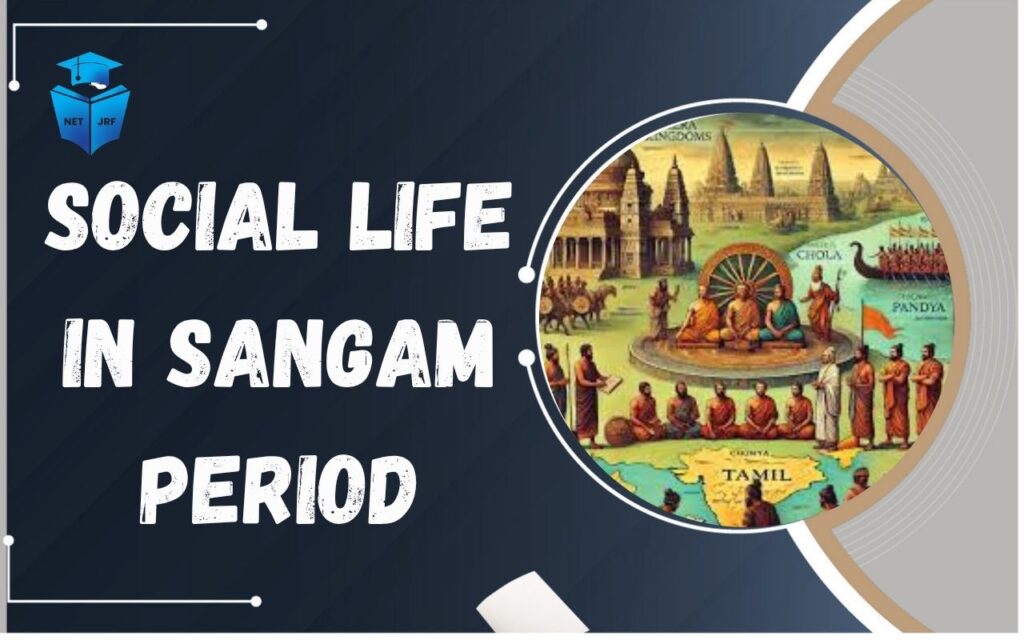
Social life in the Sangam period gives us a vivid picture of how people lived, worked, loved, and organized their society in ancient South India. This period, roughly between 300 BCE to 300 CE, is known through Sangam literature, which reflects everyday life in a very realistic and human way.

Social life in Sangam Period Introduction
Social life in the Sangam period was simple yet well-organized. Society was mainly based on land divisions, occupations, and clan relationships rather than rigid caste systems. People lived in harmony with nature and followed traditions that were closely connected to their environment.
Join UGC NET Foundation Batch Online
Sangam Period Structure of Society
The Social life in Sangam period was divided into five regions called tinai. Each region had its own lifestyle and occupation.
- Kurinji – Hilly region, hunting and gathering
- Mullai – Forest area, pastoral life
- Marutham – Agricultural land, farming
- Neithal – Coastal region, fishing
- Palai – Desert area, survival struggle
This shows that Social life in Sangam period was deeply connected with geography.
Social Groups
Society was not strictly divided by caste but by occupation.
- Kings and chieftains
- Priests and scholars
- Farmers and traders
- Hunters and fishermen
This flexible system made Social life in Sangam period more practical compared to later rigid caste structures.
Sangam period Family System and Marriage
The Social life in Sangam period gave great importance to family. Families were usually nuclear but strong emotional bonds existed.
Types of Marriage
- Love marriage was common
- Arranged marriage also existed
- Widow remarriage was allowed
Women had the freedom to choose their partners, which shows that Social life in Sangam period respected individual choice.
Role of Family
- Family was the basic unit of society
- Elders guided decisions
- Mutual respect was important
This reflects the emotional strength of Social life in Sangam period.
Sangam period Status of Women
One of the most striking features of Social life in Sangam period was the respectable position of women.
Rights and Freedom
- Women could choose their husbands
- They participated in social activities
- Education was available to some women
Women in Literature
Women poets like Avvaiyar contributed to Sangam literature. This proves that Social life in Sangam period encouraged intellectual participation.
Role in Society
- Household management
- Participation in agriculture
- Emotional support in family
The dignity given to women is a key highlight of Social life in Sangam period.

Sangam period Occupations
The Social life in Sangam period was closely linked with occupation.
Major Occupations
- Agriculture was the main occupation
- Fishing in coastal regions
- Trade with foreign countries
- Craftsmanship like weaving and pottery
Trade System
- Internal trade within regions
- External trade with Rome and Southeast Asia
This shows that Social life in Sangam period was economically active and well-connected.
Best UGC NET Foundation Course
Sangam period Food Habits and Lifestyle
Food habits reflect daily life clearly.
Common Food
- Rice was the staple food
- Meat and fish were consumed
- Fruits and vegetables were common
Lifestyle
- Simple living
- Use of ornaments
- Enjoyment of music and dance
The simplicity in lifestyle defines Social life in Sangam period very clearly.
Sangam period Religion and Beliefs
The Social life in Sangam period included diverse religious beliefs.
Main Features
Nature Worship
- People had a deep reverence for nature.
- Hills, forests, rivers, and seas were considered sacred and powerful.
- Specific landscapes were associated with different emotions and deities:
- Hills (Kurinji): linked to love and union
- Plains (Mullai): linked to pastoral life and peace
- Seashore (Neithal): associated with trade and maritime life
- Nature worship influenced festivals, rituals, and community practices.
Worship of Deities
- Murugan: The most popular deity, considered the god of war, youth, and valor.
- Shiva: Worshiped in certain regions as the supreme cosmic power.
- Other local deities were also venerated, reflecting regional diversity and localized religious practices.
Belief in Spirits and Ancestors
- People believed in spirits, ghosts, and supernatural forces.
- Ancestor worship was common, emphasizing respect for family and lineage.
- Rituals and offerings were made to honor ancestors and seek protection or blessings.
Features of Religion in Sangam Society
- Practical and community-oriented: Religion was integrated into daily life.
- Flexible and tolerant: No rigid orthodoxy; multiple forms of worship coexisted.
- Connected to cultural expressions: Poetry, festivals, and music often reflected religious devotion.
Religion was not rigid, making Social life in Sangam period flexible and inclusive.
Sangam period Cultural Life
The Sangam Age (c. 3rd century BCE – 3rd century CE) was not only politically and economically vibrant but also culturally rich. Social life was enriched by arts, festivals, literature, and shared moral values, which reflected the ideals of ancient Tamil society.
Music and Dance
- Music and dance were an integral part of daily life and courtly entertainment.
- Kings and nobles patronized musicians and dancers, who performed during festivals, royal ceremonies, and special occasions.
- Folk traditions and classical performances were both celebrated and preserved.
Poetry and Storytelling
- Poetry was highly esteemed and formed the heart of Sangam culture.
- Sangam literature, written in Akam and Puram genres, captured:
- Love, emotions, and relationships
- Heroism, bravery, and warfare
- Nature and landscapes
- Storytelling and oral recitations allowed knowledge, history, and cultural values to be transmitted across generations.
Festivals and Celebrations
- Festivals were central to social life, bringing communities together.
- They celebrated harvests, victories, marriages, and religious events.
- Entertainment during festivals included music, dance, poetry competitions, and feasts, fostering a sense of community and cultural pride.
Moral Values and Social Ideals
- Sangam society placed a strong emphasis on personal honor, bravery, and loyalty.
- Key virtues included:
- Courage and heroism in battle
- Faithfulness in friendship and relationships
- Respect for elders and ancestors
- These values were celebrated in literature and oral traditions, reinforcing social cohesion and ethical behavior.
Join UGC NET Offline Coaching in Jaipur
Key Features of Social life in Sangam period
The Sangam Age (c. 3rd century BCE – 3rd century CE) in ancient Tamilakam had a vibrant and organized social structure, which was closely connected with culture, politics, economy, and religion.
| Aspect | Description |
| Social life in Sangam period | Based on occupation and landscape |
| Family | Strong emotional bonds |
| Women | Respectful position with freedom |
| Economy | Agriculture and trade |
| Religion | Nature worship and flexibility |
| Culture | Rich in arts and traditions |
Sangam period Education
Education during the Sangam Age was practical, experience-based, and closely tied to daily life rather than formal classroom instruction.
Oral Tradition and Knowledge Transmission
- Knowledge was primarily passed down orally from teachers, elders, and poets.
- Stories, poems, and songs were used to teach history, ethics, and social values.
- This method ensured that literary, cultural, and practical knowledge was preserved across generations.
Role of Poets and Scholars
- Poets and scholars were highly respected in society.
- They guided people in moral conduct, cultural practices, and social norms.
- Their works were recited at festivals and courts, influencing both common people and rulers.
Practical Learning
- Education emphasized ethics, life skills, and social behavior.
- People learned about:
- Trade and craft skills
- Warfare and strategy
- Agriculture and resource management
- Moral duties like loyalty, honor, and bravery
- This approach made learning hands-on, meaningful, and socially relevant.
Sangam period Political Influence on Social Life
The political system of the Sangam period also shaped social life, but it allowed flexibility and local autonomy:
Role of Kings and Chieftains
- Kings were respected for bravery and justice but did not interfere in every aspect of social life.
- Local chieftains (Velir) governed smaller areas, ensuring localized administration and quick decision-making.
Justice and Custom
- Justice was often based on local customs and traditions rather than rigid laws.
- Villages handled minor disputes, while major cases were taken to the king or chief.
Social Stability
- This balance of central authority and local autonomy allowed society to flourish.
- People respected rulers for courage and fairness, which reinforced loyalty and trust.
- Social life remained organized, stable, and community-oriented despite the lack of strict control.
Top UGC NET Offline Coaching in Jaipur
Summary
Social life in the Sangam period was:
- Flexible yet organized: Roles based on occupation, not rigid caste
- Culturally rich: Music, dance, poetry, and festivals flourished
- Morally guided: Honor, bravery, and loyalty were highly valued
- Practical in learning: Oral education and life skills emphasized
- Politically balanced: Kings and chieftains guided society without strict control
- Economically active: Agriculture, trade, and craft production supported social life
This combination of culture, ethics, economy, and politics made the Sangam society vibrant, cohesive, and resilient, leaving a lasting legacy in Tamil history.

Social life in Sangam period FAQs

How was society structured during the Sangam Age?
Society was divided by occupations and landscapes called tinai, such as hills, forests, plains, coasts, and deserts. Kings, priests, farmers, and traders had defined roles. This ensured harmony between people and environment.
What was the family system like in Sangam society?
Families were mostly nuclear with strong emotional bonds. Elders guided decisions while mutual respect was emphasized. Marriage included love, arranged unions, and widow remarriage, showing social flexibility.
What was the status of women in the Sangam Period?
Women held a respectable position with freedom in choosing partners. They managed households, participated in agriculture, and some received education. Women poets like Avvaiyar contributed to literature and culture.
What were the main occupations during the Sangam Period?
Agriculture was dominant, while fishing, trade, and craftsmanship were also common. Trade connected regions internally and with foreign lands like Rome. Occupations shaped lifestyle and social organization.